

Solution Manual for Principles and Practice of Physics, 1st Edition
- Physics
- 898 pages
- Shared May 2025
Get detailed solutions to your textbook questions with Solution Manual for Principles and Practice of Physics, 1st Edition, a guide designed to make studying easier.
Preview 16 of 898 pages
See the first 16 pages exactly as they appear in the document.
Page 1 Read page 1 as text
1-1 F OUNDATIONS 1 Solutions to Developing a Feel Questions, Guided Problems, and Questions and Problems Developing a Feel 1. 2 10 m − 2. 2 10 m 3. 2 10 m 4. 1 2 10 m 5. 3 10 6. 3 10 kg 7. 4 10 kg 8. 13 10 kg 9. 5 10 kg 10. 11 10 11. 9 10 12. 5 10 Guided Problems 1.2 Solar oxygen 1. Getting Started Much of the plan used in Worked Problem 1.1 can be used here. We wish to use the volume of the sun and the percent of the Sun that is made up of oxygen to calculate the mass density and number density of oxygen atoms. As before we assume the Sun is a perfect sphere. 2. Devise Plan As before, we use the mass density / m V ρ = and the number density / . n N V = We will use 3 4 3 V R π = for the volume of the Sun. We will use the total mass of the Sun and the fraction of that mass that is made up of oxygen to calculate the mass of oxygen in the Sun. We will divide by volume to get the mass density. Then, one need only divide by the mass of a single oxygen atom to convert from mass density to number density. 3. Execute Plan First, the mass density is given by oxygen Sun 3 3 Sun Sun 30 3 8 3 (0.00970) 4 4 3 3 (0.00970)(1.99 10 kg) 13.7 kg/m 4 (6.96 10 m) 3 m m M V R R ρ π π ρ π = = = × = = × We convert from mass density to number density using 3 26 3 26 atom 13.7 kg/m 5.14 10 atoms/m 2.66 10 kg/atom n m ρ − = = = × × 4. Evaluate Result The calculated mass density of oxygen is approximately two orders of magnitude smaller than the mass density of hydrogen calculated in Worked Problem 1.1. This is what we expect, because the oxygen accounts for only about 1% of the mass of the Sun and hydrogen makes up approximately 70%. Since the oxygen accounts for two orders of magnitude less mass, it is perfectly sensible that the mass density of oxygen would also be two orders of magnitude smaller. Similarly, the number density of oxygen is about three orders of magnitude smaller than the number density of hydrogen. If the only issue were the relative percentages of the Sun’s mass made up by oxygen and hydrogen, we would expect a difference of only two orders of magnitude. However, oxygen is also much
Page 2 Page 3 Read page 3 as text
1-2 Chapter 1 more massive than hydrogen (around one order of magnitude more massive). Hence, mass densities that differ by two orders of magnitude mean number densities that differ by three orders of magnitude. Our results are consistent with those of Worked Problem 1.1. 1.4 Box volume 1. Getting Started This problem is similar to Worked Problem 1.3 in that we are given a mixture of units which we must convert to SI units. However, the expressions for volume here is completely different from that of Worked Problem 1.3. 2. Devise Plan We convert from feet to inches using the conversion factor 1 ft 12 in, = and convert from inches to meters using 1 in 0.0254 m. = We can convert millimeters and centimeters to meters by simply dividing by the appropriate factor of ten. When all quantities are in units of meters, we proceed to find the volume of the box using box , V wh = A where , A , w and h are the length, width, and height of the box, respectively. 3. Execute Plan We first convert the length, width and height to units of meters: 3 1 m 1420 mm 1.420 m 10 mm = × = A 12 in 0.0254 m 2.75 ft 0.838 m 1 ft 1 in w = × × = 2 1 m 87.8 cm 0.878 m 10 cm h = × = Finally the volume is given by 3 box (1.420 m)(0.838 m)(0.878 m) 1.05 m . V wh = = = A 4. Evaluate Result A volume of 3 1.05 m is reasonable. The box had a size that was on the order of 1.0 m in each dimension. One dimension had a length greater than 1.0 m and the other two were smaller than 1.0 m. This is the approximate size we would expect. 1.6 Digits on your own 1. Getting Started The methods used in Worked Problem 1.5 are essentially the same that will be used here. The expressions involve quantities with varying numbers of significant digits. The number of significant digits in the answer will depend on how many significant digits are in the given in the problem statement, and on the operation carried out between quantities (subtraction, multiplication, etc). 2. Devise Plan As in Worked Problem 1.5, the number of significant digits in a product or quotient is the same as the number of significant digits in the input quantity that has the fewest significant digits. The number of decimal places in a sum or difference is the same as the number of decimal places in the input quantity that has the fewest decimal places. To express our answers as orders of magnitude, we write each in scientific notation, round the coefficient either down to 1 (for coefficients 3) ≤ or up to 10 (for coefficients 3). > We then write the answer as a power of ten without the coefficient. 3. Execute Plan ( a ) In (205)(0.0041)(489.62), the middle quantity (0.0041) has the fewest significant digits, with only two. Hence the answer must be given to only two significant digits: 2 4.1 10 . × Here the coefficient is greater than 3, so we round it to 10 and obtain for the order of magnitude 2 3 10 10 10 . × = ( b ) Here, the first factor is given to four significant digits, which is the fewest of all factors (since π is known to many digits). Hence the answer must be given to five significant digits: 1 2.475 10 . × Here the prefactor is less than 3, so we round it down to 1. This yields an order of magnitude of 1 1 10 10 . × = ( c ) The first term is known to the thousandths place, whereas the second term is known only to the tenths place. Hence the answer can be given only out to the tenths place: 3 6.9802 10 . × The prefactor is greater than 3, so we round it to 10. This yields an order of magnitude of 3 4 10 10 10 . × =
Page 4 Read page 4 as text
Foundations 1-3 4. Evaluate Result We could check our answers by getting order of magnitude estimates for each number. ( a ) Using orders of magnitude of (205)(0.0041)(489.62) yields 2 2 3 3 (10 )(10 )(10 ) 10 , − = which is consistent with our answer. ( b ) Similarly, (190.8)(0.407 500)/ π becomes 2 0 1 1 (10 )(10 )/(10 ) 10 , = which is again consistent with our answer. ( c ) Finally, to nearest order (6980.035) (0.2) + yields 4 1 4 (10 ) (10 ) 10 , − − = which is also consistent. 1.8 Roof area 1. Getting Started We will approximate the United States as a rectangle 5,000 km wide and 3,000 km high. A very small percentage of this area is occupied by buildings. Only in cities can we approximate the surface as being covered by structures. 2. Devise Plan The approximate area of the United States is 4 3 7 2 (10 km)(10 km) 10 km . = Depending on one’s definition of a “city” the percentage of this surface area that is occupied by cities could be anywhere between 0.1% and 1%. But since even cities are not completely filled with structures, we will use the smaller of these two percentages for our estimate (0.1%). These two numbers can be used to find an order of magnitude estimate of the total roof area in the United States. 3. Execute Plan The roof area is given by 7 2 4 2 roof US (0.1%) (0.001)(10 km ) 10 km . A A = = = 4. Evaluate Result We could check our result by estimating the roof surface area in a completely different way. Let us start with the population of the United States ( 8 3 10 people × to one significant digit), and assume that there exists a structure that houses every set of three or four people, and assume further that these structures have a footprint of approximately 2 30 m . Of course, many people live alone and many people live in apartment buildings that have many floors (meaning less of a footprint per person). But these cases might cancel each other out, making our estimate plausible. This yields a surface area of 9 2 2.3 10 m . × Let us double this number to account for the places of business that employ many of these people. This gives a total surface area of order 10 2 10 m . Using known conversion factors, one can see that this is equivalent to 4 2 10 km . This agrees with our previous estimate. Questions and Problems 1.1. The word “undetectable” prevents this from being a valid scientific hypothesis. A hypothesis must be experimentally verifiable. 1.2. You assume that the competing product contains non-zero fat, and that the serving sizes of the two are equal. Say the two foods contain the same amount of fat per ounce. The maker of the product being advertised could print his label showing a recommended serving size 50 percent smaller than the recommended serving size of the competing product. This makes the claim of 50 percent less fat per serving true but of course misleading. 1.3. You assume the sequence is linear, meaning each entry is larger than the previous one by a constant amount. As an alternative, the sequence could be formed by starting with 1, 2 and then setting the th n term n c equal to the sum of the previous two terms: 1 2 . n n n c c c − − = + This would work for 3 2 1 2 1 3, c c c = + = + = and would yield 5 as the next number in the sequence. 1.4. If you assume that the coins are currently circulated U.S. currency, you would not be able to find a solution. If, however, you consider that the word “cents” is also used to refer to hundredths of other currencies, then all that would be required is that increments of 10 and 20 centers exist in some currency. As an example, “cents” may refer to hundredths of a Euro. You would say the coins must be worth 10 and 20 Euro cents, respectively (which do exist).
Page 5 Read page 5 as text
1-4 Chapter 1 1.5. There are 12 ways: 4|3|2|1 4|3|2|1 4|3|2|1 4|3|2|1 1|2|3|4 1|2|3|4 1|2|3|4 1|2|3|4 3|1|4|2 2|1|4|3 2|4|1|3 3|4|1|2 2|4|1|3 3|4|1|2 3|1|4|2 2|1|4|3 4|3|1|2 4|3|1|2 4|3|1|2 4|3|1|2 1|2|3|4 1|2|3|4 1|2|4|3 1|2|4|3 2|1|4|3 3|4|1|2 2|1|3|4 2|4|3|1 3|4|2|1 2|1|4|3 3|4|2|1 3|1|2|4 4|3|1|2 4|3|1|2 4|3|2|1 4|3|2|1 1|2|4|3 1|2|4|3 1|2|4|3 1|2|4|3 3|1|2|4 3|4|2|1 2|1|3|4 3|4|1|2 2|4|3|1 2|1|3|4 3|4|1|2 2|1|3|4 1.6. There is one axis of reflection symmetry. It is marked by the dashed line: 1.7. One. An axis of rotational symmetry is an axis about which the object can be rotated (through some angle other than a multiple of 360 degrees), that results in an indistinguishable appearance compared to the original orientation of the object. For a cone the axis passing through the center of the circular face and through the vertex (point) of the cone is the only axis of rotational symmetry. 1.8. One unit down and left from the upper right corner. This way the coins form a square:
Page 6 Read page 6 as text
Foundations 1-5 1.9. “T” and “A” are reflection symmetric across a vertical line passing through the center of the letter. “E” and “B” are reflection symmetric across a horizontal line passing through the center of the letter. “L” and “S” have no reflection symmetry. 1.10. Reflection and rotation symmetry. A sphere is reflection symmetric across any plane that passes through its center, and rotationally symmetric around any axis passing through its center. 1.11. A cube has 9 planes of reflection symmetry and 13 axes of rotational symmetry. 3 planes each bisect four sides of the cube. The remaining six planes pass through edges that are diagonally opposite each other. 3 of the axes of rotational symmetry pass orthogonally through the centers of two square faces. 4 of the axes pass through corners that are opposite each other along the body diagonal. 6 axes pass through the centers of edges that are opposite each other along the body diagonal. 1.12. There is one axis of reflection symmetry: 1.13. The maximum number of axes of reflection symmetry is two. There are two sides about which we have no information. Let us assume the side opposite the visible blue side is also blue, and the side opposite the visible red side is also red. In that case, the object would be reflection symmetric about a vertical plane that bisects both blue sides, and a about a vertical plane that bisects both red sides. 1.14. We use / x v x t = Δ Δ for constant speed in the x direction to write: 17 299,792,458 m 3600 s 24 h 365.25 days 78 yrs 7.4 10 m 1s 1 h 1 day 1 yr x x v t Δ = Δ = × × × × = × 1.15. ( a ) We convert units using known conversion factors: 3 7 14 1609 m 10 mm 9.3 10 miles 1.5 10 mm 1 mi 1 m × × × = × ( b ) If we divide the distance by the width of Earth, that will tell us how many Earths can fit in that distance. 7 4 3 Earth 1.609 km 9.3 10 mi Distance to Sun 1 mi Number of Earths 1.2 10 Earths 2 2(6.38 10 km) R × × = = = × × 1.16. The blue whale and a human have densities that are the same orders of magnitude, and contain similar concentrations of different atom types. Hence it is reasonable to say that the ratio of the numbers of atoms in these two species should be roughly equal to the ratio of volumes of these two species: 32 3 bw 29 human 10 10 . 10 V V = = Since whales and people are three dimensional, this corresponds to blue whales being roughly one order of magnitude larger in each of three dimensions. Hence, the blue whale is approximately 10 times longer than a human is tall. 1.17. Because the gastrotrich lifetime is given as three days, this should technically be treated as being on the order of one day. However, this is an approximate value of a lifetime, and if it were slightly higher, it would be treated as
Page 7 Read page 7 as text
1-6 Chapter 1 being on the order of ten days. Either of these is defensible in order of magnitude treatments. One tortoise lifetime can be related to gastrotrich lifetimes using the following order of magnitude conversions: 3 2 5 10 days 1 gastrotrich lifetime 10 yr 10 gastrotrich lifetimes 1 yr 1 day × × = If we had used 10 days as the order of magnitude for a gastrotrich lifetime we would have obtained 4 10 gastrotrich lifetimes. Hence there are 10,000 to 100,000 gastrotrich lifetimes in one tortoise lifetime. Either of these is acceptable. 1.18. Given the diameter of a droplet of water, we can estimate the volume of a droplet using 3 drop 4 1 3 V r π = ≈ × 3 3 8 3 10 (10 m) 10 m . − − × = We can estimate the volume of a human body to be on the order of 1 3 body 10 m . V − = Hence an order of magnitude estimate of the number of droplets in the human body is given by body 7 drop 10 . V V = 1.19. Answers may vary by an order of magnitude since some textbooks may be somewhat thicker than 3.0 cm, and others may be thinner. My textbook has a thickness that is on the order of 1 10 m. − The distance to the moon is 8 3.84 10 m, × meaning the distance is of order 9 10 m. Dividing the distance by the thickness of one textbook yields 9 10 1 Distance to Moon 10 Number of books 10 . Thickness of book 10 − = = = Hence 10 10 copies of my physics textbook could fit between Earth and the Moon. 1.20. We proceed by finding the total mass of water in the pool, and dividing this by the mass of a single molecule of water: pool water pool molecule A / m V N m M N ρ = = where 3 water 1000 kg/m ρ = is the density of water, 3 pool (15 8.5 1.5) m V = × × is the volume of the swimming pool, 0.018kg M = is the molar mass of water, and 23 1 A 6.02 10 mol N − = × is Avogadro’s number. Using this information we find 3 3 3 23 1 30 (1.0 10 kg/m )(191 m ) (6.02 10 mol ) 6.4 10 molecules in the pool. (0.018 kg/mol) N − × = × = × 1.21. ( a ) Since numbers are not given, it might be natural to cancel lengths and be left with a factor of 3 2 . In that case the volume of the cube would increase by one order of magnitude. But if one were asked to use an order of magnitude estimate to first express 2 A in terms of 1 , A one might find that they have the same order of magnitude and that the volume therefore does not increase. Either of these answers (one order of magnitude, or zero orders of magnitude) is acceptable. ( b ) Yes, because of the rules of rounding numerical values. For example, if 3 1 3.5 m , V = that value would round to an order of magnitude of 10 m 3 . Then 3 2 1 8 28 m , V V = = which also rounds to an order of magnitude of 10 m 3 . 1.22. The speed of light is of order 8 10 m/s. The length of Earth’s trip around the Sun is of order 12 10 m. Hence the order of magnitude of the time light would need to make the same trip around the sun is 12 4 8 distance 10 m time 10 s. speed 10 m/s = = = Hence light would take approximately 4 10 s to complete this trip. 1.23. The surface area of the roughly spherical distribution of leaves is 2 4 r π , where r is the radius of the tree’s sphere of leaves. The surface area of an individual leaf is just its length A times its width . w We can find the number of leaves by dividing the total surface area by the area of one leaf: 2 2 5 4 10(10 m) 10 (0.1m)(0.1 m) r N w π = = = A leaves.
Page 8 Read page 8 as text
Foundations 1-7 1.24. To find the number of generations since the universe began, we divide the age of the universe by the time required for one human generation. We simply have to get both times in the same units. Let us express one human generation in seconds: 8 365.25 days 24 h 3600 s 30 yr 9.5 10 s. 1yr 1 day 1h × × × = × Hence the number of human generations N is given by 17 8 universe 8 generation 10 s 10 9.5 10 s t N t = = = × generations. 1.25. Not reasonable. Because light travels much faster than sound, any thunder peal is delayed compared to the light signal caused by the lightning bolt event. From the principle of causality, the lightning you see after you hear the peal cannot have caused the peal. The peal you heard must have come from a previous lightning strike. 1.26. Call the period of time required for one such oscillation T. Then the second is defined such that 9 1.0 s (9.19 10 ) T = × or 10 9 1.0 s 1.09 10 s. (9.19 10 ) T − = = × × 1.27. That the barrier lowers time after time 30 s before a train passes is consistent with a causal relationship between the two events. The single negative result, however, tells you that the lowering of the barrier cannot be the direct cause of the passing of the train. More likely, the lowering is triggered when the train passes a sensor quite a distance up the tracks from the barrier and the sensor sends an electrical signal to the lowering mechanism. A malfunction in either the sensor, the electrical connections, or the lowering mechanism would account for the one negative result you observed. 1.28. The period calculated in Problem 26 was 10 1.09 10 s. T − = × The speed of light is 8 3.00 10 m/s. c = × Here the distance travelled is just the speed times the time: 8 10 (3.00 10 m/s)(1.09 10 s) 0.0326 m d c t − = Δ = × × = . 1.29. 2 E mc = Here, E is the type of energy described, m is the mass of the object, and c is the speed of light. 1.30. Rectangle, parallelogram, and two equilateral triangles meeting at a vertex forming an hourglass shape. 1.31. The problem states that two adjacent sides must make an angle of 30 . ° This most likely means the interior angle between actual sides. This angle is labeled α in the figure below. But one might also describe the exterior angle in this way. This angle is labeled β below. If one accepts this interpretation, some of the 30 ° angles could be interior and some could be exterior. Let us first address the case in which the 30 ° angle refers to the interior angle. Remembering that the segments cannot cross, there is only one possible arrangement of segments that fits the description:
Page 9 Read page 9 as text
1-8 Chapter 1 Clearly 2 sin( ) y θ Δ = A and 2 (1 cos( )). x θ Δ = − A The Pythagorean Theorem tells us that the distance between the two unconnected points must be ( ) 1/ 2 2 2 2 2 2 (1 cos(30 )) sin (30 ) 1.0 . d x y = Δ + Δ = − ° + ° = A A So the distance between unconnected ends is . A If the 30 ° angle refers to the exterior angle, we can obtain several possible shapes. The two shapes that give the shortest and longest distances are shown below: We can see in the top figure (that yields the shortest distance) (1 cos(30 ) cos(60 ) 0), x Δ = + ° + ° + A and since the x and y distances are equal based on symmetry, we find 2 (1 cos(30 ) cos(60 )) 3.3 . d = + ° + ° = A A In the second figure (that yields the greatest distance) we find 2 (1 cos(30 )) x Δ = + ° A and 2 (sin(30 )). x Δ = ° A Again using the Pythagorean Theorem yields a distance of 1/ 2 2 2 (2 (1 cos(30 ))) (2 sin(30 )) 3.9 . d ⎡ ⎤ = + ° + ° = ⎣ ⎦ A A A If a combination of interior and exterior angles is used, there are even more possibilities. The shortest of these distances is 0 (parallelogram). It can be shown that other possible distances include 2.0 , 2.2 , 2.4 . A A A 1.32. Uncle, cousin, grandmother, aunt, grandfather, brother. 1.33. Consider the diagram below.
Page 10 Read page 10 as text
Foundations 1-9 The distance from the Sun to point P is 2 2 11 2 11 2 11 (1/ 2) (1.50 10 m) (7.78 10 m) 3.96 10 m x y Δ + Δ = × + × = × The time that light would require to cross this distance can be found using 11 8 3 / (3.96 10 m) /(3.00 10 m/s) 1.32 10 s t d v Δ = = × × = × which is equivalent to about 22.0 minutes. 1.34. Time (s) Position (m) 0.00 0.00 2.00 0.40 4.00 1.59 6.00 3.64 1.35. ( a ) The position decreases linearly as a function of time, from an initial position of 4.0 m to a final position of zero at a time of 8.0 s, with a slope of 0.5 m/s. − ( b ) ( ) x t mt b = + where 0.5 m/s, and 4.0 m. m b = − = 1.36. Forming a regular tetrahedron from these triangles will automatically satisfy all conditions. 1.37. 1 ft 12 inch 8.95 m 352 inches 0.3048 m 1 ft × × = 1.38. We change units using known conversion factors: 1 mile 35,000 ft 6.629 miles 5280 ft × = 3 3 12 in 25.4 mm 1 m 1 km 35,000 ft 10.7 km 1 ft 1 in 10 mm 10 m × × × × = 1.39. ( a ) The density will be the same. ( b ) The density will be the same. 1.40. We change units using known conversion factors: 8 5 2.9979 10 m 1 mile 1.863 10 miles/s 1 s 1609 m × × = × 8 3 9 2.9979 10 m 1 s 10 mm 1 in 11.8 inches/ns 1 s 10 ns 1m 25.4 mm × × × × =
Page 11 Read page 11 as text
1-10 Chapter 1 8 9 2.9979 10 m 1 km 3600 s 1.079 10 km/h 1 s 1000 m 1 hr × × × = × 1.41. If the two stones are made from the same material, they should have roughly the same density. We calculate the density of each stone and compare them: 2 3 3 1 1 3 1 2.9 10 kg 2.9 10 kg/cm 10.0 cm m V ρ − − × = = = × 2 3 3 2 2 3 2 2.5 10 kg 3.3 10 kg/cm 7.50 cm m V ρ − − × = = = × No, it is not likely. Stone 2 has considerably higher density. 1.42. This length can be expressed as 3 ft 1 mi 1.000 mi 440 yd 1.250 mi. 1 yd 5,280 ft + × × = We now convert this entirely to feet: 5280 ft 1.250 mi 6,600 ft. 1 mi × = 1.43. We can find the units of A from given information: 2 2 units[ ] m/s s m. A = ⋅ = If A has units of meters, and we wish to add A and B , then B must also have units of meters. 1.44. Mass density is the ratio of mass per unit volume. While one could have any mass of a given substance, or any volume of that substance, the density tends to be a constant value for a given material (under certain conditions). 1.45. For all cases we find the order of magnitude of the mass of Earth using 3 E 4 . 3 m V R ρ ρ π ⎛ ⎞ = = ⎜ ⎟ ⎝ ⎠ ( a ) 3 0 3 7 3 22 air E 4 (10 kg/m )(1 10 (10 m) ) 10 kg 3 m R ρ π ⎛ ⎞ = = × × = ⎜ ⎟ ⎝ ⎠ ( b ) 3 4 3 7 3 26 5515 E 4 (10 kg/m )(1 10 (10 m) ) 10 kg 3 m R ρ π ⎛ ⎞ = = × × = ⎜ ⎟ ⎝ ⎠ ( c ) 3 18 3 7 3 40 nucleus E 4 (10 kg/m )(1 10 (10 m) ) 10 kg 3 m R ρ π ⎛ ⎞ = = × × = ⎜ ⎟ ⎝ ⎠ 1.46. We rearrange the given expression to solve for y and then write all units in terms of SI base units and powers of ten: 2 / 3 2 / 3 2 3 2 / 3 18 15 2 3 3 6 12 10 2 2 61.7 Eg fm /ms 7.81 g/Tm 61.7 (10 g) (10 m) /(10 s) 7.81 (10 g)/(10 m) 3.97 10 m /s x y a y y μ − − − ⎛ ⎞ ⋅ ⎛ ⎞ = = ⎜ ⎟ ⎜ ⎟ ⎝ ⎠ ⎝ ⎠ ⎛ ⎞ ⋅ = ⎜ ⎟ ⎝ ⎠ = × 1.47. ( a ) 8 3.00 10 m/s × ( b ) 16 2 2 8.99 10 m /s × ( c ) No. There is a small difference because the answer to ( a ) was rounded before squaring. The answer to ( b ) was obtained using more digits of the speed of light, and only the result was rounded to three significant digits. 1.48. The given distance can also be written as 1.25 miles. We now convert to kilometers using known the known conversion factor: 1.609 km 1.25 mi 2.012 km 1 mi × =
Page 12 Read page 12 as text
Foundations 1-11 1.49. Your answer has four significant digits. When dividing a quantity by an integer, the number of significant digits should not change. 1.50. Yes, there is a difference in the precision. You will calculate your gas mileage by dividing the number of miles you travel by the gallons of gasoline used. Since the gas pump gives you thousandths (and most vehicles take 10 gal or more) you know the fuel used to five significant digits. Neither distance given has this many, making the precision of the distance value the limiting factor. Thus you can calculate mileage to three significant digits when you use 40.0 mi for distance and to four significant digits when you use 400.0 mi. 1.51. The odometer should still say 35,987.1 km. 47.00 m is only 0.04700 km. Because the odometer reading is only given to the nearest tenth of a kilometer, the sum (final odometer reading) must also be given only to the tenth of a kilometer. 1.52. We convert the given amount of ingested caffeine using known conversion factors: 23 22 3 34 mg 2 servings 365.25 days 1g 1 mol 6.02 10 molecules 7.7 10 molecules/yr serving day 1 yr 10 mg 194.19 g 1mol × × × × × × = × 1.53. The molarity of the solution must be known to a precision of 1 part in 15. Since we can measure volume to arbitrary precision and we have the molar mass to very high precision, the limiting factor on the precision of our molarity is the precision of the mass we use. Hence the precision of the mass we use must be at least as good as the required precision of the molarity. We can only measure tenths of a gram, so we must have at least 1.5 grams in order to know the precision of our mass to 1 part in 15 or better. Mathematically: (0.15 0.01) mol/L 0.1 g 0.01 0.1 g (0.01 mol/L)(58.44 g/mol) 0.17 L 0.15( ) 1.5 g m m MV MV m MV V V m MV Δ ± = ± ≤ Δ = ≥ ≥ = = As can be seen from the above calculation, the answer could also be given in terms of the minimum volume of solution prepared. That minimum volume is 0.17 L. 1.54. The mass density is given by / . m V ρ = The volume is given in milliliters, which are equivalent to cubic centimeters. Hence 3 6 3 3 3 3 3 25.403 g 10 kg 10 cm 1.085 10 kg/m 23.42 cm 1 g 1 m ρ − = × × = × 1.55. The mass evaporated each second is given by dish liquid final 3 (145.67 g) (0.335 g) (145.82 g) (25.01 s) 7.4 10 g/s m m m m t t − + − Δ = Δ Δ + − = = × Note that we have only two significant digits. Because two of the masses were only known to the hundredths place, we only had two digits of precision after taking the sum (and difference) of masses. 1.56. There are too many significant digits. The volume is only given to two significant digits. The answer could have at most two significant digits.
Page 13 Read page 13 as text
1-12 Chapter 1 1.57. We find the distance travelled by each hand in a day and we take the difference. The minute hand makes 24 full revolutions in one day, such that the distance travelled by its tip is 24 rev 2 24 rev 2 (0.0113 m) 1.70 m 1 day 1 rev 1 day 1 rev r π π × = × = The hour hand makes only two revolutions, such that the distance travelled by its tip is 2 rev 2 2 rev 2 (0.0080 m) 0.10 m 1 day 1 rev 1 day 1 rev r π π × = × = Clearly, the minute hand travels farther in one day by a distance of 1.60 m. 1.58. The path lengths are exactly the same along the straight sections of track. We need only consider the two curved ends. Along those sections, the runner in lane 1 moves through a circle of radius 1 36.80 m. R = A runner in lane 8 moves through a circle of radius 8 36.80 m 7(1.22 m) 45.34 m. R = + = The total path length difference will then be given by the difference in the circumferences of these two circles: 8 1 2 ( ) 2 (8.54 m) 53.7 m. x R R π π Δ = − = = 1.59. Place two coins on the balance, and hold the third in your hand. If they are balanced, the one coin in your hand is the counterfeit. If the two coins are not balanced, then one must be the counterfeit. Swap the lighter of the coins on the balance for the one in your hand. If the two coins now have equal mass, then the counterfeit coin is the one you just removed, and it is lighter than real coins. If they are still unbalanced, then the counterfeit is the one that left in place on the scale, and it is heavier than real coins. 1.60. ( a ) We proceed by assuming nearly perfect packing of the grains of rice (no unoccupied volume in the cup). This would almost certainly not be exactly true, but since the rice is not rigid after cooking, deformations could allow the rice to be tightly packed almost to this limit. With that assumption, we find the number of grains by dividing the total volume by the volume of a single grain: 3 cup cup 4 2 2 grain 250 cm 1 10 grains (0.6 cm) (0.1 cm) V V N V R π π = = = = × A ( b ) We simply divide the given energy by the number of grains we found in part ( a ): 4 785 Cal 0.06 Cal/grain. 1.3 10 grains = × ( c ) The total food calories needed would be 8,000. Dividing this by the 785 food calories in one cup, we find that 10.2 cups of such rice would be required. 1.61. From Principles Figure 1.9 we see that there are approximately 80 10 atoms in the universe. We also know that the number of atoms in a mole is of order 24 10 atoms/Mole. Hence the number of Moles is given by 80 56 24 10 atoms 10 Moles 10 atoms/Mole = 1.62. We divide the volume of the bread by the number of raisins in the bread and find: 3 3 bread 2 raisin (1)(10 in) 10 in /raisin 10 raisins V N = = This volume could be treated as a spherical or cubic region of bread surrounding each raisin. The side length of such a cubic region would be of order 1 inch. This also means that 1 inch would be the order of magnitude of the distance between raisins. 1.63. We could divide the volume of the tree by the volume of the board to obtain the number of boards. But if a half-integer number of boards fits along the height of the tree, this does not help us and we have to round down. So, let us first find how many boards fit along the height. 3 tree 10 mm 1 in 1 ft 32 m 105 ft or 17.5 boards 1 m 25.4 mm 12 in h = × × × =
Page 14 Read page 14 as text
Foundations 1-13 So we can only fit 17 entire boards along the height of the tree. Now if we look at a cross-section of the tree, we can calculate how many boards can fit across the tree. We will treat the tree as though it has a circular cross section. 2 2 2 3 3 tree 2 board (0.40 m) 10 mm 1 in 190 boards (2 in) 1 m 25.4 mm A A π ⎛ ⎞ ⎛ ⎞ = × × = ⎜ ⎟ ⎜ ⎟ ⎝ ⎠ ⎝ ⎠ Clearly, this overestimates the number of boards that can actually be cut, because of the curvature of the tree trunk. We might estimate how many boards will be affected by the curvature by determining how many boards would lie along the circumference of the trunk. We do this by dividing the circumference of the tree by the width of one board. Some might lie with an edge parallel to the trunk, whereas most will lie with their edges at some angle to the trunk. Still, as this is only an estimate, let us approximate the width of a single board as 2 in. Then the number of boards that would lie along the edge is 3 tree tree board board 2 2 (0.40 m) 10 mm 1 in 49 boards 2 in 1 m 25.4 mm C r N w w π π = = = × × = So we estimate that we can fit a cross section of 140 complete boards in the cross section of the tree. Finally, we have a total number of boards given by the number of boards that fit length-wise along the height of the tree times the number of complete boards in a cross section: 3 total high across 17 140 2 10 N N N = = × = × In the last step we have rounded to one significant figure. In addition to being given only one significant figure in the width of the board, we have also ignored secondary corrections such as wood that is lost to the sawing process. Hence our best estimate is 3 2 10 boards. × 1.64. Estimates will vary, as there are many methods of estimating. One method of estimation would be to count the number of times it occurs on a few lines to obtain an average number of occurrences per line of text. One could then multiply by the number of lines in a book. One could also estimate the number of letters in the book and assume that “d” occurs just as often as all other letters (not strictly true, but correct to an order of magnitude). The former method is crude, but requires no prior knowledge of the frequency of letters’ occurrence in the English language. For this reason, we proceed with the former method. After counting the number of times “d” occurs on a few lines, I estimate that it occurs approximately twice on each line (of order 1). Each page of this book contains a number of lines that is of order 2 10 . The book has a number of pages that is of order 3 10 . Multiplying yields: 2 3 5 1 "d" 10 lines 10 pages 10 "d"/book 1 line 1 page 1 book × × = One could obtain a much more reliable estimate if one happens to know that the letter “d” accounts for approximately 4% of the letters in a typical English text. But this method agrees with our crude method to the nearest order of magnitude. 1.65. The average full head of human hair has on the order of 5 10 hairs. Shoulder-length hair is right on the boundary between being of order 1 m and 0.1 m, but let us assume that the average human has hair that is shorter than 0.30 m. This yields a total length of all hairs of 4 10 m. 1.66. Not feasible during a four year stay at university, but perhaps possible by starting at age 5. $200K of university cost and 5 cents per can means the student must collect 4 million cans. Doing this during a 4-year university career would require almost 3000 cans every day. Because these must be pulled out of waste bins, even at one can every 10 seconds that uses more than 8 hours each and every day. This is not feasible. But if the student started collecting at age 5 and spent 12 full years at the job, at about 3 hours per day, by the time she reached university she would have her tuition money. Not a fun childhood, but perhaps feasible. 1.67. Call S the storage capacity and A the area required. We wish to obtain an order of magnitude by which the fraction / S A has increased. Hence we estimate ( ) ( ) 12 1 2 2 8 f f 7 2 0 2 i i (10 bytes) / (10 plates)(10 m /plates) / 10 / (10 bytes) / (10 plates)(10 m /plates) S A S A − = = Hence storage per unit area has increased by a factor of approximately 8 10 .
Page 15 Read page 15 as text
1-14 Chapter 1 1.68. We convert to units of m/s using known conversion factors: 19 9 1.08243 10 nm 1 m 1 yr 1 day 1 h 343.009 m/s 1 yr 10 nm 365.242 days 24.0 h 3600 s × × × × × = 1.69. We first convert from inches to millimeters: 25.4 mm 2.75 in 69.9 mm 1 in × = We know this thickness is from 200 sheets, meaning 200 69.9 mm t = or 69.9 mm 0.349 mm/sheet. 200 sheets t = = Hence the thickness of each sheet is 0.349 mm. 1.70. ( a ) We use known conversion factors: 3 3 3 3 4 10 3 3 3 1 m (10 ) mm 5.0 10 L 5.0 10 mm 10 L 1 m × × × = × ( b ) The density of water is 3 6 3 3 3 9 3 1.0 10 kg 10 mg 1 m 1.0 mg/mm . m 1kg 10 mm × × × = From here it follows trivially that the mass of the water is 10 5.0 10 mg. × ( c ) Answers will vary based on assumptions about the size of a standard glass. A glass that holds a full liter would be very large, but a significant fraction of a liter would be plausible. Let us assume that 8 averaged sized glasses is approximately 5 L. Then we find 4 1 day 1 yr 5.0 10 L 30 yrs 5.0 L 365 days × × × = Hence the water would last about 30 years. Answers up to 45 years would also be plausible given different assumptions about the glass volume. 1.71. No, the model will not fit. Atoms are typically 5 10 times larger than nuclei. In order for the nucleus to be that large, the atom itself would need to be about 50 km across. 1.72. We calculate both sides of the equation and check for agreement. ( a ) Initially keeping all the significant digits provided: 2 2 6 2 11 3 2 24 14 3 2 14 3 2 (9.80665 m/s )(6.378140 10 m) (6.6738 10 m /(kg s ))(5.9736 10 kg) 3.98941 10 m /s 3.98666 10 m /s E E gR GM − = × = × ⋅ × × = × The results agree to three significant digits. ( b ) Proceeding in exactly the same way as in part ( a ) one can round each quantity to various numbers of significant digits and calculate the two sides of the equation. We do this and look for a point at which the two answers no longer agree to three significant digits. One obtains: 14 3 2 14 3 2 14 3 2 14 3 2 14 3 2 14 3 2 14 3 2 14 3 2 4 sig. dig. : 3.98938 10 m /s 3.98705 10 m /s 3 sig. dig. : 3.99310 10 m /s 3.98199 10 m /s 2 sig. dig. : 4.01408 10 m /s 4.02000 10 m /s 1 sig. dig. : 3.6 10 m /s 4.2 10 m /s × = × × = × × = × × = × Clearly, the two sides of the equation agree to three significant digits unless the physical values are all rounded to only three significant digits or fewer.
Page 16 Read page 16 as text
Foundations 1-15 1.73. When the tire swing moves through an angle θ from vertical, it will have risen a vertical distance (1 cos( )), L θ − and it will have moved over a horizontal distance sin( ). L θ Call the angle that the ground makes with the horizontal . φ Then ground ground tan( ) / . y x φ = Δ Δ Hence we can write the amount by which the ground has risen, when the tire swing moves through a certain angle: ground ground tan( ) sin( ) tan( ). y x L φ θ φ Δ = Δ = The total vertical distance from the ground to the tire swing is then i swing ground (1.0 m) (1 cos( )) sin( ) tan( ) y y y L L θ θ φ + Δ − Δ = + − − Not surprisingly, the maximum of this height occurs when the swing is at its maximum angle. This height is only about 1.1 m, which is a perfectly safe height. Of course, swinging out over the water (where the ground does not rise up to meet the swing) will result in a greater height above the water. But this is also only about 1.7 m, which is also not a dangerous height for falling into water. You might also have a concern that the tire swing may drag a child across the ground. We can find the minimum height of the tire swing above the ground by differentiating with respect to θ and requiring that the derivative be equal to zero. This yields the condition tan( ) tan( ), θ φ = or . θ φ = This tells us that the minimum height of the tire swing above the ground is about 0.89 m. This is high enough that it is not likely that a child would unexpectedly strike the ground. There is no need for concern. The swing is perfectly safe. 1.74. We begin by calculating how much oxygen is actually needed per breath. Since oxygen is only 20.95% of the air we breathe, the volume of oxygen taken in during each breath is only 0.943 L. Since each breath only absorbs 25% of the oxygen present, the oxygen that actually gets used in each breath is only 0.236 L. This corresponds to approximately 4 2.36 10 kg − × of oxygen per breath. Finally we calculate how much oxygen is needed for an entire year using simple conversion factors: 4 2.36 10 kg 15 breaths 60 min 24 h 365 days 1900 kg breath 1 min 1 h 1 day 1 yr − × × × × × = The mass of oxygen required is around 1900 kg. This is reasonable. However, at atmospheric pressure and room temperature this air would occupy 1900 cubic meters, or a cubic room of side length 12 m. In an environment in which space is a precious commodity, this is probably not feasible. Alternatives would be to use highly compressed, cooled air to decrease storage requirements, or rely on plant life in the ship to replenish oxygen. 1.75. ( a ) The density is given by 30 17 3 4 3 10 kg 10 kg/m (1)(10)(10 m) m V = = ( b ) To the nearest order of magnitude, the density of Earth is 4 3 10 kg/m , and the density of water is 3 3 10 kg/m . Hence the neutron star is 13 orders of magnitude greater than the density of Earth and 14 orders of magnitude greater than the density of water. ( c ) The mass of a liter of water is 1.0 kg. Since the neutron star is 14 orders of magnitude denser than water, the mass contained in a 2-L container would be of the order 14 10 kg.
882 more pages in the full document
Unlock it once and it stays in your library, ready to chat with or turn into flashcards.
Unlock the full documentMore Physics study materials
See all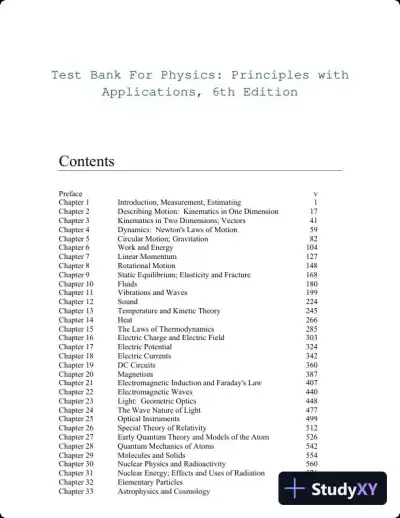 Exam Guides
Test Bank For Physics: Principles with Applications, 6th Edition
Physics
606 pages160downloadsFeb 2025 Textbook Guides
Solution Manual for Modern Physics, 2nd Edition
Physics
187 pages141downloadsFeb 2025 Class Notes
Class Notes for Financial Accounting, 10th Edition
Physics
208 pages139downloadsFeb 2025 Textbook Guides
Solution Manual for Physics: for Scientists and Engineers with Modern Physics, 3rd Edition
Physics
1291 pages136downloadsFeb 2025 Textbook Guides
Solution Manual for E and M TIPERs Electricity And Magnetism: Electricity And Magnetism Tasks: Inspried By Physics Education Research, 1st Edition
Physics
257 pages118downloadsFeb 2025 Textbook Guides
Solution Manual for Financial Accounting, 10th Edition
Physics
1061 pages107downloadsFeb 2025 Exam Guides
Test Bank for Conceptual Physics, 12th Edition
Physics
581 pages71downloadsFeb 2025 Textbook Guides
Solution Manual For College Physics With Masteringphysics, 7th Edition
Physics
536 pages37downloadsFeb 2025
Study this document with CramX
Once it is in your library, every tool can work from it.