

Developmental Psychology - Physical, Cognitive Development Age 12+
- Psychology
- Texas A&M University
- 8 pages
- Shared March 2026
Preview 3 of 8 pages
See the first 3 pages exactly as they appear in the document.
Page 1 Read page 1 as text
Study Guide Developmental Psychology – Physical, Cognitive Development: Age 12+ 1. Health Issues: Ages 12 – 19 Teenagers are usually healthy, but some major health problems can appear during adolescence. Health challenges are often linked to low income, poor diet, lack of medical care, risky behavior, personality factors, and a sedentary lifestyle . The three main issues to be aware of are eating disorders, depression, and substance abuse . 1.1 Eating Disorders Obesity • Obesity means being heavily overweight for your height . • About 15 – 20% of adolescents are obese. • Obesity can lead to chronic health problems, psychological stress, and social stigma . Anorexia Nervosa • Anorexia is self - starvation , often seen in perfectionist teenagers. • Individuals may buy, cook, and prepare food but eat very little themselves. • They usually have a distorted body image , thinking they are too fat. • Anorexics are typically 20% under their ideal weight . • About 1% of adolescent girls develop anorexia, and sadly, 2 – 8% may die from starvation . Bulimia Nervosa • Bulimia involves a binge - purge cycle : eating large amounts of food and then vomiting, using laxatives, or exercising excessively. • Bulimics focus intensely on food, weight, and body shape but usually maintain a normal weight . Both anorexia and bulimia are more common in girls, and their exact causes are unknown . They can affect teenagers from all social and economic backgrounds .
Page 2 Read page 2 as text
Study Guide 1.2 Depression • Up to 40% of adolescents experience periods of depression. • Signs include: o Low self - esteem or feeling worthless o Losing interest in activities o Changes in eating and sleeping habits • Teenage depression is often influenced by hormonal changes, life stressors, and concerns about appearance . • More girls than boys experience depression. Suicide • A serious risk of depression is suicide . • About 13% of adolescents report attempting suicide at least once. • Risk factors include: o Feeling hopeless o Previous suicide attempts o Having a detailed plan o Access to firearms or medications o Stressful life events • Girls attempt suicide more often , but boys die more often due to using more lethal methods. 1.3 Substance Abuse • Some teens use alcohol, tobacco, or drugs to cope with stress, escape problems, or fit in with friends. • Alcohol : a depressant that lowers inhibitions and creates relaxation. • Nicotine : a stimulant that produces mild alertness.
Page 3 Read page 3 as text
Study Guide • Marijuana : the most common illegal drug in the U.S., causing mild changes in perception. Trends in Teen Substance Use • Drug use is less common today than in the 1960s and 1970s. • However, risky behavior still occurs: o In a 1989 study, 35% of high school seniors had at least five drinks in a row in the past two weeks. o About 24% of seniors reported occasional marijuana use. Key Takeaway Adolescence is mostly a healthy period , but teenagers should be aware of eating disorders, depression, and substance use . Healthy habits, emotional support, and awareness of risks can help teens navigate these challenges safely. 2. Cognitive Development: Ages 12 – 19 During adolescence, teenagers’ thinking skills grow in amazing ways. Their brains mature, social experiences expand, and they gain the ability to think more abstractly, critically, and flexibly . 2.1 Formal Operational Thinking According to Piaget, most adolescents enter the formal operations stage (ages 12+). Here’s what that means: • Teens can think abstractly — about ideas, possibilities, and “what if” scenarios. • They can reason deductively , testing hypotheses and drawing conclusions about situations they haven’t personally experienced. • They can plan for the future , solve complex problems, and think in more flexible ways. Not all teens reach this stage at the same time. Life experience and education help develop these advanced thinking skills. For example, college students continue to improve in reasoning and problem - solving, showing the importance of learning in cognitive growth.
5 more pages in the full document
Unlock it once and it stays in your library, ready to chat with or turn into flashcards.
Unlock the full documentMore Psychology study materials
See all Quick Guides
Developmental Psychology - Physical, Cognitive Development Age 2–6
Psychology
7 pagesMar 2026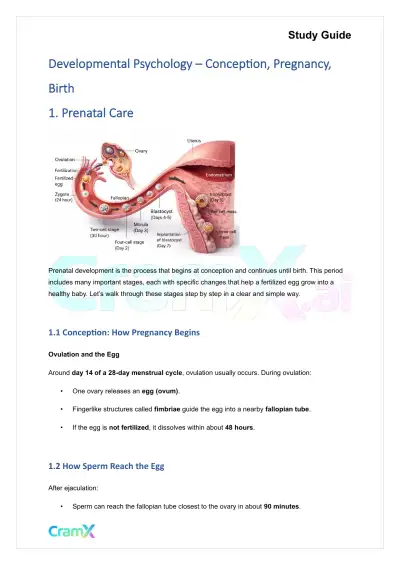 Quick Guides
Developmental Psychology - Conception, Pregnancy, Birth
Psychology
17 pagesMar 2026 Quick Guides
Developmental Psychology - Psychosocial Development Age 12–19
Psychology
7 pagesMar 2026 Quick Guides
Developmental Psychology - Physical, Cognitive Development 17–45
Psychology
7 pagesMar 2026 Quick Guides
Developmental Psychology - Physical, Cognitive Development 65+
Psychology
10 pagesMar 2026 Quick Guides
Developmental Psychology - Psychosocial Development Age 2–6
Psychology
8 pagesMar 2026 Quick Guides
Developmental Psychology - Death and Dying
Psychology
8 pagesMar 2026 Quick Guides
Developmental Psychology - Introduction to Developmental Psychology.docx
Psychology
10 pagesMar 2026
Study this document with CramX
Once it is in your library, every tool can work from it.