

Developmental Psychology - Psychosocial Development Age 12–19
- Psychology
- Texas A&M University
- 7 pages
- Shared March 2026
Preview 3 of 7 pages
See the first 3 pages exactly as they appear in the document.
Page 1 Read page 1 as text
Study Guide Developmental Psychology – Psychosocial Development: Age 12 – 19 1. Sexual Identity and Orientation: Ages 12 – 19 Part of growing up as a teen is figuring out your sexual identity and orientation . This involves understanding who you are attracted to — emotionally, romantically, sexually, and affectionately. 1.1 Understanding Sexual Orientation Sexual orientation can take different forms: • Heterosexual : attracted to people of the opposite sex • Homosexual : attracted to people of the same sex o Often called gay for males and lesbian for females • Bisexual : attracted to both sexes Everyone’s experience is unique, and figuring this out is a normal part of adolescence. 1.2 Sexual Orientation as a Spectrum In the 1940s and 1950s, researcher Alfred Kinsey discovered that sexual orientation isn’t just “heterosexual” or “homosexual.” Instead, it exists on a continuum , meaning people can experience varying degrees of attraction to the same sex, opposite sex, or both. Many people may feel some attraction to the same sex without acting on it. Kinsey’s research helped medical science recognize heterosexuality, homosexuality, and bisexuality as related but distinct orientations . 1.3 Why People Have Different Sexual Orientations Scientists are still exploring why people have different sexual orientations. Current theories fall into three main categories : biological, psychological/social, and interactional.
Page 2 Read page 2 as text
Study Guide 1. Biological Theories Some researchers think sexual orientation might be influenced by biology. Possible factors include: • Hormone levels before birth (like testosterone) • Prenatal biological influences, including maternal stress • Differences in brain structures • Genetic influences So far, no single biological cause has been proven. 2. Psychological and Social Theories Early experiences and social learning may also play a role. Some theories suggest: • Early childhood experiences could influence attraction • Freudian ideas: troubled family relationships or certain parent - child dynamics might contribute (though these ideas can’t explain all cases) • Social learning: early cross - gender behaviors or strong same - gender friendships during adolescence may shape sexual preferences 3. Interactional Theories The interactional approach combines biological, psychological, and social factors. For example: • Prenatal hormones may create a biological predisposition • Early childhood experiences and social learning either strengthen or weaken that predisposition In other words, sexual orientation is likely influenced by a mix of factors working together , not a single cause. 2. Sexuality: Ages 12 – 19 Adolescence is a time when teens begin to explore their sexual feelings and desires. Learning how to express sexuality safely and responsibly is a major part of growing up.
Page 3 Read page 3 as text
Study Guide 2.1 Sexual Activity in Adolescence Teenagers often experience sexual feelings similar to adults, but they usually lack the maturity to maintain long - term, committed relationships. Sometimes, teens may believe they are “in love” and stay with one partner for a while, but emotional readiness for intimacy often isn’t fully developed. Some teens may engage in promiscuous behavior , which can reflect emotional issues such as: • Low self - esteem • Dependence on others • Immaturity or insecurity • Deep - seated anger or hostility 2.2 How Teens Express Sexuality Teens find different ways to relieve sexual tension and explore their sexuality: 1. Masturbation – Most teens engage in self - stimulation by age 17 (about 90% of males, 60% of females). This is normal and erotically motivated. 2. Mutual Petting – Sexual activity with another person, excluding intercourse. Petting can be: o Light : above the waist o Heavy : below the waist 3. Intercourse – Sex mechanics are the same as adults, but the emotional intimacy and commitment are often missing. According to U.S. statistics, the average age of first sexual intercourse is 16 – 17 , though many teens may not consistently use contraception or protection against sexually transmitted diseases (STDs), even in the era of HIV/AIDS. 2.3 Homosexual and Bisexual Exploration About 5% of teens experiment with same - sex sexual activity . Most of these experiences are part of exploration and do not necessarily indicate a lifelong sexual orientation. • Teens may be hesitant to reveal their sexual orientation due to fear of negative reactions from peers or society.
4 more pages in the full document
Unlock it once and it stays in your library, ready to chat with or turn into flashcards.
Unlock the full documentMore Psychology study materials
See all Quick Guides
Developmental Psychology - Physical, Cognitive Development Age 2–6
Psychology
7 pagesMar 2026 Quick Guides
Developmental Psychology - Conception, Pregnancy, Birth
Psychology
17 pagesMar 2026 Quick Guides
Developmental Psychology - Physical, Cognitive Development Age 12+
Psychology
8 pagesMar 2026 Quick Guides
Developmental Psychology - Physical, Cognitive Development 17–45
Psychology
7 pagesMar 2026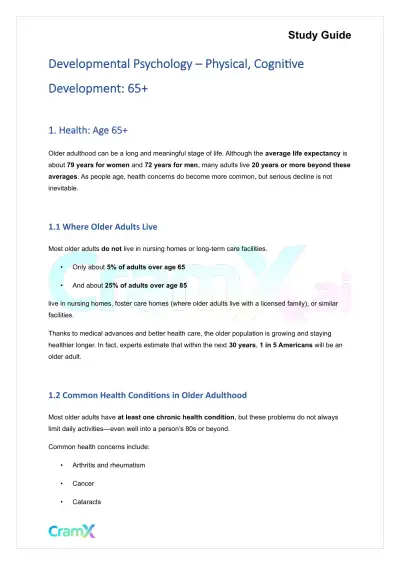 Quick Guides
Developmental Psychology - Physical, Cognitive Development 65+
Psychology
10 pagesMar 2026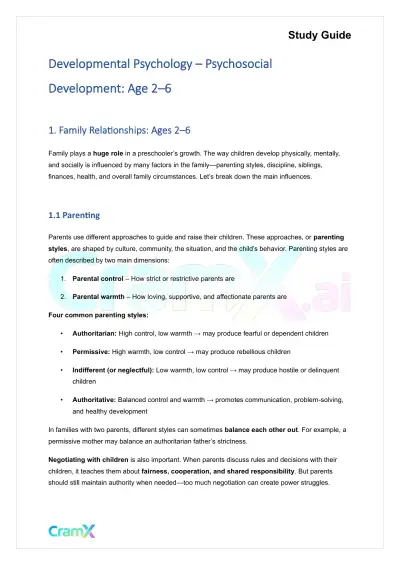 Quick Guides
Developmental Psychology - Psychosocial Development Age 2–6
Psychology
8 pagesMar 2026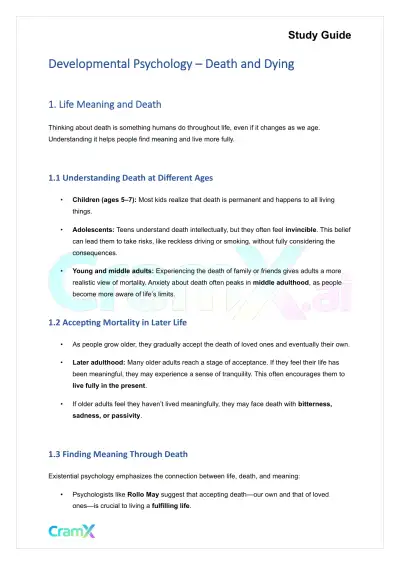 Quick Guides
Developmental Psychology - Death and Dying
Psychology
8 pagesMar 2026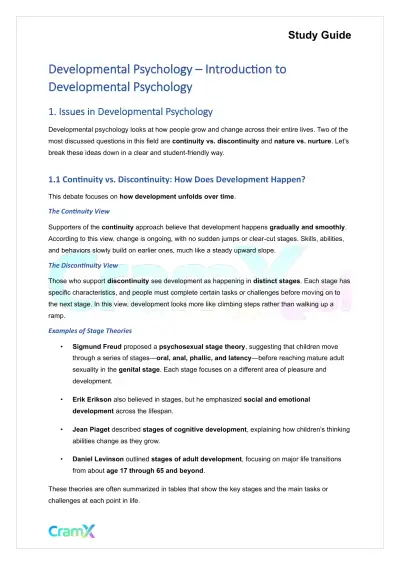 Quick Guides
Developmental Psychology - Introduction to Developmental Psychology.docx
Psychology
10 pagesMar 2026
Study this document with CramX
Once it is in your library, every tool can work from it.