

Developmental Psychology - Psychosocial Development Age 7–11
- Psychology
- Texas A&M University
- 12 pages
- Shared March 2026
Preview 4 of 12 pages
See the first 4 pages exactly as they appear in the document.
Page 1 Read page 1 as text
Study Guide Developmental Psychology – Psychosocial Development: Age 7 – 11 1. Family Relationships: Ages 7 – 11 Even though school - age children spend more time away from home than when they were younger, their family relationships remain very important . Families typically include parents, siblings, grandparents, and other extended family members. 1.1 Sharing Power and Decision - Making Middle childhood is a transitional stage . Children begin to take on more responsibility and parents start sharing power with them. • Example of shared power: Parents letting children negotiate their allowance . • Example of limits: Parents deciding which friends their children can or cannot play with . Even though children are gaining more freedom, parents still need to set rules and boundaries , because children don’t yet have the experience to make all adult decisions safely. 1.2 Increasing Responsibility During these years, children are given more responsibilities : • They may be allowed to go unsupervised to a movie or park . • They may help with household chores , like cleaning up or watching younger siblings. Most children enjoy these more grown - up roles and appreciate their parents trusting them with responsibility.
Page 2 Read page 2 as text
Study Guide 1.3 Discipline and Guidance Discipline is still important in middle childhood. The goal is to teach values, morals, self - control, and integrity rather than just punish children. • Research shows positive reinforcement — rewarding good behavior — is usually more effective than punishment. • Discipline helps children learn how to make better choices and develop responsibility. 1.4 Time Together and Working Parents Many modern families need two incomes , which means parents may spend less time at home. This can lead to children feeling like latchkey kids , who are alone after school while parents work. Children may feel: • Confused about why parents aren’t home • Resentful if they don’t get attention after school Communication is key: • Parents should talk honestly with their children about why they work. • Parents should emphasize that quality time matters more than quantity . • Families should make sure the time spent together is meaningful and engaging. Summary During middle childhood, family relationships: • Remain the most important connections in a child’s life • Evolve as children gain responsibility and parents share some decision - making • Are strengthened by positive reinforcement, guidance, and open communication • Benefit when parents balance work and family time, focusing on quality interactions Middle childhood is a time for growing independence while still relying on family for love, support, and guidance.
Page 3 Read page 3 as text
Study Guide 2. Friendships: Ages 7 – 11 Friendships become very important during middle childhood , especially with kids of the same gender. Friends play many roles: they are classmates, playmates, adventurers, and people children can confide in . Friends also help children build self - esteem and feel competent in social situations. 2.1 The Growing Importance of Friends As children get older, peer relationships become more central in their lives. • Kids enjoy group activities , like skating, riding bikes, playing house, or building forts. • Peer groups help children learn cooperation, teamwork, and social rules . At the same time, friendships may bring concerns about popularity and fitting in . Children may start to worry about what others think and may feel pressure to conform. 2.2 How Friendships Form Friendships in middle childhood are usually based on similarities , such as: • Interests and hobbies • Values or attitudes • Age and gender Children may also become aware of racial, cultural, or other differences , which can influence friendships. 2.3 Prejudice and Social Learning • Sometimes, children reject peers who are different , which can lead to prejudice — negative attitudes toward other groups. • Friends and peer groups can reinforce stereotypes , but most children become less rigid over time and learn to accept others from different backgrounds.
Page 4 Read page 4 as text
Study Guide Summary Between ages 7 and 11: • Friends are important for fun, support, and learning social skills • Group activities help children develop cooperation and teamwork • Friendships often form based on similarities , but awareness of differences may affect interactions • Children may experience prejudice , but their attitudes usually become more flexible as they grow Friendships in middle childhood help children practice social skills, build confidence, and understand others , making them a crucial part of growing up. 3. Peer Pressure: Ages 7 – 11 Peer pressure is when friends or classmates influence a child to think or act in certain ways. During middle childhood, peer pressure can sometimes be negative , leading children to make choices they might not otherwise make. 3.1 Who Is Most Affected Children who are most susceptible to peer pressure often have low self - esteem . They may adopt the group’s behaviors or opinions in an attempt to fit in or feel valued . 3.2 Examples of Negative Peer Pressure When children cannot resist peer influence, especially in uncertain or ambiguous situations , they may: • Start smoking or drinking • Steal or lie • Make other risky or harmful choices Resisting peer pressure is not always easy. In some cases, children who stand up for themselves may be seen as less popular .
8 more pages in the full document
Unlock it once and it stays in your library, ready to chat with or turn into flashcards.
Unlock the full documentMore Psychology study materials
See all Quick Guides
Developmental Psychology - Physical, Cognitive Development Age 2–6
Psychology
7 pagesMar 2026 Quick Guides
Developmental Psychology - Conception, Pregnancy, Birth
Psychology
17 pagesMar 2026 Quick Guides
Developmental Psychology - Physical, Cognitive Development Age 12+
Psychology
8 pagesMar 2026 Quick Guides
Developmental Psychology - Psychosocial Development Age 12–19
Psychology
7 pagesMar 2026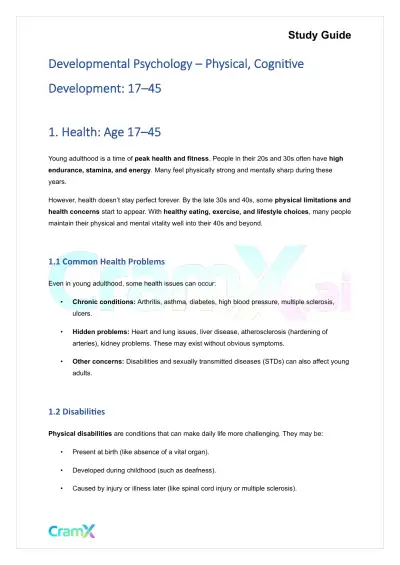 Quick Guides
Developmental Psychology - Physical, Cognitive Development 17–45
Psychology
7 pagesMar 2026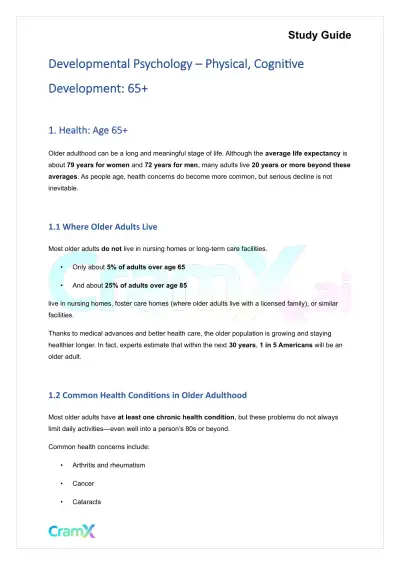 Quick Guides
Developmental Psychology - Physical, Cognitive Development 65+
Psychology
10 pagesMar 2026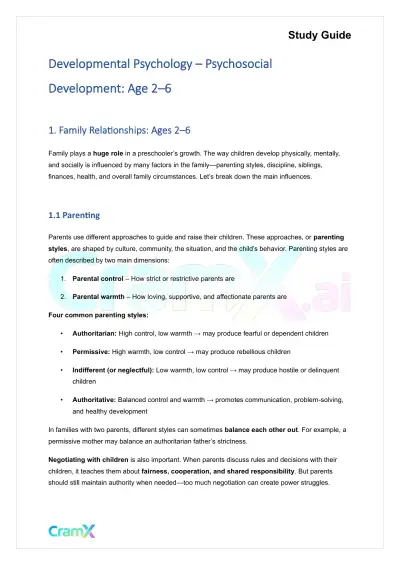 Quick Guides
Developmental Psychology - Psychosocial Development Age 2–6
Psychology
8 pagesMar 2026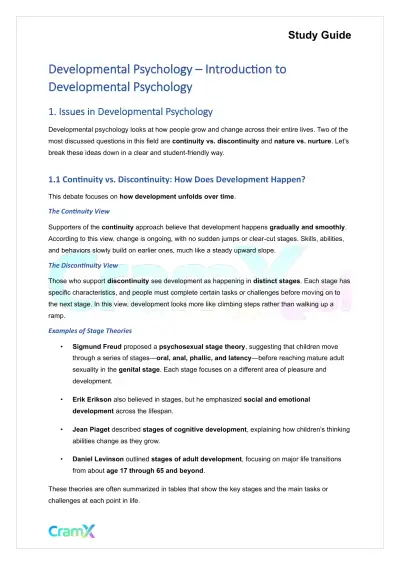 Quick Guides
Developmental Psychology - Introduction to Developmental Psychology.docx
Psychology
10 pagesMar 2026
Study this document with CramX
Once it is in your library, every tool can work from it.