

Barron's SAT Study Guide Premium, 2021-2022: 7 Practice Tests and Interactive Online Practice with Automated Scoring (2021)
- Scholastic Assessment Test
- 1477 pages
- Shared May 2025
Barron's SAT Study Guide Premium, 2021-2022: 7 Practice Tests and Interactive Online Practice with Automated Scoring (2021) is your go-to practice exam, covering essential topics needed for your certification success.
Preview 16 of 1477 pages
See the first 16 pages exactly as they appear in the document.
Page 1 Read page 1 as text
THE TRUSTED NAME IN TEST PREP © D 80 or P I 2021-2022 Reflects the 20271 exam update 7 full-length practice tests with detailed answer explanations Interactive online practice with a timed test option and automated scoring Comprehensive review and practice for all topics on the exam Sharon Weiner Green, M.A., W ONLINEPRACTICE [ion ener reer Brian W. Stewart, M.Ed. SAT® is a registered trademark of the College Board, which was not involved in the production of, and does not endorse, this product.
Page 2 Read page 2 as text
Downloaded from StudyXY.com ® + StudyXY Sd Ye. o> \ | iF ’ pr E \ 3 S Stu dy Anything This ContentHas been Posted On StudyXY.com as supplementary learning material. StudyXY does not endrose any university, college or publisher. Allmaterials posted are under the liability of the contributors. wv 8) www.studyxy.com
Page 3 Read page 3 as text
THE TRUSTED NAME IN TEST PREP P 1 2021-2022 Sharon Weiner Green, M.A. Former Instructor in English Merritt College Oakland, California Ira K. Wolf, Ph.D. Former High School Teacher, College Professor, and University Director of Teacher Preparation Brian W. Stewart, M.Ed. Founder and President BWS Education Consulting, Inc. SAT® is a registered trademark of the College Board, which was not involved in the production of, and does not endorse, this product. Study.
Page 4 Read page 4 as text
DEDICATION In memory of Mitchel Weiner and Samuel Brownstein, who first brought college entrance test preparation to the high school students of America. SW.G. To Elaine, my wife and best friend, for all of your support and love. LK.W. To Caitlin, Andrew, and Eloise for all of your love and support. B.W.sS. + StudyXY
Page 5 Read page 5 as text
ABOUT THE AUTHORS Sharon Green started helping prepare students for the PSAT and SAT as a 13-year-old assistant at her father’s college entrance tutoring course; she has never stopped since. A National Merit Scholar, she holds degrees from Harvard College, New York University School of Education, and the University of California at Berkeley. Her test preparation books, all published by Barron’s, run the gamut from the California High School Proficiency Examination to the GRE. Whenever she can dig her way out from under multiple dictionaries, Sharon enjoys folk dancing, reading Jane Austen and science fiction, and watching Little League baseball. Dr. Ira Wolf has had a long career in math education. In addition to teaching math at the high school level for several years, he was a professor of mathematics at Brooklyn College and the Director of the Mathematics Teacher Preparation program at SUNY Stony Brook. Dr. Wolf has been helping students prepare for college entrance exams, including the PSAT, SAT, ACT, and SAT Subject Tests in Math for more than 35 years. He is the founder and former president of PowerPrep, a test preparation company on Long Island that has helped several thousand high school students prepare for the SAT. Brian W. Stewart is the founder and president of BWS Education Consulting, Inc., a boutique tutoring and test preparation company based in Columbus, Ohio. His company has worked with thousands of students from all over the world to help them improve their test scores and earn admission to selective schools. Brian earned his A.B. in Philosophy at Princeton University and his Master’s in Education at The Ohio State University. He is also the author of Barron’s ACT Study Guide, Barron’s Strategies and Practice for the PSAT/NMSQT, Barron’s PSAT/NMSQT 1520, and Barron’s SAT Reading Workbook. You can connect with Brian at www.bwseducationconsulting.com.
Page 6 Read page 6 as text
© Copyright 2021, 2019, 2017, 2016, 2014, 2012, 2010, 2008 by Kaplan, Inc., d/b/a Barron’s Educational Series Previous editions © copyright 2006, 2005, 2001, 1998, 1997, 1994, 1993, 1991, 1989, 1987, 1986, 1984, 1982, 1980, 1978, 1975, 1974, 1973, 1972, 1971, 1969, 1966, 1965, 1964, 1962, 1958, 1955, 1954 by Barron’s Educational Series, Inc., under the titles How to Prepare for the SAT, How to Prepare for the SAT 1, and How to Prepare for the Scholastic Aptitude Test. All rights reserved. No part of this publication may be reproduced or distributed in any form or by any means without the written permission of the copyright owner. Published by Kaplan, Inc., d/b/a Barron’s Educational Series 750 Third Avenue New York, NY 10017 www.barronseduc.com ISBN: 978-1-5062-8161-2 10987654321 Kaplan, Inc., d/b/a Barron’s Educational Series print books are available at special quantity discounts to use for sales promotions, employee premiums, or educational purposes. For more information or to purchase books, please call the Simon & Schuster special sales department at 866-506-1949. + StudyXY
Page 7 Read page 7 as text
Contents _§ -— -— -— -— -— -— -— -— -— -— Preface SAT Format and Test Dates Countdown to the SAT Acknowledgments PART ONE: GET ACQUAINTED WITH THE SAT Introduction: Let’s Look at the SAT What Is the SAT? What Is Score Choice? What Is the Format of the SAT? The Reading Test The Writing and Language Test The Math Test Winning Tactics for the SAT PART TWO: PINPOINT YOUR TROUBLE SPOTS A Diagnostic Test Diagnostic Test Answer Key
Page 8 Read page 8 as text
Score Analysis Answers Explained PART THREE: THE SAT READING TEST 1 The Evidence-Based Reading Test Quick Overview Testing Tactics Practice Exercises Answers Explained 2 Build Your Vocabulary The Master Word List PART FOUR: THE SAT WRITING AND LANGUAGE TEST 3 The Evidence-Based Writing and Language Test SAT Writing and Language Test Overview SAT Grammar Review Quantitative Graph Analysis 13 SAT Writing Strategies Putting It All Together Practice Passages PART FIVE: THE SAT MATH TEST Introduction to the Math Test 4 Math Strategies and Tactics Testing Tactics Practice Exercises Answers Explanations
Page 9 Read page 9 as text
5 Reviewing Mathematics Arithmetic 5-A Basic Arithmetic Concepts 5-B Fractions and Decimals 5-C Percents 5-D Ratios and Proportions 5-E Averages Algebra 5-F Polynomials 5-G Solving Equations and Inequalities 5-H Word Problems Geometry 5-1 Lines and Angles 5-J Triangles 5-K Quadrilaterals and Other Polygons 5-L Circles 5-M Solid Geometry 5-N Coordinate Geometry Data Analysis 5-O Interpretation of Data Miscellaneous Topics 5-P Counting and Probability 5-Q Sequences 5-R Functions and Their Graphs 5-S Trigonometry 5-T Imaginary and Complex Numbers PART SIX: TEST YOURSELF Practice Test 1 Practice Test 2 Practice Test 3 Practice Test 4 Index
Page 10 Read page 10 as text
Preface __N -— -— -— -— _— - -— -— -— -— n writing this edition of Barron’s SAT, we have aimed to give you the advantages on the SAT that the students we tutor and teach in classes have enjoyed for decades. Therefore, we’d like you to think of this study guide as your personal SAT tutor, because that’s precisely what it is. Like any good tutor, it will work closely with you, prompting you and giving you pointers to improve your testing skills. It will help you pinpoint your trouble spots and show you how to work on them, and it will point out your strengths as well. After working with your tutor, you should see marked improvement in your performance. Your personal tutor will be available to work with you whenever you like, for as long or short a time as you like. Working with your tutor, you can go as quickly or as slowly as you like, repeating sections as often as you need, or skipping over sections you already know well. Your tutor will give you explanations, not just correct answers, when you make mistakes, and will be infinitely patient and adaptable. ONLINE This book comes with online access to two additional practice tests and vocabulary flashcards. You can access all online content here: http://online.barronsbooks.com/ Here are just a few of the things your tutor offers you: » It takes you step by step through thousands of reading, writing and language, and mathematical questions, showing you how to solve them + StudyXY
Page 11 Read page 11 as text
and how to avoid going wrong. » It offers you dozens of clear-cut Testing Tactics and shows you how to use them to attack every question type you will find on the SAT. » It enables you to simulate actual testing conditions, providing you with a diagnostic test and four practice tests—all with answers fully explained—each of which follows the format of the SAT. n If you're on the move and don’t have your book with you, you can access two additional practice tests online. These tests provide you with timed conditions and fully explained answers. » [It provides a comprehensive review of all the math topics you need to know to do well on the SAT. a It thoroughly prepares you for the Writing and Language sections of the exam. With step-by-step lessons on English grammar and informational graphics drills, you will have the tools to approach these sections with total confidence. n It gives you Barron’s Master Word List, your best chance to acquaint yourself with the whole range of college-level vocabulary you will face on the SAT. nm It even gives you access to the word list in the form of online flashcards. Test your vocabulary on your tablet or on your smartphone, at home or on the go. No other book offers you as much. Your personal tutor embodies Barron’s ongoing commitment to provide you with the best possible coaching for the SAT and every other important test you take. It has benefited from the dedicated labors of Annie Bernberg and other members of the editorial staff of Barron’s, all of whom wish you the best as you settle down with your tutor to work on the SAT.
Page 12 Read page 12 as text
lH WA WA Wh WW Wh OW Wm Wm Wm WW SAT Format Total Time: 3 Hours Section 1: Reading 5 Reading Passages, including 1 paired passage 52 Questions Time—65 minutes Section 2: Writing and Language 4 Passages 44 Questions Time—35 minutes Section 3: Math, No Calculator 15 Multiple Choice, 5 Grid-in 20 Questions Time—25 minutes Section 4: Math, Calculator 30 Multiple Choice, 8 Grid-in 38 Questions Time—55 minutes Note that the SAT will no longer offer a January test administration. An August test date is now available. You can register for the SAT at sat.collegeboard.org. SAT Test Dates 2021-2022 School Year* 2022-2023 School Year* August 28, 2021 August 27, 2022 October 2, 2021 October 1, 2022 November 6, 2021 November 5, 2022 December 4, 2021 March 11, 2023 March 12, 2022 May 6, 2023 May 7, 2022 June 3, 2023 June 4, 2022 + StudyXxy
Page 13 Read page 13 as text
*As of press time, exam dates for the 2021-2022 and 2022-2023 school years are approximate. Check collegeboard.org periodically to confirm the anticipated test dates and the registration and late registration deadlines. + StudyXxy
Page 14 Read page 14 as text
Countdown to the SAT mB WA WA WA WA WA WA WA WA WA wa The day before you take the test, don’t do practice tests. Do look over all the tactics that follow so they will be fresh in your mind. BEFORE THE TEST If the test location is unfamiliar to you, drive there before the test day so that you will know exactly where you’re going on the day you take the test. Set out your test kit the night before. You will need your admission ticket, a photo ID (a driver’s license or a non-driver picture ID, a passport, or a school ID), your calculator, four or five sharpened No. 2 pencils (with erasers), plus a map or directions showing how to get to the test center. Get a good night’s sleep so you are well rested and alert. Wear comfortable clothes. Dress in layers. Bring a sweater in case the room is cold. Bring an accurate watch—not one that beeps and not your cell phone—in case the room has no clock. You’ll want to use the same watch or small clock that you’ve been using during your practice sessions. Bring a small snack for quick energy. Don’t be late. Allow plenty of time for getting to the test site. You want to be in your seat, relaxed, before the test begins. Pick your favorite letter from among A, B, C, and D. This is the letter you will always use when you have to make a quick guess. Leave your phone at home. You won’t be able to use it during the test or during breaks. If your phone makes noise or you are seen using it, your scores could be canceled. + StudyXxy
Page 15 Read page 15 as text
DURING THE TEST Pace yourself. Don’t work so fast that you start making careless errors. On the other hand, don’t get bogged down on any one question. Feel free to skip back and forth between questions within a section. Play the percentages: always eliminate as many of the answer choices as possible and then make an educated guess, not a random one. If you have no idea, quickly guess your favorite letter and move on. If you are running out of time in a section, use your last 20 seconds to fill in your favorite letter on every question you didn’t get to. Watch out for eye-catchers, answer choices that are designed to tempt you into guessing wrong. Change answers only if you have a reason for doing so; don’t change them on a last-minute hunch or whim. Check your assumptions. Make sure you are answering the question asked and not the one you thought was going to be asked. Remember that you are allowed to write anything you want in your test booklet. Make full use of it. » Do math calculations and draw diagrams. » Underline key words in reading passages. n Cross out answer choices you are sure are wrong. » Circle questions you want to come back to, but first make a guess. Be careful not to make any stray marks on your answer sheet. The test is graded by a machine, and a machine cannot always tell the difference between an accidental mark and an intentionally filled-in answer. Check frequently to make sure you are answering the questions in the right spots. Remember that you don’t have to attempt every question to do well. Just be sure to fill in answers for every question you don’t attempt. TIPS FOR THE EVIDENCE-BASED READING QUESTIONS Read all the answer choices before you decide which is best.
Page 16 Read page 16 as text
Think of a context for an unfamiliar word; the context may help you come up with the word’s meaning. Break down unfamiliar words into recognizable parts—prefixes, suffixes, roots. Consider secondary meanings of words. If none of the answer choices seems right to you, take another look. A word may have more than one meaning. When you have a choice, tackle reading passages with familiar subjects before passages with unfamiliar ones. First attempt the passages that you know are easier for you. Leave the sorts of passages that are hard for you until later. Make use of the introductions to acquaint yourself with the text. Read as rapidly as you can with understanding, but do not force yourself. As you read the opening sentence, try to predict what the passage is about. When you tackle the questions, use any line references given to help in the passage. Base your answer only on what is written in the passage, not on what you know from other books or courses. In answering questions on the paired reading passages, first read one passage and answer the questions based on it; then read the second passage and tackle the remaining questions. On graph analysis questions, ask yourself this: (1) What information is here? (2) What does it mean? Take time to evaluate the graph labels and axes. Be mindful that you will often need to integrate information from the reading passage with information presented in the graph. The vocabulary in context questions typically involve unusual meanings of words you know—be sure you read enough of the text in which the word appears so that you’ll be able to figure exactly how the word is being used in the passage. If you notice that a question is immediately followed by a second question that asks which lines in the passage provide evidence supporting your answer to the first question, don’t waste time going over the second question’s answer choices. Instead, as you answer the first question, note where you found the evidence supporting your answer choice. Mark the lines with an asterisk, or set them in brackets. Then answer the second question. Do not hesitate to come back to questions if you are unsure; a question
1461 more pages in the full document
Unlock it once and it stays in your library, ready to chat with or turn into flashcards.
Unlock the full documentMore Scholastic Assessment Test study materials
See all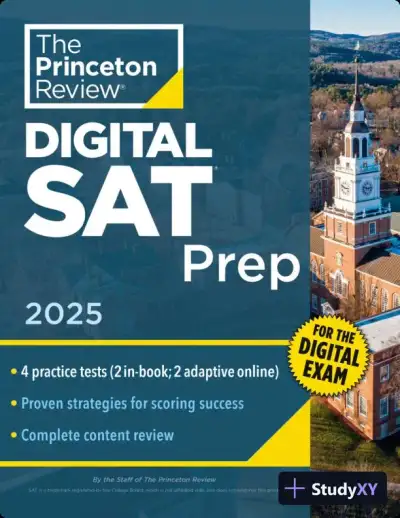 Certification Guides
Princeton Review Digital SAT Prep, 2025: 4 Full-Length Practice Tests (2024)
Scholastic Assessment Test
1073 pages167downloadsFeb 2025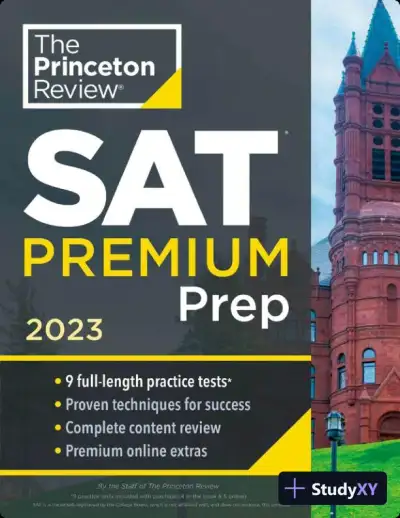 Certification Guides
Princeton Review SAT Premium Prep, 2023: 9 Practice Tests + Review and Techniques (2022)
Scholastic Assessment Test
1391 pages155downloadsFeb 2025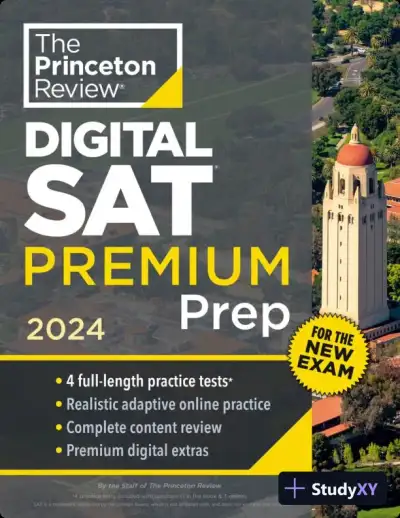 Certification Guides
Princeton Review Digital SAT Premium Prep, 2024 : 4 Practice Tests + Online Flashcards + Review and Tools (2023)
Scholastic Assessment Test
873 pages153downloadsFeb 2025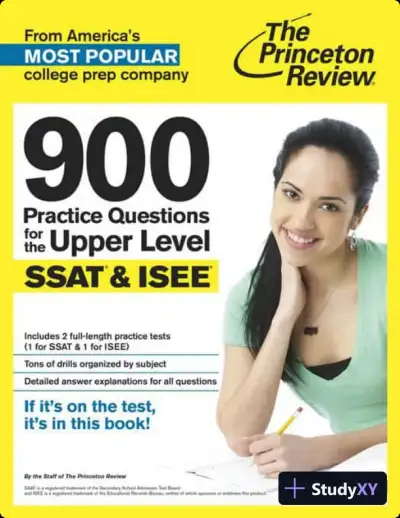 Certification Guides
900 Practice Questions for the Upper Level SSAT and ISEE (2014)
Scholastic Assessment Test
870 pages137downloadsFeb 2025 Certification Guides
Princeton Review Digital SAT Advanced (College Test Preparation), 2nd Edition (2024)
Scholastic Assessment Test
415 pages128downloadsFeb 2025 Certification Guides
SAT Power Vocab : A Complete Guide to Vocabulary Skills and Strategies for the SAT (2024)
Scholastic Assessment Test
355 pages94downloadsFeb 2025 Certification Guides
The Princeton Review 2025 PREMIUM @DSATuz1 (2024)
Scholastic Assessment Test
1094 pages89downloadsFeb 2025 Certification Guides
Princeton Review SSAT and ISEE Prep, 2023: 6 Practice Tests + Review and Techniques (2023)
Scholastic Assessment Test
1194 pages89downloadsFeb 2025
Study this document with CramX
Once it is in your library, every tool can work from it.