

Analysis of Variance (ANOVA) and Post-Hoc Comparisons: A Comprehensive Study
- Statistics
- 6 pages
- Shared May 2025
This assignment provides an in-depth analysis of ANOVA and post-hoc tests, explaining their applications in research.
Preview 2 of 6 pages
See the first 2 pages exactly as they appear in the document.
Page 1 Read page 1 as text
Analysis of Variance (ANOVA) and Post - Hoc Comparisons: A Comprehensive Study 1. Jackson, even - numbered Chapter Exercises, pp. 308 - 310. 2) What is the difference between a randomized ANOVA and a repeated measures ANOVA? What does the term one - way mean with respect to ANOVA? The randomized ANOVA design is the parametric inferential statistical test to compare the mean of three or more groups. Whereas the repeated measures ANOVA is almost same as randomized ANOVA but except the fact that here the groups are correlated to each other. So the main difference between a randomized ANOVA and a repeated measures ANOVA is that 1 st one uses uncorrelated groups and 2 nd one uses correlated groups. When we use one way in ANOVA that mean we are considering only one independent variable. 4) If a researcher decides to use multiple comparisons in a study with three conditions, what is the probability of a Type I err or across these comparisons? Use the Bonferroni adjustment to determine the suggested alpha level. Assuming alpha is 0.05 then the probability of a Type I error across these comparisons would be, ( 1 − ( 1 − 0 . 05 ) 3 ) = 0 . 14263 = 14 . 26% With the Bonferroni adjustment, the alpha level is 0.05/3 = 0.0167 for each comparison. 6) When should post - hoc comparisons be performed? The post - hoc comparisons should be performed when we reject the null hypothesis of ANOVA and conclude that at least one groups mean is significantly different than others. The post - hoc test is performed to see which group mean is different. 8) Why is repeated measures ANOVA statistically more powerful than a randomized ANOVA? The repeated measures ANOVA is statistically more powerful than a randomized ANOVA because both uses different method for the analysis. A repeated measures ANOVA divides the total variance into two parts and only the error variance is used to calculate the F value. So the F value becomes larger giving more power. 10) In a study of the effects of stress on illness, a researcher taillied the number of colds people contracted during a 6 - month period as a function of the amount of stress they reported during the same period. There were three stress levels: minimal, moderate, and high stress. The sums of squares appear in the following ANOVA summary table. The mean for each condition and the number of subjects per condition and the number of subjects per condition are also noted. Source df SS MS f Between groups 2 22.167 11.084 6.763 Within Groups 9 14.750 1.639 Total 11 36.917 Stress level Mean N minimal 3 4 moderate 4 4 maximum 6 4 A) Complete the ANOVA summary table
Page 2
4 more pages in the full document
Unlock it once and it stays in your library, ready to chat with or turn into flashcards.
Unlock the full documentMore Statistics study materials
See all Exam Guides
Test Bank for Biostatistics for the Biological and Health Sciences , 2nd Edition
Statistics
182 pages161downloadsFeb 2025 Exam Guides
Elementary Statistics, 13th Edition Test Bank
Statistics
239 pages160downloadsFeb 2025 Textbook Guides
Solution Manual For Statistics for Managers Using Microsoft Excel, 7th Edition
Statistics
1418 pages158downloadsFeb 2025 Textbook Guides
Statistics for Managers Using Microsoft Excel 8th Edition Solution Manual
Statistics
1343 pages156downloadsFeb 2025 Textbook Guides
Essentials of Social Statistics for a Diverse Society Second Edition Solution Manual
Statistics
137 pages135downloadsFeb 2025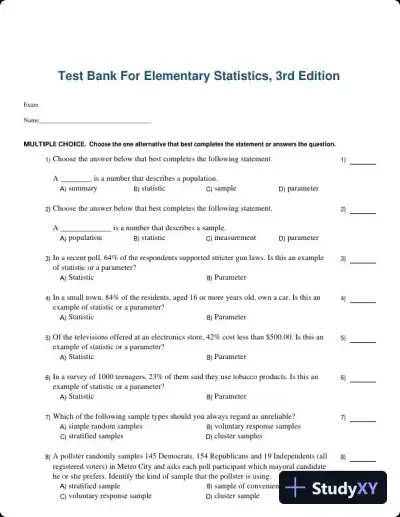 Exam Guides
Test Bank For Elementary Statistics, 3rd Edition
Statistics
969 pages126downloadsFeb 2025 Textbook Guides
Solution Manual for Business Statistics, 4th Edition
Statistics
582 pages125downloadsFeb 2025 Exam Guides
Test Bank for Business Statistics: A Decision-Making Approach, 10th Edition
Statistics
881 pages110downloadsFeb 2025
Study this document with CramX
Once it is in your library, every tool can work from it.