
Statistics Notes, Questions, and Study Resources
academicStatistics is a branch of mathematics that focuses on collecting, organizing, analyzing, and interpreting data to understand patterns, trends, and relationships. It helps students and professionals make informed decisions based on data across fields such as business, science, healthcare, and social research.
On CramX, you can explore a wide range of statistics resources, including study notes and concept guides, questions with detailed explanations, and flashcards for key formulas and concepts. These materials support coursework, assignments, and exam preparation.
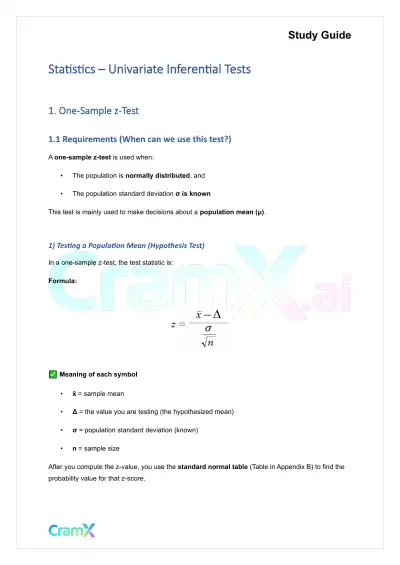
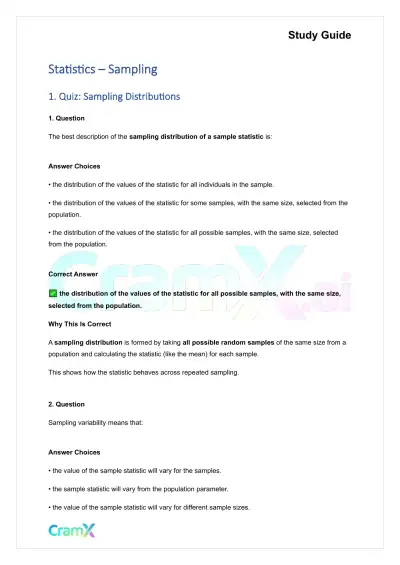
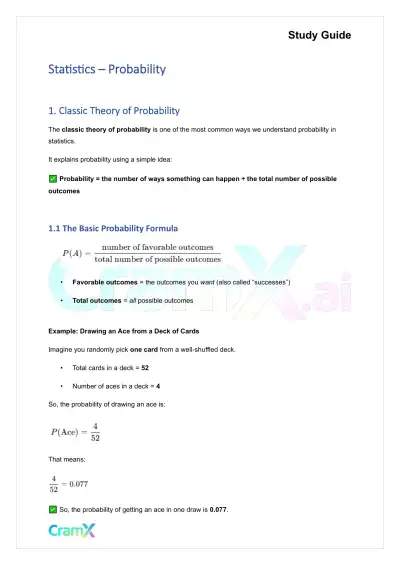
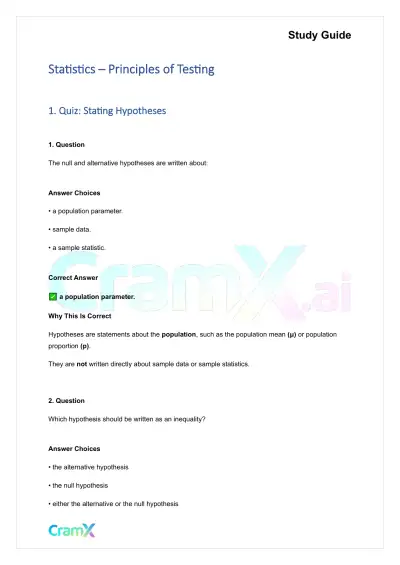
Statistics covers key topics such as probability, data distributions, descriptive and inferential statistics, hypothesis testing, and regression analysis. Students learn how to interpret data, test assumptions, and draw meaningful conclusions.
The t is widely used to analyze real-world data, from business performance and market trends to scientific experiments and public health studies. Understanding statistics helps develop analytical thinking and problem-solving skills.
You may also explore related ts such as Mathematics, Economics, and Data Science, which often involve data analysis and quantitative methods.
Recent Statistics Documents
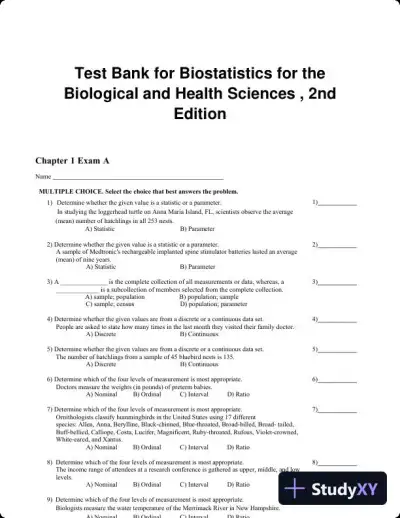
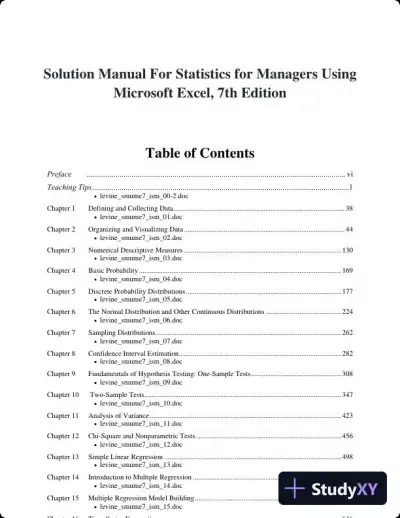
Explore the latest Statistics notes, study materials, and exam resources. These documents help you understand key concepts and prepare effectively for coursework and exams. These resources cover essential topics, key concepts, and commonly studied areas within Statistics. Latest Statistics documents include notes, assignments, and practice materials from various courses and universities.
Most Popular Statistics Documents
Explore the most popular Statistics notes, study materials, and solution manuals trusted by students. Ranked based on student ratings, downloads, and engagement.
Recent Statistics Flashcards
Explore recently created Statistics flashcard decks that simplify complex topics and support quick revision and active recall. Browse interactive flashcard decks created by students to help with Statistics revision and exam preparation. Perfect for quick revision and spaced repetition learning.
Statistics for Behavioral Sciences Exam 3 Part 4
Statistics for Behavioral Sciences Exam 3 Part 3
Statistics for Behavioral Sciences Exam 3 Part 2
Statistics for Behavioral Sciences Exam 3 Part 1
Statistics for Behavioral Sciences Chapter 2
Statistics for Behavioral Sciences Chapter 1 Part 2
Statistics for Behavioral Sciences Chapter 1 Part 1
Recent Statistics Questions & Answers
Explore recently answered Statistics questions, including step-by-step solutions and explanations to support your learning and exam preparation. These questions cover important topics, concepts, and real-world problems commonly asked in Statistics courses and exams. Perfect for homework help, quick problem-solving, and concept clarification. New questions and answers are added regularly to keep content fresh and relevant.
vast majority
Explain how to find the value for 96% confidence level.
How do you calculate the mode when there are 3 modes
Why is the median resistant, but the mean is not? Choose the correct answer below. A. The mean is not resistant because when data are skewed, there are extreme values in the tail, which tend to pull the mean in the direction of the tail. The median is resistant because the median of a variable is the value that lies in the middle of the data when arranged in ascending order and does not depend on the extreme values of the data. B. The mean is not resistant because it is dependent upon the sample size, n. The larger n is, the smaller the mean becomes. However, the median is resistant because it is not dependent on the sample size, n. C. The mean is not resistant because when data are skewed, there are extreme values in the tail, which do not pull the mean in that direction. However, the median is pulled in the direction of the extreme values, making it resistant. D. The median is resistant, while the mean is not, because when there are extreme values in the tail, the value of the median changes while the mean does not.
True or False? In stratified sampling, the population is split into non-overlapping groups or strata (e.g., men and women; people under 30 years of age and people 30 years of age and older) and then sample within each strata.
"Which of the following is an example of inferential statistics? Find the average height of 50 female students at State University. Summarize the variability of the exam scores of 40 students based on all 40 exam scores. Test the longevity of all light bulbs based on a sample of 100 light bulbs. Calculate a mutual fund's average return for the last five years."
Outline the advantages and disadvantages of the use of tally charts as quantitative data.
How do I find the t* at the 0.05 significance level?
Explore Related Subjects and Topics
Discover related subjects and academic topics connected to Statistics. Explore study materials, notes, flashcards, and questions across multiple disciplines. These subjects share important concepts with Statistics and can help you build a broader understanding. Browse study materials, documents, flashcards, and answers across these subjects.
Statistics Study Materials from Top Universities
Explore Statistics study materials, notes, and documents from top universities and institutions. Access resources created by students and educators from leading academic programs. These universities offer a wide range of Statistics resources across different courses and levels of study. Trusted by students from universities worldwide. Browse documents, notes, and study materials from these universities.