
Past Exams
2023-2024 TNCC Final Practice Exam 4 with Answers (49 Solved Questions)
- Trauma Nursing Core Course
- 11 pages
- Shared February 2025
- 123 downloads
Boost your score by practicing with 2023-2024 TNCC Final Practice Exam 4 with Answers, featuring past exam content.
Preview · 4 of 11 pages
100%
Page 1
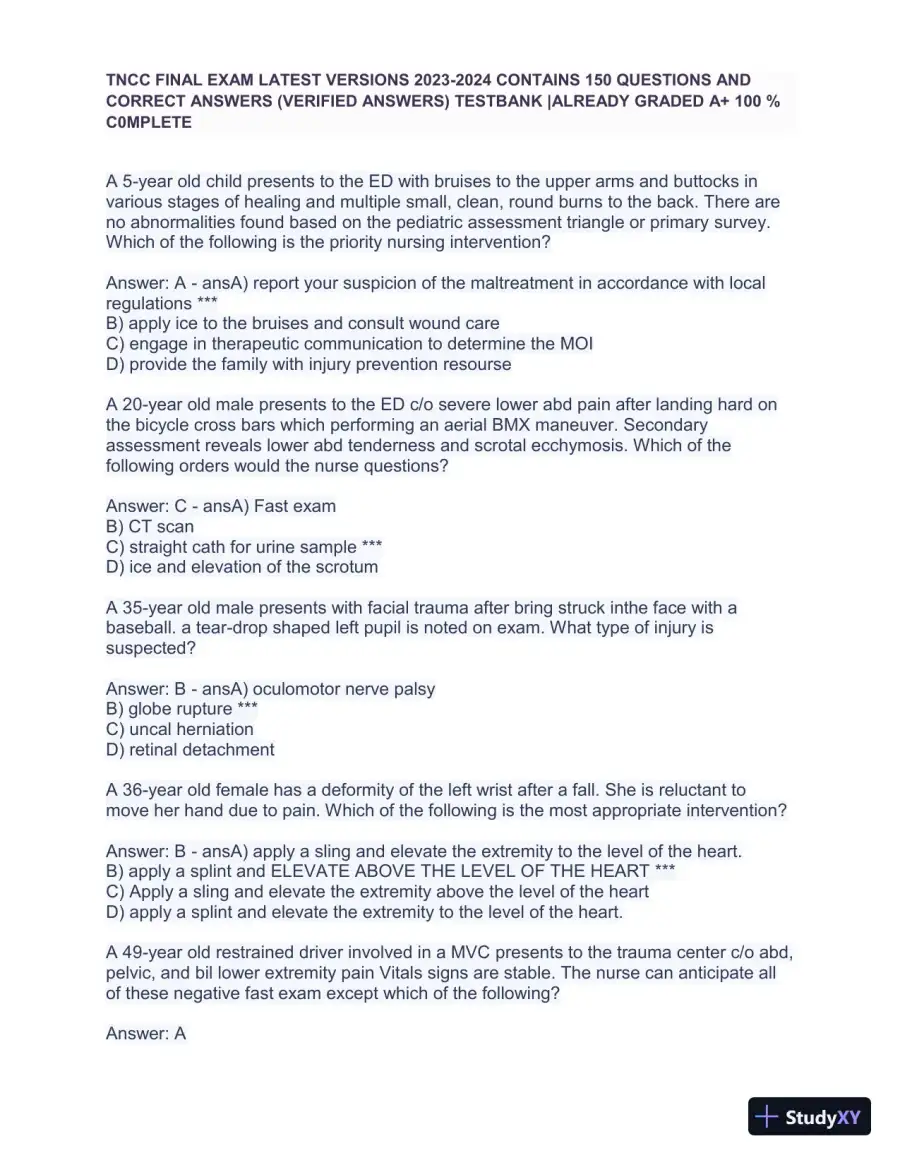 TNCC FINAL EXAM LATEST VERSIONS 2023-2024 CONTAINS 150 QUESTIONS ANDCORRECT ANSWERS (VERIFIED ANSWERS) TESTBANK |ALREADY GRADED A+ 100 %C0MPLETEA 5-year old child presents to the ED with bruises to the upper arms and buttocks invarious stages of healing and multiple small, clean, round burns to the back. There areno abnormalities found based on the pediatric assessment triangle or primary survey.Which of the following is the priority nursing intervention?Answer: A - ansA) report your suspicion of the maltreatment in accordance with localregulations ***B) apply ice to the bruises and consult wound careC) engage in therapeutic communication to determine the MOID) provide the family with injury prevention resourseA 20-year old male presents to the ED c/o severe lower abd pain after landing hard onthe bicycle cross bars which performing an aerial BMX maneuver. Secondaryassessment reveals lower abd tenderness and scrotal ecchymosis. Which of thefollowing orders would the nurse questions?Answer: C - ansA) Fast examB) CT scanC) straight cath for urine sample ***D) ice and elevation of the scrotumA 35-year old male presents with facial trauma after bring struck inthe face with abaseball. a tear-drop shaped left pupil is noted on exam. What type of injury issuspected?Answer: B - ansA) oculomotor nerve palsyB) globe rupture ***C) uncal herniationD) retinal detachmentA 36-year old female has a deformity of the left wrist after a fall. She is reluctant tomove her hand due to pain. Which of the following is the most appropriate intervention?Answer: B - ansA) apply a sling and elevate the extremity to the level of the heart.B) apply a splint and ELEVATE ABOVE THE LEVEL OF THE HEART ***C) Apply a sling and elevate the extremity above the level of the heartD) apply a splint and elevate the extremity to the level of the heart.A 49-year old restrained driver involved in a MVC presents to the trauma center c/o abd,pelvic, and bil lower extremity pain Vitals signs are stable. The nurse can anticipate allof these negative fast exam except which of the following?Answer: A
Page 2

Page 3
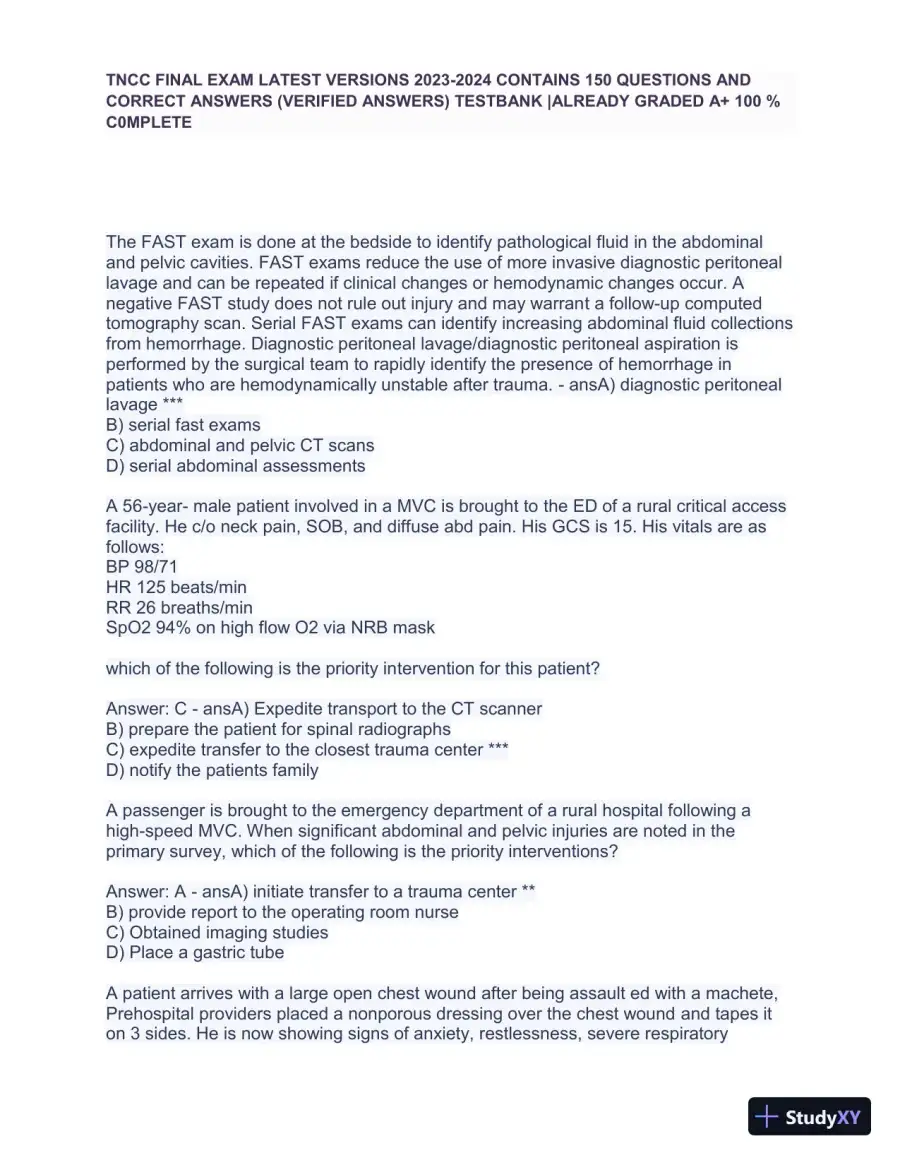 TNCC FINAL EXAM LATEST VERSIONS 2023-2024 CONTAINS 150 QUESTIONS ANDCORRECT ANSWERS (VERIFIED ANSWERS) TESTBANK |ALREADY GRADED A+ 100 %C0MPLETEThe FAST exam is done at the bedside to identify pathological fluid in the abdominaland pelvic cavities. FAST exams reduce the use of more invasive diagnostic peritoneallavage and can be repeated if clinical changes or hemodynamic changes occur. Anegative FAST study does not rule out injury and may warrant a follow-up computedtomography scan. Serial FAST exams can identify increasing abdominal fluid collectionsfrom hemorrhage. Diagnostic peritoneal lavage/diagnostic peritoneal aspiration isperformed by the surgical team to rapidly identify the presence of hemorrhage inpatients who are hemodynamically unstable after trauma. - ansA) diagnostic peritoneallavage ***B) serial fast examsC) abdominal and pelvic CT scansD) serial abdominal assessmentsA 56-year- male patient involved in a MVC is brought to the ED of a rural critical accessfacility. He c/o neck pain, SOB, and diffuse abd pain. His GCS is 15. His vitals are asfollows:BP 98/71HR 125 beats/minRR 26 breaths/minSpO2 94% on high flow O2 via NRB maskwhich of the following is the priority intervention for this patient?Answer: C - ansA) Expedite transport to the CT scannerB) prepare the patient for spinal radiographsC) expedite transfer to the closest trauma center ***D) notify the patients familyA passenger is brought to the emergency department of a rural hospital following ahigh-speed MVC. When significant abdominal and pelvic injuries are noted in theprimary survey, which of the following is the priority interventions?Answer: A - ansA) initiate transfer to a trauma center **B) provide report to the operating room nurseC) Obtained imaging studiesD) Place a gastric tubeA patient arrives with a large open chest wound after being assault ed with a machete,Prehospital providers placed a nonporous dressing over the chest wound and tapes iton 3 sides. He is now showing signs of anxiety, restlessness, severe respiratory
Page 4
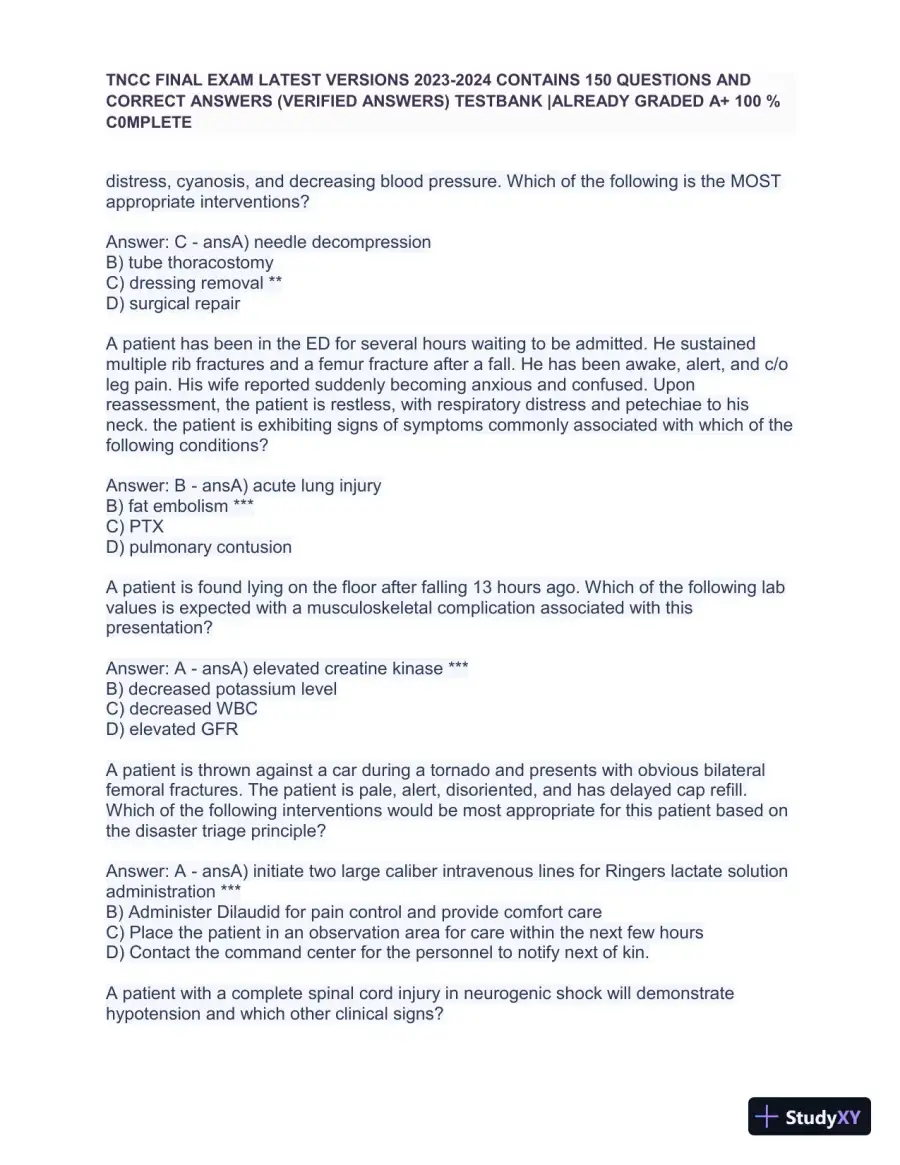 TNCC FINAL EXAM LATEST VERSIONS 2023-2024 CONTAINS 150 QUESTIONS ANDCORRECT ANSWERS (VERIFIED ANSWERS) TESTBANK |ALREADY GRADED A+ 100 %C0MPLETEdistress, cyanosis, and decreasing blood pressure. Which of the following is the MOSTappropriate interventions?Answer: C - ansA) needle decompressionB) tube thoracostomyC) dressing removal **D) surgical repairA patient has been in the ED for several hours waiting to be admitted. He sustainedmultiple rib fractures and a femur fracture after a fall. He has been awake, alert, and c/oleg pain. His wife reported suddenly becoming anxious and confused. Uponreassessment, the patient is restless, with respiratory distress and petechiae to hisneck. the patient is exhibiting signs of symptoms commonly associated with which of thefollowing conditions?Answer: B - ansA) acute lung injuryB) fat embolism ***C) PTXD) pulmonary contusionA patient is found lying on the floor after falling 13 hours ago. Which of the following labvalues is expected with a musculoskeletal complication associated with thispresentation?Answer: A - ansA) elevated creatine kinase ***B) decreased potassium levelC) decreased WBCD) elevated GFRA patient is thrown against a car during a tornado and presents with obvious bilateralfemoral fractures. The patient is pale, alert, disoriented, and has delayed cap refill.Which of the following interventions would be most appropriate for this patient based onthe disaster triage principle?Answer: A - ansA) initiate two large caliber intravenous lines for Ringers lactate solutionadministration ***B) Administer Dilaudid for pain control and provide comfort careC) Place the patient in an observation area for care within the next few hoursD) Contact the command center for the personnel to notify next of kin.A patient with a complete spinal cord injury in neurogenic shock will demonstratehypotension and which other clinical signs?
7 more pages in the full document
Unlock it once and it stays in your library, ready to chat with or turn into flashcards.
Unlock the full documentMore Trauma Nursing Core Course study materials
See all Past Exams
2024 TNCC Nursing Process with Answers (17 Solved Questions)
Trauma Nursing Core Course
2 pages144downloadsFeb 2025 Past Exams
TNCC Trauma Nursing Core Course 11th Edition ENA Test with Answers (220 Solved Questions)
Trauma Nursing Core Course
53 pages106downloadsFeb 2025 Past Exams
2023-2024 TNCC Final Practice Exam 4 with Answers (1343 Solved Questions)
Trauma Nursing Core Course
196 pages92downloadsFeb 2025 Past Exams
2024-2025 TNCC: Trauma Nursing Process with Answers (71 Solved Questions)
Trauma Nursing Core Course
11 pages84downloadsFeb 2025 Past Exams
TNCC 10th Edition Practice Exam 3 Version A and B with Answers (740 Solved Questions)
Trauma Nursing Core Course
124 pages77downloadsFeb 2025 Past Exams
2023-2024 TNCC Final Exam 4 with Answers (1343 Solved Questions)
Trauma Nursing Core Course
196 pages76downloadsFeb 2025 Past Exams
2023-2024 TNCC Final Exam with Answers (48 Solved Questions)
Trauma Nursing Core Course
11 pages40downloadsFeb 2025 Past Exams
2023-2024 TNCC 9th Edition with Answers (498 Solved Questions)
Trauma Nursing Core Course
100 pagesMay 2025
Study this document with CramX
Once it is in your library, every tool can work from it.