
Past Exams
2023-2024 TNCC Final Practice Exam 4 with Answers (1343 Solved Questions)
- Trauma Nursing Core Course
- 196 pages
- Shared February 2025
- 92 downloads
2023-2024 TNCC Final Practice Exam 4 with Answers lets you test yourself with actual exam-style questions.
Preview · 31 of 196 pages
100%
Page 1
 TNCC FINAL EXAM 4 LATEST VERSIONS 2023-2024 CONTAINS 500QUESTIONS AND CORRECT ANSWERS (VERIFIED ANSWERS)TESTBANK | 100 % COMPLETE ALREADY GRADED A+A a 22 yr old was struck by a vehicle while crossing the street, sustaining multiple fx sheis alert and answering qestions and crying what is the best method for initial painassessment for this pt - ANSself report scaleA a pt sustrained a penetrating injury of his upper leg. the pre hospital personnel statesa large amount of blood loss before hemostasiswas achieved. he presents to the ERresponding to painful stimuli with moaning. he is tachy 142 b/p 104/96 and RR 24 -ANSdecompensatedA an unrestrained driver was involved in a frontal collision without airbag deployment.he is hypotensive and tachycardic with shallow respirations, distended JVD and muffledheart tones the nurse prepare for what - ANSpericardiocentesisA during assessment of an extremety with suspected pulses are - ANScan be normalA for a ptwho has undergone recent bariatric surgery, flouroscopy is recommended toplace - ANSNG tubeA identification of vulnerabilities is an example of what phase of disaster management -ANSmitigationA in mass casualty "doing the greatest good for the greatest number of people refers toa situation where - ANSthere may be more patients than resourcesA in neurogenic shock, alterations in vital signs include hypotension and which otherabnormal VS - ANSbradycardiaA In the primary survey AVPU is performed to determine if the patient can: - ANSProtecttheir aiwayA prego trauma pt develops tachy, hypotension, a rigide board like uterus, and dark, redvaginal bleeding. she reports constant back pain which is increasing. the most likelycause of s/s is - ANSplacental abruptionA several groups of people are at higher risk for maltreatment including children, elderly,prego, and ... - ANSpt's with disabilityA the nurse is preparing to cleanse an extensive abrasion contaminated with dirt andgravel. which of the following intervention is indicated - ANSus copious amounts of NSA The systemic inflammatory response is a normal part of the body's response to shockfrom traumatic injury. what best describes this response - ANSit is activated by tissuehypoxia and sends neutrophils to injury site
Page 2

Page 3
 TNCC FINAL EXAM 4 LATEST VERSIONS 2023-2024 CONTAINS 500QUESTIONS AND CORRECT ANSWERS (VERIFIED ANSWERS)TESTBANK | 100 % COMPLETE ALREADY GRADED A+A what is an early assessment finding to increased ICP in pt with a brain injury -ANSvomitingA when providing care for the pedicatric pt with burns the post resuscitation care, howare fluids delivered - ANSparkland formula with maintainence fluidssA which of hte following nursing interventions would be best for traumitc __________ -ANSHOB 30 degreesA which of the following structures would be hte most affected by teh concept ofcaviation - ANSLiverA which of the following values is within the acceptable limits for trauma pt - ANSendtidal CO2 of 40B a pt father arrives in teh ER and needs to be told his son was severely injured in aMVC and is in surgery, the father si agitated, yelling, and smells of alcohol. in planningto talk with the father the trauma nurse will - ANSdeliver information regarding the son;scare in a calm voiceB a pt involved in an MVC develops asymmetric pupillary reactivity, bilateral pupillarydilation and abnormal motor posturing. what does the nurse suspect as the most likelycause - ANSherniation syndromeB a pt with injury to the middle meningeal artery is at risk for which of the following -ANSepidural hematomaB an occlusive dressing has been applied to a pt with a penetrating injury to the chest.upon assessment the nurse notes that the patient is in respiratory distress nad hasabsnet breath sounds on hte affected side. what is the priroruty intervention -ANSremove the dressing to the woundB an unrestrained driver inlvolved in a MVC in which alcohol was involed. he denies anypain and numbness and tinlging. according to NEXUS critera which factors indicateneed for radiological - ANSsuspected alcohol abuseB pt to ER after being pinned to brick retaining wall. knwoing crushing injuries can resultto significant damage to muslces the priority asessment for trauma nruse is for -ANSmyoglobinemia nd renal failureB the most common cause of shock in the trauma pt is - ANSloss of circ volumeB the unrestrained fron seat passenger in a MVC develops echymosis aroundumbillicus. this assessment finding is most commonly associated with: - ANSbleeding inthe peritoneal cavity
Page 4
 TNCC FINAL EXAM 4 LATEST VERSIONS 2023-2024 CONTAINS 500QUESTIONS AND CORRECT ANSWERS (VERIFIED ANSWERS)TESTBANK | 100 % COMPLETE ALREADY GRADED A+B thinning skin and diminished autonomic response in older adult can have what effecton primary assessment - ANScompromised thermoregulationB when assessing a pt following a MVC the nurses asks how fsat the car was going -ANSwhen volocity is doubled speed is quadroupledB WHich may lead to unreliable pulse ox reading - ANScarboxyhemoglobinB which of hte following significant assessment findigns is frequently found in a patientwith complete cransiofacial separation involving the maxilla, zygoma, orbits, and bonesof the cranial base. - ANSdiplopiaB which of the following hemodynamic support strategies is the prioririty intervention fora pt with traumatic pulmonary contusion - ANSjudicios use of IV fluidsBduring the primary survery which of the following has the greatest priority -ANScervical spine injuryC 32 wk pregnant lady arrives in er after trapped in a car that flipped. the initialassessment reveals s/s of shock, vaginal bleeding, a palpable asymmetrical uterus, andslowing fetal heart tones what is the most likely cause - ANSuterine ruptureC a college student presents to the er stating afterarriving at a party , she awoke in adorm rom. she didnt recognize with no memory of the previous evening the traumanurse prepare for what exam. - ANSsexual assultC an adult pt involved in a brush fire arrives to the er. upon initial assessment in the erthe most concerning finding is - ANShoarse voice and repeatedly decides to clearthroat.C an older adult pt fell in the bathtub 3 days ago. now she is exihibiting decreasd LOCand difficulty with speaking and walking. which of the following injuries is most effective- ANSsubdural hematomaC effective pain management in hte pt iwth rib fxwill promote what - ANScough withability to clear secretionsC properly restrained 6 wk old kid was involved in a MVC. after the assessment andstabilization the pt becomes more difficult to rouse. responding with a weak cry topainful stimuli. the pupils remain brisk and reactive. the anterior fontanel is soft and flat.what is the most likely cause and pririty interventions - ANShypoglycemiaC What are the primary benefits of a team approach to trauma care - ANSit provides asystemic approach to care and organizes care
Page 5
 TNCC FINAL EXAM 4 LATEST VERSIONS 2023-2024 CONTAINS 500QUESTIONS AND CORRECT ANSWERS (VERIFIED ANSWERS)TESTBANK | 100 % COMPLETE ALREADY GRADED A+C what organ might be injured in left lower rib fx - ANSspleenC which of the following would be priority intervention for a pt with multiple rib fracturesand chest wall instability follwoing a mvc collision - ANSassist with endotrachealintubationC which of the follwoing is a risk factor for DVT in the trauma pt. - ANSpelvic fxCthe term worried well when refering to disaster preparedness planning refers to: -ANSindividuals hwo think they have been affected by the event but are asymptomaticCthe trauma nurse would prepare for a definitive airwya for which of the followingcondition. - ANSGCS of 8 or lsD An unrestrained driver is brought into the emergency department following a frontalimpact MVC. she is pale, anxious, and c/o SOB. what is the potential injury -ANSLumbar fxD elevated comaprtment pressure can be the result of - ANShemorrhage from within themuscleD pt with amputation of an index finger with a knife. amputaiton is brought in with pt. it iswrapped in sterile gauze with saline and sealed in a plastic bag. the next stepamputation care is - ANSplace the bag on iceD restrained driver is involved in a severe head on MVC and presnts with a seatbeltmark along the neck and upper chest area. bilateral decreased breath sounds,hemoptysis and diffuse sub q emphysemato the neck and upper chest area -ANStracheobronchial injuryD which of the following diagnostic intervention is most appropriate for the unstable ptwith a suspectedinternal hemorrhage - ANSfocused assessment with sonography fortraumaD which physiological change in airway of an odler adult pt places the pt at risk fordifficult intubation - ANScervical arthritisA a 22 yr old was struck by a vehicle whilecrossing the street, sustaining multiple fx she is alert and answering qestions and cryingwhat is the best method for initial pain assessment for this pt - ANSself report scaleA a pt sustrained a penetrating injury of his upper leg. the pre hospital personnel statesa large amount of blood loss before hemostasiswas achieved. he presents to the ERresponding to painful stimuli with moaning. he is tachy 142 b/p 104/96 and RR 24 -ANSdecompensated
Page 6
 TNCC FINAL EXAM 4 LATEST VERSIONS 2023-2024 CONTAINS 500QUESTIONS AND CORRECT ANSWERS (VERIFIED ANSWERS)TESTBANK | 100 % COMPLETE ALREADY GRADED A+A an unrestrained driver was involved in a frontal collision without airbag deployment.he is hypotensive and tachycardic with shallow respirations, distended JVD and muffledheart tones the nurse prepare for what - ANSpericardiocentesisA during assessment of an extremety with suspected pulses are - ANScan be normalA for a ptwho has undergone recent bariatric surgery, flouroscopy is recommended toplace - ANSNG tubeA identification of vulnerabilities is an example of what phase of disaster management -ANSmitigationA in mass casualty "doing the greatest good for the greatest number of people refers toa situation where - ANSthere may be more patients than resourcesA in neurogenic shock, alterations in vital signs include hypotension and which otherabnormal VS - ANSbradycardiaA In the primary survey AVPU is performed to determine if the patient can: - ANSProtecttheir aiwayA prego trauma pt develops tachy, hypotension, a rigide board like uterus, and dark, redvaginal bleeding. she reports constant back pain which is increasing. the most likelycause of s/s is - ANSplacental abruptionA several groups of people are at higher risk for maltreatment including children, elderly,prego, and ... - ANSpt's with disabilityA the nurse is preparing to cleanse an extensive abrasion contaminated with dirt andgravel. which of the following intervention is indicated - ANSus copious amounts of NSA The systemic inflammatory response is a normal part of the body's response to shockfrom traumatic injury. what best describes this response - ANSit is activated by tissuehypoxia and sends neutrophils to injury siteA what is an early assessment finding to increased ICP in pt with a brain injury -ANSvomitingA when providing care for the pedicatric pt with burns the post resuscitation care, howare fluids delivered - ANSparkland formula with maintainence fluidssA which of hte following nursing interventions would be best for traumitc __________ -ANSHOB 30 degrees
Page 7
 TNCC FINAL EXAM 4 LATEST VERSIONS 2023-2024 CONTAINS 500QUESTIONS AND CORRECT ANSWERS (VERIFIED ANSWERS)TESTBANK | 100 % COMPLETE ALREADY GRADED A+A which of the following structures would be hte most affected by teh concept ofcaviation - ANSLiverA which of the following values is within the acceptable limits for trauma pt - ANSendtidal CO2 of 40B a pt father arrives in teh ER and needs to be told his son was severely injured in aMVC and is in surgery, the father si agitated, yelling, and smells of alcohol. in planningto talk with the father the trauma nurse will - ANSdeliver information regarding the son;scare in a calm voiceB a pt involved in an MVC develops asymmetric pupillary reactivity, bilateral pupillarydilation and abnormal motor posturing. what does the nurse suspect as the most likelycause - ANSherniation syndromeB a pt with injury to the middle meningeal artery is at risk for which of the following -ANSepidural hematomaB an occlusive dressing has been applied to a pt with a penetrating injury to the chest.upon assessment the nurse notes that the patient is in respiratory distress nad hasabsnet breath sounds on hte affected side. what is the priroruty intervention -ANSremove the dressing to the woundB an unrestrained driver inlvolved in a MVC in which alcohol was involed. he denies anypain and numbness and tinlging. according to NEXUS critera which factors indicateneed for radiological - ANSsuspected alcohol abuseB pt to ER after being pinned to brick retaining wall. knwoing crushing injuries can resultto significant damage to muslces the priority asessment for trauma nruse is for -ANSmyoglobinemia nd renal failureB the most common cause of shock in the trauma pt is - ANSloss of circ volumeB the unrestrained fron seat passenger in a MVC develops echymosis aroundumbillicus. this assessment finding is most commonly associated with: - ANSbleeding inthe peritoneal cavityB thinning skin and diminished autonomic response in older adult can have what effecton primary assessment - ANScompromised thermoregulationB when assessing a pt following a MVC the nurses asks how fsat the car was going -ANSwhen volocity is doubled speed is quadroupledB WHich may lead to unreliable pulse ox reading - ANScarboxyhemoglobin
Page 8
 TNCC FINAL EXAM 4 LATEST VERSIONS 2023-2024 CONTAINS 500QUESTIONS AND CORRECT ANSWERS (VERIFIED ANSWERS)TESTBANK | 100 % COMPLETE ALREADY GRADED A+B which of hte following significant assessment findigns is frequently found in a patientwith complete cransiofacial separation involving the maxilla, zygoma, orbits, and bonesof the cranial base. - ANSdiplopiaB which of the following hemodynamic support strategies is the prioririty intervention fora pt with traumatic pulmonary contusion - ANSjudicios use of IV fluidsBduring the primary survery which of the following has the greatest priority -ANScervical spine injuryC 32 wk pregnant lady arrives in er after trapped in a car that flipped. the initialassessment reveals s/s of shock, vaginal bleeding, a palpable asymmetrical uterus, andslowing fetal heart tones what is the most likely cause - ANSuterine ruptureC a college student presents to the er stating afterarriving at a party , she awoke in adorm rom. she didnt recognize with no memory of the previous evening the traumanurse prepare for what exam. - ANSsexual assultC an adult pt involved in a brush fire arrives to the er. upon initial assessment in the erthe most concerning finding is - ANShoarse voice and repeatedly decides to clearthroat.C an older adult pt fell in the bathtub 3 days ago. now she is exihibiting decreasd LOCand difficulty with speaking and walking. which of the following injuries is most effective- ANSsubdural hematomaC effective pain management in hte pt iwth rib fxwill promote what - ANScough withability to clear secretionsC properly restrained 6 wk old kid was involved in a MVC. after the assessment andstabilization the pt becomes more difficult to rouse. responding with a weak cry topainful stimuli. the pupils remain brisk and reactive. the anterior fontanel is soft and flat.what is the most likely cause and pririty interventions - ANShypoglycemiaC What are the primary benefits of a team approach to trauma care - ANSit provides asystemic approach to care and organizes careC what organ might be injured in left lower rib fx - ANSspleenC which of the following would be priority intervention for a pt with multiple rib fracturesand chest wall instability follwoing a mvc collision - ANSassist with endotrachealintubationC which of the follwoing is a risk factor for DVT in the trauma pt. - ANSpelvic fx
Page 9
 TNCC FINAL EXAM 4 LATEST VERSIONS 2023-2024 CONTAINS 500QUESTIONS AND CORRECT ANSWERS (VERIFIED ANSWERS)TESTBANK | 100 % COMPLETE ALREADY GRADED A+Cthe term worried well when refering to disaster preparedness planning refers to: -ANSindividuals hwo think they have been affected by the event but are asymptomaticCthe trauma nurse would prepare for a definitive airwya for which of the followingcondition. - ANSGCS of 8 or lsD An unrestrained driver is brought into the emergency department following a frontalimpact MVC. she is pale, anxious, and c/o SOB. what is the potential injury -ANSLumbar fxD elevated comaprtment pressure can be the result of - ANShemorrhage from within themuscleD pt with amputation of an index finger with a knife. amputaiton is brought in with pt. it iswrapped in sterile gauze with saline and sealed in a plastic bag. the next stepamputation care is - ANSplace the bag on iceD restrained driver is involved in a severe head on MVC and presnts with a seatbeltmark along the neck and upper chest area. bilateral decreased breath sounds,hemoptysis and diffuse sub q emphysemato the neck and upper chest area -ANStracheobronchial injuryD which of the following diagnostic intervention is most appropriate for the unstable ptwith a suspectedinternal hemorrhage - ANSfocused assessment with sonography fortraumaD which physiological change in airway of an odler adult pt places the pt at risk fordifficult intubation - ANScervical arthritisA 5-year old child presents to the ED with bruises to the upper arms and buttocks invarious stages of healing and multiple small, clean, round burns to the back. There areno abnormalities found based on the pediatric assessment triangle or primary survey.Which of the following is the priority nursing intervention?A) report your suspicion of the maltreatment in accordance with local regulationsB) apply ice to the bruises and consult wound careC) engage in therapeutic communication to determine the MOID) provide the family with injury prevention recourses - ANSA) report your suspicion ofthe maltreatment in accordance with local regulationsA 20-year old male presents to the ED c/o severe lower abd pain after landing hard onthe bicycle cross bars which performing an aerial BMX maneuver. Secondaryassessment reveals lower abd tenderness and scrotal ecchymosis. Which of thefollowing orders would the nurse questions?A) Fast exam
Page 10
 TNCC FINAL EXAM 4 LATEST VERSIONS 2023-2024 CONTAINS 500QUESTIONS AND CORRECT ANSWERS (VERIFIED ANSWERS)TESTBANK | 100 % COMPLETE ALREADY GRADED A+B) CT scanC) straight cath for urine sampleD) ice and elevation of the scrotum - ANSC) straight cath for urine sampleA 35-year old male presents with facial trauma after bring struck in the face with abaseball. a tear-drop shaped left pupil is noted on exam. What type of injury issuspected?A) oculomotor nerve palsyB) globe rupture ***C) Uncal herniationD) retinal detachment - ANSB) globe ruptureA 36-year old female has a deformity of the left wrist after a fall. She is reluctant tomove her hand due to pain. Which of the following is the most appropriate intervention?A) apply a sling and elevate the extremity to the level of the heart.B) apply a splint and elevate above the level of the heartC) Apply a sling and elevate the extremity above the level of the heartD) apply a splint and elevate the extremity to the level of the heart. - ANSB) apply asplint and ELEVATE ABOVE THE LEVEL OF THE HEARTA 49-year old restrained driver involved in a MVC presents to the trauma center c/o abd,pelvic, and bil lower extremity pain Vitals signs are stable. The nurse can anticipate allof these negative fast exam except which of the following?A. Diagnostic peritoneal lavageB. Serial FAST examsC. Abdominal and pelvic CT scansD. Serial abdominal assessments - ANSA) diagnostic peritoneal lavageThe FAST exam is done at the bedside to identify pathological fluid in the abdominaland pelvic cavities. FAST exams reduce the use of more invasive diagnostic peritoneallavage and can be repeated if clinical changes or hemodynamic changes occur. Anegative FAST study does not rule out injury and may warrant a follow-up computedtomography scan. Serial FAST exams can identify increasing abdominal fluid collectionsfrom hemorrhage. Diagnostic peritoneal lavage/diagnostic peritoneal aspiration isperformed by the surgical team to rapidly identify the presence of hemorrhage inpatients who are hemodynamically unstable after trauma.A 56-year- male patient involved in a MVC is brought to the ED of a rural critical accessfacility. He c/o neck pain, SOB, and diffuse abd pain. His GCS is 15. His vitals are asfollows:BP 98/71HR 125 beats/minRR 26 breaths/minSpO2 94% on high flow O2 via NRB mask
Page 11
 TNCC FINAL EXAM 4 LATEST VERSIONS 2023-2024 CONTAINS 500QUESTIONS AND CORRECT ANSWERS (VERIFIED ANSWERS)TESTBANK | 100 % COMPLETE ALREADY GRADED A+which of the following is the priority intervention for this patient?A) Expedite transport to the CT scannerB) prepare the patient for spinal radiographsC) expedite transfer to the closest trauma centerD) notify the patients family - ANSC) expedite transfer to the closest trauma centerA passenger is brought to the emergency department of a rural hospital following ahigh-speed MVC. When significant abdominal and pelvic injuries are noted in theprimary survey, which of the following is the priority interventions?A) initiate transfer to a trauma centerB) provide report to the operating room nurseC) Obtained imaging studiesD) Place a gastric tube - ANSA) initiate transfer to a trauma centerA patient arrives with a large open chest wound after being assaulted with a machete,Prehospital providers placed a nonporous dressing over the chest wound and tapes iton 3 sides. He is now showing signs of anxiety, restlessness, severe respiratorydistress, cyanosis, and decreasing blood pressure. Which of the following is the MOSTappropriate interventions?A) needle decompressionB) tube thoracostomyC) dressing removalD) surgical repair - ANSC) dressing removalA patient has been in the ED for several hours waiting to be admitted. He sustainedmultiple rib fractures and a femur fracture after a fall. He has been awake, alert, and c/oleg pain. His wife reported suddenly becoming anxious and confused. Uponreassessment, the patient is restless, with respiratory distress and petechiae to hisneck. the patient is exhibiting signs of symptoms commonly associated with which of thefollowing conditions?A) acute lung injuryB) fat embolismC) PTXD) pulmonary contusion - ANSB) fat embolismA patient is found lying on the floor after falling 13 hours ago. Which of the following labvalues is expected with a musculoskeletal complication associated with thispresentation?A) elevated creatine kinaseB) decreased potassium level
Page 12
 TNCC FINAL EXAM 4 LATEST VERSIONS 2023-2024 CONTAINS 500QUESTIONS AND CORRECT ANSWERS (VERIFIED ANSWERS)TESTBANK | 100 % COMPLETE ALREADY GRADED A+C) decreased WBCD) elevated GFR - ANSA) elevated creatine kinaseA patient is thrown against a car during a tornado and presents with obvious bilateralfemoral fractures. The patient is pale, alert, disoriented, and has delayed cap refill.Which of the following interventions would be most appropriate for this patient based onthe disaster triage principle?A) initiate two large bore intravenous lines for Ringers lactate solution administrationB) Administer Dilaudid for pain control and provide comfort careC) Place the patient in an observation area for care within the next few hoursD) Contact the command center for the personnel to notify next of kin. - ANSA) initiatetwo large bore intravenous lines for Ringers lactate solution administrationA patient with a complete spinal cord injury in neurogenic shock will demonstratehypotension and which other clinical signs?A) Bradycardia and ipsilateral absences of motor functionB) Tachycardia and respiratory depressionC) Tachycardia and absent motor function below the level of injuryD) Bradycardia and absent motor function below the level of the injury - ANSD)Bradycardia and absent motor function below the level of the injuryA patient with lower extremity fracture complains of severe pain and tightness in his calf,minimally relieved by pain medications. Which of the following is the priority nursingintervention?A) elevating the extremity above the level of the heartB) repositioning and apply iceC) Elevating the extremity to the level of the heartD) Preparing the patient for ultrasound - ANSC) Elevating the extremity to the level ofthe heartA trauma patient is en route to a rural ED. Radiology notifies the charge nurse that theCT scanner will be out of service for several of hours. The team gathers to planaccordingly. Which of the following terms best describes this trauma teamscommunication?A) BriefB) loopC) debriefD) huddle - ANSD) huddleA trauma patient is restless and repeatedly asking "where am I?" vital signs upon arrivalwere BP 100/60 mm Hg, HR 96 beats/min, and RR 24 breaths/min. Her skin is cool and
Page 13
 TNCC FINAL EXAM 4 LATEST VERSIONS 2023-2024 CONTAINS 500QUESTIONS AND CORRECT ANSWERS (VERIFIED ANSWERS)TESTBANK | 100 % COMPLETE ALREADY GRADED A+dry. Current vital signs are BP 104/84mm Hg, HR 108, RR 28 breaths/min. The patientis demonstrating signs and symptoms of which stage of shock?A) compensatedB) ProgressiveC) irreversibleD) decompensated - ANSA) compensatedAn elderly patient with a history of anticoagulant use presents after a fall at home thatday. she denies any loss of consciousness. She has a hematoma to her forehead andcomplains of headache, dizziness, and nausea. Which is a most likely cause of hersymptoms?A) epidural hematomaB) diffuse axonal injuryC) post-concussive syndromeD) subdural hematoma - ANSD) subdural hematomaAn intubated trauma patient is being transferred to a tertiary care center. After movingthe patient to the stretcher for transport, a drop in pulse oximetry to 85% is noted. Whichof the following is the priority interventions?A) call for a portable CXR statB) chest to make sure the ventilator is plugged inC) suction the ET tubeD) confirm ET tube placement - ANSD) confirm ET tube placementAn unresponsive trauma patient has an oropharyngeal airway in place, shallow andlabored respiratory, and dusky skin. the trauma team has administered medications fordrug assisted intubation and attempted intubation but was unsuccessful. What is themost appropriate immediate next step?A) Ventilate with a BVMB) Prepare for cricothyroidotomyC) administer reversal medicationsD) contact anesthesia for assistance - ANSA) Ventilate with a BVMCaregivers carry a 2-year old into the ED who fell out of 2nd story window. The patientis awake and crying with increased work of breathing and pale skin. which of thefollowing interventions has the highest priority?A) padding the upper back while stabilizing the cervical spine ***B) applying a tight-fitting NRB mask with an attached reseviorC) establishing intravenous access and administering a 20mL/kg bolus
Page 14
 TNCC FINAL EXAM 4 LATEST VERSIONS 2023-2024 CONTAINS 500QUESTIONS AND CORRECT ANSWERS (VERIFIED ANSWERS)TESTBANK | 100 % COMPLETE ALREADY GRADED A+D) preparing for drug assisted intubation - ANSA) padding the upper back whilestabilizing the cervical spineDuring the primary survey of an unconscious patient with multi-system trauma, thenurse notes snoring respirations. Which priority nursing interventions should beperformed next?A) open the airway with the head-tilt/chin lift maneuverB) auscultate bilateral breath sounds to assess ventilatory statusC) assist respirations using a BVMD) insert an oropharyngeal airway if there is no gag reflex - ANSD) insert anoropharyngeal airway if there is no gag reflexEMS arrives with the intoxicated driver of a car involved in a MVC. EMS reportssignificant damage to the drivers side of the car. The patient is asking to have thecervical color removed. when is it appropriate to remove the cervical collar?A) after a physical examination if the patient has no radiologic abnormalities on acomputed tomography scan ***B) after physician evaluation if the patient has not neurologic abnormalities on examC) after palpation of the spine if the patient has no point tenderness the the vertebralcolumnD) after physical examination if the patient has not neck pain with movement - ANSA)after a physical examination if the patient has no radiologic abnormalities on acomputed tomography scanEMS brings a patient who fell riding his bicycle. Using the American College ofSurgeons screening guidelines, which assessment finding would prompt the nurse toprepare the patient for radiologic spine clearance?A) Alert with no neurologic deficitsB) Multiple abrasions to the extremitiesC) Multiple requests of waterD) Smell of alcohol on breath - ANSD) Smell of alcohol on breathFollowing a review of recent drills and a real disaster event, a hospital has identifieddeficiencies and is taking steps to minimize the impact of future disaster. Which phaseof the disaster life cycle does this describe?A) mitigationB) preparednessC) responseD) recovery - ANSA) mitigation
Page 15
 TNCC FINAL EXAM 4 LATEST VERSIONS 2023-2024 CONTAINS 500QUESTIONS AND CORRECT ANSWERS (VERIFIED ANSWERS)TESTBANK | 100 % COMPLETE ALREADY GRADED A+If a patient has received multiple transfusions of banked blood preserved with citrate,which electrolyte is most likely to drop and require supplementation?A) potassiumB) magnesiumC) sodiumD) calcium - ANSD) calciumPatients with a crush injury should be monitored for which of the following conditions?A) HypernatremiaB) HypercalcemiaC) DysrhythmiasD) polyuria - ANSC) DysrhythmiasTearing of the bridging veins is most frequently associated with which brain injury?A) epidural hematomaB) subdural hematoma ***C) diffuse axonal injuryD) intracerebral hematoma - ANSB) subdural hematomaThe most reassuring finding for a male patient with hop pain after a fall is which of thefollowing?A) a normal prostate examB) absence of abdominal distensionC) a normal fast examD) pelvic stability - ANSD) pelvic stabilityThe nurse is caring for a 120 kg male is brought in after a warehouse fire and iscalculating the patient's fluid resuscitation needs. He has painful red blistering to theentire surface of both upper extremities and superficial burns to the anterior chest.Using the modified Lund and Browder chart to calculate the total BSA burned, howmuch IV fluids would be administered in the first 8 hours?A) 2280 mLB) 3840 mLC) 4560 mLD) 7680 mL - ANSA) 2280 mL(upper arm 4+4 / lower arm 3+3 / hand 2.5+2.5) = 19% TBSA.120 kg x (2 mL) x (19% TBSA) = 4560 mL4560 / 2 (half of fluids given in first 8 hours) = 2280 mL
Page 16
 TNCC FINAL EXAM 4 LATEST VERSIONS 2023-2024 CONTAINS 500QUESTIONS AND CORRECT ANSWERS (VERIFIED ANSWERS)TESTBANK | 100 % COMPLETE ALREADY GRADED A+The trauma nurse knows that placing a bariatric patients in a "ramped position" providesbetter visualization during the insertion of which device?A) Intraosseous lineB) orogastric tubeC) ET tube ***D) urinary catheter - ANSC) ET tubeWhat bedside monitoring parameters are used to assess for adequacy of oxygenationand effectiveness of ventilation?A) pulse oximetry and capnogaphy **B) respiratory rate and capnographyC) pulse oximetry and respiratory rateD) capnography and capnometry - ANSA) pulse oximetry and capnogaphyWhat factor contributes most the kinetic energy of a body in motion?A) accelerationB) massC) velocityD) inertia - ANSC) velocityWhat finding raises suspicion of complete spinal cord injury?A) Weakness in the lower extremitiesB) PriapismC) voluntary anal sphincter toneD) intact reflexes distal to the injury - ANSB) PriapismWhich is the effect of hypothermia on the oxyhemoglobin dissociation curve?A) Hemoglobin does not readily release oxygen for use by the tissuesB) The amount of oxygen available to the tissues increasesC) Tissue oxygenation (PaO2) increasesD) Hemoglobin molecule saturation (SaO2) decreases - ANSA) Hemoglobin does notreadily release oxygen for use by the tissuesWhich of the following assessment findings differentiates a tension pneumothorax froma simple pneumothorax?A) increased work of breathingB) unilaterally diminished breath soundsC) pleuritic chest pain
Page 17
 TNCC FINAL EXAM 4 LATEST VERSIONS 2023-2024 CONTAINS 500QUESTIONS AND CORRECT ANSWERS (VERIFIED ANSWERS)TESTBANK | 100 % COMPLETE ALREADY GRADED A+D) hypotension that worsens with inspiration - ANSD) hypotension that worsens withinspiration.Assessment findings associated with tension pneumothorax include anxiety, severerestlessness, severe respiratory distress, and absent breath sounds on the injured side.Hypotension due to compression of the heart and great vessels is consistent withobstructive shock. Hypotension worsens with inspiration due to increased intrathoracicpressure. Late signs include distended neck veins, tracheal deviation, and cyanosis.Which of the following considerations is most important when caring for a geriatrictrauma patient?A) head to to examB) medical historyC) incontinenceD) falls - ANSB) medical historyWhich of the following injuries is LEAST likely to be promptly identified?A) spleenB) lungC) bowelD) brain - ANSC) bowelWhich of the following is a component of the trauma triad of death?A) AcidosisB) hyperthermiaC) hemorrhageD) sepsis - ANSA) Acidosishypothermia, metabolic acidosis, coagulopathyWhich of the following is a late sign of increased intracranial pressure?A) Restlessness or drowsinessB) Nausea and vomitingC) Decreased respiratory effortD) Amnesia and anxiety - ANSC) Decreased respiratory effortWhich of the following is an expected finding in a patient with a thoracostomy connectedto a chest drainage system?A) output of 200 mL/hrB) tubing clamp closed for transportC) dependent loops in the tubing to promote drainage
Page 18
 TNCC FINAL EXAM 4 LATEST VERSIONS 2023-2024 CONTAINS 500QUESTIONS AND CORRECT ANSWERS (VERIFIED ANSWERS)TESTBANK | 100 % COMPLETE ALREADY GRADED A+D) fluctuations in the water serial chamber - ANSD) fluctuations in the water serialchamberWhich of the following is NOT considered goal-directed therapy of cardiogenic shock?A) controlled fluid bolusesB) antidysrhythmic administrationC) pericardiocentesisD) cardiac cath - ANSC) pericardiocentesisWhich of the following is possible complication of positive-pressure ventilation?A) worsening pneumothoraxB) worsening flail chestC) reabsorption of pleural airD) negative intrapleural pressure - ANSA) worsening pneumothoraxWhich of the following is true about the log roll maneuver?A) it causes less spinal motion than the lift and slide maneuverB) it is recommended for patients with unstable pelvic fracturesC) it can worsen cord damage from an unstable spinal injury ***D) it does not increases the risk of life threatening hemorrhage from unstable injuries -ANSC) it can worsen cord damage from an unstable spinal injuryWhich of the following mnemonics can help the nurse prioritize care for a trauma patientwith massive uncontrolled hemorrhage?A) ABCB) MARCHC) AVPUD) VIPP - ANSB) MARCHWhich of the following occurs during the third impact of a motor vehicle crash?A) The driver of the vehicle collides with the steering wheelB) the vehicle collides with a treeC) the aorta is torn at its attachment with the ligamentum arteriosumD) the airbag deploys and strikes the front seat passenger - ANSC) the aorta is torn atits attachment with the ligamentum arteriosumWhich of the following patients warrants referral to a burn center?A) a 21- year old female with a partial thickness burn to the right forearmB) a 40-year old hypertensive male with a superficial burn to the back
Page 19
 TNCC FINAL EXAM 4 LATEST VERSIONS 2023-2024 CONTAINS 500QUESTIONS AND CORRECT ANSWERS (VERIFIED ANSWERS)TESTBANK | 100 % COMPLETE ALREADY GRADED A+C) a 52-year old diabetic male with partial thickness burn to the left lower legD) a 35-year old hyperlipidemic female with superficial burns to the anterior thorax. -ANSC) a 52-year old diabetic male with partial thickness burn to the left lower legWhich of the following values indicates the need for alcohol withdrawal interventions?A) CIWA-Ar of 36 ***B) GCS 13C) ETCo2 of 48 mm HgD) heart rate of 45 beats/min - ANSA) CIWA-Ar of 36Which pulse pressure description is an indication of early hypovolemic shock?A) widenedB) narrowedC) boundingD) weak - ANSB) narrowedWhy is a measure of serum lactate obtained in the initial assessment of the traumapatient?a) to measure oxygenation and ventilationb) to quantify the base deficit for the adequacy of cellular perfusionc) to gauge end-organ perfusion and tissue hypoxiad) to determine the underlying cause of shock - ANSc) to gauge end-organ perfusionand tissue hypoxiaYou are caring for a patient who was involved in a MVA and is 32 weeks pregnant.Findings of your secondary survey include abd pain on palpation, fundal high at thecostal margin, and some dark bloody show. Varying, accelerations and decelerationsare noted on the cardiotocography. These findings are most consistent with which of thefollowing?A) placental abruptionB) preterm laborC) uterine ruptureD) fetal demise - ANSA) placental abruptionYou are treating a 27-year old male in respiratory distress who was involved in a housefire. Calculating TBSA burned is deferred d/t the need for emergent intubation. At whatrate should you begin fluid resuscitation?A) 1000 mL/hrB) 500 mL/hrC) 250 mL/hr
Page 20
 TNCC FINAL EXAM 4 LATEST VERSIONS 2023-2024 CONTAINS 500QUESTIONS AND CORRECT ANSWERS (VERIFIED ANSWERS)TESTBANK | 100 % COMPLETE ALREADY GRADED A+D) 125 mL/hr - ANSB) 500 mL/hrA (AVPU) - ANSAlert. Will be able to maintain airway once clear.A (Primary Survey) - ANSAirway and alertness with simultaneous cervical spinalstabilization.Airway Assessment - ANSInspect: tongue obstruction, loose/missing teeth, foreignobjects, blood, vomitus, secretions, edema, burns or evidence of inhalation injuryAuscultate: listen for obstructive airway sounds (ie. snoring, gurgling, stridor)Palpate: palpate for possible occlusive maxillofacial bony deformity, subcutaneousemphysemaAirway Interventions: - ANSSuctionRemove foreign body if notedJaw thrust maneuver (maintain cspine)Nasopharyngeal airway (can be conscious) Oropharyngeal airway (no gag)Consider definitive airwayAlertness Assessment - ANSA-AlertV-VerbalP-PainfulU-UnresponsiveB (Primary Survey) - ANSBreathing and VentilationBreathing and Ventilation Assessment - ANSInspect: spontaneous breathing,symmetrical rise and fall, depth/pattern/rate of respirations, accessory muscle use,diaphragmatic breathing, skin color (normal, pale, flushed, cyanotic),contusions/abrasions/deformities (signs of underlying injury), open pneumothoraces(sucking chest wound), JVD, tracheal position, signs of inhalation injuryAuscultate: presence, absence and equality of breath sounds at 2nd intercostal spacemidclavicular line and bases at the fifth intercostal space anterior axillary linePalpate: bony structures, possible rib fractures, SQ emphysema, soft tissue injury, JVpulsations at suprasternal notch or supraclavicular areaLife-threatening pulmonary injuries requiring immediate intervention: openpneumothorax, tension pneumothorax, flail chest, hemothorax.Breathing and Ventilation Intervention - ANSBreathing absent: jaw-thrust maneuver,oral airway adjunct, assist ventilation with bag-mask device, prepare for definitive airway
Page 21
 TNCC FINAL EXAM 4 LATEST VERSIONS 2023-2024 CONTAINS 500QUESTIONS AND CORRECT ANSWERS (VERIFIED ANSWERS)TESTBANK | 100 % COMPLETE ALREADY GRADED A+Breathing present: NRB. Determine if ventilation effective: etCO2 35-45, SpO2 94% orhigher. If ineffective: assist with bag-mask and determine need for definitive airwayC (Primary Survey) - ANSCirculation and Control of HemorrhageCardiogenic Shock - ANSResults from pump failure in the presence of adequateintravascular volume. There is a lack of cardiac output and end-organ perfusionsecondary to a decrease in myocardial contractility and/or valvular insufficiency.Acute causes - myocardial infarction, dysrhythmias or toxicologic pathologies. Heartfailure is a chronic cause.Blunt cardiac injury may present similar to MI.Excess of volume administration or increased after load can result in pulmonary edemaand increased myocardial ischemia.Inotropic support to improve contractility.Circulation and Control of Hemorrhage Assessment - ANSInspect: Uncontrolledexternal bleeding, skin colorAuscultate: Muffled heart sounds - may indicate pericardial tamponadePalpate: carotid and/or femoral pulses for rate, rhythm, strengthCirculation and Control of Hemorrhage Interventions - ANSControl and treat externalbleeding: apply direct pressure, elevate bleeding extremity, apply pressure over arterialsites, consider use of a tourniquet.2 large bore IVs, if unable consider IO, obtain labs and crossmatch.Initiate IVF of warmed isotonic crystalloid solution. Consider blood products after 2L.**Large volumes of fluid lead to dilution coagulopathy which worsens metabolic acidosisand may cause hypothermia. Component therapy, including administering RBC, plasmaand platelets is a balanced approach so that O2 delivery is optimized, acidosiscorrected and coagulopathy prevented.Classifications of Shock - ANSHypovolemic - decrease in the amount of circulatingblood volumeObstructive - obstruction in either the vasculature or heartCardiogenic - pump failure in the presence of adequate intravascular volume
Page 22
 TNCC FINAL EXAM 4 LATEST VERSIONS 2023-2024 CONTAINS 500QUESTIONS AND CORRECT ANSWERS (VERIFIED ANSWERS)TESTBANK | 100 % COMPLETE ALREADY GRADED A+Distributive - maldistribution of an adequate circulating blood volume (septic,anaphylactic, neurogenic)Corneal Abrasion - ANSDamage to the corneal epithelium. Easy to evaluate withfluorescein.Findings: photophobia, tearing, pain, injected conjunctiva (redness), lid swelling,irritationTreatment: Ophthalmic ABX, Cycloplegic agent to decrease spasms and pain,ophthalmic NSAIDS to decrease swelling, oral analgesics, Ophthalmic f/u in 24 hours.(Do NOT patch - increases infection)Corneal Foreign Body - ANSRoutinely metal, plastic or wood.Findings: photophobia, pain, injected conjunctiva (redness), lid swellingTreatment: topical anesthetic, removal of foreign body, ophthalmic ABX, cycloplegics,oral analgesiaCorneal Laceration - ANSInvolves one or more layers of the cornea. Visualized with aslit lamp.Findings: similar to abrasion, pain out of proportion to findings, decreased visionTreatment: treat small lacerations similar to an abrasion, larger lacerations needophthalmology referral and possible surgeryCycloplegic agent - ANSCycloplegia is paralysis of the ciliary muscle of the eye,resulting in a loss of accommodation. Because of the paralysis of the ciliary muscle, thecurvature of the lens can no longer be adjusted to focus on nearby objects.D (Primary Survey) - ANSDisability (Neurologic Status)Disability Assessment - ANSAssess GCS on arrival and repeat per policy.Assess pupils for equality, shape and reactivity (PERRL)Disability interventions - ANSEvaluate for need for CT. Assume AMS to be the result ofCNS injury until proven otherwise.Consider ABGs - AMS may be indicator of decreased cerebral perfusion,hypoventilation or acid-base imbalance.
Page 23
 TNCC FINAL EXAM 4 LATEST VERSIONS 2023-2024 CONTAINS 500QUESTIONS AND CORRECT ANSWERS (VERIFIED ANSWERS)TESTBANK | 100 % COMPLETE ALREADY GRADED A+Consider bedside glucose.Distributive Shock - ANSOccurs as a result of maldistribution of an adequate circulatingvolume with a loss of vascular tone or increased permeability.Diffuse vasodilation lowers the systemic pressure, creating a relative hypovolemia orreduction of the mean systemic volume and venous return to the heart or drop inpreload, resulting in distributive shock.Anaphylactic: release of inflammatory mediators, such as histamine, which contractsbronchial smooth muscle and increases vascular permeability and vasodilation.Septic Shock: systemic release of bacterial endotoxins, resulting in an increasedvascular permeability and vasodilationNeurogenic shock: loss of sympathetic nervous system control of vascular tone, whichproduces venous and arterial vasodilation. With the loss of sympathetic nervous systeminput in spinal cord injury, unopposed vagal activity may result in decreased cardiacoutput through bradycardia.TREATMENT: increase systemic resistance, controlled volume replacement.Vasoconstriction and in some cases (neurogenic) Atropine to counteract bradycardia.E (Primary Survey) - ANSExposure and Environmental ControlExposure and Environmental Control - ANSCarefully and completely undress thepatient. Inspect for uncontrolled bleeding and note any obvious injuries.Prevent heat loss. Hypothermia combined with hypotension and acidosis is a potentiallylethal combination in the injured patient. Consider: warm blankets, keep ambienttemperature warm, warm IVF, forced air warmers, radiant warming lights.F (Primary Survey) - ANSFull Set of VS & Family PresenceG (Primary Survey) - ANSGet Resuscitation Adjuncts:(LMNOP)L: LabsM: Monitor cardiac rate and rhythmN: Naso or orogastric tube considerationO: Oxygenation - SpO2 and/or etCO2 monitorP: Pain assessment and managementGCS - ANSGCSEYES
Page 24
 TNCC FINAL EXAM 4 LATEST VERSIONS 2023-2024 CONTAINS 500QUESTIONS AND CORRECT ANSWERS (VERIFIED ANSWERS)TESTBANK | 100 % COMPLETE ALREADY GRADED A+1: Does not open eyes2: Opens eyes in response to pain3: Opens eyes in response to voice4: Opens eyes spontaneouslyVERBAL1. Makes no sounds2. Makes sounds3. Words4. Confused, disoriented5. Oriented, converses normallyMOTOR1. Makes no movements2. Extension to painful stimuli (decerebrate)3. Abnormal flexion to painful stimuli (decorticate)4. Withdrawal to painful stimuli5. Localizes painful stimuli6. Obeys commandsH (Secondary Survey) - ANSHistoryPrehospital Report (MIST)M: MOII: Injuries sustainedS: Signs and symptoms in the fieldT: Treatment in fieldPatient History (SAMPLE):S: SymptomsA: Allergies and tetanus statusM: MedicationsP: Past medical historyL: Last oral intakeE: Events and Environmental factors related to injury.H: Head and FaceHead to Toe Assessment (secondary survey) - ANSSOFT TISSUE:Inspect: lacerations, puncture wounds, abrasions, contusions, edema, ecchymosis,impaled objects.Palpate: areas of tenderness, step-offs, crepitusBONY DEFORMITIES:
Page 25
 TNCC FINAL EXAM 4 LATEST VERSIONS 2023-2024 CONTAINS 500QUESTIONS AND CORRECT ANSWERS (VERIFIED ANSWERS)TESTBANK | 100 % COMPLETE ALREADY GRADED A+Inspect: asymmetry of facial expressions, exposed tissue or bone for brain matterPalpate: depressions, angulations, tendernessHepatic Injuries - ANSIn blunt trauma the liver may lacerate from increased abdominalpressure.Hematoma - bleeding contained within the capsuleLaceration - the capsule is disruptedFindings: Cullen sign (ecchymosis around the umbilicus or RUQ), tenderness, guardingor rigidity RUQ, 9-12 rib FXs, elevated LFTGraded I-VI, I = minor traumaNonoperative management is standard of care in hemodynamically stable patient.Observed with serial abdominal exams.Findings of contrast extravasation may be embolized by IR.For surgical patients - fluid resuscitation is essential. Risks of surgery include disruptionof the natural tamponade process due to the evacuation of large amounts of bloodresulting in hypovolemia.Hypovolemic Shock - ANSCaused by a decrease in the amount of circulating bloodvolume.In trauma typically results from hemorrhage, but can result in a precipitous loss ofvolume, ie vomiting or diarrhea.Burn trauma can result in hypovolemic shock from damage to the cell membranesleading to plasma and protein leakage. of body water, results in inadequate perfusion.Hyperventilation can cause increased intrathoracic pressure resulting in compression ofthe heart and decreased cardiac output.Initial Assessment - ANS1. Preparation and Triage2. Primary Survey3. Reevaluation4. Secondary Survey5. Reevaluation Adjuncts6. Reevaluation and Post Resuscitation Care7. Definitive Care or Transport
Page 26
 TNCC FINAL EXAM 4 LATEST VERSIONS 2023-2024 CONTAINS 500QUESTIONS AND CORRECT ANSWERS (VERIFIED ANSWERS)TESTBANK | 100 % COMPLETE ALREADY GRADED A+Intraocular Foreign Body - ANS*TRUE EMERGENCY AND EARLY INTERVENTION ISESSENTIAL.Findings: compromised visual acuity, misshapen pupils, painTreatment: elevate HOB, ophthalmology, immobilize foreign body, patch UNAFFECTEDeye to limit concomitant eye movement, globe closure ASAP, systemic and ophthalmicABX, analgesics.Postop infection, retinal detachment and vision loss are common complications.lid injury - ANSLiver - ANSLargest solid organ of the body. RUQ, 6th to 10th ribs. Encased by Glissoncapsule with blood vessels, lymphatics and nerves. Filters 1.7L of blood per minute.The liver filters out toxins, takes the nutrients and returns the blood to the heart via thehepatic veins.Hepatocyte cells are capable of regeneration allowing the liver to repair its own tissue.Functions: Store and metabolize lipids, transport nutrients, produce glucose andbilirubin, convert ammonia to urea, secrete electrolytes, lipids, lecithin, cholesterol andbile. Metabolizes vitamin K and produces thrombin and fibrinogen (all necessary forclotting).Obstructive Shock - ANSResults from hypo perfusion of the tissue due to an obstructionin either the vasculature or heart.Tension pneumothorax - increased thoracic pressure leads to displacement of the venacava, obstruction to atrial filling, decreased preload and decreased cardiac output.Cardiac tamponade - impedes diastolic expansion and filling leads to decreasedpreload, strokes volume and cardiac output and ultimately end organ perfusion.P (AVPU) - ANSPainful. Responds only to painful stimuli.(Airway adjunct may be needed while determining need for intubation)Reevaluation - ANSPortable radiograph - AP chest, pelvis. Can quickly identifypotentially life-threatening injuries such as pneumothorax or pelvic fracture withuncontrolled internal hemorrhage. Can also confirm placement of ET tubes, chest tubesand gastric tubes.Consider need for transfer.
Page 27
 TNCC FINAL EXAM 4 LATEST VERSIONS 2023-2024 CONTAINS 500QUESTIONS AND CORRECT ANSWERS (VERIFIED ANSWERS)TESTBANK | 100 % COMPLETE ALREADY GRADED A+shock - ANSInadequate tissue perfusion.Spleen - ANSEncapsulated organ LUQ level of 9th-11th ribs and curves around aportion of the stomach. Minimal elasticity and flexibility - most frequent injured organ inblunt trauma.Secondary lymph organ that filters and cleanses the blood. Removes old RBCs andholds a reserve of blood. It recycles iron. It removes antibody-coated bacteria. Supplieslymphocytes to stimulate an immune response to blood borne microorganisms. Stores200-300ml of blood and leads to hemodynamic instability quickly if damaged.Splenic Injuries - ANSIn blunt trauma the spleen may lacerate from increasedabdominal pressure.Graded I-V, I = minor traumaAssessment findings: signs of trauma LUQ, abdominal distention, asymmetry, abnormalcontour, tenderness, guarding, rigidity, pain left shoulder when supine.CT: Hemoperitoneum. Hypodensity - represents parenchymal disruption,intraparenchymal hematoma or subcapsular hematoma. Contrast blush or extravasation- hyperdense area that represent traumatic disruption. Active extravasation impliesongoing bleeding.Nonoperative management is preferred if hemodynamically stable, stable H/H x 12-24hours, minimal transfusion requirements (<2units), grade I or II without blush, age <55,alert able to assist in assessment of abdomen.Surgical options: total splenectomy for severe injury, for less severe - direct pressurepacking, embolization, splenorrhaphy (suturing spleen), partial removal.Asplenic patients have difficulty destroying encapsulated bacteria - Streptococcuspneumonia, Neisseria meningitides and Haemophilus influenza. At risk forpneumococcal sepsis. Need annual flu shot and q5yr meningococcal andpneumococcal vaccines.U (AVPU) - ANSUnresponsive. Does not respond to any stimuli.V (AVPU) - ANSVerbal. Needs verbal stimuli to respond.(Airway adjunct may be needed to prevent tongue obstruction)- ANSPrehospital shock index pg. 85____________ ___________ Injury: shearing or tearing. Diagnosed with MRI.Widespread microscopic hemorrhage. - ANSDiffuse Axonal Injury (Cannot recover fromthis; shearing/tearing portion DOES NOT heal)
Page 28
 TNCC FINAL EXAM 4 LATEST VERSIONS 2023-2024 CONTAINS 500QUESTIONS AND CORRECT ANSWERS (VERIFIED ANSWERS)TESTBANK | 100 % COMPLETE ALREADY GRADED A+____________ ___________ Injury: shearing or tearing. Diagnosed with MRI.Widespread microscopic hemorrhage. - ANSDiffuse Axonal Injury (Cannot recover fromthis; shearing/tearing portion DOES NOT heal)______________ Shock: Spinal cord injury at any level. Transient loss of reflex belowthe level of injury. Variable duration. S & S: flaccidity, loss of reflexes, bowel/bladderdysfunction. - ANSSpinal______________ Shock: Spinal cord injury at any level. Transient loss of reflex belowthe level of injury. Variable duration. S & S: flaccidity, loss of reflexes, bowel/bladderdysfunction. - ANSSpinal__________________ Shock: Spinal cord injury at T6 or above. Temporary loss ofvasomotor tone and sympathetic innervation. Temporary duration usually <72 hours. S& S: hypotension, bradycardia, loss of ability to sweat below level of injury. -ANSNeurogenic__________________ Shock: Spinal cord injury at T6 or above. Temporary loss ofvasomotor tone and sympathetic innervation. Temporary duration usually <72 hours. S& S: hypotension, bradycardia, loss of ability to sweat below level of injury. -ANSNeurogenic___________________: Impairs thrombin production and platelet function_____________ ______________: Impairs thrombin production_______________________: Results in depletion of clotting factors throughhemodilution and the impaired ability to produce clotting factors. - ANSTrauma Triad ofDeath1. Hypothermia2. Metabolic Acidosis3. Coagulopathy___________________: Impairs thrombin production and platelet function_____________ ______________: Impairs thrombin production_______________________: Results in depletion of clotting factors throughhemodilution and the impaired ability to produce clotting factors. - ANSTrauma Triad ofDeath1. Hypothermia2. Metabolic Acidosis3. Coagulopathy???;.][''''''''''''''''''' - ANSthis card was created by a cat. enjoy... activation: .... are found in the carotid sinus and along the aortic arch, are sensitive tothe degree of stretch in the arterial wall. When the receptors sense a decrease in
Page 29
 TNCC FINAL EXAM 4 LATEST VERSIONS 2023-2024 CONTAINS 500QUESTIONS AND CORRECT ANSWERS (VERIFIED ANSWERS)TESTBANK | 100 % COMPLETE ALREADY GRADED A+stretch, they stimulate the sympathetic nervous system to release Epi, norepi, causingstimulation of cardiac activity and constriction of blood vessels, which causes a rise inheart rate and diastolic blood pressure - ANSBaroreceptors:... describes the concept of under treatment of pain. - ANSOligoanalgesia... describes the concept of under treatment of pain. - ANSOligoanalgesia... describes the concept of under treatment of pain. - ANSOligoanalgesia... is a principle that confuses on prevention rather than intervention. - ANSDamagecontrol resuscitation... is a principle that confuses on prevention rather than intervention. - ANSDamagecontrol resuscitation... is a principle that confuses on prevention rather than intervention. - ANSDamagecontrol resuscitation... is a test that requires fluid to be sent to the lab and is considered the gold standardfor identifying CSF - ANSBeta2-Transferrin... is a test that requires fluid to be sent to the lab and is considered the gold standardfor identifying CSF - ANSBeta2-Transferrin... is a test that requires fluid to be sent to the lab and is considered the gold standardfor identifying CSF - ANSBeta2-Transferrin... is a triad of assessment findings; widening pulse pressure, bradycardia, anddiminished respiratory effort - ANSCushing ( it is an attempt to increase MAP againstelevated ICP, ultimately trying to cause a rise in CPP)... is a triad of assessment findings; widening pulse pressure, bradycardia, anddiminished respiratory effort - ANSCushing ( it is an attempt to increase MAP againstelevated ICP, ultimately trying to cause a rise in CPP)... is a triad of assessment findings; widening pulse pressure, bradycardia, anddiminished respiratory effort - ANSCushing ( it is an attempt to increase MAP againstelevated ICP, ultimately trying to cause a rise in CPP)... is damaged brain tissue usually caused by blunt trauma - ANSCerebral contusion... is damaged brain tissue usually caused by blunt trauma - ANSCerebral contusion... is damaged brain tissue usually caused by blunt trauma - ANSCerebral contusion
Page 30
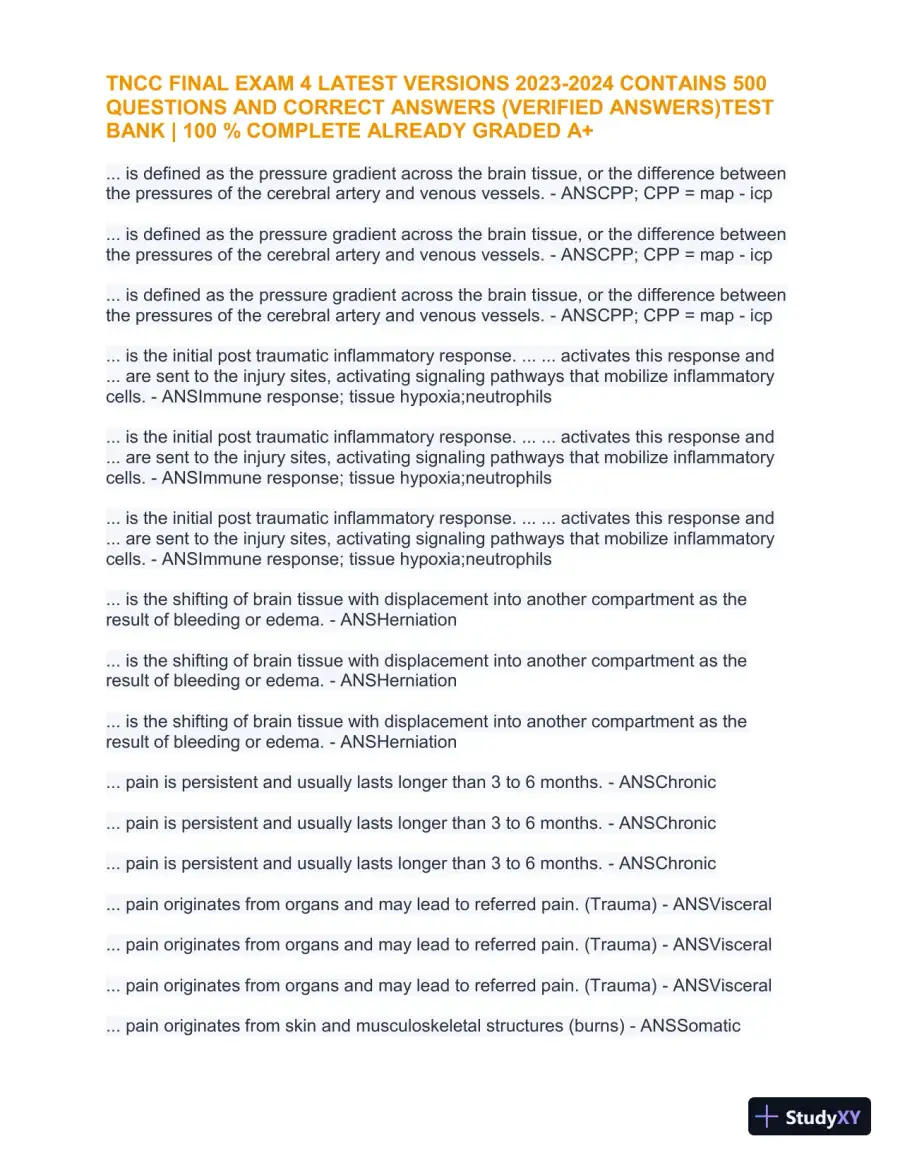 TNCC FINAL EXAM 4 LATEST VERSIONS 2023-2024 CONTAINS 500QUESTIONS AND CORRECT ANSWERS (VERIFIED ANSWERS)TESTBANK | 100 % COMPLETE ALREADY GRADED A+... is defined as the pressure gradient across the brain tissue, or the difference betweenthe pressures of the cerebral artery and venous vessels. - ANSCPP; CPP = map - icp... is defined as the pressure gradient across the brain tissue, or the difference betweenthe pressures of the cerebral artery and venous vessels. - ANSCPP; CPP = map - icp... is defined as the pressure gradient across the brain tissue, or the difference betweenthe pressures of the cerebral artery and venous vessels. - ANSCPP; CPP = map - icp... is the initial post traumatic inflammatory response. ... ... activates this response and... are sent to the injury sites, activating signaling pathways that mobilize inflammatorycells. - ANSImmune response; tissue hypoxia;neutrophils... is the initial post traumatic inflammatory response. ... ... activates this response and... are sent to the injury sites, activating signaling pathways that mobilize inflammatorycells. - ANSImmune response; tissue hypoxia;neutrophils... is the initial post traumatic inflammatory response. ... ... activates this response and... are sent to the injury sites, activating signaling pathways that mobilize inflammatorycells. - ANSImmune response; tissue hypoxia;neutrophils... is the shifting of brain tissue with displacement into another compartment as theresult of bleeding or edema. - ANSHerniation... is the shifting of brain tissue with displacement into another compartment as theresult of bleeding or edema. - ANSHerniation... is the shifting of brain tissue with displacement into another compartment as theresult of bleeding or edema. - ANSHerniation... pain is persistent and usually lasts longer than 3 to 6 months. - ANSChronic... pain is persistent and usually lasts longer than 3 to 6 months. - ANSChronic... pain is persistent and usually lasts longer than 3 to 6 months. - ANSChronic... pain originates from organs and may lead to referred pain. (Trauma) - ANSVisceral... pain originates from organs and may lead to referred pain. (Trauma) - ANSVisceral... pain originates from organs and may lead to referred pain. (Trauma) - ANSVisceral... pain originates from skin and musculoskeletal structures (burns) - ANSSomatic
Page 31
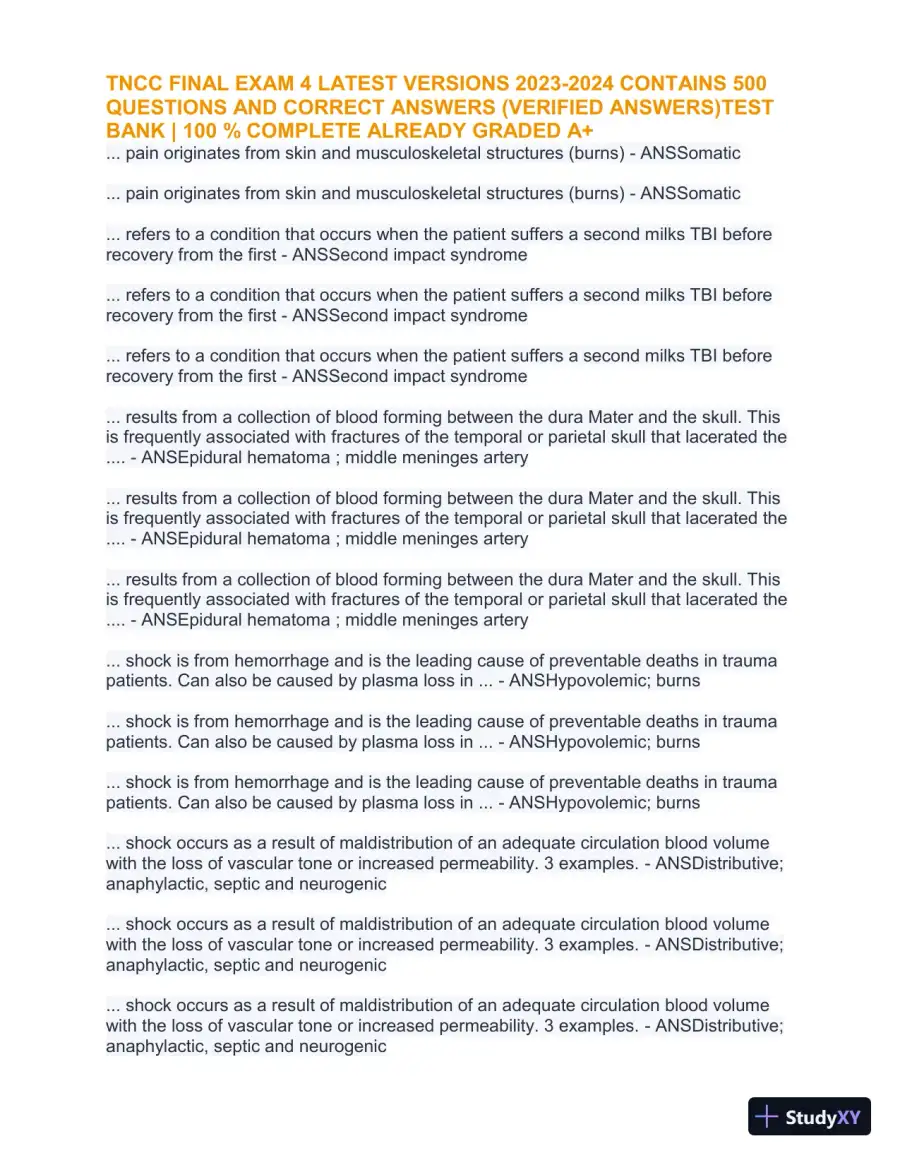 TNCC FINAL EXAM 4 LATEST VERSIONS 2023-2024 CONTAINS 500QUESTIONS AND CORRECT ANSWERS (VERIFIED ANSWERS)TESTBANK | 100 % COMPLETE ALREADY GRADED A+... pain originates from skin and musculoskeletal structures (burns) - ANSSomatic... pain originates from skin and musculoskeletal structures (burns) - ANSSomatic... refers to a condition that occurs when the patient suffers a second milks TBI beforerecovery from the first - ANSSecond impact syndrome... refers to a condition that occurs when the patient suffers a second milks TBI beforerecovery from the first - ANSSecond impact syndrome... refers to a condition that occurs when the patient suffers a second milks TBI beforerecovery from the first - ANSSecond impact syndrome... results from a collection of blood forming between the dura Mater and the skull. Thisis frequently associated with fractures of the temporal or parietal skull that lacerated the.... - ANSEpidural hematoma ; middle meninges artery... results from a collection of blood forming between the dura Mater and the skull. Thisis frequently associated with fractures of the temporal or parietal skull that lacerated the.... - ANSEpidural hematoma ; middle meninges artery... results from a collection of blood forming between the dura Mater and the skull. Thisis frequently associated with fractures of the temporal or parietal skull that lacerated the.... - ANSEpidural hematoma ; middle meninges artery... shock is from hemorrhage and is the leading cause of preventable deaths in traumapatients. Can also be caused by plasma loss in ... - ANSHypovolemic; burns... shock is from hemorrhage and is the leading cause of preventable deaths in traumapatients. Can also be caused by plasma loss in ... - ANSHypovolemic; burns... shock is from hemorrhage and is the leading cause of preventable deaths in traumapatients. Can also be caused by plasma loss in ... - ANSHypovolemic; burns... shock occurs as a result of maldistribution of an adequate circulation blood volumewith the loss of vascular tone or increased permeability. 3 examples. - ANSDistributive;anaphylactic, septic and neurogenic... shock occurs as a result of maldistribution of an adequate circulation blood volumewith the loss of vascular tone or increased permeability. 3 examples. - ANSDistributive;anaphylactic, septic and neurogenic... shock occurs as a result of maldistribution of an adequate circulation blood volumewith the loss of vascular tone or increased permeability. 3 examples. - ANSDistributive;anaphylactic, septic and neurogenic
165 more pages in the full document
Unlock it once and it stays in your library, ready to chat with or turn into flashcards.
Unlock the full documentMore Trauma Nursing Core Course study materials
See all Past Exams
2024 TNCC Nursing Process with Answers (17 Solved Questions)
Trauma Nursing Core Course
2 pages144downloadsFeb 2025 Past Exams
2023-2024 TNCC Final Practice Exam 4 with Answers (49 Solved Questions)
Trauma Nursing Core Course
11 pages123downloadsFeb 2025 Past Exams
TNCC Trauma Nursing Core Course 11th Edition ENA Test with Answers (220 Solved Questions)
Trauma Nursing Core Course
53 pages106downloadsFeb 2025 Past Exams
2024-2025 TNCC: Trauma Nursing Process with Answers (71 Solved Questions)
Trauma Nursing Core Course
11 pages84downloadsFeb 2025 Past Exams
TNCC 10th Edition Practice Exam 3 Version A and B with Answers (740 Solved Questions)
Trauma Nursing Core Course
124 pages77downloadsFeb 2025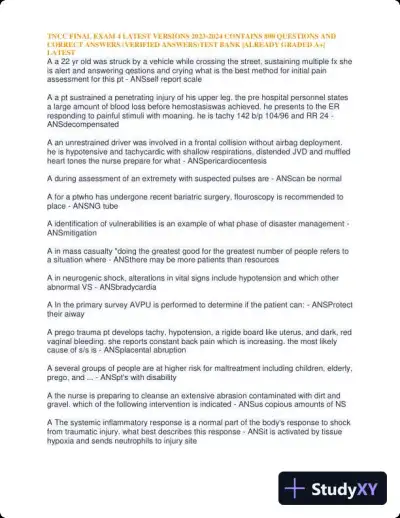 Past Exams
2023-2024 TNCC Final Exam 4 with Answers (1343 Solved Questions)
Trauma Nursing Core Course
196 pages76downloadsFeb 2025 Past Exams
2023-2024 TNCC Final Exam with Answers (48 Solved Questions)
Trauma Nursing Core Course
11 pages40downloadsFeb 2025 Past Exams
2023-2024 TNCC 9th Edition with Answers (498 Solved Questions)
Trauma Nursing Core Course
100 pagesMay 2025
Study this document with CramX
Once it is in your library, every tool can work from it.