
Past Exams
TNCC 10th Edition Practice Exam 3 Version A and B with Answers (740 Solved Questions)
- Trauma Nursing Core Course
- 124 pages
- Shared February 2025
- 77 downloads
Master your subject with TNCC 10th Edition Practice Exam 3 Version A and B with Answers, designed to simulate real exams.
Preview · 31 of 124 pages
100%
Page 1
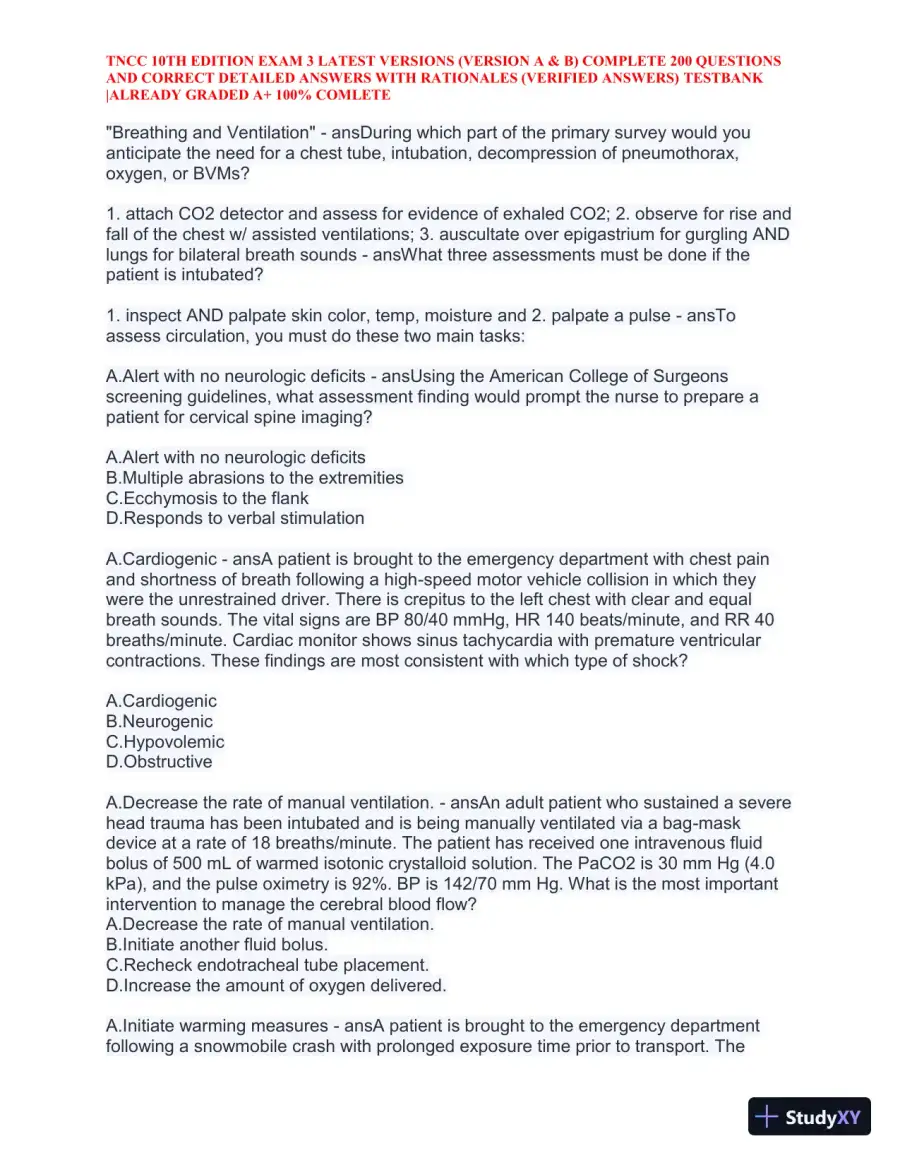 TNCC 10TH EDITION EXAM 3 LATEST VERSIONS (VERSION A & B) COMPLETE 200 QUESTIONSAND CORRECT DETAILED ANSWERS WITH RATIONALES (VERIFIED ANSWERS) TESTBANK|ALREADY GRADED A+ 100% COMLETE"Breathing and Ventilation" - ansDuring which part of the primary survey would youanticipate the need for a chest tube, intubation, decompression of pneumothorax,oxygen, or BVMs?1. attach CO2 detector and assess for evidence of exhaled CO2; 2. observe for rise andfall of the chest w/ assisted ventilations; 3. auscultate over epigastrium for gurgling ANDlungs for bilateral breath sounds - ansWhat three assessments must be done if thepatient is intubated?1. inspect AND palpate skin color, temp, moisture and 2. palpate a pulse - ansToassess circulation, you must do these two main tasks:A.Alert with no neurologic deficits - ansUsing the American College of Surgeonsscreening guidelines, what assessment finding would prompt the nurse to prepare apatient for cervical spine imaging?A.Alert with no neurologic deficitsB.Multiple abrasions to the extremitiesC.Ecchymosis to the flankD.Responds to verbal stimulationA.Cardiogenic - ansA patient is brought to the emergency department with chest painand shortness of breath following a high-speed motor vehicle collision in which theywere the unrestrained driver. There is crepitus to the left chest with clear and equalbreath sounds. The vital signs are BP 80/40 mmHg, HR 140 beats/minute, and RR 40breaths/minute. Cardiac monitor shows sinus tachycardia with premature ventricularcontractions. These findings are most consistent with which type of shock?A.CardiogenicB.NeurogenicC.HypovolemicD.ObstructiveA.Decrease the rate of manual ventilation. - ansAn adult patient who sustained a severehead trauma has been intubated and is being manually ventilated via a bag-maskdevice at a rate of 18 breaths/minute. The patient has received one intravenous fluidbolus of 500 mL of warmed isotonic crystalloid solution. The PaCO2 is 30 mm Hg (4.0kPa), and the pulse oximetry is 92%. BP is 142/70 mm Hg. What is the most importantintervention to manage the cerebral blood flow?A.Decrease the rate of manual ventilation.B.Initiate another fluid bolus.C.Recheck endotracheal tube placement.D.Increase the amount of oxygen delivered.A.Initiate warming measures - ansA patient is brought to the emergency departmentfollowing a snowmobile crash with prolonged exposure time prior to transport. The
Page 2

Page 3
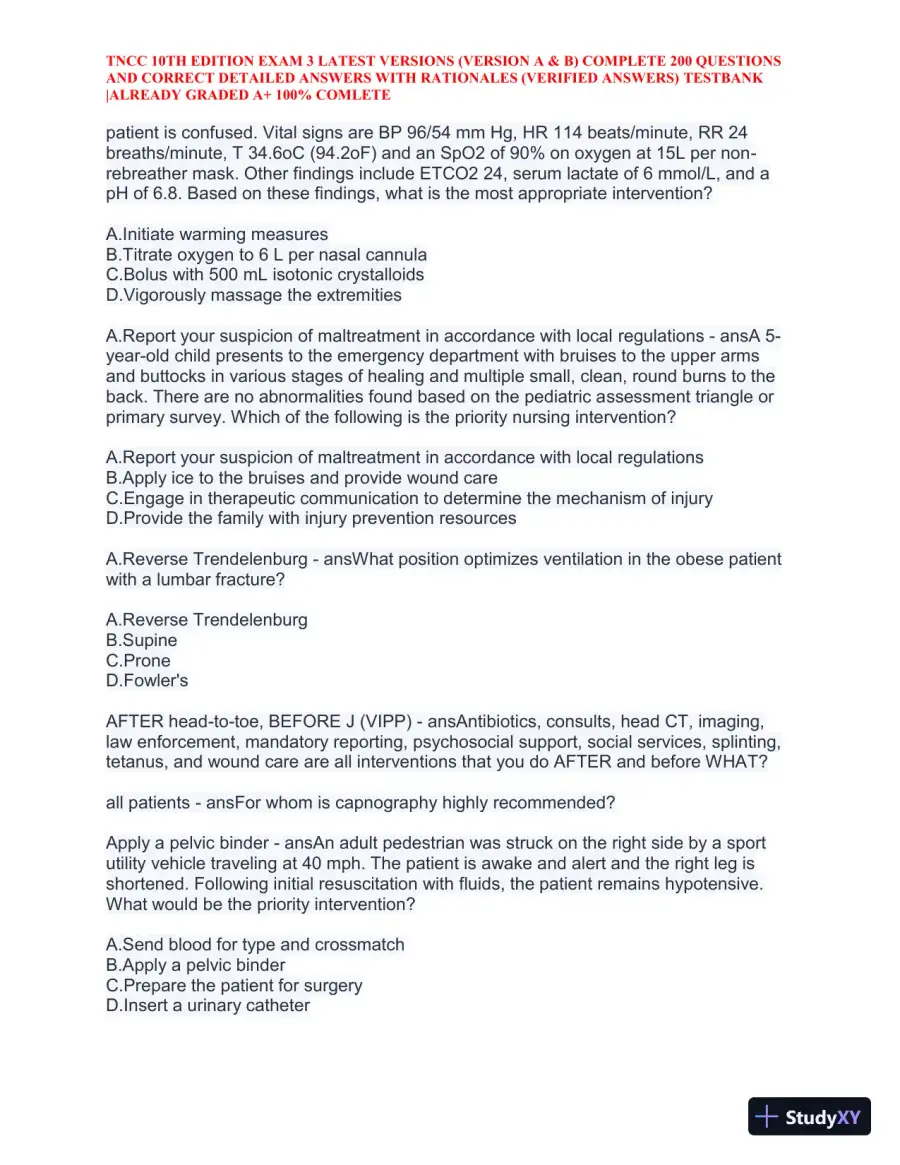 TNCC 10TH EDITION EXAM 3 LATEST VERSIONS (VERSION A & B) COMPLETE 200 QUESTIONSAND CORRECT DETAILED ANSWERS WITH RATIONALES (VERIFIED ANSWERS) TESTBANK|ALREADY GRADED A+ 100% COMLETEpatient is confused. Vital signs are BP 96/54 mm Hg, HR 114 beats/minute, RR 24breaths/minute, T 34.6oC (94.2oF) and an SpO2 of 90% on oxygen at 15L per non-rebreather mask. Other findings include ETCO2 24, serum lactate of 6 mmol/L, and apH of 6.8. Based on these findings, what is the most appropriate intervention?A.Initiate warming measuresB.Titrate oxygen to 6 L per nasal cannulaC.Bolus with 500 mL isotonic crystalloidsD.Vigorously massage the extremitiesA.Report your suspicion of maltreatment in accordance with local regulations - ansA 5-year-old child presents to the emergency department with bruises to the upper armsand buttocks in various stages of healing and multiple small, clean, round burns to theback. There are no abnormalities found based on the pediatric assessment triangle orprimary survey. Which of the following is the priority nursing intervention?A.Report your suspicion of maltreatment in accordance with local regulationsB.Apply ice to the bruises and provide wound careC.Engage in therapeutic communication to determine the mechanism of injuryD.Provide the family with injury prevention resourcesA.Reverse Trendelenburg - ansWhat position optimizes ventilation in the obese patientwith a lumbar fracture?A.Reverse TrendelenburgB.SupineC.ProneD.Fowler'sAFTER head-to-toe, BEFORE J (VIPP) - ansAntibiotics, consults, head CT, imaging,law enforcement, mandatory reporting, psychosocial support, social services, splinting,tetanus, and wound care are all interventions that you do AFTER and before WHAT?all patients - ansFor whom is capnography highly recommended?Apply a pelvic binder - ansAn adult pedestrian was struck on the right side by a sportutility vehicle traveling at 40 mph. The patient is awake and alert and the right leg isshortened. Following initial resuscitation with fluids, the patient remains hypotensive.What would be the priority intervention?A.Send blood for type and crossmatchB.Apply a pelvic binderC.Prepare the patient for surgeryD.Insert a urinary catheter
Page 4
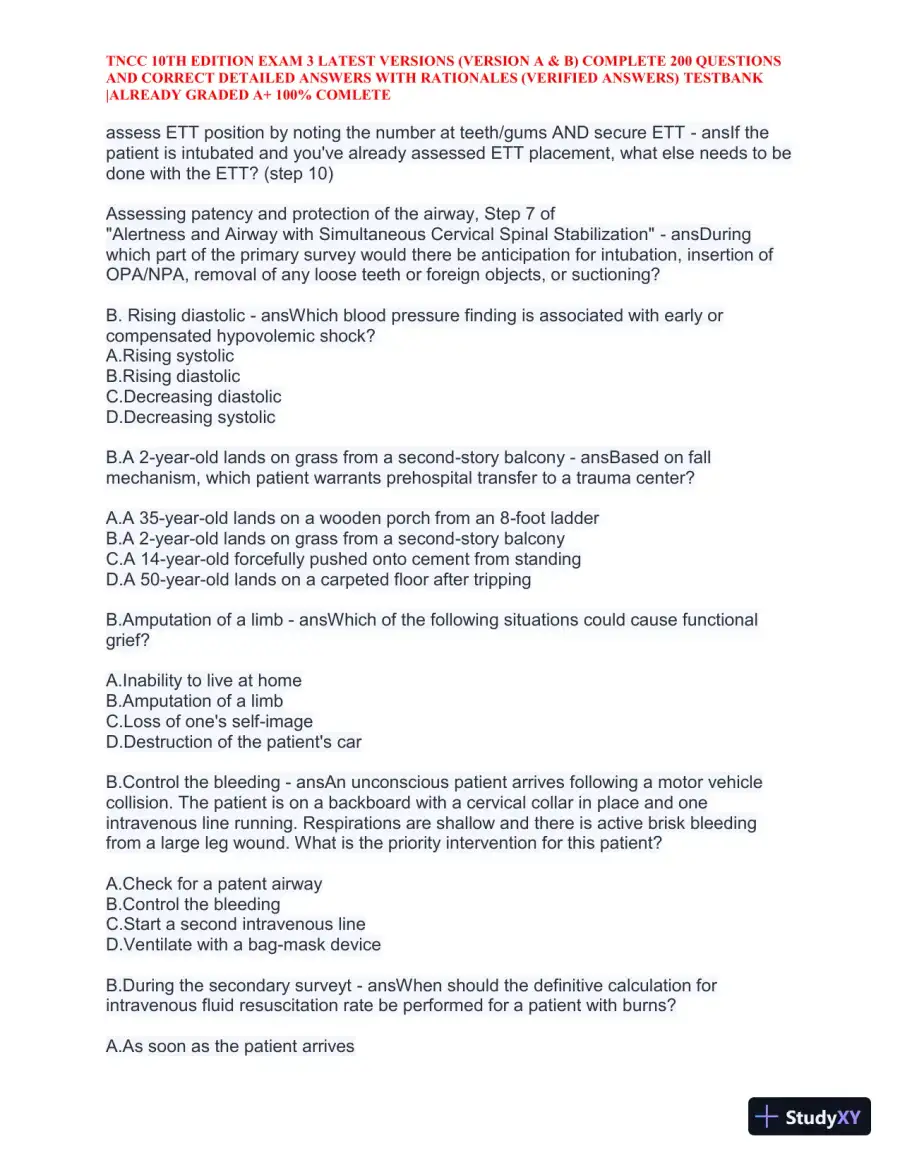 TNCC 10TH EDITION EXAM 3 LATEST VERSIONS (VERSION A & B) COMPLETE 200 QUESTIONSAND CORRECT DETAILED ANSWERS WITH RATIONALES (VERIFIED ANSWERS) TESTBANK|ALREADY GRADED A+ 100% COMLETEassess ETT position by noting the number at teeth/gums AND secure ETT - ansIf thepatient is intubated and you've already assessed ETT placement, what else needs to bedone with the ETT? (step 10)Assessing patency and protection of the airway, Step 7 of"Alertness and Airway with Simultaneous Cervical Spinal Stabilization" - ansDuringwhich part of the primary survey would there be anticipation for intubation, insertion ofOPA/NPA, removal of any loose teeth or foreign objects, or suctioning?B. Rising diastolic - ansWhich blood pressure finding is associated with early orcompensated hypovolemic shock?A.Rising systolicB.Rising diastolicC.Decreasing diastolicD.Decreasing systolicB.A 2-year-old lands on grass from a second-story balcony - ansBased on fallmechanism, which patient warrants prehospital transfer to a trauma center?A.A 35-year-old lands on a wooden porch from an 8-foot ladderB.A 2-year-old lands on grass from a second-story balconyC.A 14-year-old forcefully pushed onto cement from standingD.A 50-year-old lands on a carpeted floor after trippingB.Amputation of a limb - ansWhich of the following situations could cause functionalgrief?A.Inability to live at homeB.Amputation of a limbC.Loss of one's self-imageD.Destruction of the patient's carB.Control the bleeding - ansAn unconscious patient arrives following a motor vehiclecollision. The patient is on a backboard with a cervical collar in place and oneintravenous line running. Respirations are shallow and there is active brisk bleedingfrom a large leg wound. What is the priority intervention for this patient?A.Check for a patent airwayB.Control the bleedingC.Start a second intravenous lineD.Ventilate with a bag-mask deviceB.During the secondary surveyt - ansWhen should the definitive calculation forintravenous fluid resuscitation rate be performed for a patient with burns?A.As soon as the patient arrives
Page 5
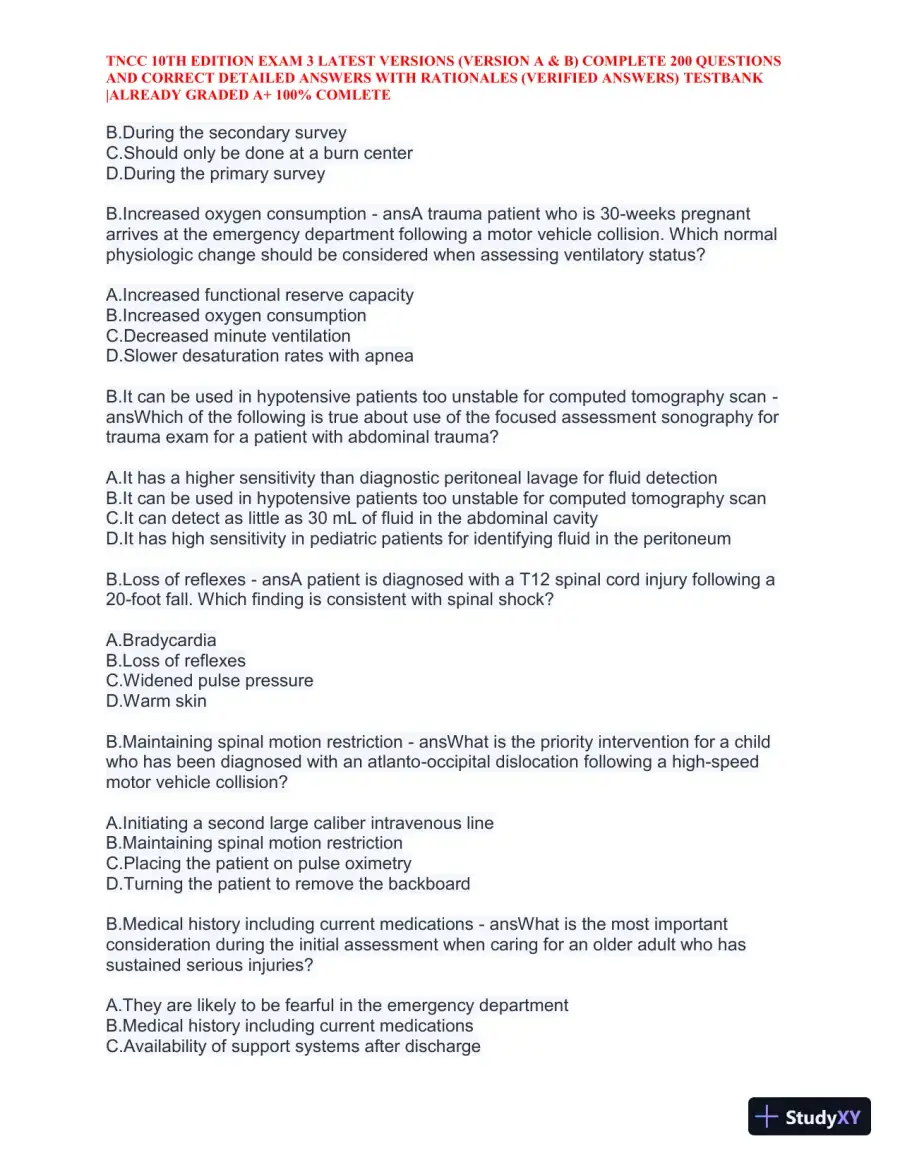 TNCC 10TH EDITION EXAM 3 LATEST VERSIONS (VERSION A & B) COMPLETE 200 QUESTIONSAND CORRECT DETAILED ANSWERS WITH RATIONALES (VERIFIED ANSWERS) TESTBANK|ALREADY GRADED A+ 100% COMLETEB.During the secondary surveyC.Should only be done at a burn centerD.During the primary surveyB.Increased oxygen consumption - ansA trauma patient who is 30-weeks pregnantarrives at the emergency department following a motor vehicle collision. Which normalphysiologic change should be considered when assessing ventilatory status?A.Increased functional reserve capacityB.Increased oxygen consumptionC.Decreased minute ventilationD.Slower desaturation rates with apneaB.It can be used in hypotensive patients too unstable for computed tomography scan -ansWhich of the following is true about use of the focused assessment sonography fortrauma exam for a patient with abdominal trauma?A.It has a higher sensitivity than diagnostic peritoneal lavage for fluid detectionB.It can be used in hypotensive patients too unstable for computed tomography scanC.It can detect as little as 30 mL of fluid in the abdominal cavityD.It has high sensitivity in pediatric patients for identifying fluid in the peritoneumB.Loss of reflexes - ansA patient is diagnosed with a T12 spinal cord injury following a20-foot fall. Which finding is consistent with spinal shock?A.BradycardiaB.Loss of reflexesC.Widened pulse pressureD.Warm skinB.Maintaining spinal motion restriction - ansWhat is the priority intervention for a childwho has been diagnosed with an atlanto-occipital dislocation following a high-speedmotor vehicle collision?A.Initiating a second large caliber intravenous lineB.Maintaining spinal motion restrictionC.Placing the patient on pulse oximetryD.Turning the patient to remove the backboardB.Medical history including current medications - ansWhat is the most importantconsideration during the initial assessment when caring for an older adult who hassustained serious injuries?A.They are likely to be fearful in the emergency departmentB.Medical history including current medicationsC.Availability of support systems after discharge
Page 6
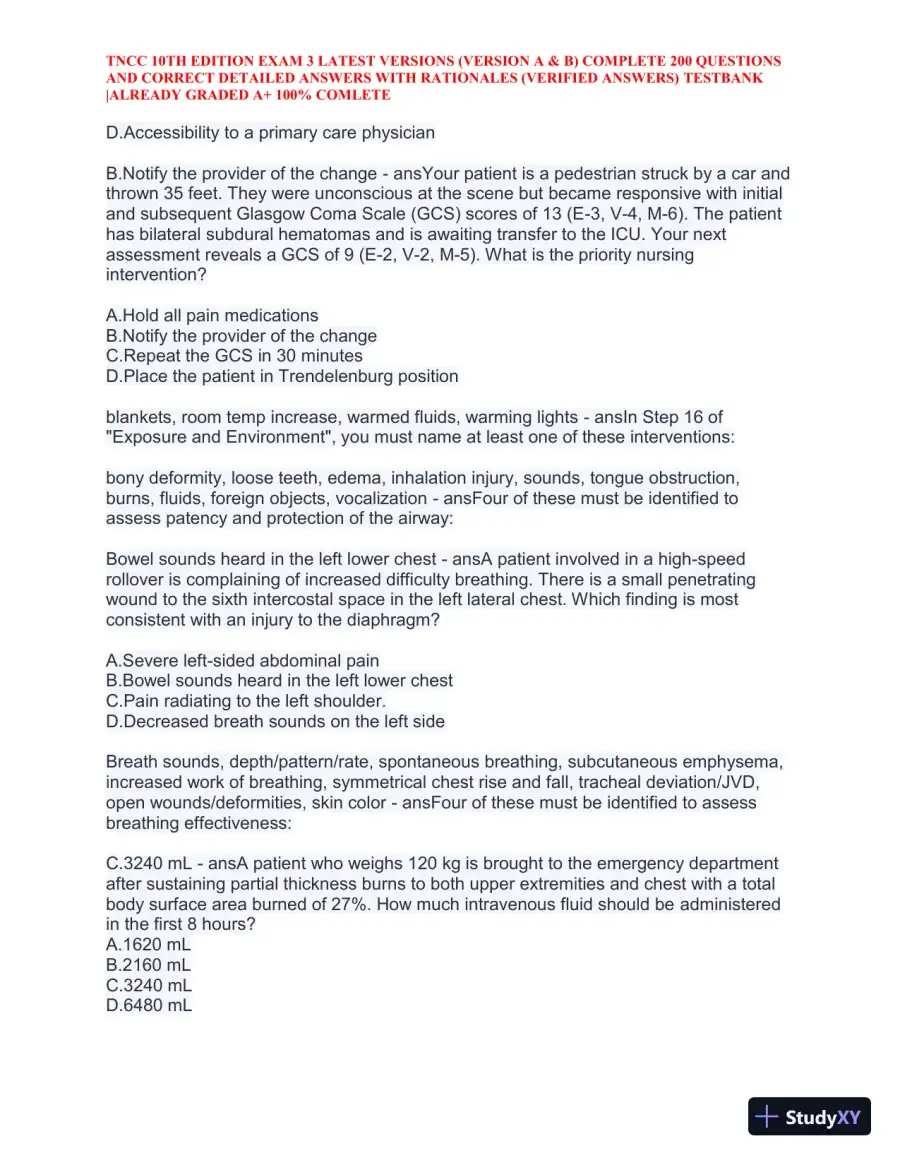 TNCC 10TH EDITION EXAM 3 LATEST VERSIONS (VERSION A & B) COMPLETE 200 QUESTIONSAND CORRECT DETAILED ANSWERS WITH RATIONALES (VERIFIED ANSWERS) TESTBANK|ALREADY GRADED A+ 100% COMLETED.Accessibility to a primary care physicianB.Notify the provider of the change - ansYour patient is a pedestrian struck by a car andthrown 35 feet. They were unconscious at the scene but became responsive with initialand subsequent Glasgow Coma Scale (GCS) scores of 13 (E-3, V-4, M-6). The patienthas bilateral subdural hematomas and is awaiting transfer to the ICU. Your nextassessment reveals a GCS of 9 (E-2, V-2, M-5). What is the priority nursingintervention?A.Hold all pain medicationsB.Notify the provider of the changeC.Repeat the GCS in 30 minutesD.Place the patient in Trendelenburg positionblankets, room temp increase, warmed fluids, warming lights - ansIn Step 16 of"Exposure and Environment", you must name at least one of these interventions:bony deformity, loose teeth, edema, inhalation injury, sounds, tongue obstruction,burns, fluids, foreign objects, vocalization - ansFour of these must be identified toassess patency and protection of the airway:Bowel sounds heard in the left lower chest - ansA patient involved in a high-speedrollover is complaining of increased difficulty breathing. There is a small penetratingwound to the sixth intercostal space in the left lateral chest. Which finding is mostconsistent with an injury to the diaphragm?A.Severe left-sided abdominal painB.Bowel sounds heard in the left lower chestC.Pain radiating to the left shoulder.D.Decreased breath sounds on the left sideBreath sounds, depth/pattern/rate, spontaneous breathing, subcutaneous emphysema,increased work of breathing, symmetrical chest rise and fall, tracheal deviation/JVD,open wounds/deformities, skin color - ansFour of these must be identified to assessbreathing effectiveness:C.3240 mL - ansA patient who weighs 120 kg is brought to the emergency departmentafter sustaining partial thickness burns to both upper extremities and chest with a totalbody surface area burned of 27%. How much intravenous fluid should be administeredin the first 8 hours?A.1620 mLB.2160 mLC.3240 mLD.6480 mL
Page 7
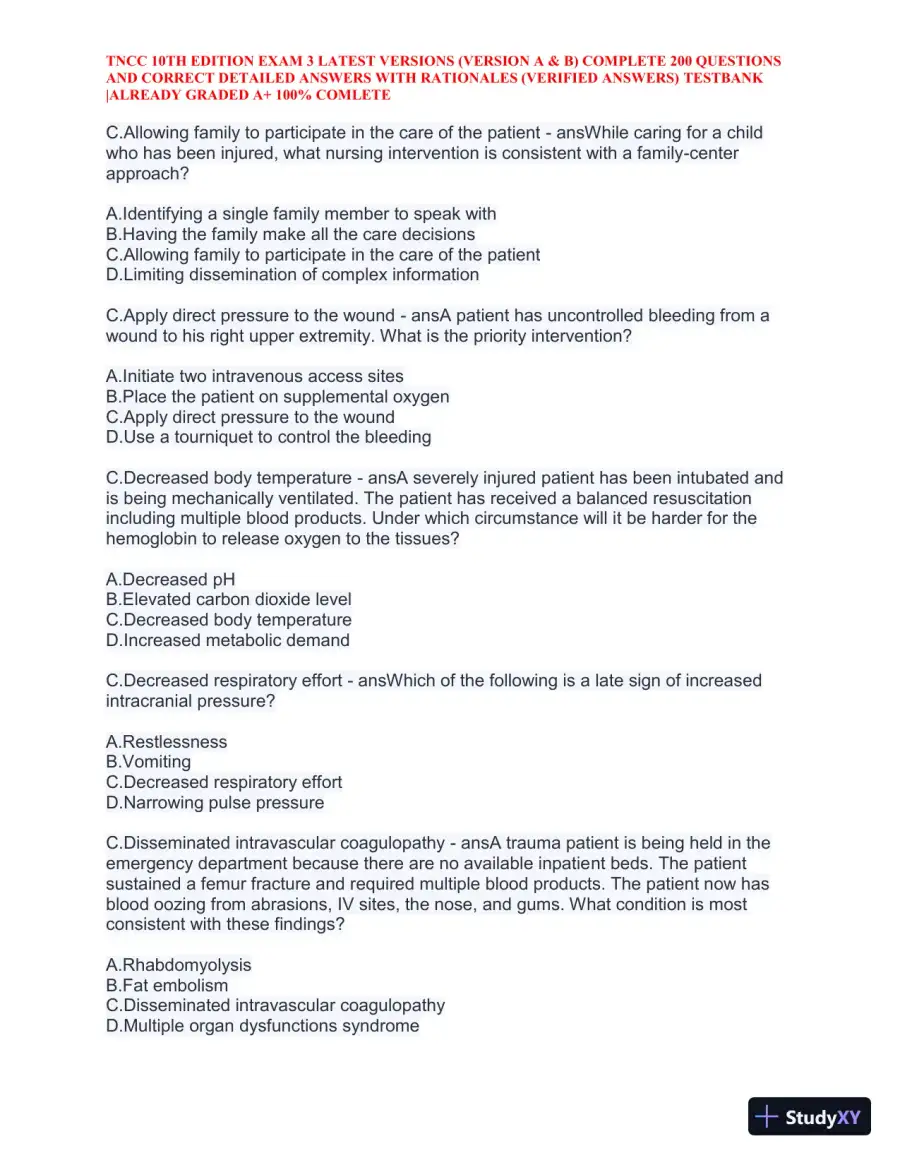 TNCC 10TH EDITION EXAM 3 LATEST VERSIONS (VERSION A & B) COMPLETE 200 QUESTIONSAND CORRECT DETAILED ANSWERS WITH RATIONALES (VERIFIED ANSWERS) TESTBANK|ALREADY GRADED A+ 100% COMLETEC.Allowing family to participate in the care of the patient - ansWhile caring for a childwho has been injured, what nursing intervention is consistent with a family-centerapproach?A.Identifying a single family member to speak withB.Having the family make all the care decisionsC.Allowing family to participate in the care of the patientD.Limiting dissemination of complex informationC.Apply direct pressure to the wound - ansA patient has uncontrolled bleeding from awound to his right upper extremity. What is the priority intervention?A.Initiate two intravenous access sitesB.Place the patient on supplemental oxygenC.Apply direct pressure to the woundD.Use a tourniquet to control the bleedingC.Decreased body temperature - ansA severely injured patient has been intubated andis being mechanically ventilated. The patient has received a balanced resuscitationincluding multiple blood products. Under which circumstance will it be harder for thehemoglobin to release oxygen to the tissues?A.Decreased pHB.Elevated carbon dioxide levelC.Decreased body temperatureD.Increased metabolic demandC.Decreased respiratory effort - ansWhich of the following is a late sign of increasedintracranial pressure?A.RestlessnessB.VomitingC.Decreased respiratory effortD.Narrowing pulse pressureC.Disseminated intravascular coagulopathy - ansA trauma patient is being held in theemergency department because there are no available inpatient beds. The patientsustained a femur fracture and required multiple blood products. The patient now hasblood oozing from abrasions, IV sites, the nose, and gums. What condition is mostconsistent with these findings?A.RhabdomyolysisB.Fat embolismC.Disseminated intravascular coagulopathyD.Multiple organ dysfunctions syndrome
Page 8
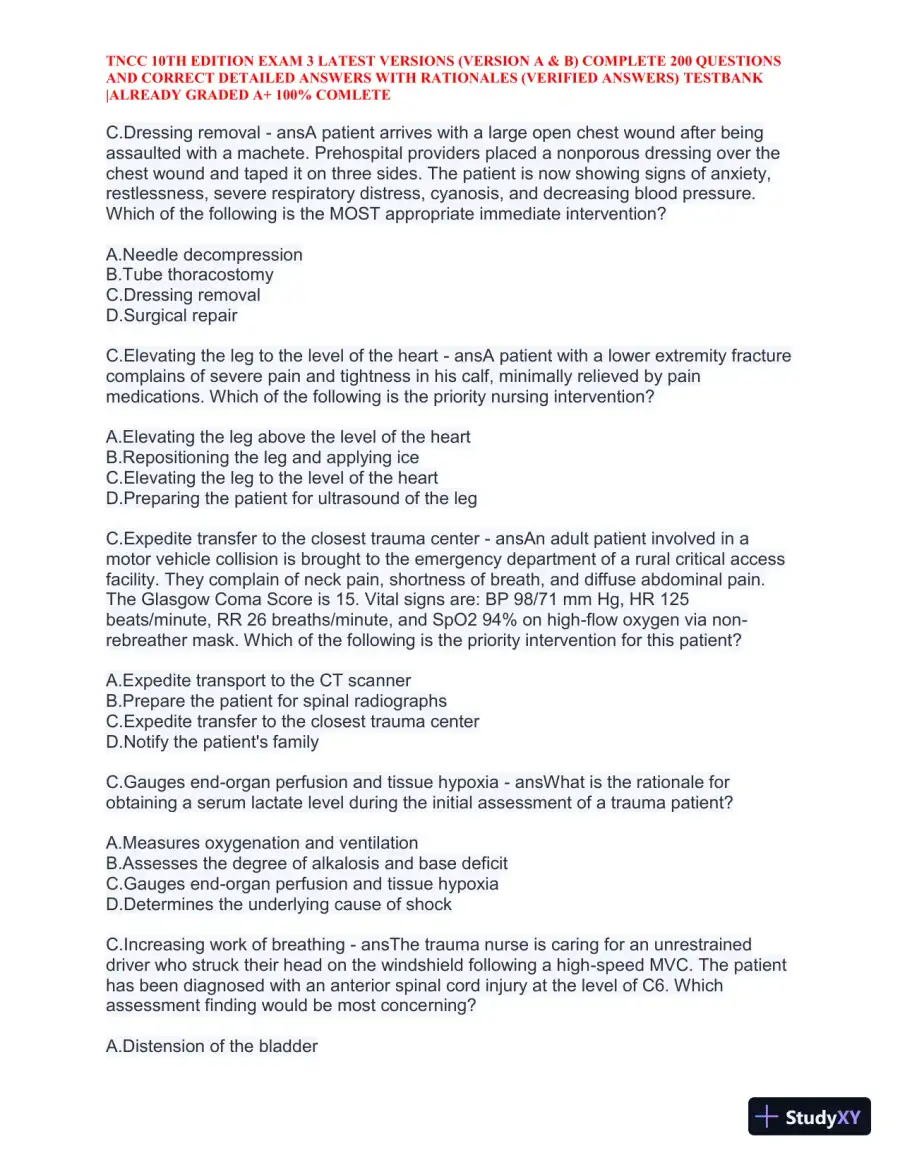 TNCC 10TH EDITION EXAM 3 LATEST VERSIONS (VERSION A & B) COMPLETE 200 QUESTIONSAND CORRECT DETAILED ANSWERS WITH RATIONALES (VERIFIED ANSWERS) TESTBANK|ALREADY GRADED A+ 100% COMLETEC.Dressing removal - ansA patient arrives with a large open chest wound after beingassaulted with a machete. Prehospital providers placed a nonporous dressing over thechest wound and taped it on three sides. The patient is now showing signs of anxiety,restlessness, severe respiratory distress, cyanosis, and decreasing blood pressure.Which of the following is the MOST appropriate immediate intervention?A.Needle decompressionB.Tube thoracostomyC.Dressing removalD.Surgical repairC.Elevating the leg to the level of the heart - ansA patient with a lower extremity fracturecomplains of severe pain and tightness in his calf, minimally relieved by painmedications. Which of the following is the priority nursing intervention?A.Elevating the leg above the level of the heartB.Repositioning the leg and applying iceC.Elevating the leg to the level of the heartD.Preparing the patient for ultrasound of the legC.Expedite transfer to the closest trauma center - ansAn adult patient involved in amotor vehicle collision is brought to the emergency department of a rural critical accessfacility. They complain of neck pain, shortness of breath, and diffuse abdominal pain.The Glasgow Coma Score is 15. Vital signs are: BP 98/71 mm Hg, HR 125beats/minute, RR 26 breaths/minute, and SpO2 94% on high-flow oxygen via non-rebreather mask. Which of the following is the priority intervention for this patient?A.Expedite transport to the CT scannerB.Prepare the patient for spinal radiographsC.Expedite transfer to the closest trauma centerD.Notify the patient's familyC.Gauges end-organ perfusion and tissue hypoxia - ansWhat is the rationale forobtaining a serum lactate level during the initial assessment of a trauma patient?A.Measures oxygenation and ventilationB.Assesses the degree of alkalosis and base deficitC.Gauges end-organ perfusion and tissue hypoxiaD.Determines the underlying cause of shockC.Increasing work of breathing - ansThe trauma nurse is caring for an unrestraineddriver who struck their head on the windshield following a high-speed MVC. The patienthas been diagnosed with an anterior spinal cord injury at the level of C6. Whichassessment finding would be most concerning?A.Distension of the bladder
Page 9
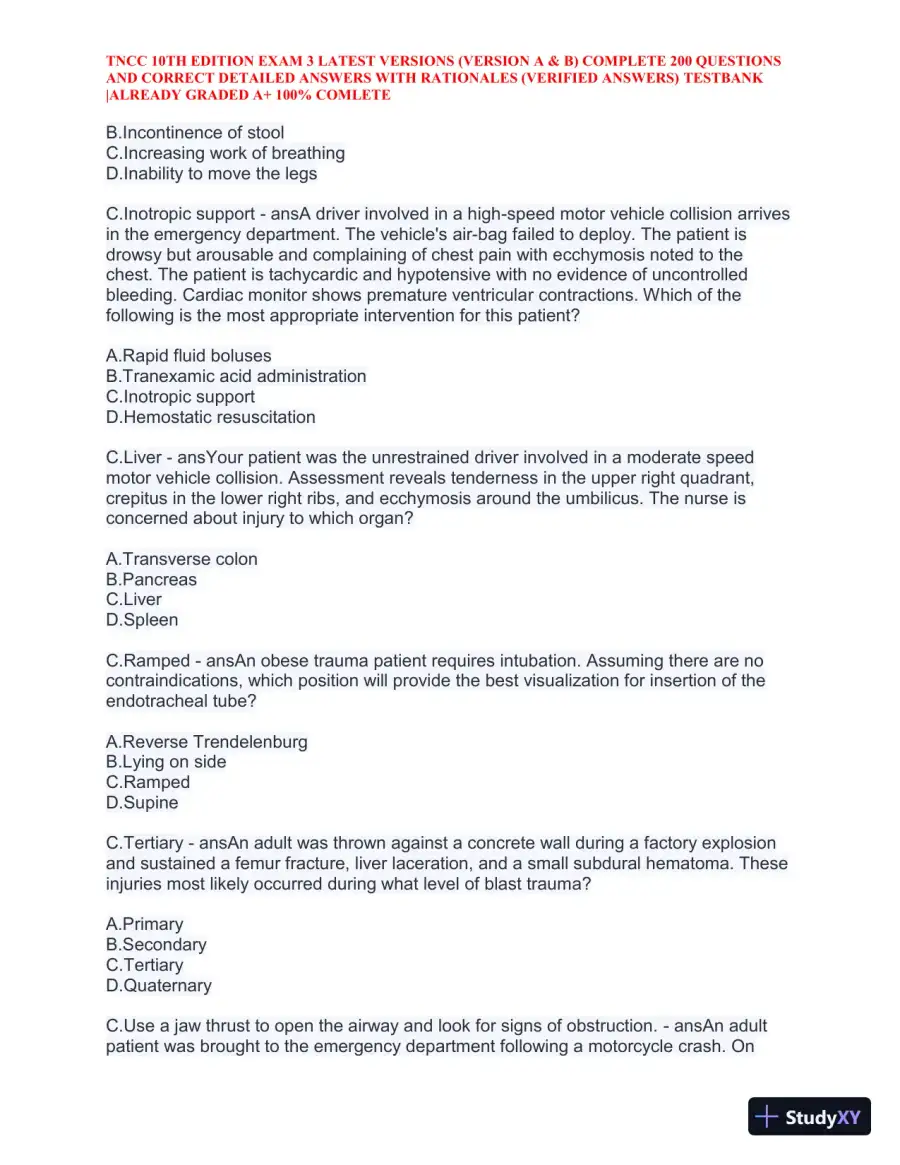 TNCC 10TH EDITION EXAM 3 LATEST VERSIONS (VERSION A & B) COMPLETE 200 QUESTIONSAND CORRECT DETAILED ANSWERS WITH RATIONALES (VERIFIED ANSWERS) TESTBANK|ALREADY GRADED A+ 100% COMLETEB.Incontinence of stoolC.Increasing work of breathingD.Inability to move the legsC.Inotropic support - ansA driver involved in a high-speed motor vehicle collision arrivesin the emergency department. The vehicle's air-bag failed to deploy. The patient isdrowsy but arousable and complaining of chest pain with ecchymosis noted to thechest. The patient is tachycardic and hypotensive with no evidence of uncontrolledbleeding. Cardiac monitor shows premature ventricular contractions. Which of thefollowing is the most appropriate intervention for this patient?A.Rapid fluid bolusesB.Tranexamic acid administrationC.Inotropic supportD.Hemostatic resuscitationC.Liver - ansYour patient was the unrestrained driver involved in a moderate speedmotor vehicle collision. Assessment reveals tenderness in the upper right quadrant,crepitus in the lower right ribs, and ecchymosis around the umbilicus. The nurse isconcerned about injury to which organ?A.Transverse colonB.PancreasC.LiverD.SpleenC.Ramped - ansAn obese trauma patient requires intubation. Assuming there are nocontraindications, which position will provide the best visualization for insertion of theendotracheal tube?A.Reverse TrendelenburgB.Lying on sideC.RampedD.SupineC.Tertiary - ansAn adult was thrown against a concrete wall during a factory explosionand sustained a femur fracture, liver laceration, and a small subdural hematoma. Theseinjuries most likely occurred during what level of blast trauma?A.PrimaryB.SecondaryC.TertiaryD.QuaternaryC.Use a jaw thrust to open the airway and look for signs of obstruction. - ansAn adultpatient was brought to the emergency department following a motorcycle crash. On
Page 10
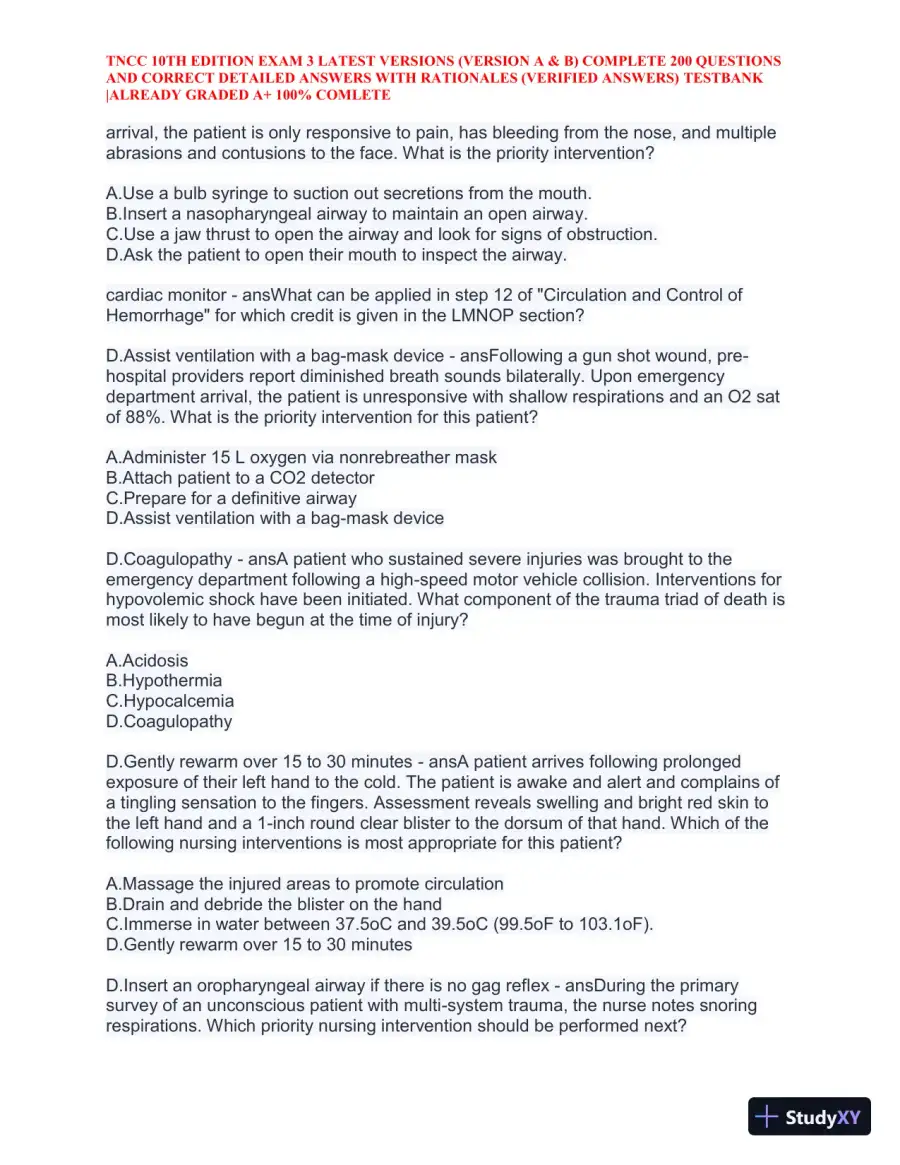 TNCC 10TH EDITION EXAM 3 LATEST VERSIONS (VERSION A & B) COMPLETE 200 QUESTIONSAND CORRECT DETAILED ANSWERS WITH RATIONALES (VERIFIED ANSWERS) TESTBANK|ALREADY GRADED A+ 100% COMLETEarrival, the patient is only responsive to pain, has bleeding from the nose, and multipleabrasions and contusions to the face. What is the priority intervention?A.Use a bulb syringe to suction out secretions from the mouth.B.Insert a nasopharyngeal airway to maintain an open airway.C.Use a jaw thrust to open the airway and look for signs of obstruction.D.Ask the patient to open their mouth to inspect the airway.cardiac monitor - ansWhat can be applied in step 12 of "Circulation and Control ofHemorrhage" for which credit is given in the LMNOP section?D.Assist ventilation with a bag-mask device - ansFollowing a gun shot wound, pre-hospital providers report diminished breath sounds bilaterally. Upon emergencydepartment arrival, the patient is unresponsive with shallow respirations and an O2 satof 88%. What is the priority intervention for this patient?A.Administer 15 L oxygen via nonrebreather maskB.Attach patient to a CO2 detectorC.Prepare for a definitive airwayD.Assist ventilation with a bag-mask deviceD.Coagulopathy - ansA patient who sustained severe injuries was brought to theemergency department following a high-speed motor vehicle collision. Interventions forhypovolemic shock have been initiated. What component of the trauma triad of death ismost likely to have begun at the time of injury?A.AcidosisB.HypothermiaC.HypocalcemiaD.CoagulopathyD.Gently rewarm over 15 to 30 minutes - ansA patient arrives following prolongedexposure of their left hand to the cold. The patient is awake and alert and complains ofa tingling sensation to the fingers. Assessment reveals swelling and bright red skin tothe left hand and a 1-inch round clear blister to the dorsum of that hand. Which of thefollowing nursing interventions is most appropriate for this patient?A.Massage the injured areas to promote circulationB.Drain and debride the blister on the handC.Immerse in water between 37.5oC and 39.5oC (99.5oF to 103.1oF).D.Gently rewarm over 15 to 30 minutesD.Insert an oropharyngeal airway if there is no gag reflex - ansDuring the primarysurvey of an unconscious patient with multi-system trauma, the nurse notes snoringrespirations. Which priority nursing intervention should be performed next?
Page 11
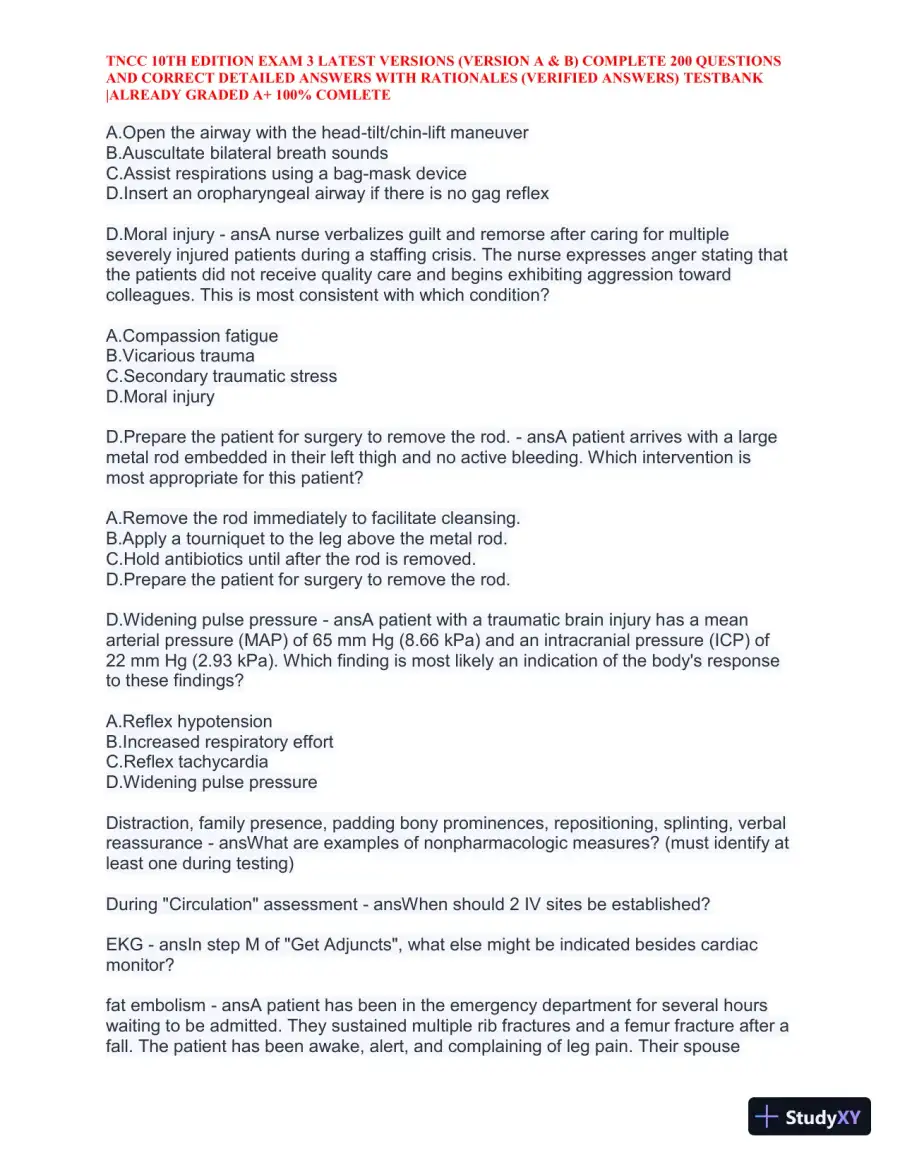 TNCC 10TH EDITION EXAM 3 LATEST VERSIONS (VERSION A & B) COMPLETE 200 QUESTIONSAND CORRECT DETAILED ANSWERS WITH RATIONALES (VERIFIED ANSWERS) TESTBANK|ALREADY GRADED A+ 100% COMLETEA.Open the airway with the head-tilt/chin-lift maneuverB.Auscultate bilateral breath soundsC.Assist respirations using a bag-mask deviceD.Insert an oropharyngeal airway if there is no gag reflexD.Moral injury - ansA nurse verbalizes guilt and remorse after caring for multipleseverely injured patients during a staffing crisis. The nurse expresses anger stating thatthe patients did not receive quality care and begins exhibiting aggression towardcolleagues. This is most consistent with which condition?A.Compassion fatigueB.Vicarious traumaC.Secondary traumatic stressD.Moral injuryD.Prepare the patient for surgery to remove the rod. - ansA patient arrives with a largemetal rod embedded in their left thigh and no active bleeding. Which intervention ismost appropriate for this patient?A.Remove the rod immediately to facilitate cleansing.B.Apply a tourniquet to the leg above the metal rod.C.Hold antibiotics until after the rod is removed.D.Prepare the patient for surgery to remove the rod.D.Widening pulse pressure - ansA patient with a traumatic brain injury has a meanarterial pressure (MAP) of 65 mm Hg (8.66 kPa) and an intracranial pressure (ICP) of22 mm Hg (2.93 kPa). Which finding is most likely an indication of the body's responseto these findings?A.Reflex hypotensionB.Increased respiratory effortC.Reflex tachycardiaD.Widening pulse pressureDistraction, family presence, padding bony prominences, repositioning, splinting, verbalreassurance - ansWhat are examples of nonpharmacologic measures? (must identify atleast one during testing)During "Circulation" assessment - ansWhen should 2 IV sites be established?EKG - ansIn step M of "Get Adjuncts", what else might be indicated besides cardiacmonitor?fat embolism - ansA patient has been in the emergency department for several hourswaiting to be admitted. They sustained multiple rib fractures and a femur fracture after afall. The patient has been awake, alert, and complaining of leg pain. Their spouse
Page 12
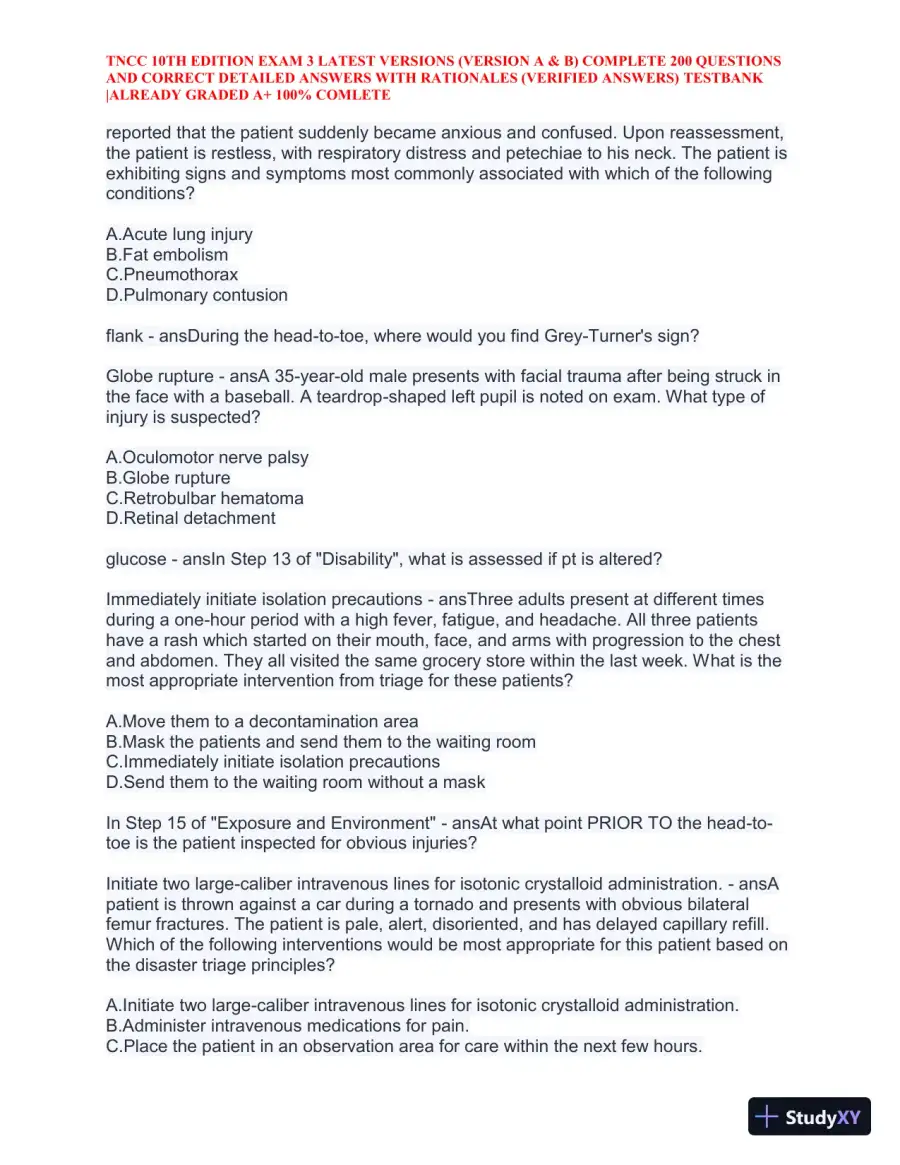 TNCC 10TH EDITION EXAM 3 LATEST VERSIONS (VERSION A & B) COMPLETE 200 QUESTIONSAND CORRECT DETAILED ANSWERS WITH RATIONALES (VERIFIED ANSWERS) TESTBANK|ALREADY GRADED A+ 100% COMLETEreported that the patient suddenly became anxious and confused. Upon reassessment,the patient is restless, with respiratory distress and petechiae to his neck. The patient isexhibiting signs and symptoms most commonly associated with which of the followingconditions?A.Acute lung injuryB.Fat embolismC.PneumothoraxD.Pulmonary contusionflank - ansDuring the head-to-toe, where would you find Grey-Turner's sign?Globe rupture - ansA 35-year-old male presents with facial trauma after being struck inthe face with a baseball. A teardrop-shaped left pupil is noted on exam. What type ofinjury is suspected?A.Oculomotor nerve palsyB.Globe ruptureC.Retrobulbar hematomaD.Retinal detachmentglucose - ansIn Step 13 of "Disability", what is assessed if pt is altered?Immediately initiate isolation precautions - ansThree adults present at different timesduring a one-hour period with a high fever, fatigue, and headache. All three patientshave a rash which started on their mouth, face, and arms with progression to the chestand abdomen. They all visited the same grocery store within the last week. What is themost appropriate intervention from triage for these patients?A.Move them to a decontamination areaB.Mask the patients and send them to the waiting roomC.Immediately initiate isolation precautionsD.Send them to the waiting room without a maskIn Step 15 of "Exposure and Environment" - ansAt what point PRIOR TO the head-to-toe is the patient inspected for obvious injuries?Initiate two large-caliber intravenous lines for isotonic crystalloid administration. - ansApatient is thrown against a car during a tornado and presents with obvious bilateralfemur fractures. The patient is pale, alert, disoriented, and has delayed capillary refill.Which of the following interventions would be most appropriate for this patient based onthe disaster triage principles?A.Initiate two large-caliber intravenous lines for isotonic crystalloid administration.B.Administer intravenous medications for pain.C.Place the patient in an observation area for care within the next few hours.
Page 13
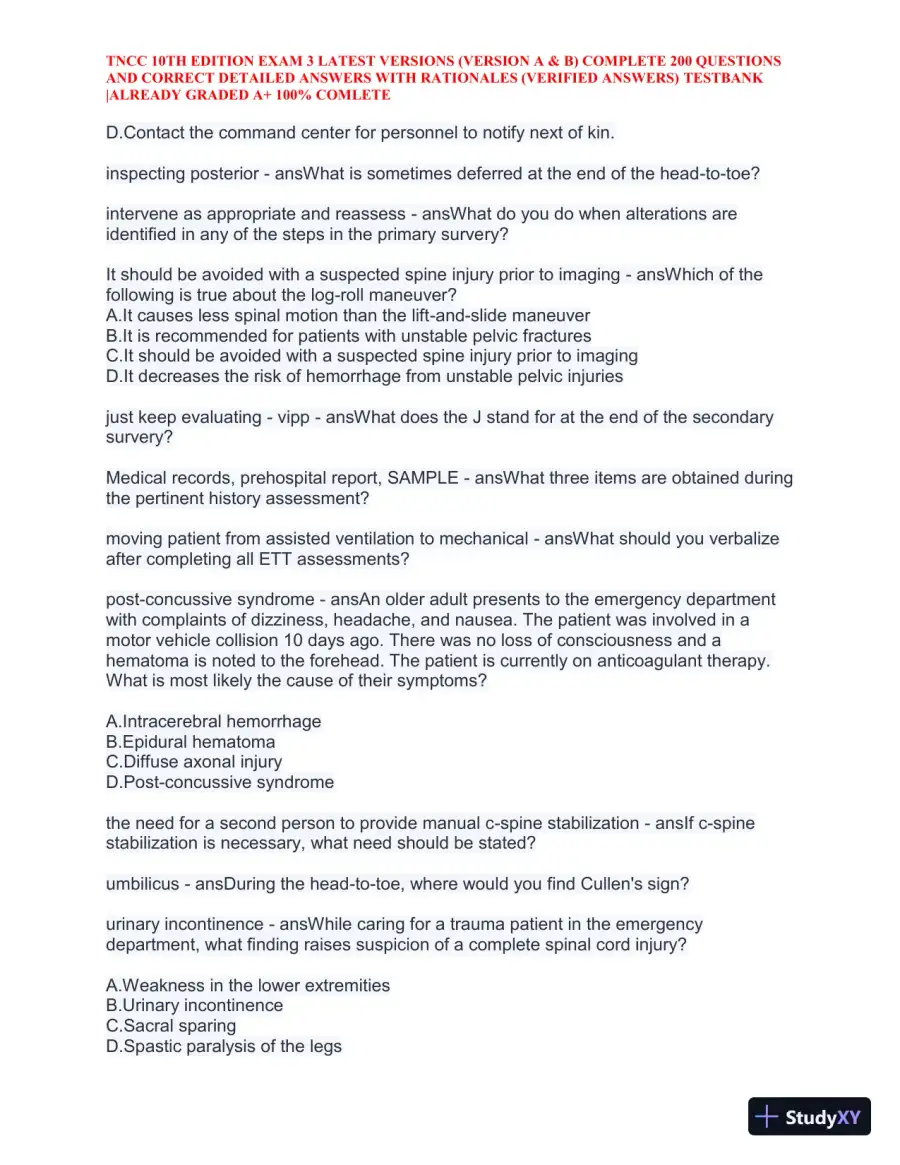 TNCC 10TH EDITION EXAM 3 LATEST VERSIONS (VERSION A & B) COMPLETE 200 QUESTIONSAND CORRECT DETAILED ANSWERS WITH RATIONALES (VERIFIED ANSWERS) TESTBANK|ALREADY GRADED A+ 100% COMLETED.Contact the command center for personnel to notify next of kin.inspecting posterior - ansWhat is sometimes deferred at the end of the head-to-toe?intervene as appropriate and reassess - ansWhat do you do when alterations areidentified in any of the steps in the primary survery?It should be avoided with a suspected spine injury prior to imaging - ansWhich of thefollowing is true about the log-roll maneuver?A.It causes less spinal motion than the lift-and-slide maneuverB.It is recommended for patients with unstable pelvic fracturesC.It should be avoided with a suspected spine injury prior to imagingD.It decreases the risk of hemorrhage from unstable pelvic injuriesjust keep evaluating - vipp - ansWhat does the J stand for at the end of the secondarysurvery?Medical records, prehospital report, SAMPLE - ansWhat three items are obtained duringthe pertinent history assessment?moving patient from assisted ventilation to mechanical - ansWhat should you verbalizeafter completing all ETT assessments?post-concussive syndrome - ansAn older adult presents to the emergency departmentwith complaints of dizziness, headache, and nausea. The patient was involved in amotor vehicle collision 10 days ago. There was no loss of consciousness and ahematoma is noted to the forehead. The patient is currently on anticoagulant therapy.What is most likely the cause of their symptoms?A.Intracerebral hemorrhageB.Epidural hematomaC.Diffuse axonal injuryD.Post-concussive syndromethe need for a second person to provide manual c-spine stabilization - ansIf c-spinestabilization is necessary, what need should be stated?umbilicus - ansDuring the head-to-toe, where would you find Cullen's sign?urinary incontinence - ansWhile caring for a trauma patient in the emergencydepartment, what finding raises suspicion of a complete spinal cord injury?A.Weakness in the lower extremitiesB.Urinary incontinenceC.Sacral sparingD.Spastic paralysis of the legs
Page 14
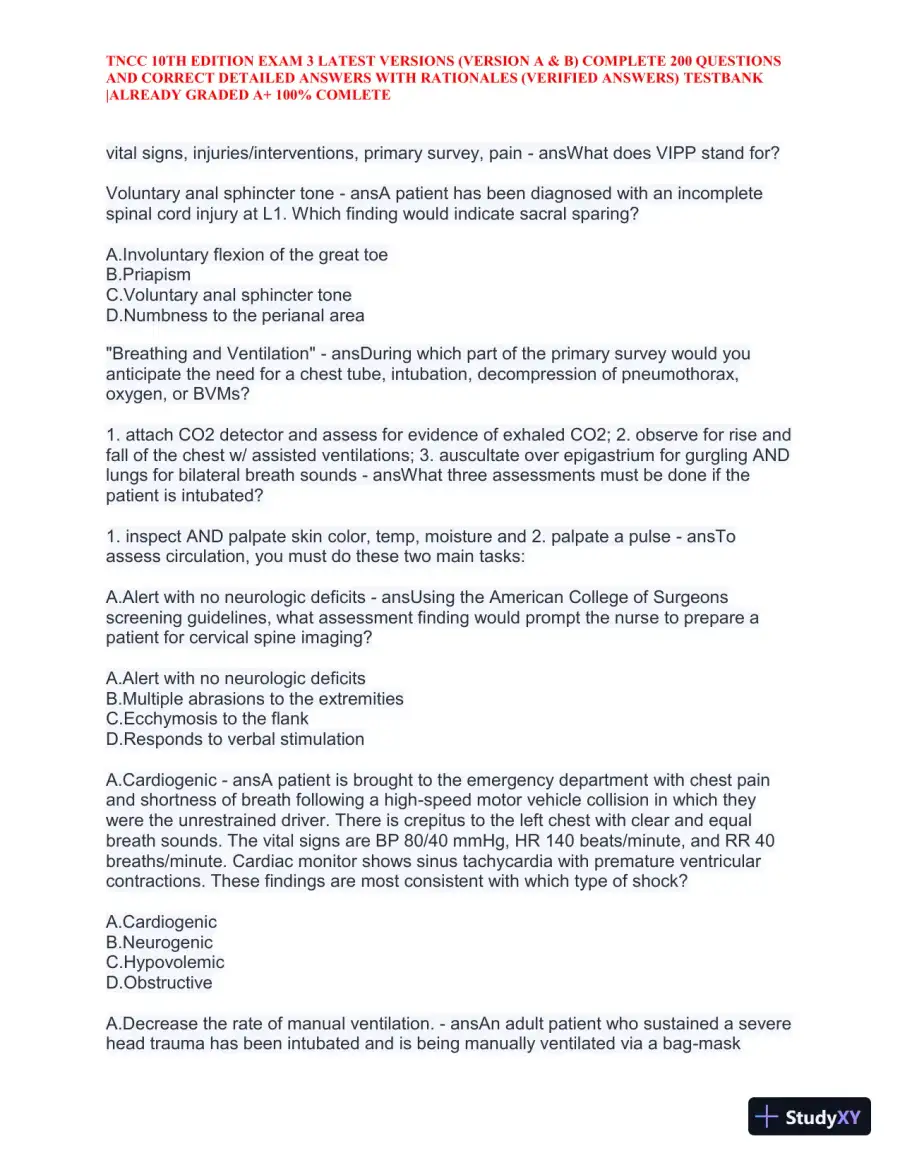 TNCC 10TH EDITION EXAM 3 LATEST VERSIONS (VERSION A & B) COMPLETE 200 QUESTIONSAND CORRECT DETAILED ANSWERS WITH RATIONALES (VERIFIED ANSWERS) TESTBANK|ALREADY GRADED A+ 100% COMLETEvital signs, injuries/interventions, primary survey, pain - ansWhat does VIPP stand for?Voluntary anal sphincter tone - ansA patient has been diagnosed with an incompletespinal cord injury at L1. Which finding would indicate sacral sparing?A.Involuntary flexion of the great toeB.PriapismC.Voluntary anal sphincter toneD.Numbness to the perianal area"Breathing and Ventilation" - ansDuring which part of the primary survey would youanticipate the need for a chest tube, intubation, decompression of pneumothorax,oxygen, or BVMs?1. attach CO2 detector and assess for evidence of exhaled CO2; 2. observe for rise andfall of the chest w/ assisted ventilations; 3. auscultate over epigastrium for gurgling ANDlungs for bilateral breath sounds - ansWhat three assessments must be done if thepatient is intubated?1. inspect AND palpate skin color, temp, moisture and 2. palpate a pulse - ansToassess circulation, you must do these two main tasks:A.Alert with no neurologic deficits - ansUsing the American College of Surgeonsscreening guidelines, what assessment finding would prompt the nurse to prepare apatient for cervical spine imaging?A.Alert with no neurologic deficitsB.Multiple abrasions to the extremitiesC.Ecchymosis to the flankD.Responds to verbal stimulationA.Cardiogenic - ansA patient is brought to the emergency department with chest painand shortness of breath following a high-speed motor vehicle collision in which theywere the unrestrained driver. There is crepitus to the left chest with clear and equalbreath sounds. The vital signs are BP 80/40 mmHg, HR 140 beats/minute, and RR 40breaths/minute. Cardiac monitor shows sinus tachycardia with premature ventricularcontractions. These findings are most consistent with which type of shock?A.CardiogenicB.NeurogenicC.HypovolemicD.ObstructiveA.Decrease the rate of manual ventilation. - ansAn adult patient who sustained a severehead trauma has been intubated and is being manually ventilated via a bag-mask
Page 15
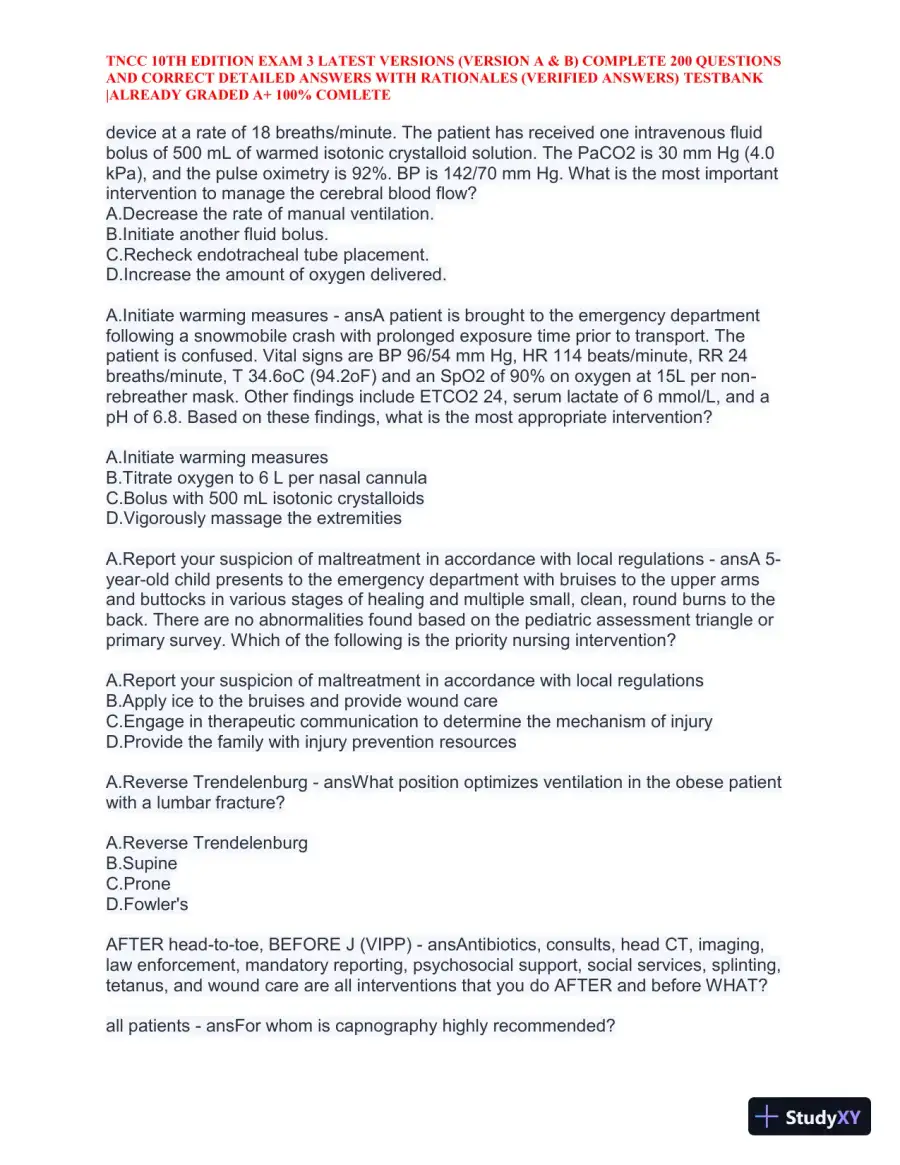 TNCC 10TH EDITION EXAM 3 LATEST VERSIONS (VERSION A & B) COMPLETE 200 QUESTIONSAND CORRECT DETAILED ANSWERS WITH RATIONALES (VERIFIED ANSWERS) TESTBANK|ALREADY GRADED A+ 100% COMLETEdevice at a rate of 18 breaths/minute. The patient has received one intravenous fluidbolus of 500 mL of warmed isotonic crystalloid solution. The PaCO2 is 30 mm Hg (4.0kPa), and the pulse oximetry is 92%. BP is 142/70 mm Hg. What is the most importantintervention to manage the cerebral blood flow?A.Decrease the rate of manual ventilation.B.Initiate another fluid bolus.C.Recheck endotracheal tube placement.D.Increase the amount of oxygen delivered.A.Initiate warming measures - ansA patient is brought to the emergency departmentfollowing a snowmobile crash with prolonged exposure time prior to transport. Thepatient is confused. Vital signs are BP 96/54 mm Hg, HR 114 beats/minute, RR 24breaths/minute, T 34.6oC (94.2oF) and an SpO2 of 90% on oxygen at 15L per non-rebreather mask. Other findings include ETCO2 24, serum lactate of 6 mmol/L, and apH of 6.8. Based on these findings, what is the most appropriate intervention?A.Initiate warming measuresB.Titrate oxygen to 6 L per nasal cannulaC.Bolus with 500 mL isotonic crystalloidsD.Vigorously massage the extremitiesA.Report your suspicion of maltreatment in accordance with local regulations - ansA 5-year-old child presents to the emergency department with bruises to the upper armsand buttocks in various stages of healing and multiple small, clean, round burns to theback. There are no abnormalities found based on the pediatric assessment triangle orprimary survey. Which of the following is the priority nursing intervention?A.Report your suspicion of maltreatment in accordance with local regulationsB.Apply ice to the bruises and provide wound careC.Engage in therapeutic communication to determine the mechanism of injuryD.Provide the family with injury prevention resourcesA.Reverse Trendelenburg - ansWhat position optimizes ventilation in the obese patientwith a lumbar fracture?A.Reverse TrendelenburgB.SupineC.ProneD.Fowler'sAFTER head-to-toe, BEFORE J (VIPP) - ansAntibiotics, consults, head CT, imaging,law enforcement, mandatory reporting, psychosocial support, social services, splinting,tetanus, and wound care are all interventions that you do AFTER and before WHAT?all patients - ansFor whom is capnography highly recommended?
Page 16
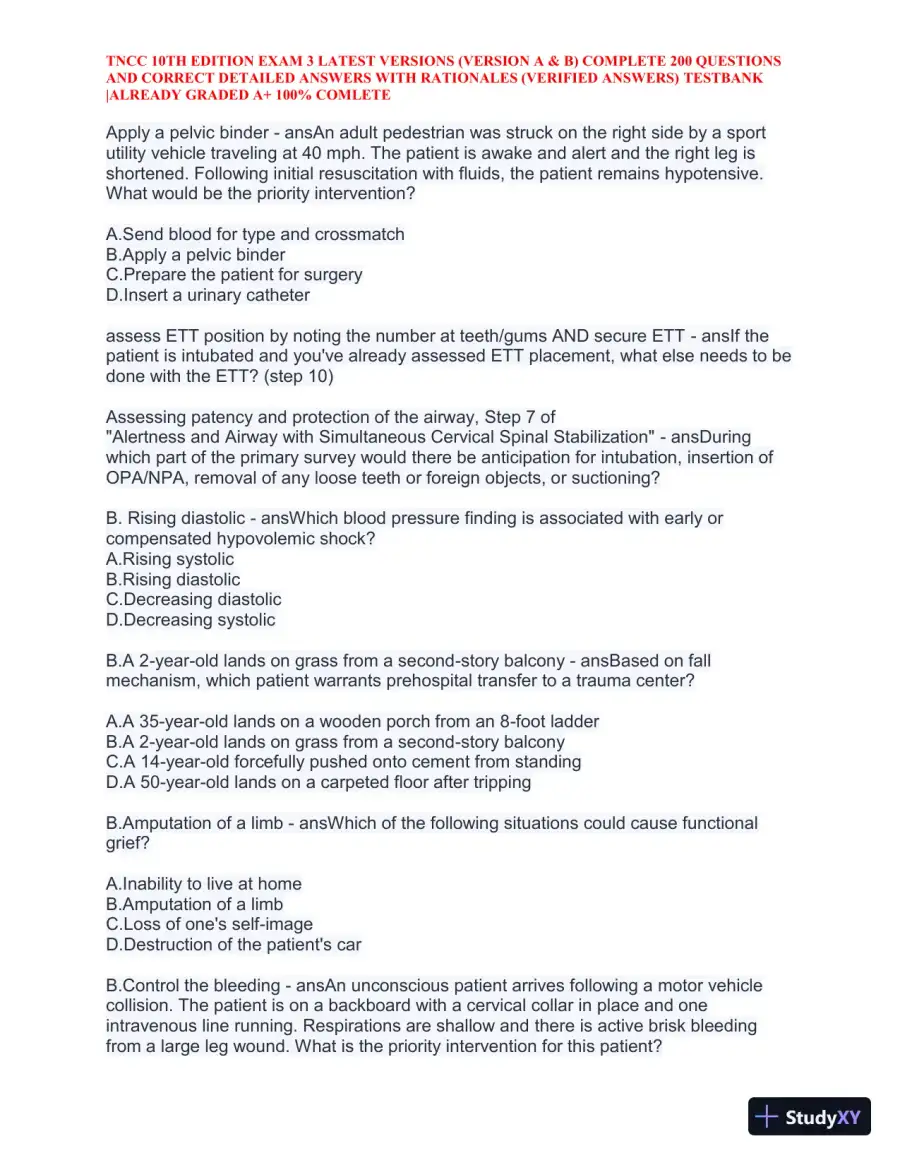 TNCC 10TH EDITION EXAM 3 LATEST VERSIONS (VERSION A & B) COMPLETE 200 QUESTIONSAND CORRECT DETAILED ANSWERS WITH RATIONALES (VERIFIED ANSWERS) TESTBANK|ALREADY GRADED A+ 100% COMLETEApply a pelvic binder - ansAn adult pedestrian was struck on the right side by a sportutility vehicle traveling at 40 mph. The patient is awake and alert and the right leg isshortened. Following initial resuscitation with fluids, the patient remains hypotensive.What would be the priority intervention?A.Send blood for type and crossmatchB.Apply a pelvic binderC.Prepare the patient for surgeryD.Insert a urinary catheterassess ETT position by noting the number at teeth/gums AND secure ETT - ansIf thepatient is intubated and you've already assessed ETT placement, what else needs to bedone with the ETT? (step 10)Assessing patency and protection of the airway, Step 7 of"Alertness and Airway with Simultaneous Cervical Spinal Stabilization" - ansDuringwhich part of the primary survey would there be anticipation for intubation, insertion ofOPA/NPA, removal of any loose teeth or foreign objects, or suctioning?B. Rising diastolic - ansWhich blood pressure finding is associated with early orcompensated hypovolemic shock?A.Rising systolicB.Rising diastolicC.Decreasing diastolicD.Decreasing systolicB.A 2-year-old lands on grass from a second-story balcony - ansBased on fallmechanism, which patient warrants prehospital transfer to a trauma center?A.A 35-year-old lands on a wooden porch from an 8-foot ladderB.A 2-year-old lands on grass from a second-story balconyC.A 14-year-old forcefully pushed onto cement from standingD.A 50-year-old lands on a carpeted floor after trippingB.Amputation of a limb - ansWhich of the following situations could cause functionalgrief?A.Inability to live at homeB.Amputation of a limbC.Loss of one's self-imageD.Destruction of the patient's carB.Control the bleeding - ansAn unconscious patient arrives following a motor vehiclecollision. The patient is on a backboard with a cervical collar in place and oneintravenous line running. Respirations are shallow and there is active brisk bleedingfrom a large leg wound. What is the priority intervention for this patient?
Page 17
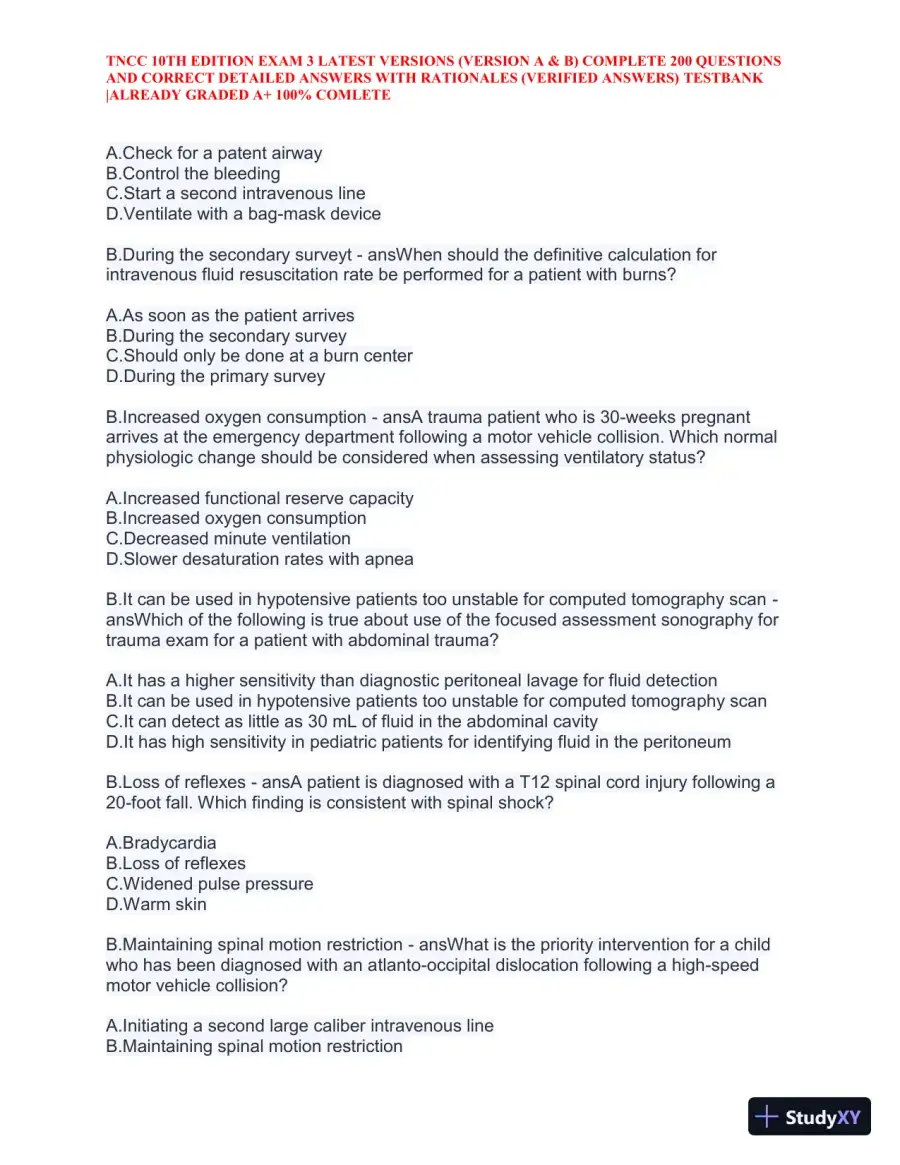 TNCC 10TH EDITION EXAM 3 LATEST VERSIONS (VERSION A & B) COMPLETE 200 QUESTIONSAND CORRECT DETAILED ANSWERS WITH RATIONALES (VERIFIED ANSWERS) TESTBANK|ALREADY GRADED A+ 100% COMLETEA.Check for a patent airwayB.Control the bleedingC.Start a second intravenous lineD.Ventilate with a bag-mask deviceB.During the secondary surveyt - ansWhen should the definitive calculation forintravenous fluid resuscitation rate be performed for a patient with burns?A.As soon as the patient arrivesB.During the secondary surveyC.Should only be done at a burn centerD.During the primary surveyB.Increased oxygen consumption - ansA trauma patient who is 30-weeks pregnantarrives at the emergency department following a motor vehicle collision. Which normalphysiologic change should be considered when assessing ventilatory status?A.Increased functional reserve capacityB.Increased oxygen consumptionC.Decreased minute ventilationD.Slower desaturation rates with apneaB.It can be used in hypotensive patients too unstable for computed tomography scan -ansWhich of the following is true about use of the focused assessment sonography fortrauma exam for a patient with abdominal trauma?A.It has a higher sensitivity than diagnostic peritoneal lavage for fluid detectionB.It can be used in hypotensive patients too unstable for computed tomography scanC.It can detect as little as 30 mL of fluid in the abdominal cavityD.It has high sensitivity in pediatric patients for identifying fluid in the peritoneumB.Loss of reflexes - ansA patient is diagnosed with a T12 spinal cord injury following a20-foot fall. Which finding is consistent with spinal shock?A.BradycardiaB.Loss of reflexesC.Widened pulse pressureD.Warm skinB.Maintaining spinal motion restriction - ansWhat is the priority intervention for a childwho has been diagnosed with an atlanto-occipital dislocation following a high-speedmotor vehicle collision?A.Initiating a second large caliber intravenous lineB.Maintaining spinal motion restriction
Page 18
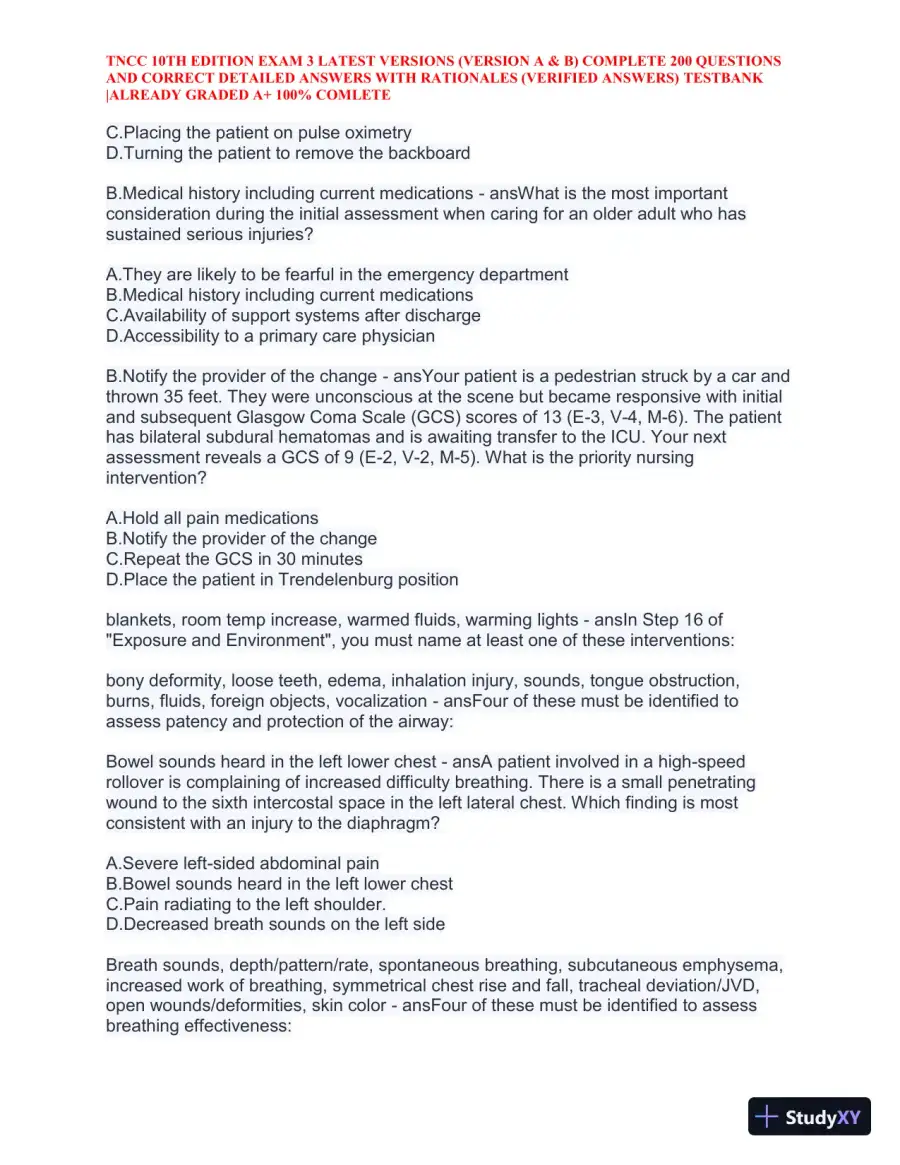 TNCC 10TH EDITION EXAM 3 LATEST VERSIONS (VERSION A & B) COMPLETE 200 QUESTIONSAND CORRECT DETAILED ANSWERS WITH RATIONALES (VERIFIED ANSWERS) TESTBANK|ALREADY GRADED A+ 100% COMLETEC.Placing the patient on pulse oximetryD.Turning the patient to remove the backboardB.Medical history including current medications - ansWhat is the most importantconsideration during the initial assessment when caring for an older adult who hassustained serious injuries?A.They are likely to be fearful in the emergency departmentB.Medical history including current medicationsC.Availability of support systems after dischargeD.Accessibility to a primary care physicianB.Notify the provider of the change - ansYour patient is a pedestrian struck by a car andthrown 35 feet. They were unconscious at the scene but became responsive with initialand subsequent Glasgow Coma Scale (GCS) scores of 13 (E-3, V-4, M-6). The patienthas bilateral subdural hematomas and is awaiting transfer to the ICU. Your nextassessment reveals a GCS of 9 (E-2, V-2, M-5). What is the priority nursingintervention?A.Hold all pain medicationsB.Notify the provider of the changeC.Repeat the GCS in 30 minutesD.Place the patient in Trendelenburg positionblankets, room temp increase, warmed fluids, warming lights - ansIn Step 16 of"Exposure and Environment", you must name at least one of these interventions:bony deformity, loose teeth, edema, inhalation injury, sounds, tongue obstruction,burns, fluids, foreign objects, vocalization - ansFour of these must be identified toassess patency and protection of the airway:Bowel sounds heard in the left lower chest - ansA patient involved in a high-speedrollover is complaining of increased difficulty breathing. There is a small penetratingwound to the sixth intercostal space in the left lateral chest. Which finding is mostconsistent with an injury to the diaphragm?A.Severe left-sided abdominal painB.Bowel sounds heard in the left lower chestC.Pain radiating to the left shoulder.D.Decreased breath sounds on the left sideBreath sounds, depth/pattern/rate, spontaneous breathing, subcutaneous emphysema,increased work of breathing, symmetrical chest rise and fall, tracheal deviation/JVD,open wounds/deformities, skin color - ansFour of these must be identified to assessbreathing effectiveness:
Page 19
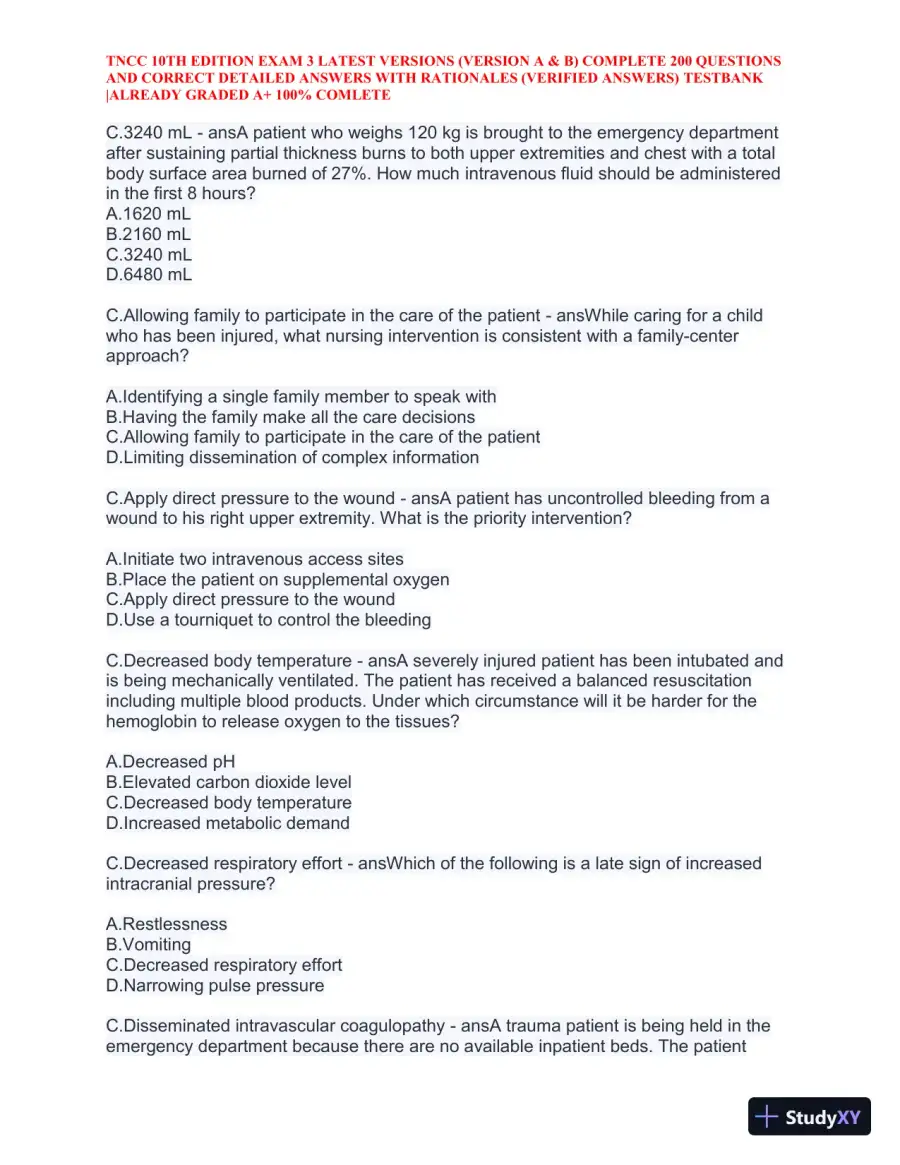 TNCC 10TH EDITION EXAM 3 LATEST VERSIONS (VERSION A & B) COMPLETE 200 QUESTIONSAND CORRECT DETAILED ANSWERS WITH RATIONALES (VERIFIED ANSWERS) TESTBANK|ALREADY GRADED A+ 100% COMLETEC.3240 mL - ansA patient who weighs 120 kg is brought to the emergency departmentafter sustaining partial thickness burns to both upper extremities and chest with a totalbody surface area burned of 27%. How much intravenous fluid should be administeredin the first 8 hours?A.1620 mLB.2160 mLC.3240 mLD.6480 mLC.Allowing family to participate in the care of the patient - ansWhile caring for a childwho has been injured, what nursing intervention is consistent with a family-centerapproach?A.Identifying a single family member to speak withB.Having the family make all the care decisionsC.Allowing family to participate in the care of the patientD.Limiting dissemination of complex informationC.Apply direct pressure to the wound - ansA patient has uncontrolled bleeding from awound to his right upper extremity. What is the priority intervention?A.Initiate two intravenous access sitesB.Place the patient on supplemental oxygenC.Apply direct pressure to the woundD.Use a tourniquet to control the bleedingC.Decreased body temperature - ansA severely injured patient has been intubated andis being mechanically ventilated. The patient has received a balanced resuscitationincluding multiple blood products. Under which circumstance will it be harder for thehemoglobin to release oxygen to the tissues?A.Decreased pHB.Elevated carbon dioxide levelC.Decreased body temperatureD.Increased metabolic demandC.Decreased respiratory effort - ansWhich of the following is a late sign of increasedintracranial pressure?A.RestlessnessB.VomitingC.Decreased respiratory effortD.Narrowing pulse pressureC.Disseminated intravascular coagulopathy - ansA trauma patient is being held in theemergency department because there are no available inpatient beds. The patient
Page 20
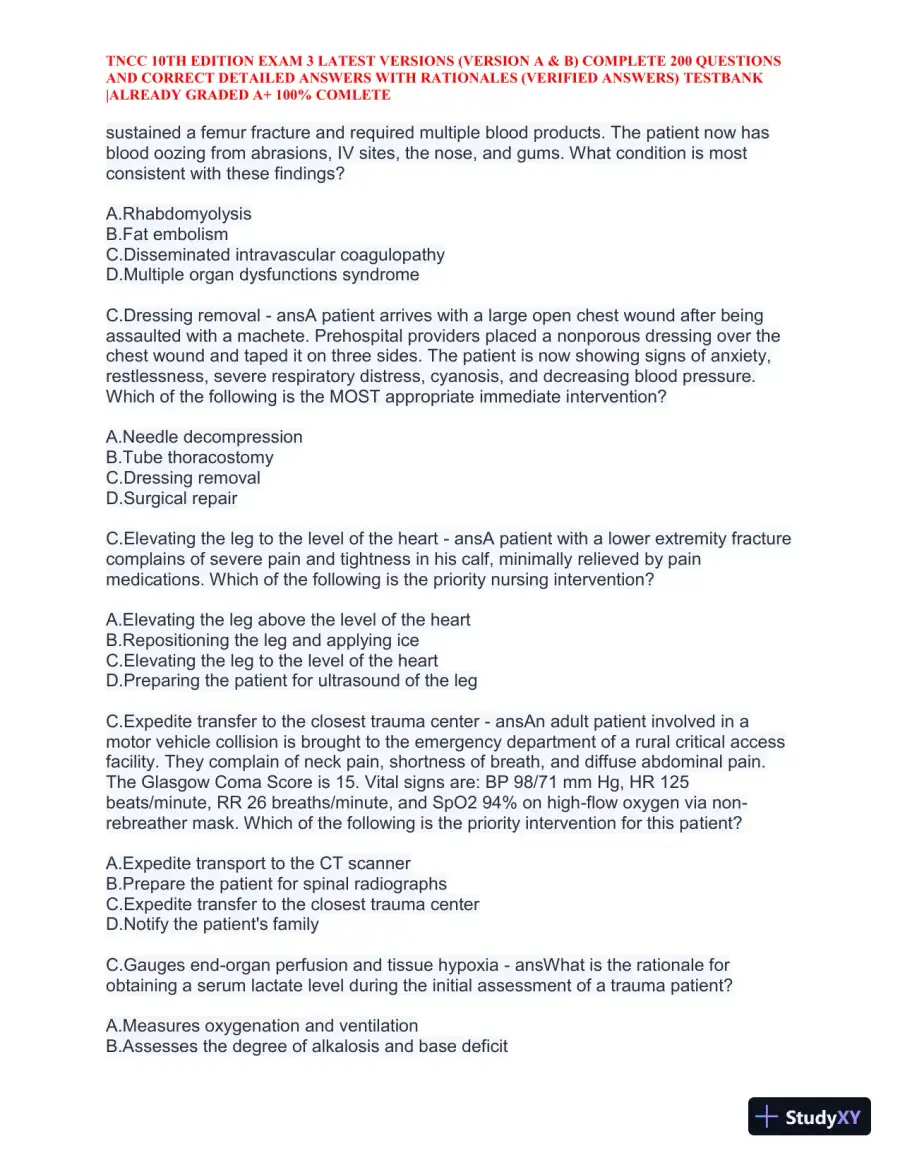 TNCC 10TH EDITION EXAM 3 LATEST VERSIONS (VERSION A & B) COMPLETE 200 QUESTIONSAND CORRECT DETAILED ANSWERS WITH RATIONALES (VERIFIED ANSWERS) TESTBANK|ALREADY GRADED A+ 100% COMLETEsustained a femur fracture and required multiple blood products. The patient now hasblood oozing from abrasions, IV sites, the nose, and gums. What condition is mostconsistent with these findings?A.RhabdomyolysisB.Fat embolismC.Disseminated intravascular coagulopathyD.Multiple organ dysfunctions syndromeC.Dressing removal - ansA patient arrives with a large open chest wound after beingassaulted with a machete. Prehospital providers placed a nonporous dressing over thechest wound and taped it on three sides. The patient is now showing signs of anxiety,restlessness, severe respiratory distress, cyanosis, and decreasing blood pressure.Which of the following is the MOST appropriate immediate intervention?A.Needle decompressionB.Tube thoracostomyC.Dressing removalD.Surgical repairC.Elevating the leg to the level of the heart - ansA patient with a lower extremity fracturecomplains of severe pain and tightness in his calf, minimally relieved by painmedications. Which of the following is the priority nursing intervention?A.Elevating the leg above the level of the heartB.Repositioning the leg and applying iceC.Elevating the leg to the level of the heartD.Preparing the patient for ultrasound of the legC.Expedite transfer to the closest trauma center - ansAn adult patient involved in amotor vehicle collision is brought to the emergency department of a rural critical accessfacility. They complain of neck pain, shortness of breath, and diffuse abdominal pain.The Glasgow Coma Score is 15. Vital signs are: BP 98/71 mm Hg, HR 125beats/minute, RR 26 breaths/minute, and SpO2 94% on high-flow oxygen via non-rebreather mask. Which of the following is the priority intervention for this patient?A.Expedite transport to the CT scannerB.Prepare the patient for spinal radiographsC.Expedite transfer to the closest trauma centerD.Notify the patient's familyC.Gauges end-organ perfusion and tissue hypoxia - ansWhat is the rationale forobtaining a serum lactate level during the initial assessment of a trauma patient?A.Measures oxygenation and ventilationB.Assesses the degree of alkalosis and base deficit
Page 21
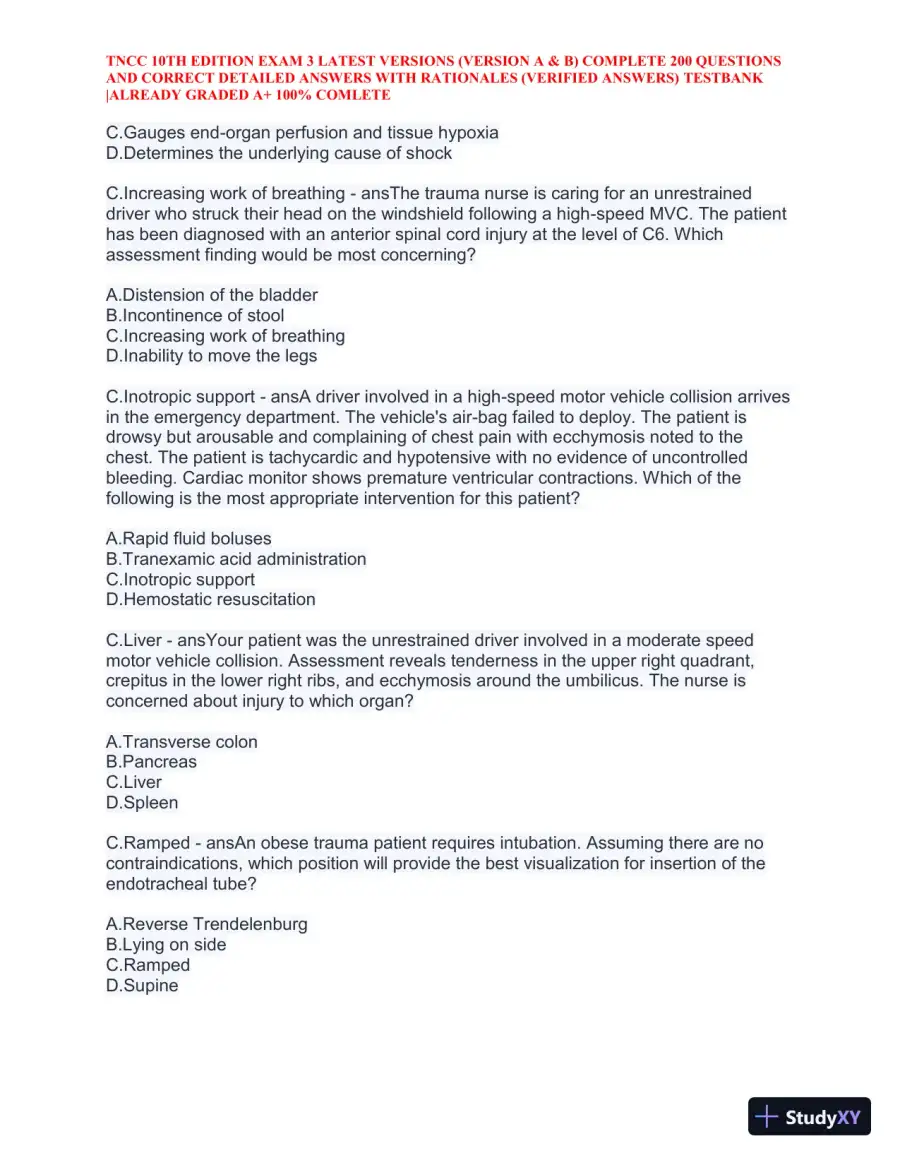 TNCC 10TH EDITION EXAM 3 LATEST VERSIONS (VERSION A & B) COMPLETE 200 QUESTIONSAND CORRECT DETAILED ANSWERS WITH RATIONALES (VERIFIED ANSWERS) TESTBANK|ALREADY GRADED A+ 100% COMLETEC.Gauges end-organ perfusion and tissue hypoxiaD.Determines the underlying cause of shockC.Increasing work of breathing - ansThe trauma nurse is caring for an unrestraineddriver who struck their head on the windshield following a high-speed MVC. The patienthas been diagnosed with an anterior spinal cord injury at the level of C6. Whichassessment finding would be most concerning?A.Distension of the bladderB.Incontinence of stoolC.Increasing work of breathingD.Inability to move the legsC.Inotropic support - ansA driver involved in a high-speed motor vehicle collision arrivesin the emergency department. The vehicle's air-bag failed to deploy. The patient isdrowsy but arousable and complaining of chest pain with ecchymosis noted to thechest. The patient is tachycardic and hypotensive with no evidence of uncontrolledbleeding. Cardiac monitor shows premature ventricular contractions. Which of thefollowing is the most appropriate intervention for this patient?A.Rapid fluid bolusesB.Tranexamic acid administrationC.Inotropic supportD.Hemostatic resuscitationC.Liver - ansYour patient was the unrestrained driver involved in a moderate speedmotor vehicle collision. Assessment reveals tenderness in the upper right quadrant,crepitus in the lower right ribs, and ecchymosis around the umbilicus. The nurse isconcerned about injury to which organ?A.Transverse colonB.PancreasC.LiverD.SpleenC.Ramped - ansAn obese trauma patient requires intubation. Assuming there are nocontraindications, which position will provide the best visualization for insertion of theendotracheal tube?A.Reverse TrendelenburgB.Lying on sideC.RampedD.Supine
Page 22
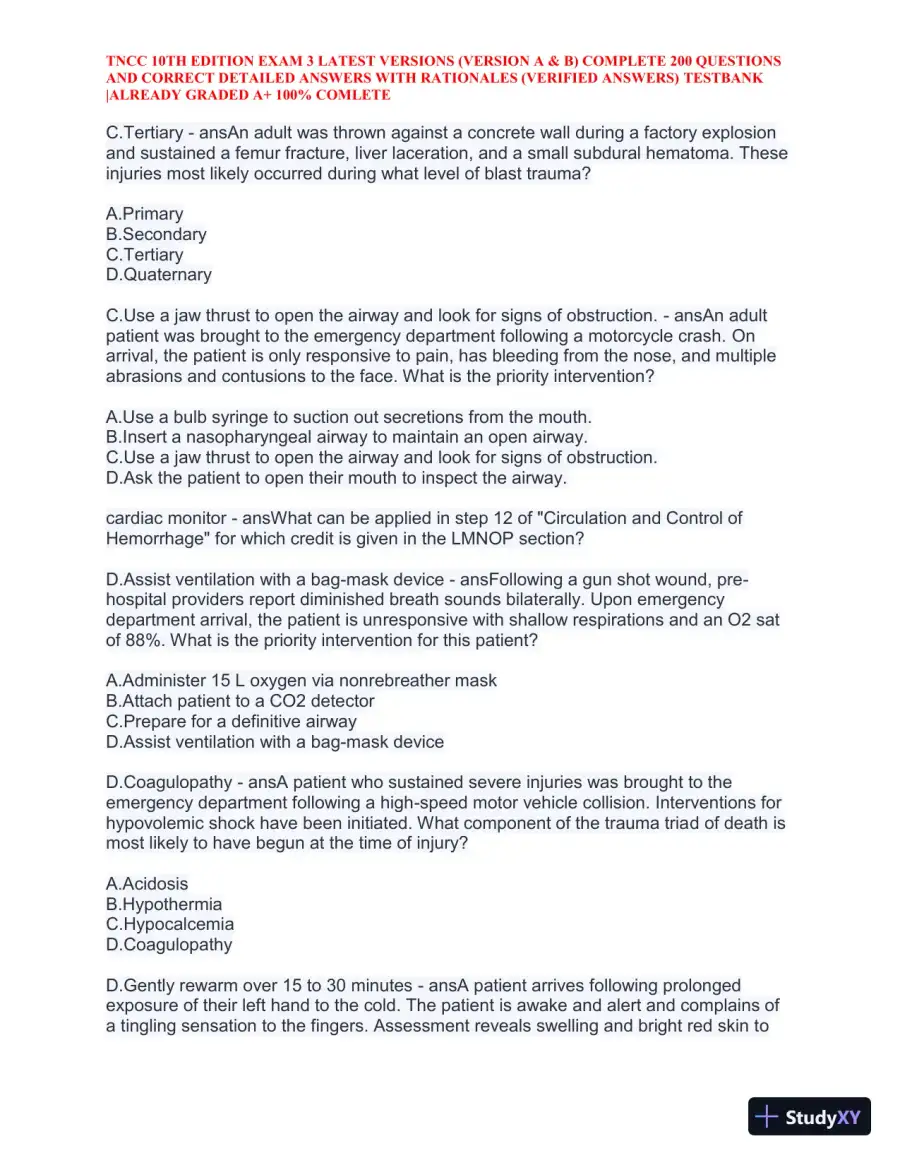 TNCC 10TH EDITION EXAM 3 LATEST VERSIONS (VERSION A & B) COMPLETE 200 QUESTIONSAND CORRECT DETAILED ANSWERS WITH RATIONALES (VERIFIED ANSWERS) TESTBANK|ALREADY GRADED A+ 100% COMLETEC.Tertiary - ansAn adult was thrown against a concrete wall during a factory explosionand sustained a femur fracture, liver laceration, and a small subdural hematoma. Theseinjuries most likely occurred during what level of blast trauma?A.PrimaryB.SecondaryC.TertiaryD.QuaternaryC.Use a jaw thrust to open the airway and look for signs of obstruction. - ansAn adultpatient was brought to the emergency department following a motorcycle crash. Onarrival, the patient is only responsive to pain, has bleeding from the nose, and multipleabrasions and contusions to the face. What is the priority intervention?A.Use a bulb syringe to suction out secretions from the mouth.B.Insert a nasopharyngeal airway to maintain an open airway.C.Use a jaw thrust to open the airway and look for signs of obstruction.D.Ask the patient to open their mouth to inspect the airway.cardiac monitor - ansWhat can be applied in step 12 of "Circulation and Control ofHemorrhage" for which credit is given in the LMNOP section?D.Assist ventilation with a bag-mask device - ansFollowing a gun shot wound, pre-hospital providers report diminished breath sounds bilaterally. Upon emergencydepartment arrival, the patient is unresponsive with shallow respirations and an O2 satof 88%. What is the priority intervention for this patient?A.Administer 15 L oxygen via nonrebreather maskB.Attach patient to a CO2 detectorC.Prepare for a definitive airwayD.Assist ventilation with a bag-mask deviceD.Coagulopathy - ansA patient who sustained severe injuries was brought to theemergency department following a high-speed motor vehicle collision. Interventions forhypovolemic shock have been initiated. What component of the trauma triad of death ismost likely to have begun at the time of injury?A.AcidosisB.HypothermiaC.HypocalcemiaD.CoagulopathyD.Gently rewarm over 15 to 30 minutes - ansA patient arrives following prolongedexposure of their left hand to the cold. The patient is awake and alert and complains ofa tingling sensation to the fingers. Assessment reveals swelling and bright red skin to
Page 23
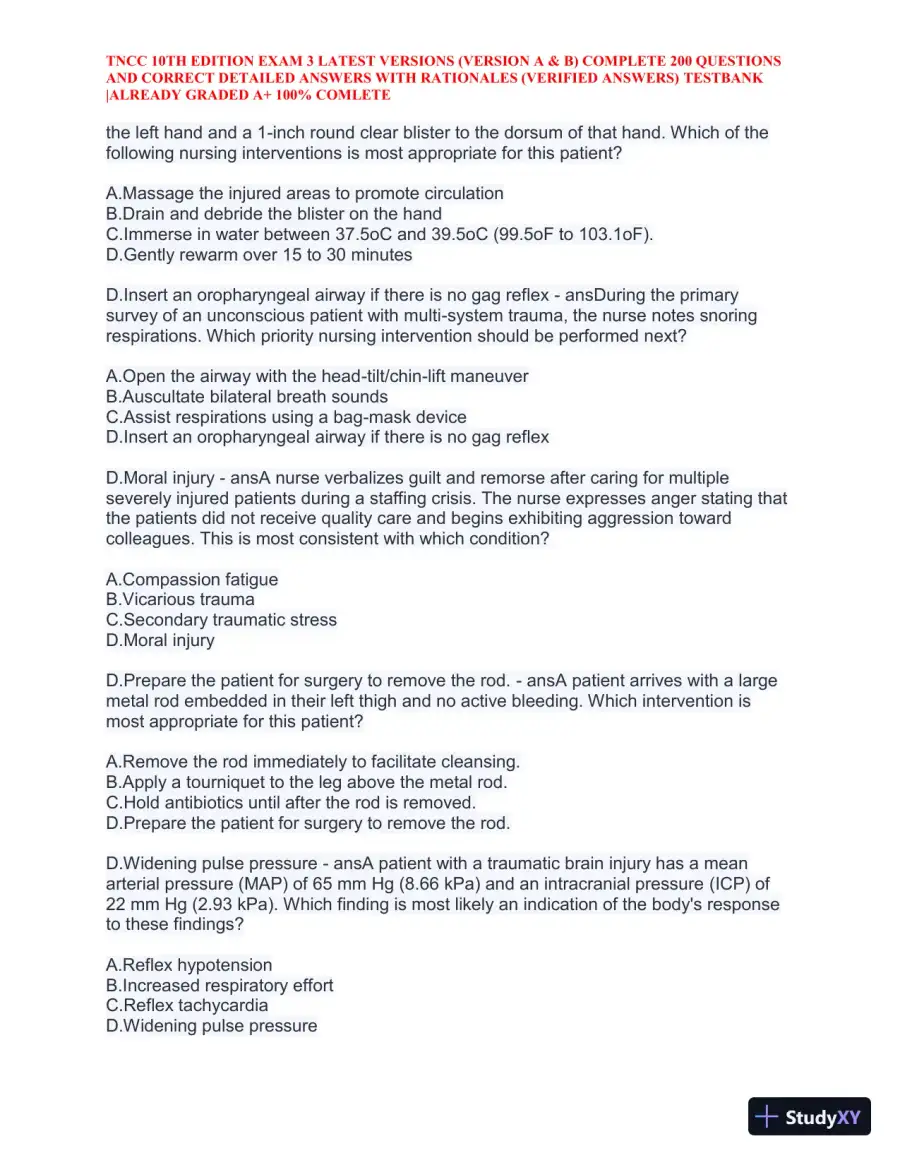 TNCC 10TH EDITION EXAM 3 LATEST VERSIONS (VERSION A & B) COMPLETE 200 QUESTIONSAND CORRECT DETAILED ANSWERS WITH RATIONALES (VERIFIED ANSWERS) TESTBANK|ALREADY GRADED A+ 100% COMLETEthe left hand and a 1-inch round clear blister to the dorsum of that hand. Which of thefollowing nursing interventions is most appropriate for this patient?A.Massage the injured areas to promote circulationB.Drain and debride the blister on the handC.Immerse in water between 37.5oC and 39.5oC (99.5oF to 103.1oF).D.Gently rewarm over 15 to 30 minutesD.Insert an oropharyngeal airway if there is no gag reflex - ansDuring the primarysurvey of an unconscious patient with multi-system trauma, the nurse notes snoringrespirations. Which priority nursing intervention should be performed next?A.Open the airway with the head-tilt/chin-lift maneuverB.Auscultate bilateral breath soundsC.Assist respirations using a bag-mask deviceD.Insert an oropharyngeal airway if there is no gag reflexD.Moral injury - ansA nurse verbalizes guilt and remorse after caring for multipleseverely injured patients during a staffing crisis. The nurse expresses anger stating thatthe patients did not receive quality care and begins exhibiting aggression towardcolleagues. This is most consistent with which condition?A.Compassion fatigueB.Vicarious traumaC.Secondary traumatic stressD.Moral injuryD.Prepare the patient for surgery to remove the rod. - ansA patient arrives with a largemetal rod embedded in their left thigh and no active bleeding. Which intervention ismost appropriate for this patient?A.Remove the rod immediately to facilitate cleansing.B.Apply a tourniquet to the leg above the metal rod.C.Hold antibiotics until after the rod is removed.D.Prepare the patient for surgery to remove the rod.D.Widening pulse pressure - ansA patient with a traumatic brain injury has a meanarterial pressure (MAP) of 65 mm Hg (8.66 kPa) and an intracranial pressure (ICP) of22 mm Hg (2.93 kPa). Which finding is most likely an indication of the body's responseto these findings?A.Reflex hypotensionB.Increased respiratory effortC.Reflex tachycardiaD.Widening pulse pressure
Page 24
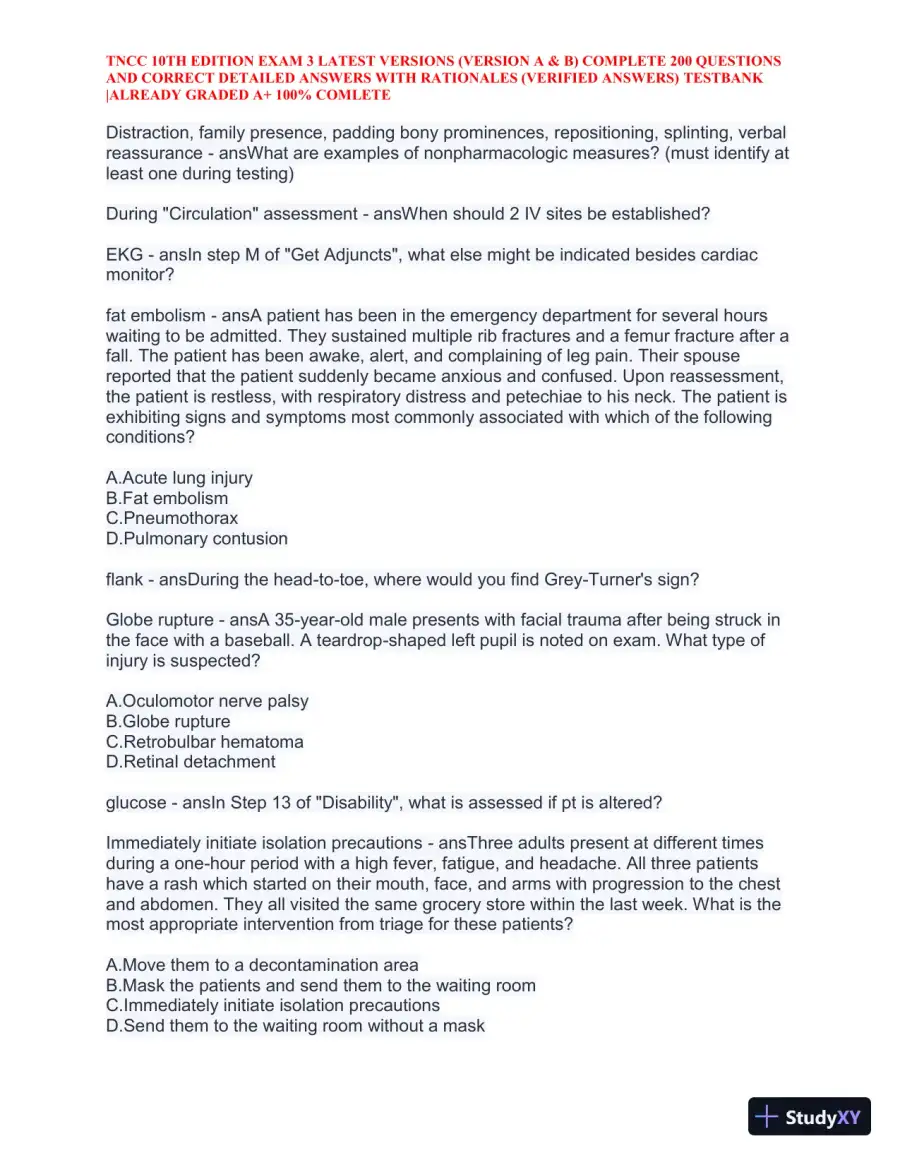 TNCC 10TH EDITION EXAM 3 LATEST VERSIONS (VERSION A & B) COMPLETE 200 QUESTIONSAND CORRECT DETAILED ANSWERS WITH RATIONALES (VERIFIED ANSWERS) TESTBANK|ALREADY GRADED A+ 100% COMLETEDistraction, family presence, padding bony prominences, repositioning, splinting, verbalreassurance - ansWhat are examples of nonpharmacologic measures? (must identify atleast one during testing)During "Circulation" assessment - ansWhen should 2 IV sites be established?EKG - ansIn step M of "Get Adjuncts", what else might be indicated besides cardiacmonitor?fat embolism - ansA patient has been in the emergency department for several hourswaiting to be admitted. They sustained multiple rib fractures and a femur fracture after afall. The patient has been awake, alert, and complaining of leg pain. Their spousereported that the patient suddenly became anxious and confused. Upon reassessment,the patient is restless, with respiratory distress and petechiae to his neck. The patient isexhibiting signs and symptoms most commonly associated with which of the followingconditions?A.Acute lung injuryB.Fat embolismC.PneumothoraxD.Pulmonary contusionflank - ansDuring the head-to-toe, where would you find Grey-Turner's sign?Globe rupture - ansA 35-year-old male presents with facial trauma after being struck inthe face with a baseball. A teardrop-shaped left pupil is noted on exam. What type ofinjury is suspected?A.Oculomotor nerve palsyB.Globe ruptureC.Retrobulbar hematomaD.Retinal detachmentglucose - ansIn Step 13 of "Disability", what is assessed if pt is altered?Immediately initiate isolation precautions - ansThree adults present at different timesduring a one-hour period with a high fever, fatigue, and headache. All three patientshave a rash which started on their mouth, face, and arms with progression to the chestand abdomen. They all visited the same grocery store within the last week. What is themost appropriate intervention from triage for these patients?A.Move them to a decontamination areaB.Mask the patients and send them to the waiting roomC.Immediately initiate isolation precautionsD.Send them to the waiting room without a mask
Page 25
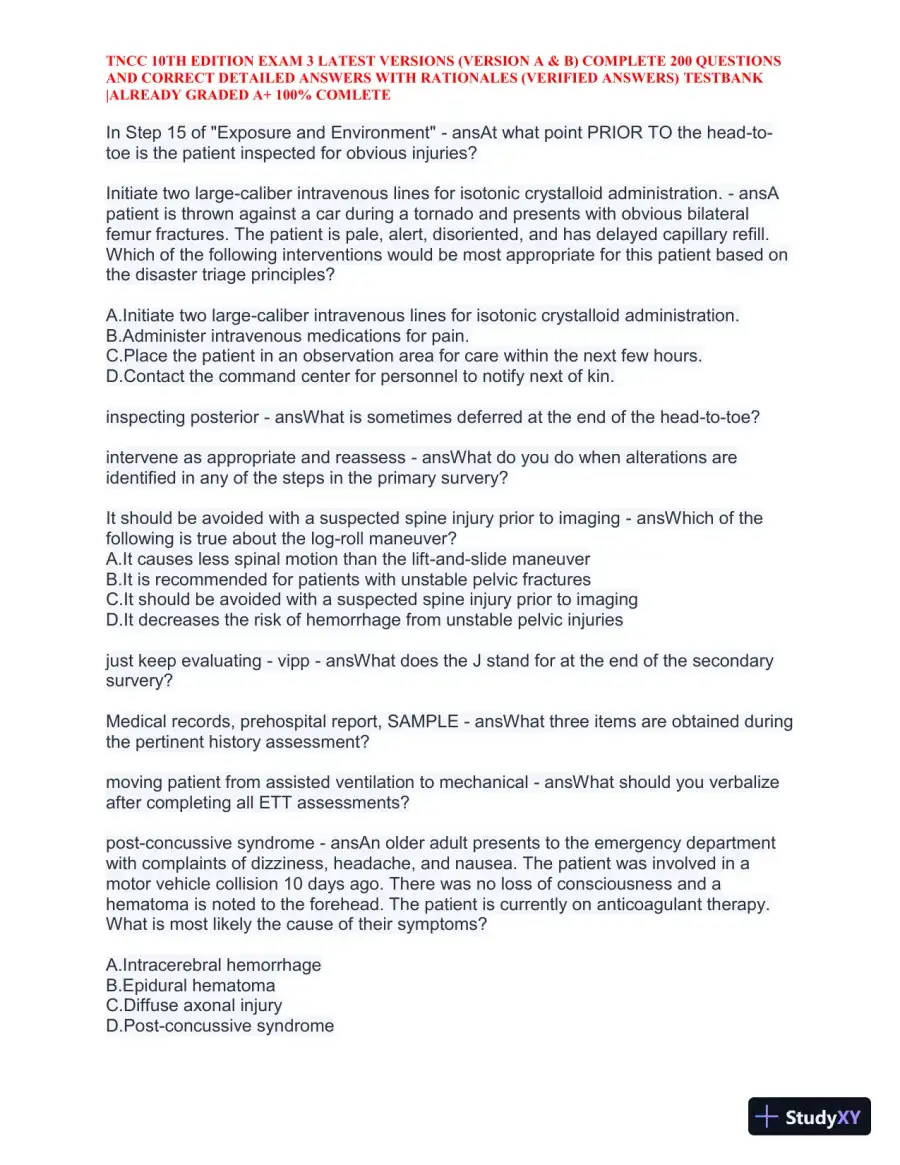 TNCC 10TH EDITION EXAM 3 LATEST VERSIONS (VERSION A & B) COMPLETE 200 QUESTIONSAND CORRECT DETAILED ANSWERS WITH RATIONALES (VERIFIED ANSWERS) TESTBANK|ALREADY GRADED A+ 100% COMLETEIn Step 15 of "Exposure and Environment" - ansAt what point PRIOR TO the head-to-toe is the patient inspected for obvious injuries?Initiate two large-caliber intravenous lines for isotonic crystalloid administration. - ansApatient is thrown against a car during a tornado and presents with obvious bilateralfemur fractures. The patient is pale, alert, disoriented, and has delayed capillary refill.Which of the following interventions would be most appropriate for this patient based onthe disaster triage principles?A.Initiate two large-caliber intravenous lines for isotonic crystalloid administration.B.Administer intravenous medications for pain.C.Place the patient in an observation area for care within the next few hours.D.Contact the command center for personnel to notify next of kin.inspecting posterior - ansWhat is sometimes deferred at the end of the head-to-toe?intervene as appropriate and reassess - ansWhat do you do when alterations areidentified in any of the steps in the primary survery?It should be avoided with a suspected spine injury prior to imaging - ansWhich of thefollowing is true about the log-roll maneuver?A.It causes less spinal motion than the lift-and-slide maneuverB.It is recommended for patients with unstable pelvic fracturesC.It should be avoided with a suspected spine injury prior to imagingD.It decreases the risk of hemorrhage from unstable pelvic injuriesjust keep evaluating - vipp - ansWhat does the J stand for at the end of the secondarysurvery?Medical records, prehospital report, SAMPLE - ansWhat three items are obtained duringthe pertinent history assessment?moving patient from assisted ventilation to mechanical - ansWhat should you verbalizeafter completing all ETT assessments?post-concussive syndrome - ansAn older adult presents to the emergency departmentwith complaints of dizziness, headache, and nausea. The patient was involved in amotor vehicle collision 10 days ago. There was no loss of consciousness and ahematoma is noted to the forehead. The patient is currently on anticoagulant therapy.What is most likely the cause of their symptoms?A.Intracerebral hemorrhageB.Epidural hematomaC.Diffuse axonal injuryD.Post-concussive syndrome
Page 26
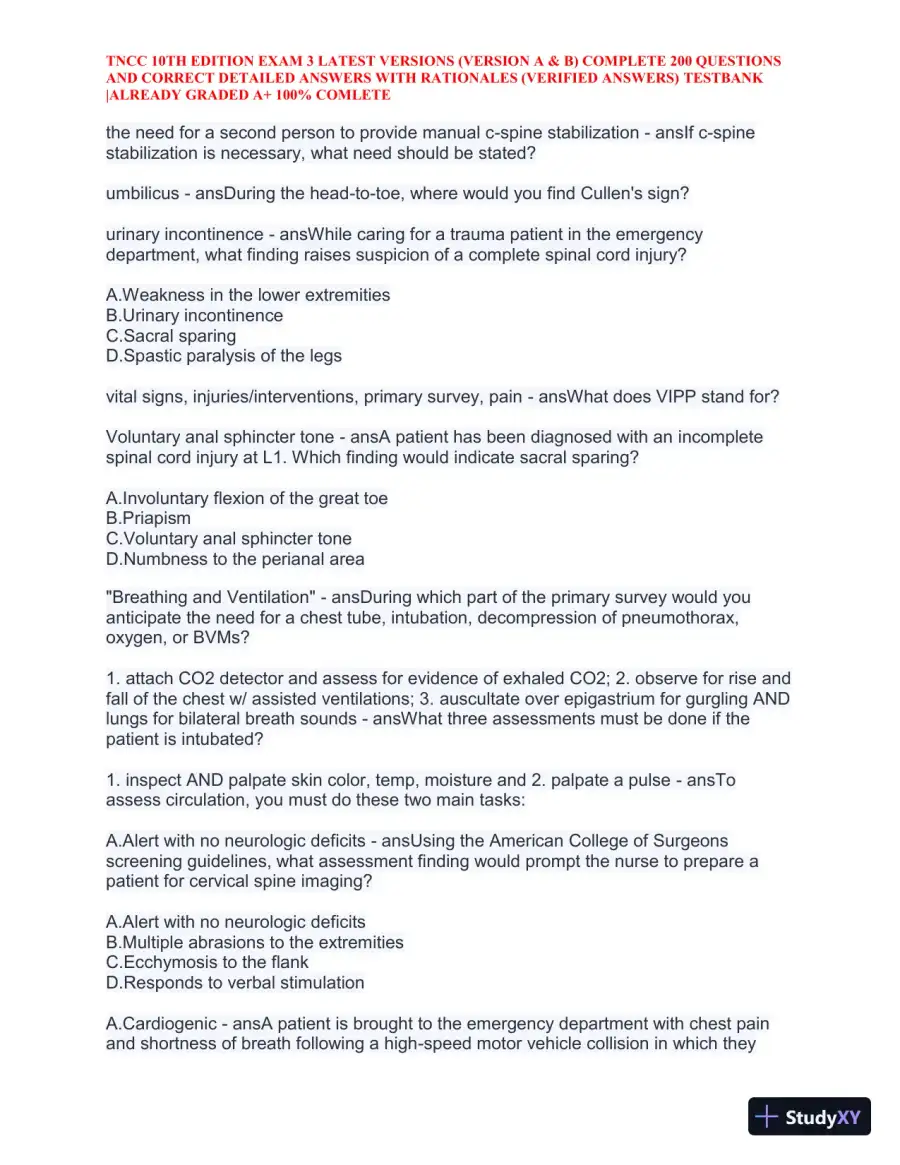 TNCC 10TH EDITION EXAM 3 LATEST VERSIONS (VERSION A & B) COMPLETE 200 QUESTIONSAND CORRECT DETAILED ANSWERS WITH RATIONALES (VERIFIED ANSWERS) TESTBANK|ALREADY GRADED A+ 100% COMLETEthe need for a second person to provide manual c-spine stabilization - ansIf c-spinestabilization is necessary, what need should be stated?umbilicus - ansDuring the head-to-toe, where would you find Cullen's sign?urinary incontinence - ansWhile caring for a trauma patient in the emergencydepartment, what finding raises suspicion of a complete spinal cord injury?A.Weakness in the lower extremitiesB.Urinary incontinenceC.Sacral sparingD.Spastic paralysis of the legsvital signs, injuries/interventions, primary survey, pain - ansWhat does VIPP stand for?Voluntary anal sphincter tone - ansA patient has been diagnosed with an incompletespinal cord injury at L1. Which finding would indicate sacral sparing?A.Involuntary flexion of the great toeB.PriapismC.Voluntary anal sphincter toneD.Numbness to the perianal area"Breathing and Ventilation" - ansDuring which part of the primary survey would youanticipate the need for a chest tube, intubation, decompression of pneumothorax,oxygen, or BVMs?1. attach CO2 detector and assess for evidence of exhaled CO2; 2. observe for rise andfall of the chest w/ assisted ventilations; 3. auscultate over epigastrium for gurgling ANDlungs for bilateral breath sounds - ansWhat three assessments must be done if thepatient is intubated?1. inspect AND palpate skin color, temp, moisture and 2. palpate a pulse - ansToassess circulation, you must do these two main tasks:A.Alert with no neurologic deficits - ansUsing the American College of Surgeonsscreening guidelines, what assessment finding would prompt the nurse to prepare apatient for cervical spine imaging?A.Alert with no neurologic deficitsB.Multiple abrasions to the extremitiesC.Ecchymosis to the flankD.Responds to verbal stimulationA.Cardiogenic - ansA patient is brought to the emergency department with chest painand shortness of breath following a high-speed motor vehicle collision in which they
Page 27
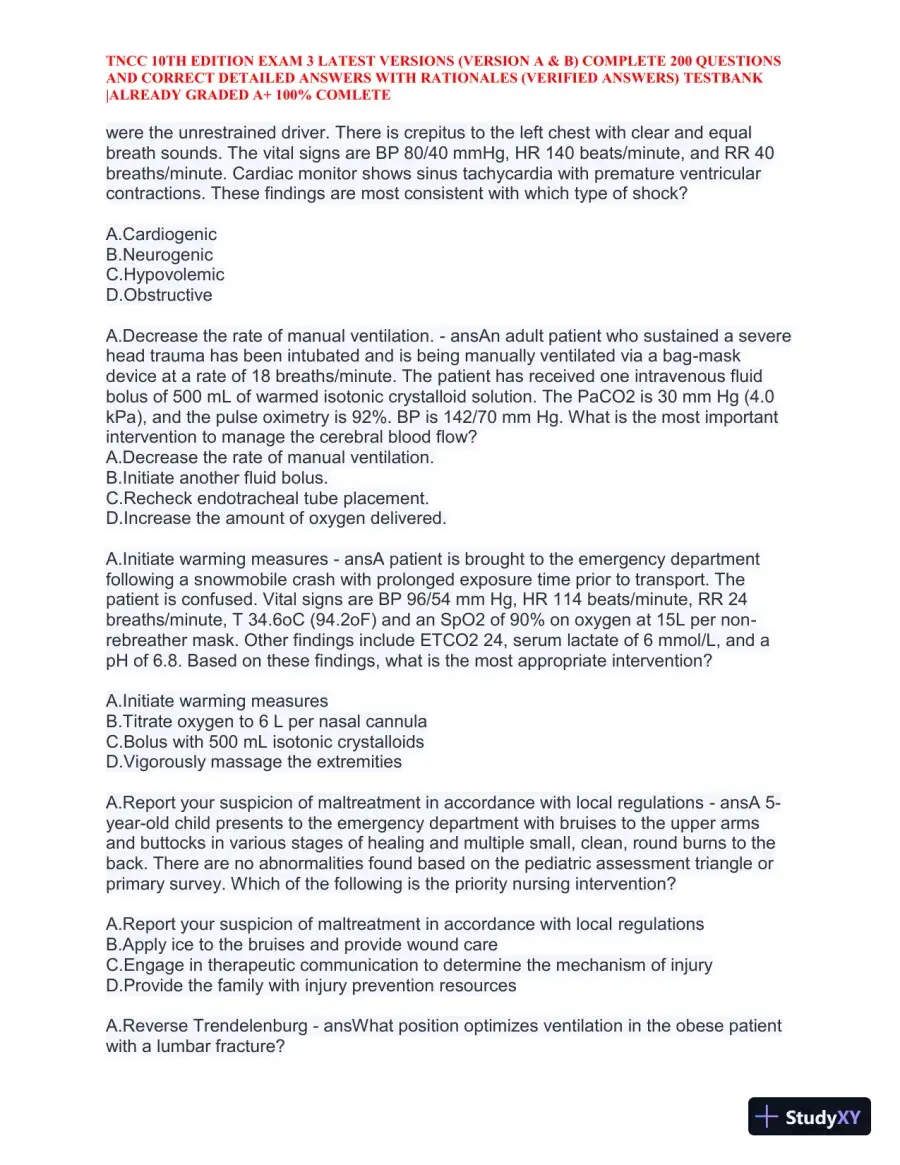 TNCC 10TH EDITION EXAM 3 LATEST VERSIONS (VERSION A & B) COMPLETE 200 QUESTIONSAND CORRECT DETAILED ANSWERS WITH RATIONALES (VERIFIED ANSWERS) TESTBANK|ALREADY GRADED A+ 100% COMLETEwere the unrestrained driver. There is crepitus to the left chest with clear and equalbreath sounds. The vital signs are BP 80/40 mmHg, HR 140 beats/minute, and RR 40breaths/minute. Cardiac monitor shows sinus tachycardia with premature ventricularcontractions. These findings are most consistent with which type of shock?A.CardiogenicB.NeurogenicC.HypovolemicD.ObstructiveA.Decrease the rate of manual ventilation. - ansAn adult patient who sustained a severehead trauma has been intubated and is being manually ventilated via a bag-maskdevice at a rate of 18 breaths/minute. The patient has received one intravenous fluidbolus of 500 mL of warmed isotonic crystalloid solution. The PaCO2 is 30 mm Hg (4.0kPa), and the pulse oximetry is 92%. BP is 142/70 mm Hg. What is the most importantintervention to manage the cerebral blood flow?A.Decrease the rate of manual ventilation.B.Initiate another fluid bolus.C.Recheck endotracheal tube placement.D.Increase the amount of oxygen delivered.A.Initiate warming measures - ansA patient is brought to the emergency departmentfollowing a snowmobile crash with prolonged exposure time prior to transport. Thepatient is confused. Vital signs are BP 96/54 mm Hg, HR 114 beats/minute, RR 24breaths/minute, T 34.6oC (94.2oF) and an SpO2 of 90% on oxygen at 15L per non-rebreather mask. Other findings include ETCO2 24, serum lactate of 6 mmol/L, and apH of 6.8. Based on these findings, what is the most appropriate intervention?A.Initiate warming measuresB.Titrate oxygen to 6 L per nasal cannulaC.Bolus with 500 mL isotonic crystalloidsD.Vigorously massage the extremitiesA.Report your suspicion of maltreatment in accordance with local regulations - ansA 5-year-old child presents to the emergency department with bruises to the upper armsand buttocks in various stages of healing and multiple small, clean, round burns to theback. There are no abnormalities found based on the pediatric assessment triangle orprimary survey. Which of the following is the priority nursing intervention?A.Report your suspicion of maltreatment in accordance with local regulationsB.Apply ice to the bruises and provide wound careC.Engage in therapeutic communication to determine the mechanism of injuryD.Provide the family with injury prevention resourcesA.Reverse Trendelenburg - ansWhat position optimizes ventilation in the obese patientwith a lumbar fracture?
Page 28
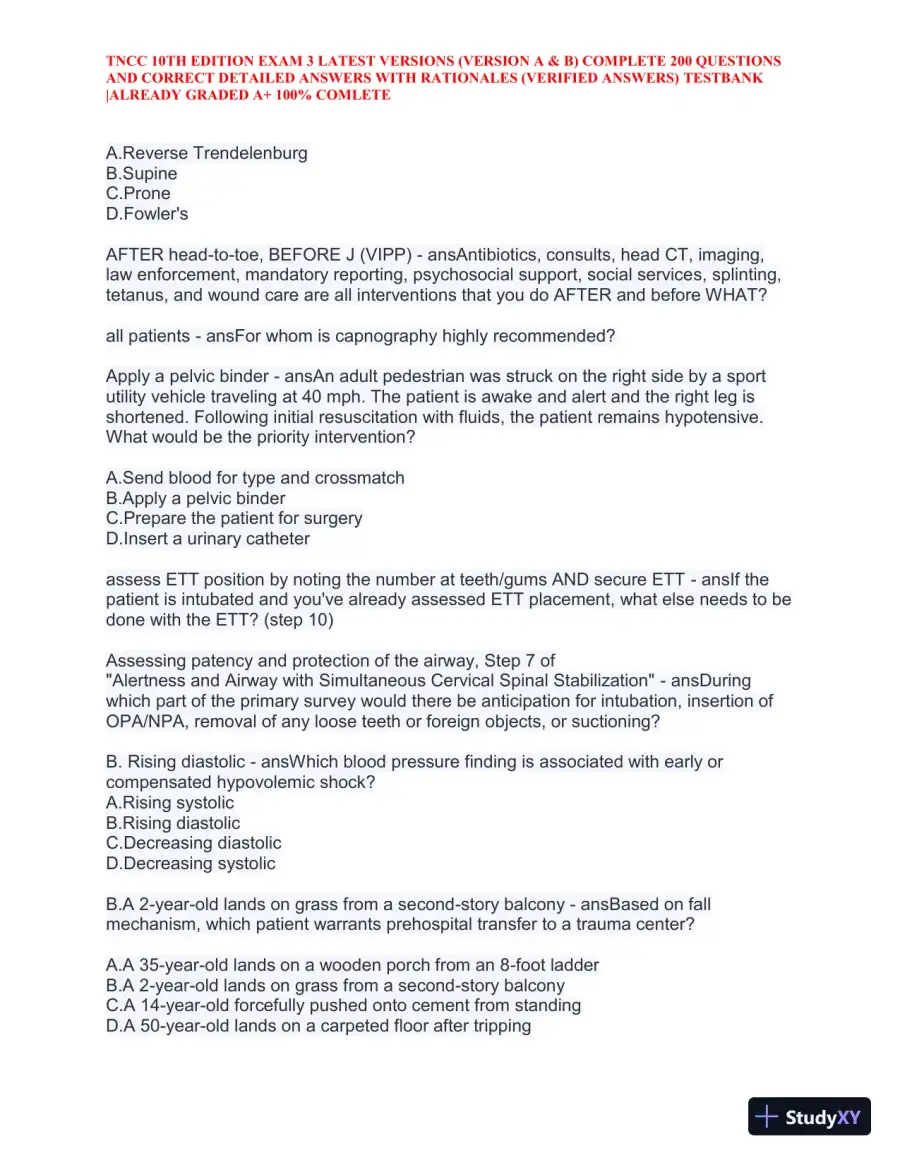 TNCC 10TH EDITION EXAM 3 LATEST VERSIONS (VERSION A & B) COMPLETE 200 QUESTIONSAND CORRECT DETAILED ANSWERS WITH RATIONALES (VERIFIED ANSWERS) TESTBANK|ALREADY GRADED A+ 100% COMLETEA.Reverse TrendelenburgB.SupineC.ProneD.Fowler'sAFTER head-to-toe, BEFORE J (VIPP) - ansAntibiotics, consults, head CT, imaging,law enforcement, mandatory reporting, psychosocial support, social services, splinting,tetanus, and wound care are all interventions that you do AFTER and before WHAT?all patients - ansFor whom is capnography highly recommended?Apply a pelvic binder - ansAn adult pedestrian was struck on the right side by a sportutility vehicle traveling at 40 mph. The patient is awake and alert and the right leg isshortened. Following initial resuscitation with fluids, the patient remains hypotensive.What would be the priority intervention?A.Send blood for type and crossmatchB.Apply a pelvic binderC.Prepare the patient for surgeryD.Insert a urinary catheterassess ETT position by noting the number at teeth/gums AND secure ETT - ansIf thepatient is intubated and you've already assessed ETT placement, what else needs to bedone with the ETT? (step 10)Assessing patency and protection of the airway, Step 7 of"Alertness and Airway with Simultaneous Cervical Spinal Stabilization" - ansDuringwhich part of the primary survey would there be anticipation for intubation, insertion ofOPA/NPA, removal of any loose teeth or foreign objects, or suctioning?B. Rising diastolic - ansWhich blood pressure finding is associated with early orcompensated hypovolemic shock?A.Rising systolicB.Rising diastolicC.Decreasing diastolicD.Decreasing systolicB.A 2-year-old lands on grass from a second-story balcony - ansBased on fallmechanism, which patient warrants prehospital transfer to a trauma center?A.A 35-year-old lands on a wooden porch from an 8-foot ladderB.A 2-year-old lands on grass from a second-story balconyC.A 14-year-old forcefully pushed onto cement from standingD.A 50-year-old lands on a carpeted floor after tripping
Page 29
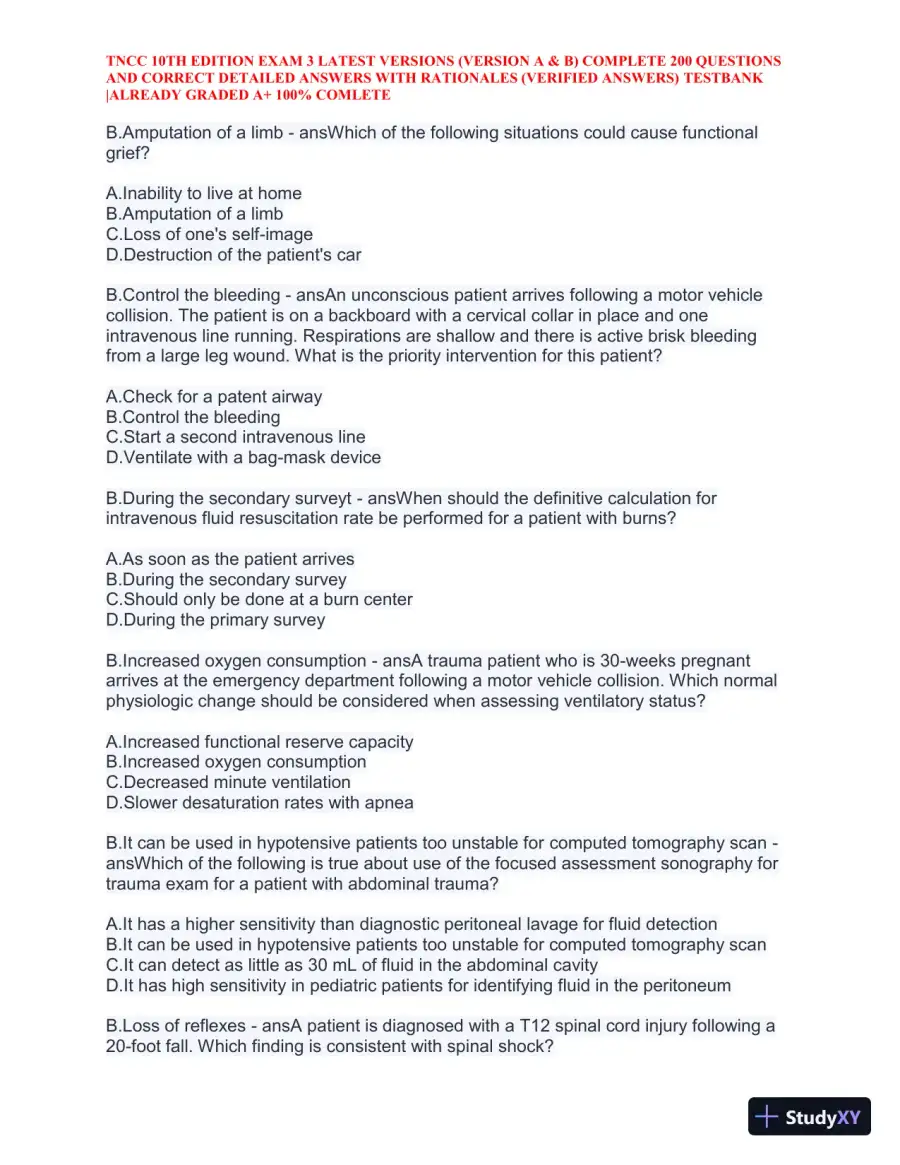 TNCC 10TH EDITION EXAM 3 LATEST VERSIONS (VERSION A & B) COMPLETE 200 QUESTIONSAND CORRECT DETAILED ANSWERS WITH RATIONALES (VERIFIED ANSWERS) TESTBANK|ALREADY GRADED A+ 100% COMLETEB.Amputation of a limb - ansWhich of the following situations could cause functionalgrief?A.Inability to live at homeB.Amputation of a limbC.Loss of one's self-imageD.Destruction of the patient's carB.Control the bleeding - ansAn unconscious patient arrives following a motor vehiclecollision. The patient is on a backboard with a cervical collar in place and oneintravenous line running. Respirations are shallow and there is active brisk bleedingfrom a large leg wound. What is the priority intervention for this patient?A.Check for a patent airwayB.Control the bleedingC.Start a second intravenous lineD.Ventilate with a bag-mask deviceB.During the secondary surveyt - ansWhen should the definitive calculation forintravenous fluid resuscitation rate be performed for a patient with burns?A.As soon as the patient arrivesB.During the secondary surveyC.Should only be done at a burn centerD.During the primary surveyB.Increased oxygen consumption - ansA trauma patient who is 30-weeks pregnantarrives at the emergency department following a motor vehicle collision. Which normalphysiologic change should be considered when assessing ventilatory status?A.Increased functional reserve capacityB.Increased oxygen consumptionC.Decreased minute ventilationD.Slower desaturation rates with apneaB.It can be used in hypotensive patients too unstable for computed tomography scan -ansWhich of the following is true about use of the focused assessment sonography fortrauma exam for a patient with abdominal trauma?A.It has a higher sensitivity than diagnostic peritoneal lavage for fluid detectionB.It can be used in hypotensive patients too unstable for computed tomography scanC.It can detect as little as 30 mL of fluid in the abdominal cavityD.It has high sensitivity in pediatric patients for identifying fluid in the peritoneumB.Loss of reflexes - ansA patient is diagnosed with a T12 spinal cord injury following a20-foot fall. Which finding is consistent with spinal shock?
Page 30
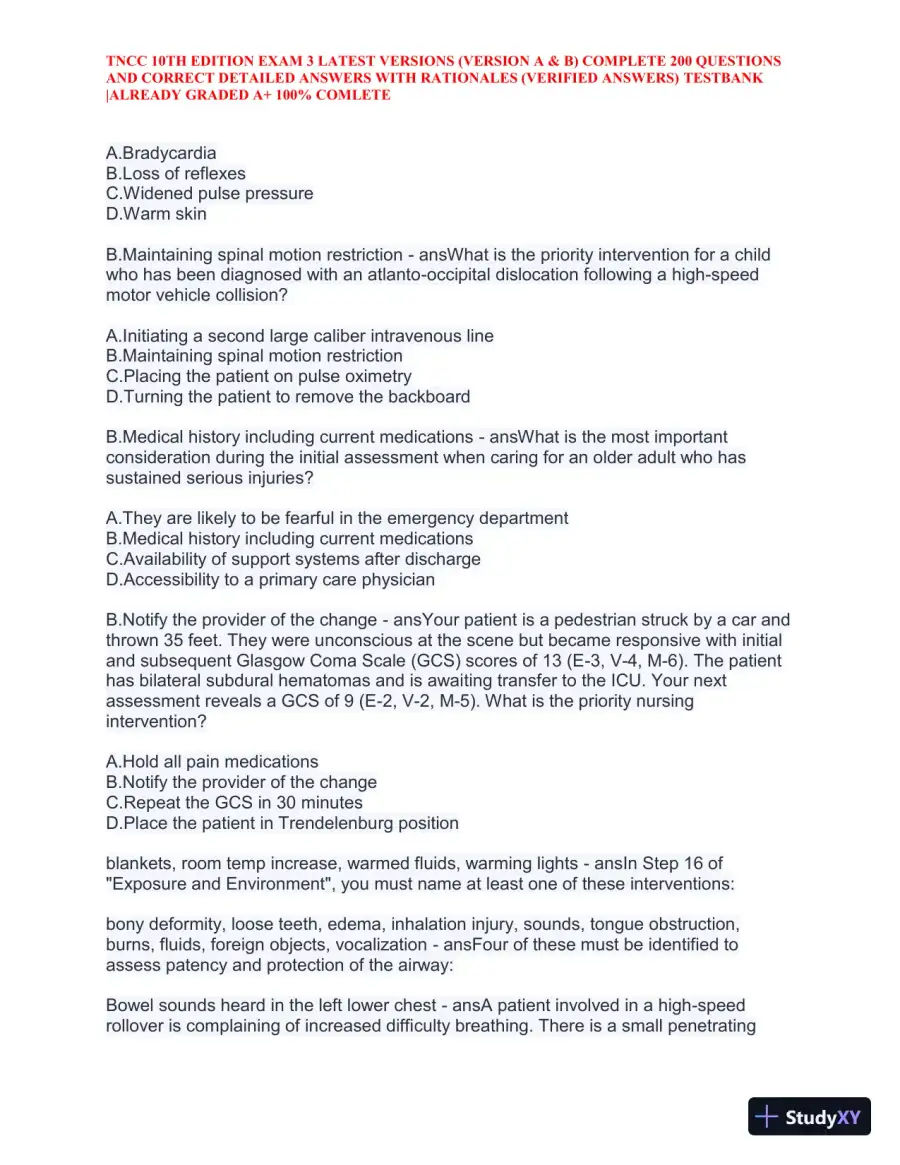 TNCC 10TH EDITION EXAM 3 LATEST VERSIONS (VERSION A & B) COMPLETE 200 QUESTIONSAND CORRECT DETAILED ANSWERS WITH RATIONALES (VERIFIED ANSWERS) TESTBANK|ALREADY GRADED A+ 100% COMLETEA.BradycardiaB.Loss of reflexesC.Widened pulse pressureD.Warm skinB.Maintaining spinal motion restriction - ansWhat is the priority intervention for a childwho has been diagnosed with an atlanto-occipital dislocation following a high-speedmotor vehicle collision?A.Initiating a second large caliber intravenous lineB.Maintaining spinal motion restrictionC.Placing the patient on pulse oximetryD.Turning the patient to remove the backboardB.Medical history including current medications - ansWhat is the most importantconsideration during the initial assessment when caring for an older adult who hassustained serious injuries?A.They are likely to be fearful in the emergency departmentB.Medical history including current medicationsC.Availability of support systems after dischargeD.Accessibility to a primary care physicianB.Notify the provider of the change - ansYour patient is a pedestrian struck by a car andthrown 35 feet. They were unconscious at the scene but became responsive with initialand subsequent Glasgow Coma Scale (GCS) scores of 13 (E-3, V-4, M-6). The patienthas bilateral subdural hematomas and is awaiting transfer to the ICU. Your nextassessment reveals a GCS of 9 (E-2, V-2, M-5). What is the priority nursingintervention?A.Hold all pain medicationsB.Notify the provider of the changeC.Repeat the GCS in 30 minutesD.Place the patient in Trendelenburg positionblankets, room temp increase, warmed fluids, warming lights - ansIn Step 16 of"Exposure and Environment", you must name at least one of these interventions:bony deformity, loose teeth, edema, inhalation injury, sounds, tongue obstruction,burns, fluids, foreign objects, vocalization - ansFour of these must be identified toassess patency and protection of the airway:Bowel sounds heard in the left lower chest - ansA patient involved in a high-speedrollover is complaining of increased difficulty breathing. There is a small penetrating
Page 31
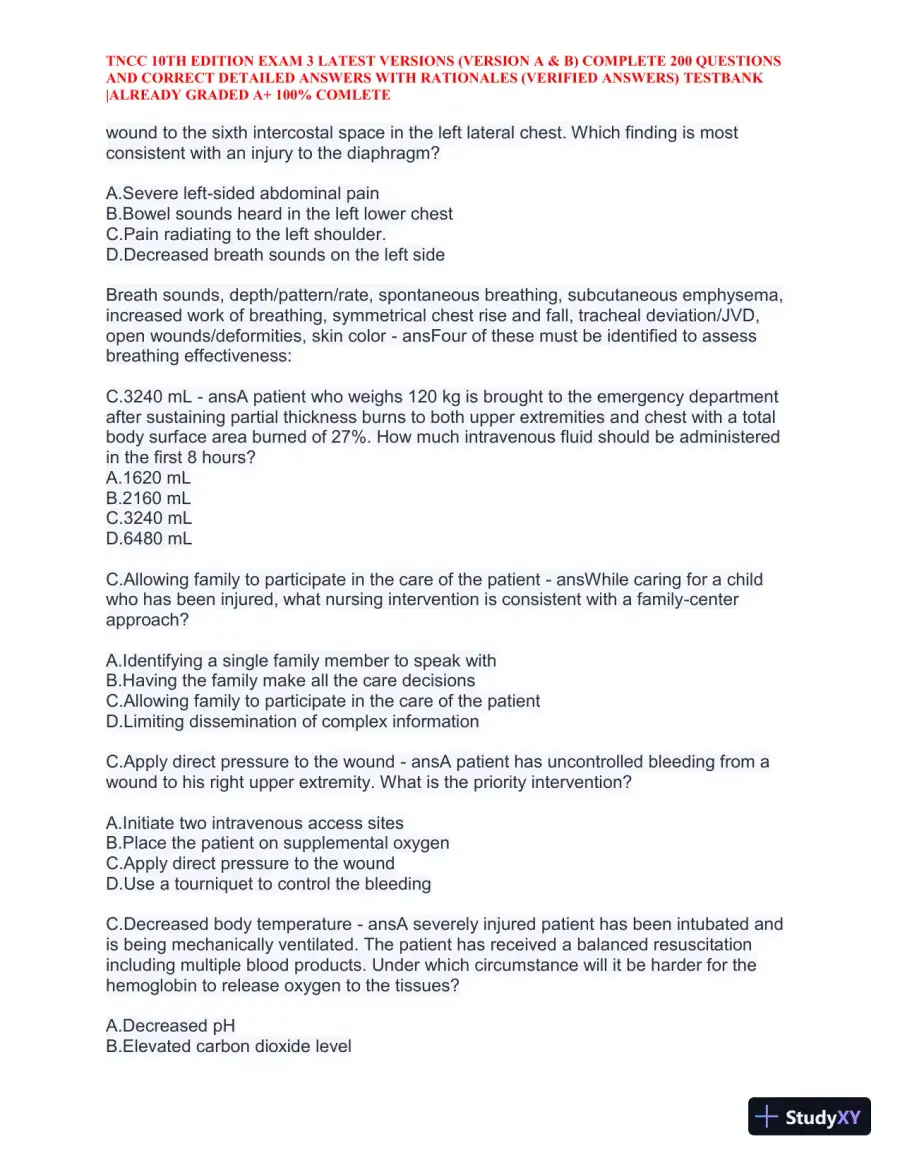 TNCC 10TH EDITION EXAM 3 LATEST VERSIONS (VERSION A & B) COMPLETE 200 QUESTIONSAND CORRECT DETAILED ANSWERS WITH RATIONALES (VERIFIED ANSWERS) TESTBANK|ALREADY GRADED A+ 100% COMLETEwound to the sixth intercostal space in the left lateral chest. Which finding is mostconsistent with an injury to the diaphragm?A.Severe left-sided abdominal painB.Bowel sounds heard in the left lower chestC.Pain radiating to the left shoulder.D.Decreased breath sounds on the left sideBreath sounds, depth/pattern/rate, spontaneous breathing, subcutaneous emphysema,increased work of breathing, symmetrical chest rise and fall, tracheal deviation/JVD,open wounds/deformities, skin color - ansFour of these must be identified to assessbreathing effectiveness:C.3240 mL - ansA patient who weighs 120 kg is brought to the emergency departmentafter sustaining partial thickness burns to both upper extremities and chest with a totalbody surface area burned of 27%. How much intravenous fluid should be administeredin the first 8 hours?A.1620 mLB.2160 mLC.3240 mLD.6480 mLC.Allowing family to participate in the care of the patient - ansWhile caring for a childwho has been injured, what nursing intervention is consistent with a family-centerapproach?A.Identifying a single family member to speak withB.Having the family make all the care decisionsC.Allowing family to participate in the care of the patientD.Limiting dissemination of complex informationC.Apply direct pressure to the wound - ansA patient has uncontrolled bleeding from awound to his right upper extremity. What is the priority intervention?A.Initiate two intravenous access sitesB.Place the patient on supplemental oxygenC.Apply direct pressure to the woundD.Use a tourniquet to control the bleedingC.Decreased body temperature - ansA severely injured patient has been intubated andis being mechanically ventilated. The patient has received a balanced resuscitationincluding multiple blood products. Under which circumstance will it be harder for thehemoglobin to release oxygen to the tissues?A.Decreased pHB.Elevated carbon dioxide level
93 more pages in the full document
Unlock it once and it stays in your library, ready to chat with or turn into flashcards.
Unlock the full documentMore Trauma Nursing Core Course study materials
See all Past Exams
2024 TNCC Nursing Process with Answers (17 Solved Questions)
Trauma Nursing Core Course
2 pages144downloadsFeb 2025 Past Exams
2023-2024 TNCC Final Practice Exam 4 with Answers (49 Solved Questions)
Trauma Nursing Core Course
11 pages123downloadsFeb 2025 Past Exams
TNCC Trauma Nursing Core Course 11th Edition ENA Test with Answers (220 Solved Questions)
Trauma Nursing Core Course
53 pages106downloadsFeb 2025 Past Exams
2023-2024 TNCC Final Practice Exam 4 with Answers (1343 Solved Questions)
Trauma Nursing Core Course
196 pages92downloadsFeb 2025 Past Exams
2024-2025 TNCC: Trauma Nursing Process with Answers (71 Solved Questions)
Trauma Nursing Core Course
11 pages84downloadsFeb 2025 Past Exams
2023-2024 TNCC Final Exam 4 with Answers (1343 Solved Questions)
Trauma Nursing Core Course
196 pages76downloadsFeb 2025 Past Exams
2023-2024 TNCC Final Exam with Answers (48 Solved Questions)
Trauma Nursing Core Course
11 pages40downloadsFeb 2025 Past Exams
2023-2024 TNCC 9th Edition with Answers (498 Solved Questions)
Trauma Nursing Core Course
100 pagesMay 2025
Study this document with CramX
Once it is in your library, every tool can work from it.