
Past Exams
TNCC Trauma Nursing Core Course 11th Edition ENA Test with Answers (220 Solved Questions)
- Trauma Nursing Core Course
- 53 pages
- Shared February 2025
- 106 downloads
Prepare like a pro with TNCC Trauma Nursing Core Course 11th Edition ENA Test with Answers, featuring authentic past exams.
Preview · 16 of 53 pages
100%
Page 1
 TNCC TRAUMA NURSING CORECOURSE 11TH EDITION ENA TESTBANK LATEST1. Which of the following requires you to develop a plan of action, initiate the plan,reassess the plan as care for the patient moves forward, and adjust the plan as thepatient's condition or circumstances change?A. Principles of PHTLSB. The Golden PeriodC. The XABCDE assessmentD. Critical thinking process - ansQuestion 1: DTo help achieve the PHTLS goals, you will apply your critical thinking skills in the field.Critical thinking in medicine is a process in which the healthcare practitioner assessesthe situation, the patient, and the resources available and uses the information to decideon and provide the best care for the patient.1. You and your partner are responding to a call for a 2-year-old patient with a burninjury to the hand. He has a visible burn to the left hand, ending at the level above thewrist, red color, and wet in appearance. What type of burn do you suspect the patienthas sustained?A. Superficial (first degree)B. Partial thickness (second degree)C. Full thickness (third degree)D. Subdermal (fourth degree) - ansQuestion 1: BScald burns are the most common burns seen in the pediatric population ages 1 to 5years. Scalds are partial thickness burns. The dermal layer is damaged, and blisters arepresent or popped. It is also the most painful type of burn.1. You are called to the scene of a possible mass casualty motor vehicle collision on thehighway. Once you arrive on scene, what is your first priority?A. Immediately begin triaging patients.B. Treat the patient with the most visible blood loss.C. Determine the need for additional resources.D. Assess the scene and ensure it is safe. - ansQuestion 1: DEnsure safety for responders, bystanders, and patient(s). The first consideration whenapproaching any scene is the safety of all emergency responders. When EMSpersonnel become victims, they not only can no longer assist others, but also add to thenumber of patients.1. You are called to the scene of an explosion and fire at a chemical plant where youfind multiple casualties.Triage has begun. Your first patient is a 40-year-old man whowas near the source of the explosion. He is unconscious and has extensive injuries.
Page 2

Page 3
 TNCC TRAUMA NURSING CORECOURSE 11TH EDITION ENA TESTBANK LATESTYou note gurgling respirations. Why should you use the trauma jaw thrust maneuverfirst when dealing with a trauma patient?A. It's an easy technique that always works to open the airway.B. It allows you to open the airway with little or no movement of the head and cervicalspine.C. Other techniques and interventions don't work as well.D. It can relieve a variety of anatomic airway obstructions in patients who are breathingspontaneously. - ansQuestion 1: BManual maneuvers like the trauma jaw thrust or chin lift are always the first airwaymaneuver you should make when treating a trauma patient. In patients with suspectedhead, neck, orfacial trauma, the cervical spine is maintained in a neutral in-lineposition.The trauma jaw thrust maneuver allows you to open the airway with little or nomovement of the head and cervical spine.1. You are responding to a call for 25-year-old, fit and healthy female who fell off amountain bike. Upon arrival, you find the patient walking around. She is alert butcomplaining of pain in her clavicle and on her right side when she inhales. You noticethat her helmet is split in two. What is the first thing you need to do?A. Complete a review of the ABCs.B. Check motor and sensory function.C. Perform manual in-line stabilization.D. Place her on a backboard. - ansQuestion 1: CBecause there's a possibility of spinal injury, you should bring the patient's head into aneutral in-line position.1. You have been performing ongoing management on a 35-year-old female patientwho sustained thoracic trauma when a car hit her as she crossed the street. Originally,your electronic monitoring devices all produce results consistent with your patient'sclinical condition. However, en route the trauma center, the monitors start to differ fromyour patient's current clinical condition each time you reassess. How should you handlethis situation?A. Treat the patient's condition, not the monitor results.B. Continue to reassess the patient and record the results for the trauma center.C. Treat your patient based on the test results.D. Stop testing and wait until you arrive at the trauma center for them to perform anassessment. - ansQuestion 1: AIf there are inconsistent data from electronic monitoring devices, reassess to be surethe monitor matches the patient's current clinical condition. However, it is mostimportant to treat the patient, not the monitor, so use other signs and symptoms ofpotential patient deterioration.
Page 4
 TNCC TRAUMA NURSING CORECOURSE 11TH EDITION ENA TESTBANK LATEST1. You're called out to an assisted living facility for a 72-year-old woman complaining ofa severe headache and experiencing increased confusion. Staff reports she fell out ofher wheelchair earlier in the week but didn't appear to be hurt; however, she's becomeincreasingly disoriented over the last day or so. Vital signs show: BP 110/90; heartrate118 and irregularly regular; ventilation rate 20 and slightly labored; SpO2 93% on roomair. She is taking warfarin for a clotting issue. Which of the following should yoususpect?A. Cerebral contusionB. Epidural hematomaC. Subarachnoid hemorrhageD. Subdural hematoma - ansQuestion 1: DThe patient's age, use of a blood thinner, and the fact she fell recently point to asubdural hematoma.1. Your partner is compressing the bleeding site of a male patient who was stabbedmultiple times in the left chest. The bleeding seems to be controlled, yet the patientbecomes combative. He is pale and is breathing rapidly, yet states that he "can'tbreathe" and feels that he is about to die. Your next step in patient management is to:A. start assisted ventilation.B. give high-flow oxygen.C. decompress the left chest.D. give a 250-mL fluid bolus. - ansQuestion 1: CAfter X come A and B. You can quickly auscultate the lungs (pneumothorax is almostcertain with multiple stabs in the chest) and decompress the chest. Decompressing atension pneumothorax is the quickest way to treat shock.1. Your patient is experiencing severe pain after sustaining a femur fracture in amotorcycle crash. You have a 20 minute transport to the nearest trauma center. Thereare no other injuries noted on your primary and secondary assessments. Which of thefollowing medications would be the best pain management choice?A. NSAIDsB. AcetaminophenC. FentanylD. Morphine - ansQuestion 1: CFentanyl is often a first-line agent due to speed of onset, short duration of action, andminimal effect on hemodynamics. Fentanyl can beadministered IN, IM, IO, or IV. The IVroute provides effects instantly whereasthe IN and IM route have an onset of <10minutes. The duration of fentanyl is short at 30 minutes to an hour. This will provideenough time to ease pain during transport and let the traumacenter decide painmanagement upon arrival.
Page 5
 TNCC TRAUMA NURSING CORECOURSE 11TH EDITION ENA TESTBANK LATEST2. A trauma patient from the highway incident is holding her right arm, and you note asignificant amount of blood steadily flowing from a long gash. This is an example ofwhat type of hemorrhage?A. Capillary bleedingB. Venous bleedingC. Arterial bleedingD. Road rash - ansQuestion 2: BVenous bleeding typically results in a steady flow of dark red blood.2. During primary survey, you find the following:. LOC: alert and oriented; speaking in full sentences. GCS: 15. Airway: good air entry to bases. Breathing: bilateral. Circulation: skin warm, flushed, dry. Pulse rate: 112 bpm, strong andregular. BP: 90/42 mm Hg. Pain: Patient complains of severe pain at clavicle site and pain on inspiration at site ofpossible fractured ribs. No other injuries detected. What is your next step?A. Apply a cervical collar and in-line immobilization device.B. Treat for hypovolemic shock.C. Apply an arm sling for the clavicle injury.D. Administer pain medication. - ansQuestion 2: AAlthough the patient's GCS is normal, she does have a distracting injury, and the stateof her helmet indicates possible spinal compression/flexion, so you should immobilizethe patient.2. The patient becomes apneic. You suspect he has a cervical injury. Which type ofairway should you use?A. Supraglottic airwayB. Blind nasotracheal intubationC. Oropharyngeal airwayD. Surgical airway - ansQuestion 2: AThe supraglottic airway's greatest advantage is that it can be inserted independent ofthe patient's position, which may be especially important in trauma patients with highsuspicion of cervical injury.2. The patient's care giver is a babysitter who reports the child was crawling on thecounter and placed his hand in a pot of water that was boiling on the stove. She isapplying ice to the burn and the child is shivering. What is your next step?A. Administer analgesia for pain.B. Cover the patient with a blanket to stop the shivering.
Page 6
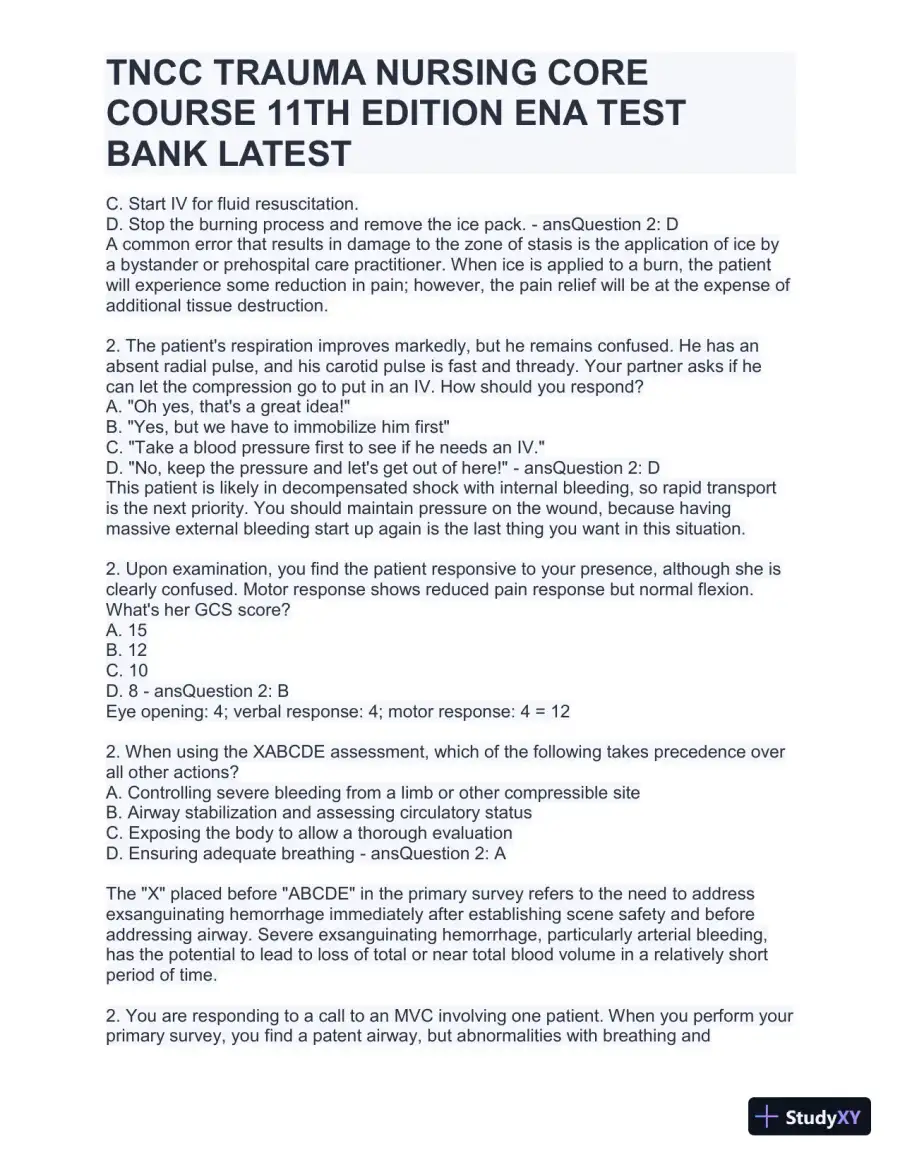 TNCC TRAUMA NURSING CORECOURSE 11TH EDITION ENA TESTBANK LATESTC. Start IV for fluid resuscitation.D. Stop the burning process and remove the ice pack. - ansQuestion 2: DA common error that results in damage to the zone of stasis is the application of ice bya bystander or prehospital care practitioner. When ice is applied to a burn, the patientwill experience some reduction in pain; however, the pain relief will be at the expense ofadditional tissue destruction.2. The patient's respiration improves markedly, but he remains confused. He has anabsent radial pulse, and his carotid pulse is fast and thready. Your partner asks if hecan let the compression go to put in an IV. How should you respond?A. "Oh yes, that's a great idea!"B. "Yes, but we have to immobilize him first"C. "Take a blood pressure first to see if he needs an IV."D. "No, keep the pressure and let's get out of here!" - ansQuestion 2: DThis patient is likely in decompensated shock with internal bleeding, so rapid transportis the next priority. You should maintain pressure on the wound, because havingmassive external bleeding start up again is the last thing you want in this situation.2. Upon examination, you find the patient responsive to your presence, although she isclearly confused. Motor response shows reduced pain response but normal flexion.What's her GCS score?A. 15B. 12C. 10D. 8 - ansQuestion 2: BEye opening: 4; verbal response: 4; motor response: 4 = 122. When using the XABCDE assessment, which of the following takes precedence overall other actions?A. Controlling severe bleeding from a limb or other compressible siteB. Airway stabilization and assessing circulatory statusC. Exposing the body to allow a thorough evaluationD. Ensuring adequate breathing - ansQuestion 2: AThe "X" placed before "ABCDE" in the primary survey refers to the need to addressexsanguinating hemorrhage immediately after establishing scene safety and beforeaddressing airway. Severe exsanguinating hemorrhage, particularly arterial bleeding,has the potential to lead to loss of total or near total blood volume in a relatively shortperiod of time.2. You are responding to a call to an MVC involving one patient. When you perform yourprimary survey, you find a patent airway, but abnormalities with breathing and
Page 7
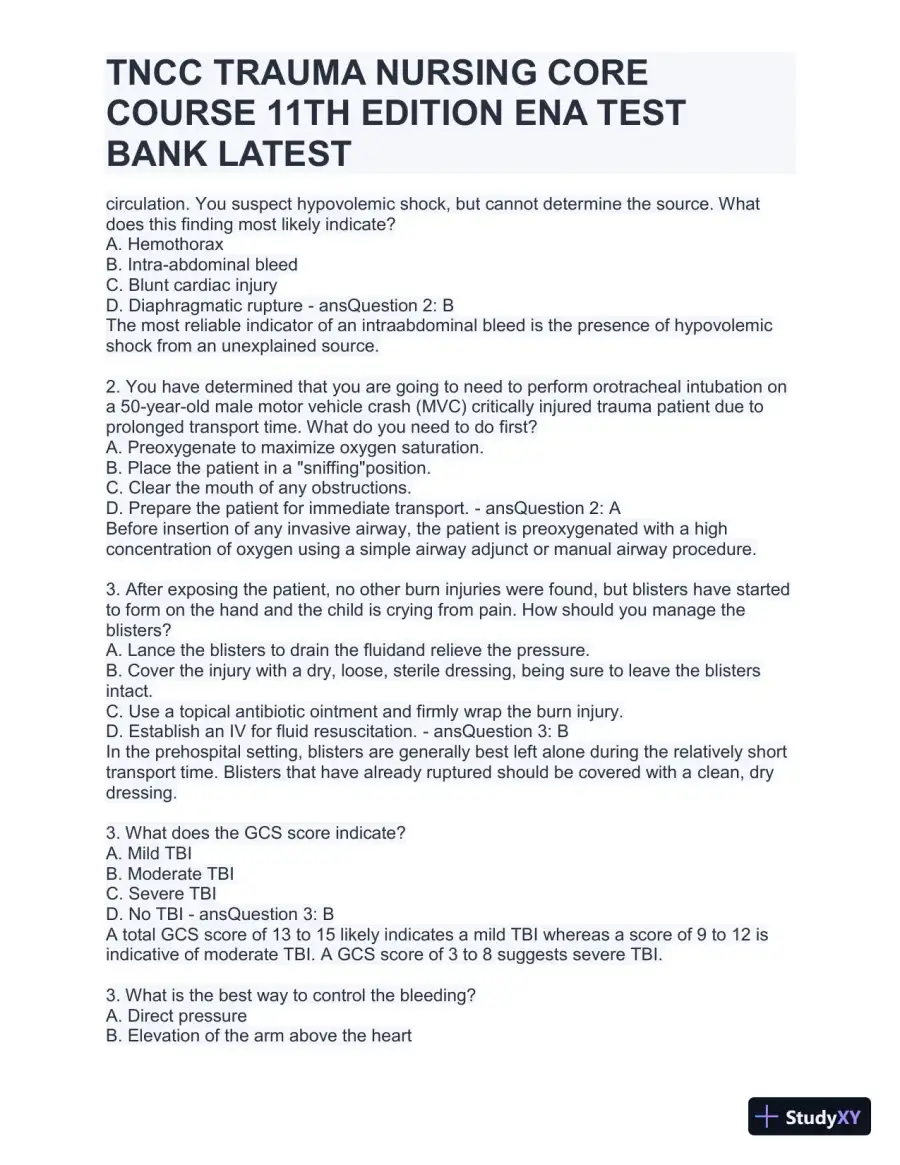 TNCC TRAUMA NURSING CORECOURSE 11TH EDITION ENA TESTBANK LATESTcirculation. You suspect hypovolemic shock, but cannot determine the source. Whatdoes this finding most likely indicate?A. HemothoraxB. Intra-abdominal bleedC. Blunt cardiac injuryD. Diaphragmatic rupture - ansQuestion 2: BThe most reliable indicator of an intraabdominal bleed is the presence of hypovolemicshock from an unexplained source.2. You have determined that you are going to need to perform orotracheal intubation ona 50-year-old male motor vehicle crash (MVC) critically injured trauma patient due toprolonged transport time. What do you need to do first?A. Preoxygenate to maximize oxygen saturation.B. Place the patient in a "sniffing"position.C. Clear the mouth of any obstructions.D. Prepare the patient for immediate transport. - ansQuestion 2: ABefore insertion of any invasive airway, the patient is preoxygenated with a highconcentration of oxygen using a simple airway adjunct or manual airway procedure.3. After exposing the patient, no other burn injuries were found, but blisters have startedto form on the hand and the child is crying from pain. How should you manage theblisters?A. Lance the blisters to drain the fluidand relieve the pressure.B. Cover the injury with a dry, loose, sterile dressing, being sure to leave the blistersintact.C. Use a topical antibiotic ointment and firmly wrap the burn injury.D. Establish an IV for fluid resuscitation. - ansQuestion 3: BIn the prehospital setting, blisters are generally best left alone during the relatively shorttransport time. Blisters that have already ruptured should be covered with a clean, drydressing.3. What does the GCS score indicate?A. Mild TBIB. Moderate TBIC. Severe TBID. No TBI - ansQuestion 3: BA total GCS score of 13 to 15 likely indicates a mild TBI whereas a score of 9 to 12 isindicative of moderate TBI. A GCS score of 3 to 8 suggests severe TBI.3. What is the best way to control the bleeding?A. Direct pressureB. Elevation of the arm above the heart
Page 8
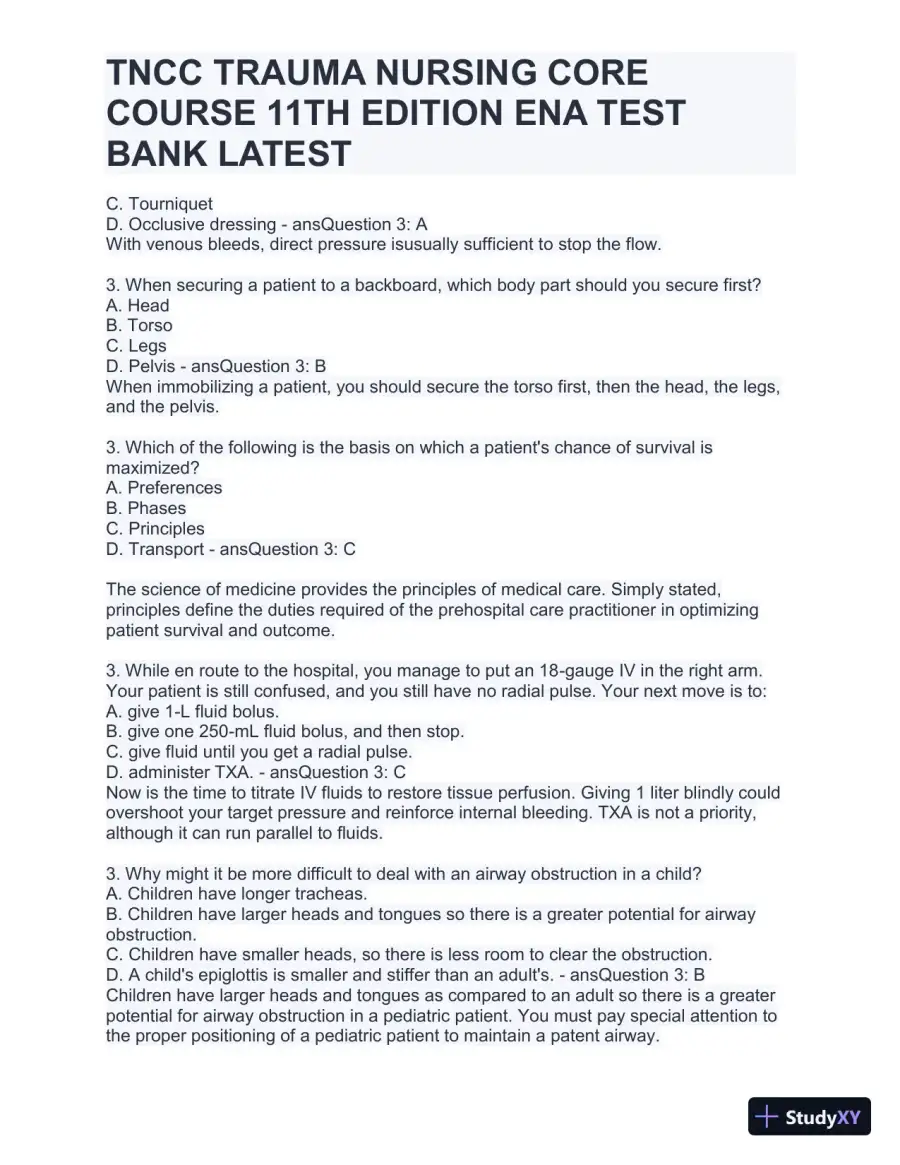 TNCC TRAUMA NURSING CORECOURSE 11TH EDITION ENA TESTBANK LATESTC. TourniquetD. Occlusive dressing - ansQuestion 3: AWith venous bleeds, direct pressure isusually sufficient to stop the flow.3. When securing a patient to a backboard, which body part should you secure first?A. HeadB. TorsoC. LegsD. Pelvis - ansQuestion 3: BWhen immobilizing a patient, you should secure the torso first, then the head, the legs,and the pelvis.3. Which of the following is the basis on which a patient's chance of survival ismaximized?A. PreferencesB. PhasesC. PrinciplesD. Transport - ansQuestion 3: CThe science of medicine provides the principles of medical care. Simply stated,principles define the duties required of the prehospital care practitioner in optimizingpatient survival and outcome.3. While en route to the hospital, you manage to put an 18-gauge IV in the right arm.Your patient is still confused, and you still have no radial pulse. Your next move is to:A. give 1-L fluid bolus.B. give one 250-mL fluid bolus, and then stop.C. give fluid until you get a radial pulse.D. administer TXA. - ansQuestion 3: CNow is the time to titrate IV fluids to restore tissue perfusion. Giving 1 liter blindly couldovershoot your target pressure and reinforce internal bleeding. TXA is not a priority,although it can run parallel to fluids.3. Why might it be more difficult to deal with an airway obstruction in a child?A. Children have longer tracheas.B. Children have larger heads and tongues so there is a greater potential for airwayobstruction.C. Children have smaller heads, so there is less room to clear the obstruction.D. A child's epiglottis is smaller and stiffer than an adult's. - ansQuestion 3: BChildren have larger heads and tongues as compared to an adult so there is a greaterpotential for airway obstruction in a pediatric patient. You must pay special attention tothe proper positioning of a pediatric patient to maintain a patent airway.
Page 9
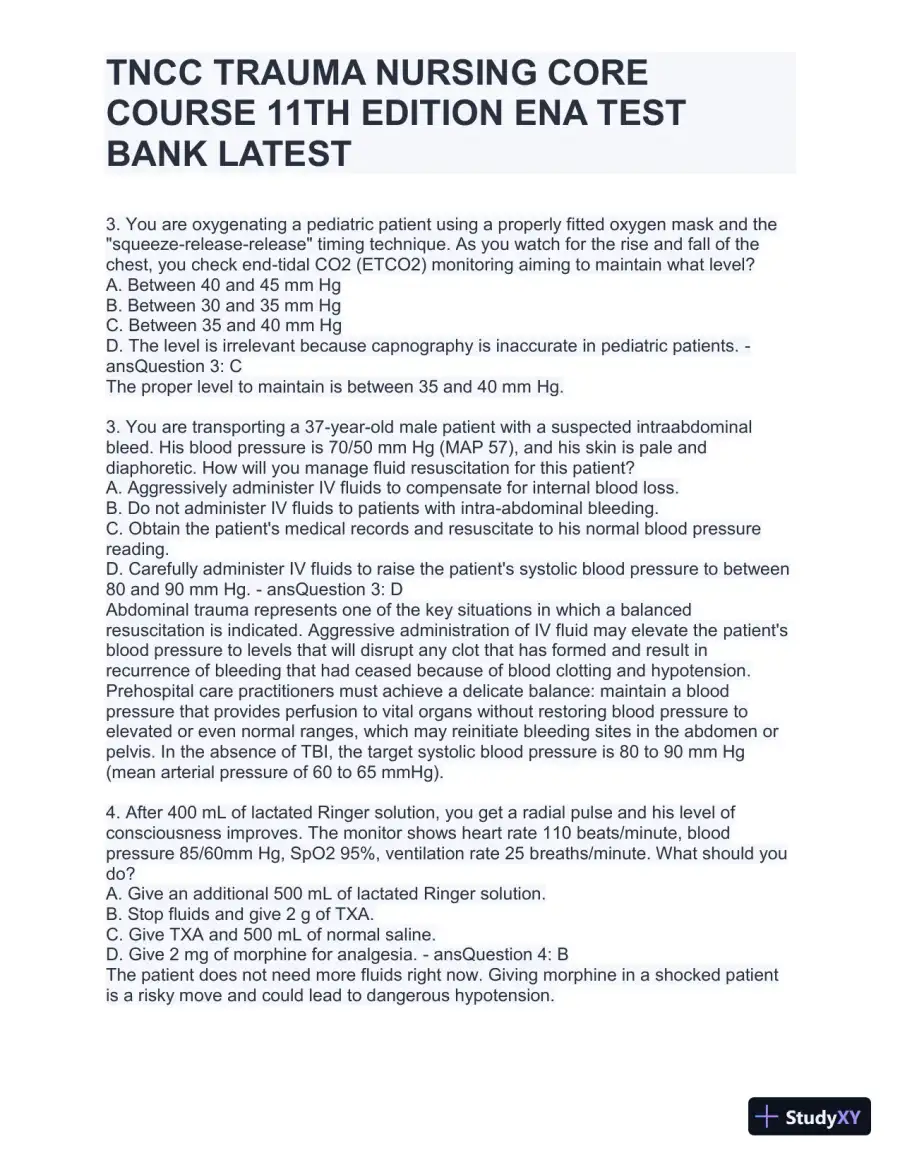 TNCC TRAUMA NURSING CORECOURSE 11TH EDITION ENA TESTBANK LATEST3. You are oxygenating a pediatric patient using a properly fitted oxygen mask and the"squeeze-release-release" timing technique. As you watch for the rise and fall of thechest, you check end-tidal CO2 (ETCO2) monitoring aiming to maintain what level?A. Between 40 and 45 mm HgB. Between 30 and 35 mm HgC. Between 35 and 40 mm HgD. The level is irrelevant because capnography is inaccurate in pediatric patients. -ansQuestion 3: CThe proper level to maintain is between 35 and 40 mm Hg.3. You are transporting a 37-year-old male patient with a suspected intraabdominalbleed. His blood pressure is 70/50 mm Hg (MAP 57), and his skin is pale anddiaphoretic. How will you manage fluid resuscitation for this patient?A. Aggressively administer IV fluids to compensate for internal blood loss.B. Do not administer IV fluids to patients with intra-abdominal bleeding.C. Obtain the patient's medical records and resuscitate to his normal blood pressurereading.D. Carefully administer IV fluids to raise the patient's systolic blood pressure to between80 and 90 mm Hg. - ansQuestion 3: DAbdominal trauma represents one of the key situations in which a balancedresuscitation is indicated. Aggressive administration of IV fluid may elevate the patient'sblood pressure to levels that will disrupt any clot that has formed and result inrecurrence of bleeding that had ceased because of blood clotting and hypotension.Prehospital care practitioners must achieve a delicate balance: maintain a bloodpressure that provides perfusion to vital organs without restoring blood pressure toelevated or even normal ranges, which may reinitiate bleeding sites in the abdomen orpelvis. In the absence of TBI, the target systolic blood pressure is 80 to 90 mm Hg(mean arterial pressure of 60 to 65 mmHg).4. After 400 mL of lactated Ringer solution, you get a radial pulse and his level ofconsciousness improves. The monitor shows heart rate 110 beats/minute, bloodpressure 85/60mm Hg, SpO2 95%, ventilation rate 25 breaths/minute. What should youdo?A. Give an additional 500 mL of lactated Ringer solution.B. Stop fluids and give 2 g of TXA.C. Give TXA and 500 mL of normal saline.D. Give 2 mg of morphine for analgesia. - ansQuestion 4: BThe patient does not need more fluids right now. Giving morphine in a shocked patientis a risky move and could lead to dangerous hypotension.
Page 10
 TNCC TRAUMA NURSING CORECOURSE 11TH EDITION ENA TESTBANK LATEST4. The patient is wearing long sleeves, and you are having trouble visualizing thewound. What should you do?A. Cut the cloth away from the site until the entire wound site is visible.B. Leave the clothing in place. Put gauze over the wound.C. Remove the patient's shirt.D. Cut through the slash on the sleeve, and use the material as a makeshift tourniquet. -ansQuestion 4: AClothing can be quickly removed by cutting. You cannot treat what you cannot see.4. What is one reason to use capnography as part of your patient reassessment?A. To get accurate readings for blood pressureB. To assure proper ET tube placementC. To measure arterial blood saturationD. To ensure proper placement for needle decompression - ansQuestion 4: BCapnography can monitor proper endotracheal tube placement. It doesn't read bloodpressure, so it cannot beused to determine if a patient is hypotensive. Pulse oximetry,not capnography, measures arterial blood saturation. Capnography is not useful inneedle decompression.4. What type of padding should you provide for this patient?A. Use compressible padding under the shoulders and torso to prevent hyperflexion.B. Use firm padding between the back of the head and the backboard to preventhyperextension.C. Do not use any padding. It can cause extension or flexion in the neck.D. No padding needed, but to avoid decreased venous return you should tip thebackboard to a left lateral position. - ansQuestion 4: BBecause the patient is an adult, you should use firm padding between the back of thehead and the backboard to prevent hyperextension. You would pad a child's shoulderand torso to prevent hyperflexion, and you would tip the backboard for a pregnantpatient to prevent decreased venous return.4. When you examine the patient's pupils, you notice the right one is dilated significantlyand her motor response on the left is delayed. What does this suggest?A. Coup-countercoup injuryB. HyphemaC. HypoxiaD. Uncal herniation - ansQuestion 4: DWhen the medial portion of the temporal lobe (uncus) is pushed toward the tentoriumand puts pressure on the brain stem, herniation compresses CN III, the motor tract, andthe reticular activating system on the same side, resulting in a dilated or blown pupil onthe same side, motor weakness on the opposite side, and respiratory dysfunction,progressing to coma.
Page 11
 TNCC TRAUMA NURSING CORECOURSE 11TH EDITION ENA TESTBANK LATEST4. Which of the following is a goal of the Golden Period?A. Provide written documentation from field care to receiving hospital.B. Expedite the field care and transport of the patient.C. Use a team approach for optimal patient care.D. Use the XABCDE approach to patient assessment. - ansQuestion 4: BOne of your most importantresponsibilities as a prehospital carepractitioner is to spendas little time onthe scene as possible and expedite yourfield care and transport of thepatient.Studies show that the time from injuryto arrival at the appropriate sitefordefinitive care is critical to survival.4. Why might you consider early mechanical ventilation via bag-mask device in ageriatric patient?A. Shorter tracheas in geriatric patients create the need for ventilation assistance.B. Laxity of the rib cage makes hyperventilation more likely.C. Geriatric patients have greatly limited physiologic reserve.D. Geriatric patients have a greater alveolar surface area of the lungs. - ansQuestion 4:CEarly mechanical ventilation via bag mask device or advanced airway measures shouldbe considered in geriatric trauma patients because of their greatly limited physiologicreserve.5. Which of the following signs would be most concerning at this point?A. A drop in systolic blood pressure to 88 mm HgB. SpO₂of 93%C. A field GCS motor score of 4D. Hemiplegia on the left side - ansQuestion 5: AA systolic blood pressure of less than 90 mm Hg indicates secondary brain injury. HerSpO2 is > 90%, and a motor score of 4 is not as concerning.5. While attempting to lay the patient supine for spinal motion restriction she becomesincreasingly distressed and complains of shortness of breath and difficulty breathing.The fractured clavicle appears to move distally and increases the difficulty of breathingas the patient lies back. What should you do?A. Tip the backboard to a left lateral position.B. Raise the back of the stretcher.C. Let her sit up in a position of comfort.D. Administer morphine. - ansQuestion 5: BBecause laying the patient supine increases the risk of airway/ventilation problems,raising the back of the stretchers slightly fundamentally maintains spinal alignment whilereducing the ventilation issues.
Page 12
 TNCC TRAUMA NURSING CORECOURSE 11TH EDITION ENA TESTBANK LATEST5. You now perform a secondary survey. You notice a sternotomy scar. Your patienttells you he is on oral clopidogrel since he had a coronary artery bypass graft 2 yearsago. Is this information useful?A. No, he should stop talking and breathe.B. Yes, he should see a cardiologist once in the local hospital.C. Yes, he will need platelets and a heart surgeon ASAP.D. Yes, you should raise his blood pressure up to 130 mm Hg systolic. - ansQuestion 5:CBecause he is on clopidogrel, his platelets are out of order for at least 5 days, so he willrequire urgent platelet transfusion.6. According to the Monro-Kellie doctrine, what happens to the brain when it is still in acompensated state after a TBI?A. CSF, ICP, heart rate, and blood pressure are still within normal range.B. CSF increases, ICP decreases, heart rate increases, and blood pressure decreases.C. CSF and blood volume decrease, while heart rate and blood pressure are still withinnormál range.D. CSF decreases, ICP increases, heart rate decreases, and blood pressure increases.- ansQuestion 6: CIn a compensated state, CSF and blood volume decrease, while heart rate and bloodpressure are still within normal range._________ therapy is now suggested for fluid resuscitation to replace patient losses,including administering PRBCs, plasma, and platelets. - ansCOMPONENT THERAPYch. 5, p. 45__________, which can occur in resuscitation, is a common IATROGENIC cause ofINCREASED intrathoracic pressure resulting in COMPRESSION of the heart andDECREASED cardiac output. - ansHYPERVENTILATIONch. 7, p. 7455% of spinal injuries occur to which part of spine? - anscervicalch. 13, p. 179A rapid, thready pulse may indicate (a. _______), and an irregular pulse may warn ofpotential (b. _______). - ansa. HYPOVOLEMIAb. CARDIAC DYSFUNCTIONch. 5, p. 45
Page 13
 TNCC TRAUMA NURSING CORECOURSE 11TH EDITION ENA TESTBANK LATESTABGs provide values of oxygen, CO2 and base excess, which are... - ansReflectiveendpoint measurements of the effectiveness of cellular perfusion, adequacy ofventilation, and the success of the resuscitation.An abnormal base deficit may indicate poor perfusion and tissue hypoxia, which resultsin the generation of hydrogen ions and metabolic acidosis.ch. 5, p. 46Activation of the SYMPATHETIC NERVOUS SYSTEM causes the ADRENAL glands torelease TWO catecholamines - EPINEPHRINE and NOREPINEPHRINE. Thesecause... - ans- HIGH levels of EPINEPHRINE cause smooth muscle relaxation in theairways and causes arteriole smooth muscle contractility (potentiating inotrophic effect).EPI also INCREASES heart rate (positive chronotrophic effect), peripheralvasocontriction, and glycogenolysis (breakdown of glycogen stores in liver into glucosefor cellular use)- NOREPINEPHRINE increases heart rate, vascular tone through alpha-adrenergicreceptor activation, and blood flow to skeletal muscle and triggers the release ofglucose from energy stores.ch. 7, p. 77Additional history includes the following (MIST mnemonic) prehospital report: - ans- MOI- Injuries sustained- Signs and Symptoms (in the field)- Treatment (in the field)ch. 5, p. 47All open fractures are considered contaminated due to exposure to the environment andare at risk for infection. These sites of injury have poor wound healing with a risk of.... -ansOSTEOMYELITIS and SEPSISch. 14, p. 197Anterior cord syndrome - ansloss of pain and temperature sensation with weakness,paresthesia, and urinary retentionch. 13, p. 182
Page 14
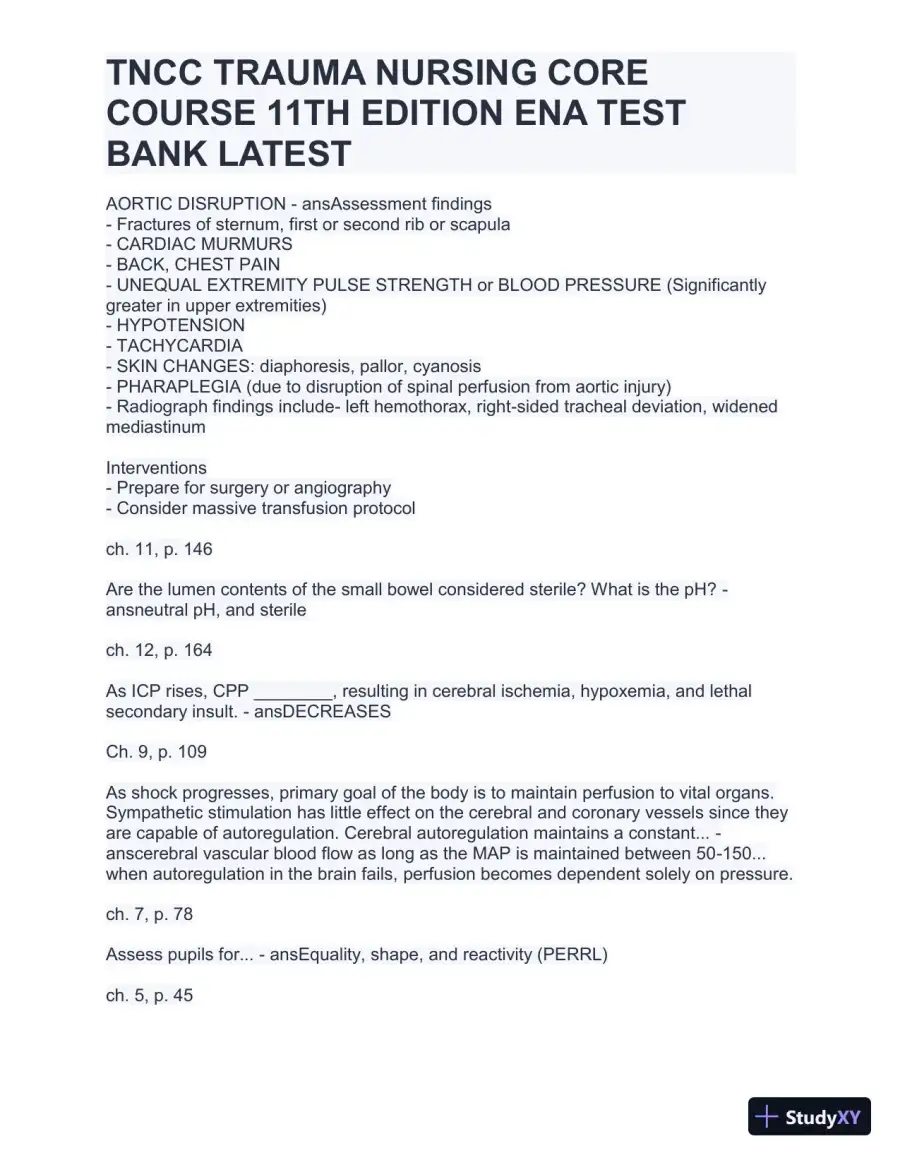 TNCC TRAUMA NURSING CORECOURSE 11TH EDITION ENA TESTBANK LATESTAORTIC DISRUPTION - ansAssessment findings- Fractures of sternum, first or second rib or scapula- CARDIAC MURMURS- BACK, CHEST PAIN- UNEQUAL EXTREMITY PULSE STRENGTH or BLOOD PRESSURE (Significantlygreater in upper extremities)- HYPOTENSION- TACHYCARDIA- SKIN CHANGES: diaphoresis, pallor, cyanosis- PHARAPLEGIA (due to disruption of spinal perfusion from aortic injury)- Radiograph findings include- left hemothorax, right-sided tracheal deviation, widenedmediastinumInterventions- Prepare for surgery or angiography- Consider massive transfusion protocolch. 11, p. 146Are the lumen contents of the small bowel considered sterile? What is the pH? -ansneutral pH, and sterilech. 12, p. 164As ICP rises, CPP ________, resulting in cerebral ischemia, hypoxemia, and lethalsecondary insult. - ansDECREASESCh. 9, p. 109As shock progresses, primary goal of the body is to maintain perfusion to vital organs.Sympathetic stimulation has little effect on the cerebral and coronary vessels since theyare capable of autoregulation. Cerebral autoregulation maintains a constant... -anscerebral vascular blood flow as long as the MAP is maintained between 50-150...when autoregulation in the brain fails, perfusion becomes dependent solely on pressure.ch. 7, p. 78Assess pupils for... - ansEquality, shape, and reactivity (PERRL)ch. 5, p. 45
Page 15
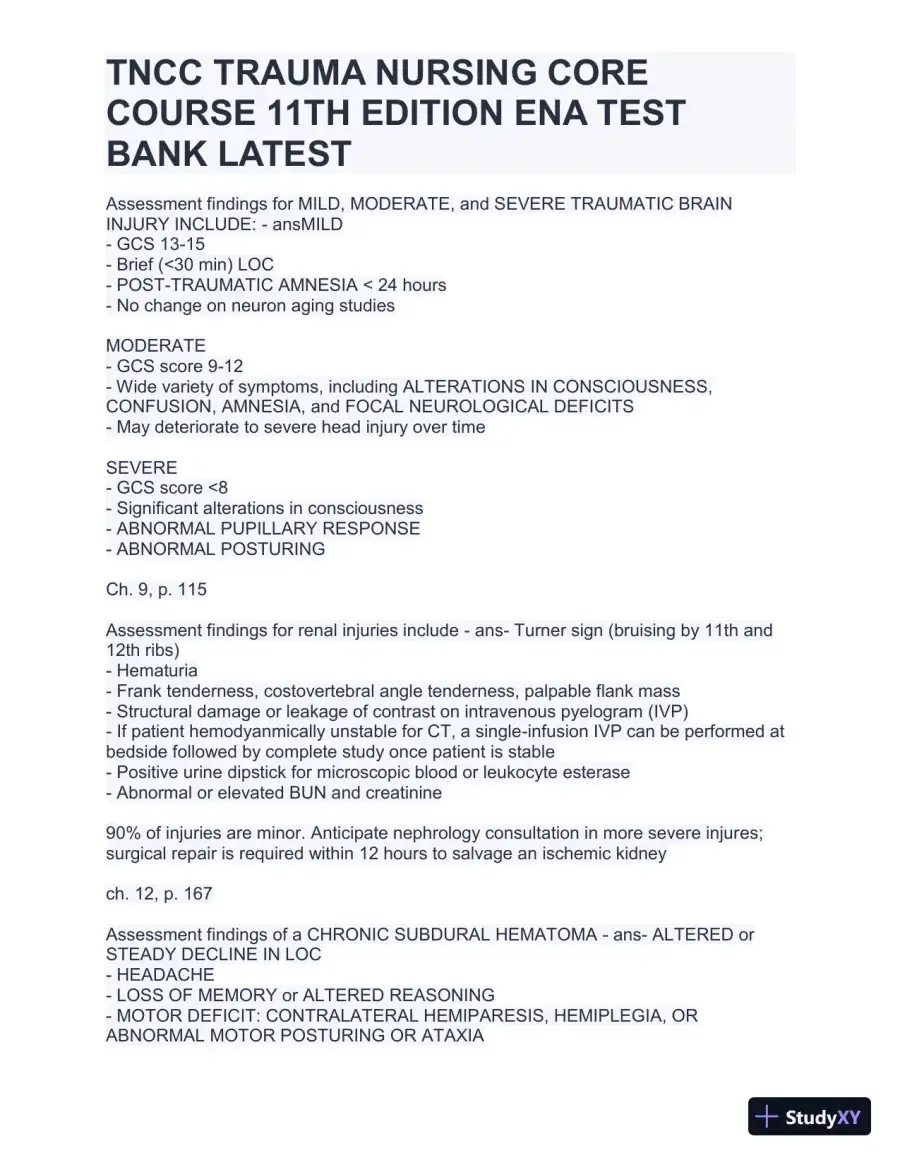 TNCC TRAUMA NURSING CORECOURSE 11TH EDITION ENA TESTBANK LATESTAssessment findings for MILD, MODERATE, and SEVERE TRAUMATIC BRAININJURY INCLUDE: - ansMILD- GCS 13-15- Brief (<30 min) LOC- POST-TRAUMATIC AMNESIA < 24 hours- No change on neuron aging studiesMODERATE- GCS score 9-12- Wide variety of symptoms, including ALTERATIONS IN CONSCIOUSNESS,CONFUSION, AMNESIA, and FOCAL NEUROLOGICAL DEFICITS- May deteriorate to severe head injury over timeSEVERE- GCS score <8- Significant alterations in consciousness- ABNORMAL PUPILLARY RESPONSE- ABNORMAL POSTURINGCh. 9, p. 115Assessment findings for renal injuries include - ans- Turner sign (bruising by 11th and12th ribs)- Hematuria- Frank tenderness, costovertebral angle tenderness, palpable flank mass- Structural damage or leakage of contrast on intravenous pyelogram (IVP)- If patient hemodyanmically unstable for CT, a single-infusion IVP can be performed atbedside followed by complete study once patient is stable- Positive urine dipstick for microscopic blood or leukocyte esterase- Abnormal or elevated BUN and creatinine90% of injuries are minor. Anticipate nephrology consultation in more severe injures;surgical repair is required within 12 hours to salvage an ischemic kidneych. 12, p. 167Assessment findings of a CHRONIC SUBDURAL HEMATOMA - ans- ALTERED orSTEADY DECLINE IN LOC- HEADACHE- LOSS OF MEMORY or ALTERED REASONING- MOTOR DEFICIT: CONTRALATERAL HEMIPARESIS, HEMIPLEGIA, ORABNORMAL MOTOR POSTURING OR ATAXIA
Page 16
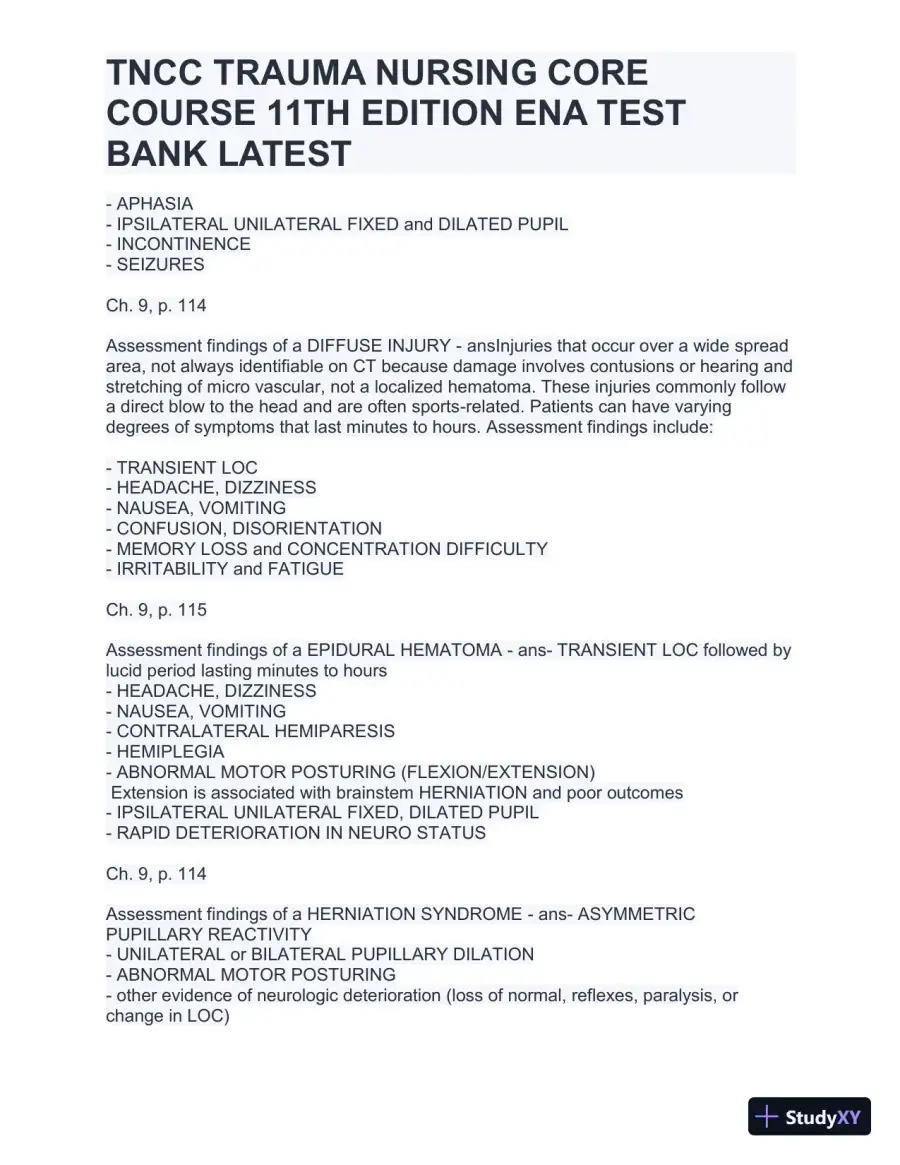 TNCC TRAUMA NURSING CORECOURSE 11TH EDITION ENA TESTBANK LATEST- APHASIA- IPSILATERAL UNILATERAL FIXED and DILATED PUPIL- INCONTINENCE- SEIZURESCh. 9, p. 114Assessment findings of a DIFFUSE INJURY - ansInjuries that occur over a wide spreadarea, not always identifiable on CT because damage involves contusions or hearing andstretching of micro vascular, not a localized hematoma. These injuries commonly followa direct blow to the head and are often sports-related. Patients can have varyingdegrees of symptoms that last minutes to hours. Assessment findings include:- TRANSIENT LOC- HEADACHE, DIZZINESS- NAUSEA, VOMITING- CONFUSION, DISORIENTATION- MEMORY LOSS and CONCENTRATION DIFFICULTY- IRRITABILITY and FATIGUECh. 9, p. 115Assessment findings of a EPIDURAL HEMATOMA - ans- TRANSIENT LOC followed bylucid period lasting minutes to hours- HEADACHE, DIZZINESS- NAUSEA, VOMITING- CONTRALATERAL HEMIPARESIS- HEMIPLEGIA- ABNORMAL MOTOR POSTURING (FLEXION/EXTENSION)Extension is associated with brainstem HERNIATION and poor outcomes- IPSILATERAL UNILATERAL FIXED, DILATED PUPIL- RAPID DETERIORATION IN NEURO STATUSCh. 9, p. 114Assessment findings of a HERNIATION SYNDROME - ans- ASYMMETRICPUPILLARY REACTIVITY- UNILATERAL or BILATERAL PUPILLARY DILATION- ABNORMAL MOTOR POSTURING- other evidence of neurologic deterioration (loss of normal, reflexes, paralysis, orchange in LOC)
37 more pages in the full document
Unlock it once and it stays in your library, ready to chat with or turn into flashcards.
Unlock the full documentMore Trauma Nursing Core Course study materials
See all Past Exams
2024 TNCC Nursing Process with Answers (17 Solved Questions)
Trauma Nursing Core Course
2 pages144downloadsFeb 2025 Past Exams
2023-2024 TNCC Final Practice Exam 4 with Answers (49 Solved Questions)
Trauma Nursing Core Course
11 pages123downloadsFeb 2025 Past Exams
2023-2024 TNCC Final Practice Exam 4 with Answers (1343 Solved Questions)
Trauma Nursing Core Course
196 pages92downloadsFeb 2025 Past Exams
2024-2025 TNCC: Trauma Nursing Process with Answers (71 Solved Questions)
Trauma Nursing Core Course
11 pages84downloadsFeb 2025 Past Exams
TNCC 10th Edition Practice Exam 3 Version A and B with Answers (740 Solved Questions)
Trauma Nursing Core Course
124 pages77downloadsFeb 2025 Past Exams
2023-2024 TNCC Final Exam 4 with Answers (1343 Solved Questions)
Trauma Nursing Core Course
196 pages76downloadsFeb 2025 Past Exams
2023-2024 TNCC Final Exam with Answers (48 Solved Questions)
Trauma Nursing Core Course
11 pages40downloadsFeb 2025 Past Exams
2023-2024 TNCC 9th Edition with Answers (498 Solved Questions)
Trauma Nursing Core Course
100 pagesMay 2025
Study this document with CramX
Once it is in your library, every tool can work from it.