

Astronomy - A Brief History of Astronomy
- Astronomy
- Texas A&M University
- 10 pages
- Shared March 2026
Preview 3 of 10 pages
See the first 3 pages exactly as they appear in the document.
Page 1 Read page 1 as text
Study Guide Astronomy – A Brief History of Astronomy 1. Archaeoastronomy Archaeoastronomy is the study of how ancient people understood the sky and how that knowledge shaped their daily lives. Long before telescopes or modern science, humans carefully watched the Sun, Moon, planets, and stars. What they saw influenced how they built structures , tracked time, traveled long distances, and even developed mathematics and belief systems. This field helps us understand how closely connected early societies were to the sky above them. 1.1 Ancient Structures and the Sky Many ancient cultures built important structures that lined up with specific events in the sky. These alignments were not accidents — they show careful planning and strong astronomical knowledge. • Newgrange , a passage grave in Ireland built around 3200 B.C., is aligned with the mid - winter sunrise . On that day, sunlight shines directly into the passage. • Stonehenge , in southern England (around 2800 B.C.), is aligned with the mid - summer sunrise . • In Mesoamerica , several Mayan buildings are positioned to match important rising and setting points of Venus on the horizon. These examples show that ancient people used the sky as a guide when designing sacred and ceremonial places. 1.2 Early Calendars and Timekeeping Before people understood that the year repeats in a predictable cycle, they relied on direct observations of the sky to organize their lives. This was especially important for farming, hunting, and religious events. Ancient people watched: • The Sun’s position compared to the background stars • The way the Sun’s rising and setting points slowly move north and south along the horizon • The seasonal appearance of constellations at night
Page 2 Read page 2 as text
Study Guide Evidence of early calendars includes: • Stonehenge , which likely helped track important times of the year • The Sun Circle built around 1100 A.D. by the people of Cahokia , near present - day Illinois These structures suggest that early societies were already keeping track of time using the sky. 1.3 Naviga Ɵ on Using the Stars When travelers could not rely on landmarks on land, the sky became their map. • Polynesian navigators used the positions of stars to sail across the vast southern Pacific Ocean. • Traders crossing the Sahara Desert depended on the sky to guide them through the featureless landscape. Some scholars believe that the oldest constellations were created as memory tools to help sailors navigate the Mediterranean Sea as early as 3000 B.C. The sky helped people know where they were — and where they were going. 1.4 The Growth of Mathema Ɵ cs As people collected more observations of the sky, they wanted to explain celestial events using numbers and measurements. • The Babylonians divided a circle into 360 degrees . This was a practical way to represent the Sun’s yearly path across the sky, which takes about 365.25 days . • Islamic scholars developed spherical trigonometry . This math was useful for navigation and for determining the direction of Mecca , which Muslims face during prayer. Astronomy pushed societies to develop new mathematical ideas that are still used today. 1.5 Other Cultural In fl uences The sky also shaped beliefs, power structures, and traditions. • Some rulers claimed they were descended from Sun or Moon gods to justify their authority. • Myths, astrology, and religions often include stories about celestial events. • These beliefs helped people make sense of the universe and feel a sense of order in the world around them.
Page 3 Read page 3 as text
Study Guide 1.6 Why Archaeoastronomy Ma Ʃ ers Archaeoastronomy shows us that ancient people were careful observers and deep thinkers. Their understanding of the sky influenced science, culture, and society in lasting ways. By studying their ideas, we gain a better appreciation for how human curiosity about the universe has shaped history. 2. Greek Astronomy Ancient Greece played a major role in shaping astronomy as we know it today. Greek thinkers were among the first people to study the universe in a scientific way. Instead of only observing the sky to make calendars or predictions, they used mathematics and logical reasoning to understand how the universe works. Greek philosophers believed that the universe followed clear rules that could be explained using numbers and geometry. This approach was very important because it helped turn astronomy into a true science rather than just observation. Even after ancient Greek civilization declined, their ideas did not disappear. Greek knowledge spread to Indian and Asian regions , where it continued to grow. Later, Islamic scholars carefully studied, preserved, and expanded these ideas. In the fifteenth century , Arab scholars helped reintroduce Greek astronomical knowledge into Europe, where it strongly influenced modern science. The Greek Alphabet in Astronomy Greek astronomy also introduced the Greek alphabet , which is still widely used today. Greek letters are commonly used to represent scientific quantities , such as angles, forces, and wavelengths. Astronomers also use Greek letters to name and classify stars within constellations.
7 more pages in the full document
Unlock it once and it stays in your library, ready to chat with or turn into flashcards.
Unlock the full documentMore Astronomy study materials
See all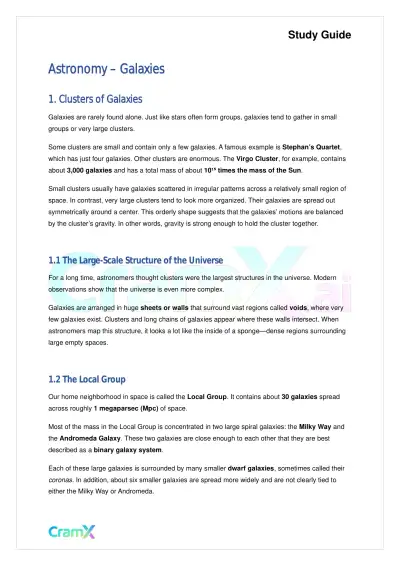 Quick Guides
Astronomy - Galaxies
Astronomy
17 pagesMar 2026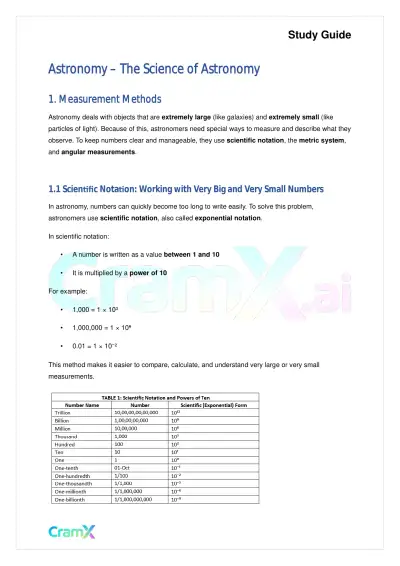 Quick Guides
Astronomy - The Science of Astronomy
Astronomy
19 pagesMar 2026 Quick Guides
Astronomy - Formation and Evolution of Stars
Astronomy
15 pagesMar 2026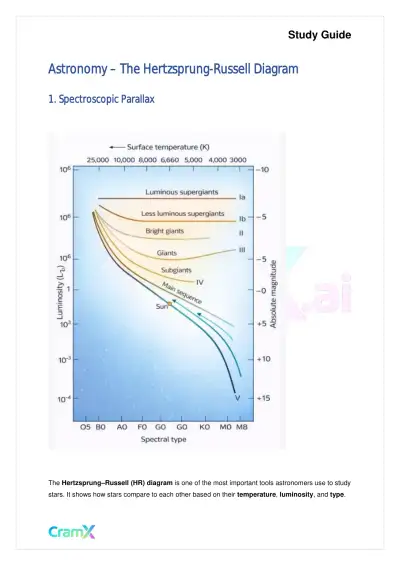 Quick Guides
Astronomy - The Hertzsprung-Russell Diagram
Astronomy
17 pagesMar 2026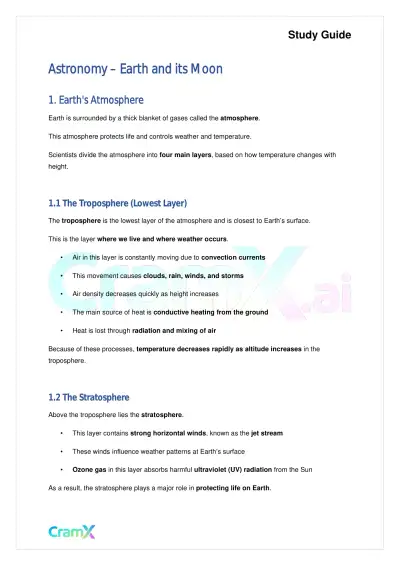 Quick Guides
Astronomy - Earth and its Moon
Astronomy
26 pagesMar 2026 Quick Guides
Astronomy - Life in the Universe
Astronomy
9 pagesMar 2026 Quick Guides
Astronomy - The Structure of Stars
Astronomy
19 pagesMar 2026 Quick Guides
Astronomy - The Sun a Representative Star
Astronomy
19 pagesMar 2026
Study this document with CramX
Once it is in your library, every tool can work from it.