

Astronomy - Formation and Evolution of Stars
- Astronomy
- Texas A&M University
- 15 pages
- Shared March 2026
Preview 5 of 15 pages
See the first 5 pages exactly as they appear in the document.
Page 1 Read page 1 as text
Study Guide Astronomy – Forma Ɵ on and Evolu Ɵ on of Stars 1. Evolu Ɵ on of Stars 1. 1 Inside a Main Sequence Star A typical main sequence star, like our Sun, produces energy at its center. The core is the hottest and densest region, where hydrogen is converted into helium through nuclear fusion. In stars like the Sun, energy production does not happen at just one tiny point. Instead, it occurs throughout a large central region, extending to about 25% of the star’s radius . Over time, the star’s composition slowly changes. Hydrogen is gradually used up and turned into helium. In the 4.6 billion years since the Sun formed, about half of the hydrogen in its core has already been converted into helium. These slow changes in chemical composition cause slow changes in the star’s structure and surface properties. Astronomers call this long - term change in a star’s life stellar evolution .
Page 2 Read page 2 as text
Study Guide 1. 2 Life on the Main Sequence Zero - Age Main Sequence (ZAMS) When nuclear fusion first begins in the core, the star enters the zero - age main sequence (ZAMS) stage. At this point: • The star has the same chemical composition throughout. • Its surface temperature is slightly warmer. • Its luminosity is slightly lower than older main sequence stars. As hydrogen fusion continues: • Hydrogen in the core decreases. • Helium builds up. • The core slowly contracts to maintain pressure. • Core temperature rises. These changes cause the star to:
Page 3 Read page 3 as text
Study Guide • Become more luminous • Slightly cool at the surface • Drift upward and to the right on the HR diagram Terminal - Age Main Sequence (TAMS) When most hydrogen in the core is used up, the star reaches the terminal - age main sequence (TAMS) . This marks the end of the main sequence phase . 1. 3 How Long Do Stars Live? A star’s lifetime depends on: • How much fuel it has (mass) • How fast it uses that fuel (luminosity)
Page 4 Read page 4 as text
Study Guide Massive stars burn fuel very quickly, so they: • Are brighter • Live much shorter lives Low - mass stars burn fuel slowly and can live billions or even trillions of years . Mathematically: • Luminosity ∝ mass³· ⁵ • Lifetime ∝ mass ⁻ ²· ⁵ This explains why large stars evolve faster than small ones. 1. 4 The Red Giant Stage
Page 5 Read page 5 as text
Study Guide When core hydrogen is exhausted, fusion stops in the core. Energy is now supplied by gravitational contraction , which heats the core further. At this stage: • A helium core forms. • Hydrogen fusion continues in a shell around the core . • The outer layers expand and cool. The star becomes a sub - giant , then a red giant . On the HR diagram, it moves: • To the right (cooler surface) • Then upward (higher luminosity) As surface temperature drops below 3,000 K , the outer layers become convective. This causes a rapid increase in brightness as stored energy reaches the surface. This path is called the Hayashi track , also known as the red giant branch . 1. 5 Helium Burning and the Triple - Alpha Process As the core contracts further, temperature rises to about 200 million K . At this point: • Helium nuclei can combine to form carbon. • This requires three helium nuclei colliding almost at once. This reaction is called the triple - alpha process . Because the core is supported by electron degeneracy pressure , the start of helium fusion happens suddenly in an explosive event called the helium flash . After the flash: • The core expands • Degeneracy pressure is removed • Helium fusion becomes stable • The star shrinks slightly and becomes hotter
10 more pages in the full document
Unlock it once and it stays in your library, ready to chat with or turn into flashcards.
Unlock the full documentMore Astronomy study materials
See all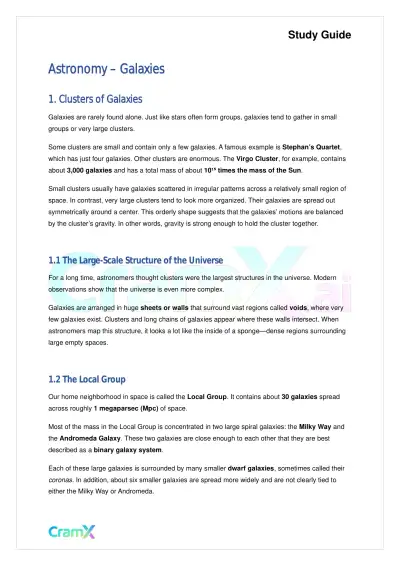 Quick Guides
Astronomy - Galaxies
Astronomy
17 pagesMar 2026 Quick Guides
Astronomy - A Brief History of Astronomy
Astronomy
10 pagesMar 2026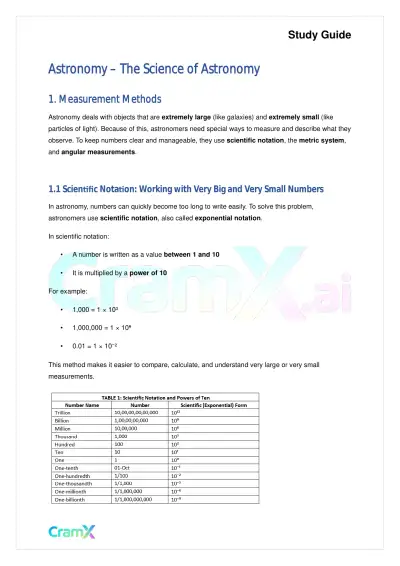 Quick Guides
Astronomy - The Science of Astronomy
Astronomy
19 pagesMar 2026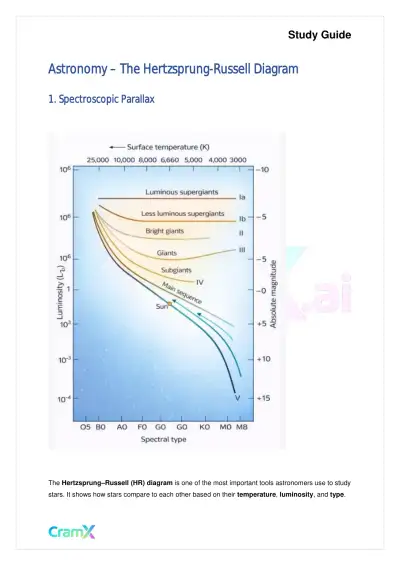 Quick Guides
Astronomy - The Hertzsprung-Russell Diagram
Astronomy
17 pagesMar 2026 Quick Guides
Astronomy - Earth and its Moon
Astronomy
26 pagesMar 2026 Quick Guides
Astronomy - Life in the Universe
Astronomy
9 pagesMar 2026 Quick Guides
Astronomy - The Structure of Stars
Astronomy
19 pagesMar 2026 Quick Guides
Astronomy - The Sun a Representative Star
Astronomy
19 pagesMar 2026
Study this document with CramX
Once it is in your library, every tool can work from it.