

Solution Manual for Astronomy: A Beginner's Guide to the Universe, 8th Edition
- Astronomy
- 193 pages
- Shared May 2025
Solution Manual for Astronomy: A Beginner's Guide to the Universe, 8th Edition is the perfect textbook guide, offering thorough solutions to all your textbook exercises.
Preview 16 of 193 pages
See the first 16 pages exactly as they appear in the document.
Page 1 Read page 1 as text
C hapter 0: Charting the Heavens The Foundations of Astronomy Outline 0.1 The “ Obvious ” View 0.2 Earth’s Orbital Motion 0.3 The Motion of the Moon 0.4 The Measurement of Distance 0.5 Science and the Scientific Method Summary This chapter covers the view from Earth, including constellations, the celestial sphere, and the apparent motions of the Sun and stars. The actual motions of Earth that give rise to those apparent motions are then discussed. The motion and appearance of the Moon are addressed in the third section. This chapter concludes with distance determinations and a discussion of the scientific method. Major Concepts The view from Earth Constellations The celestial sphere Earth’s orbital motion Rotation Revolution Angular measurement Precession Motion of the Moon Lunar phases Eclipses Measuring distance Triangulation Parallax Scientific theory and the scientific method Observation Theory Prediction Teaching Suggestions and Demonstrations One of the challenges in studying astronomy is developing the ability to view the universe from different perspectives, primarily the perspective we have from Earth, where we see the Sun and stars rise in the east and set in the west, and the perspective from outside, where we see Earth spinning on its axis and orbiting the Sun. Use plenty of models and diagrams in teaching this introductory material in order to help your students practice shifting viewpoints. Lots of new vocabulary is introduced in this chapter; take the time to define new terms.
Page 2 Page 3 Read page 3 as text
Chapter 0: Charting the Heavens 9 There has been an emphasis among the astronomy educational research community that teaching approaches in college astronomy classes should be more learner-centered. An easy way to start to incorporate this approach is the book Lecture-Tutorials for Introductory Astronomy 3/E by Prather, Slater, Adams, and Brissenden. This book contains many in-class exercises that students may work on in small groups. There are exercises on positional astronomy , solar vs. sidereal day , seasonal stars , the ecliptic , and phases of the Moon as well as additional topics that will be mentioned throughout this book. It takes a lot of consideration to decide how to use such materials, but research shows that it will benefit most students for the classroom to be more learner-centered. Section 0.1 Your students will all have heard of constellations and will probably be able to name at least a few. Emphasize that the stars in a given constellation are probably not physically close to each other in space; they just appear close to each other as seen from Earth. The stars in each constellation were grouped together by observers in ancient times, and we continue to use nearly the same groupings today. You can pass out or project a sky chart without constellations drawn in and challenge students to make up their own. Asking students what their zodiacal sign is can be a good way for the students to feel connected to the sky, even though very few might actually follow astrology. Consider using Starry Night College to demonstrate how the zodiacal constellations lie across or near the ecliptic line. Show how the sky view will change during the year. Be sure to let students know that their zodiacal constellation is associated with where the Sun was located when they were born, but it is about a month off due to precession of the equinoxes. This is illustrated in Figure 0.8. It is also interesting to compare names of northern and southern constellations. The northern constellations are typically named for animals and mythological characters. The Southern Hemisphere sky includes constellations such as the telescope, the microscope, and the octant. Ask your students if they can explain the difference. The constellation names we have inherited today derive from northern observers. The northern constellation names, therefore, date from ancient times, but the southern ones date from the early travels made by northern explorers to the Southern Hemisphere. If you have time, explain a few of the myths that involve whole families of constellations. The story of Orion, Taurus, and the Pleiades is a good one, as is the story of Cassiopeia, Cepheus, Andromeda, Cetus, and Perseus. These are all constellations that students can find in the night sky, depending on the time of year you are teaching the course. Provide star charts and encourage your students to find major constellations in the night sky throughout the course. The concept of the celestial sphere is an important one. We are missing depth perception when we look out at the night sky. If you have one, bring in a transparent model of the celestial sphere with Earth inside and point out the north and south celestial poles and the celestial equator . This is a good time to discuss Polaris and clear up any misconceptions; often, introductory astronomy students believe the North Star must be the brightest star in the sky. Introduce students to right ascension and declination by comparing these to latitude and longitude. Emphasize that the celestial coordinates are attached to the sky. Over the course of a night, stars move from east to west and the coordinate system moves with them. Look up the coordinates of a few well- known stars (including Polaris) and help students determine their positions. Ask students to compare the two different methods of describing star locations, by coordinates and by constellation, and discuss the advantages of each.
Page 4 Read page 4 as text
10 Chaisson/McMillan, Astronomy , Eighth Edition Section 0.2 Students usually know the terms rotation and revolution but often confuse them, so take a few moments to define these terms. Consider using the word “orbit” instead of “revolution” to help avoid confusion. Students will also probably know that Earth takes a day to turn on its axis and a year to orbit the Sun, but will not know the difference between a solar day and a sidereal day , or a tropical year and a sidereal year . Use lots of diagrams, such as Figure 0.7, to help explain. Models also help. Demonstrate rotation and revolution with globes, or bring students to the front of the class to model Earth’s motions. For instance, one student can spin around (slowly) while also orbiting another. Ask the class to concentrate on one point on the Earth, say, the spinning student’s nose, and imagine when it is lit and when it is dark. Use this model to explain day and night, sidereal vs. solar days, and why different constellations are visible in the night sky during different months. Figure 0.9 is also an important one. Make sure students understand that it shows the apparent path of the Sun on the celestial sphere. Use models of Earth and the Sun (or just two spheres) to help explain how Earth’s tilt changes the position of the Sun in the sky as Earth orbits the Sun. Emphasize that the terms solstice and equinox can each refer to both a point in time and a point in space. The summer solstice, for instance, is the point on the ecliptic where the Sun is at its northernmost position, but we also use the term to refer to the time and day when the Sun is at that point. Students will be most familiar with the latter meaning, and know that the summer solstice occurs around June 21. Begin your discussion of seasons with an informal, multiple-choice pre-quiz. If you’d like to make this pre-assessment a bit more formal, author Paul Green discusses more ideas in his book Peer Instruction for Astronomy starting on page 11. He also includes “concept tests” for the seasons as well as the celestial sphere and time conventions used in astronomy that can be used throughout the lecture. These can be used in conjunction with additional “clicker questions” that are provided with the instructor materials. During your lecture, ask students what causes the seasons, and include in the answer choices both the correct response, namely, Earth’s tilt, and a common misconception, the distance from Earth to the Sun. If significant numbers of students choose the distance answer, make sure you address this misconception and explain why the different distances from Earth to the Sun do not affect the seasons. Many students are surprised to find that, in fact, the Earth is farthest from the Sun during the Northern Hemisphere summer. Bring in a flashlight and shine it directly down on a tabletop or on the floor, and then shine it at an angle to show how the angle of the Sun’s rays affects solar heating. Go back to your model of Earth orbiting the Sun to show how the length of time the Sun is up in the sky also changes as the seasons change. A gyroscope or top makes a good demonstration of precession . Find Vega on a star chart and point it out to students to help them get a sense of the scale of the change. Precession is also responsible for the fact that the zodiac constellations no longer correspond to their astrological dates. The heliacal rising of Sirius, in the constellation Canis Major, was an important date in the ancient agricultural calendar, but this no longer occurs on the same date today. Angular measure is very important to astronomy. Discuss More Precisely 0 – 1 carefully. Demonstrate angular measure by holding up a penny. At a distance of about 1 meter, a penny subtends an angle of about 1 degree. Students can hold up a penny and see what objects at different distances in the classroom have an angular size of about 1 degree. Also have students try this at night and estimate the angular size of the Moon, half a degree. Go over angular measurements and then try several examples. Many problems throughout the text use the equations in this section, so it is worth spending some time with them to ensure student understanding.
Page 5 Read page 5 as text
Chapter 0: Charting the Heavens 11 Section 0.3 Demonstrate the Moon’s phases by shining a flashlight on a ball. You can also paint one half of a Ping-Pong ball black and have students hold it at arm’s length with different amounts of the black side facing them. For different positions of the Moon, ask students how much of the surface of the Moon is lit, and how much of the lit surface can be seen from Earth. Emphasize that half of the surface is always receiving light, but we just do not see it all. Before showing Figure 0.13, demonstrate and discuss with students when one particular phase, first quarter, say, will rise and set. Then ask them to predict rising and setting times of the other phases. This exercise provides an excellent opportunity for students to practice changing viewpoints as discussed in the previous sections. For best results, you should do this demo in a very dark room. Even with all the lights turned out, there will still be a lot of light reflected from the walls. It’s best to use a classroom with dark walls, but this might be a difficult task. You should always try out a demo in the room where you’ll be teaching before you do the demo in front of a class. Consider assigning students a project to track the Moon’s phases. For instance, you can ask them to look for the Moon each (clear) night for a month, sketch its shape, and note the time and position in the sky. At the end of the month, they can compare this view from Earth with a diagram showing the perspective from outside the Earth. Once your students have a good grasp of phases, they should have no trouble understanding the causes of eclipses . Some points that you may need to clarify include why we do not have a solar eclipse every new Moon and a lunar eclipse every full Moon, and why a lunar eclipse lasts a while and can be seen from about half Earth’s surface, but a solar eclipse can be seen only from a narrow band and lasts only a short time for any particular observer. A scale model using two spheres (for Earth and the Moon) and a strong light source (for the Sun) can help clarify points about lunar eclipses. Show pictures of the Sun during a solar eclipse and try to convey some of the excitement and awe inspired by eclipses. In addition to being spectacular events to watch, solar eclipses provide Earth-bound astronomers a rare opportunity to study the Sun’s corona. Section 0.4 Figure 0.21 illustrates an excellent demonstration of parallax that you can have your students try in class. Instruct them to hold up a finger (or pencil), close one eye, and line their finger up with some object on the far wall of the classroom. When they sight on their finger with the other eye open instead, it lines up at a different position. Ask students to try the exercise several times with their finger at different distances from their eyes to determine the relationship between the distance and the amount of shift. Figure 0.20 shows this method applied to astronomy using Earth’s diameter as a baseline. Challenge students to come up with a method where observers restricted to the surface of Earth can create an even longer baseline in order to measure parallaxes of more distant stars. (Observations can be made at different points in Earth’s orbit around the Sun.) Even with the diameter of Earth’s orbit as a baseline, the parallax method only works for the stars in the solar neighborhood. Section 0.5 Since many of your students are likely to have had minimal exposure to science, this section is worthwhile focusing on for class discussions. In introducing the scientific method , refer to Figure 0.22 now as well as throughout the semester. Remind the students that science is a cyclic process rather than some fixed set of ideas or laws. This is a STRENGTH , not a weakness. Sometimes those that might challenge the validity of science using non – scientific arguments often try to exploit the tentative nature of science. The strength
Page 6 Read page 6 as text
12 Chaisson/McMillan, Astronomy , Eighth Edition of science rests on the fact that it does not rely on the authority of political or religious systems nor on the interpretation of texts, ancient or otherwise. Ask the students to provide examples of ideas in their own minds that have changed once additional data or knowledge had become known to them. In my own opinion, I think science is a way that we (as humans) can sense the world around us and make predictions that can be tested and verified. At the heart of this process is the fact that the universe is inherently knowable. When discussing the nature of science, it is easy to fall into the philosophy of science. This can become a very exhaustive discussion, so make sure to have certain specific goals in mind so that you can move on to other topics when you’ve completed them. Student Writing Questions 1. What was the tiniest object you have ever seen? The largest? The longest distance you have ever traveled? What is the largest number of objects you have ever knowingly encountered? (You may encounter lots of bacteria but not knowingly.) What was the longest you ever spent doing one activity? How do the largest and the smallest of these compare? How do the distances compare to the size of Earth? To the distance to the Moon? How does your time spent in one class compare to your lifetime? 2. Describe in metric units the room in which you do most of your studying. How big is it? What is the size of your desk? The TV or radio? How heavy are your books? The dimensions of your bed? Choose objects that have a range in sizes. 3. Test your horoscope. Each day, write two or three sentences about the most significant events that occurred to you that day. Cut out or copy your horoscope for that day and save. Continue this daily for about three weeks and make sure you write down your daily events before you read the horoscope. After three weeks, check what you wrote and your horoscope for each day to see whether there is a match. Count the number of hits and misses. Discuss the results and whether there is any significance to the number of hits. Are horoscopes truly predictive? 4. Find a location to view the night sky with as little interference as possible. Do this on as clear a night as possible. What do you see? Look all over and make note of the brightest stars. Are there any planets? How can you tell? Is the Moon out? What does it look like? What sort of details can you see on its surface? 5. What would it be like to live with only one functional eye? How would this change your perception of everything around you? What would pose the greatest difficulty to you? The least? You might actually try this first and then write about it. Did you get used to not having both eyes? Is parallax the only effect you miss with only one eye? 6. Describe an ordinary situation in which people regularly apply the scientific method, even though they are not aware they are doing so. Relate the situation to the three basic steps in the scientific method: gather data, form theory, and test theory. 7. Compare and contrast science as a way of knowing with some other way of knowing, such as social science, art, philosophy, or religion. How do these disciplines differ, and how might they be similar?
Page 7 Read page 7 as text
Chapter 0: Charting the Heavens 13 Answers to End of Chapter Exercises Review and Discussion 1. The Earth’s d iameter is about 110th that of the Sun. The Earth is about 10 14 times smaller than the Milky Way Galaxy and about 10 18 times smaller than the Universe. 2. A constellation is a pattern of stars that appear together in the sky although they are generally not close together in space. Many constellations are named after mythological figures or animals. Each constellation covers a specific area on the celestial sphere, and stars are designated by the constellation to which they belong. 3. Earth’s rotation makes the Sun, the Moon, and the stars appear to rise in the east and set in the west. 4. A solar day (measured by the Sun) is about 3.9 minutes longer than a sidereal day (measured by the stars). As Earth rotates on its axis, it also moves forward in its orbit so it has to rotate a little farther than one full turn to bring the Sun back to the same position in the sky. 5. One orbit of the Sun corresponds to 1 year, so a person’s age in years equals the number of times he or she has orbited the Sun. 6. As Earth revolves around the Sun, Earth’s dark side (away from the Sun) faces a different direction at different times in Earth’s orbit. The stars visible in the winter night sky are behind the Sun in the summer and therefore not visible. 7. Seasons are caused by the tilt of Earth’s axis with respect to the plane of its orbit. The hemisphere tilted toward the Sun has summer, because the Sun appears higher in the sky and therefore the Sun is up longer and its rays are more direct. Both the length of time the Sun is in the sky and the angle of the rays contribute to increased heating. 8. Precession is the slow shift in the orientation of Earth’s rotation axis. It is caused by the combined gravitational pulls of the Moon and the Sun. 9. Only a portion of the hemisphere of the Moon that is lit by the Sun may be facing Earth. For instance, during a full Moon, the entire lit portion faces Earth, but during a new Moon, the entire lit hemisphere is facing away from Earth, so we see none of it. 10. A lunar eclipse occurs when Earth’s shadow falls on the Moon. A solar eclipse occurs when the Moon passes directly in front of the Sun, blocking its light so that shadow of the Moon falls on Earth. The Moon’s orbit is slightly inclined with respect to the ecliptic, so Earth, the Moon, and the Sun are not precisely lined up every full and new Moon. 11. Since neither Mercury nor Venus has moons, it would have to be Mars or other outer planets. However, the moons of Mars are too small to cover the solar disc as seen from the surface of Mars, as shown in Problem #10 of Chapter 6. Eclipses as seen from the cloud tops of Jupiter is the topic for Problem #5 in Chapter 8. 12. Parallax is the apparent shift in position of a foreground object with respect to the background as the ob server’s position changes. For example, as you drive down the road, a telephone pole along the road will line up with different points in the distant landscape.
Page 8 Read page 8 as text
14 Chaisson/McMillan, Astronomy , Eighth Edition 13. When using triangulation, the longer the baseline, the greater the shift in position, or the greater the parallax angle. Objects in space are so far away that their shifts are very small. A long baseline will increase the chance that the shift will at least be measurable. 14. The diameter of an object can be determined if both the distance to the object and its angular diameter are known. 15. The scientific method obtains truths that rely on empirical data obtained in a naturalistic way using our senses. Religion, on the other hand, relies on truths that are divinely revealed. Conceptual Self-Test True or False? 1. F; 2. F; 3. T; 4. F; 5. T; 6. T; 7. F Multiple Choice 8. b; 9. b; 10. c; 11. a; 12. c; 13. d; 14. b; 15. a Problems 1. The year 10,000 A.D. is about 8000 years from now, which is about 0.3 of the total precessional period of 26,000 years. Because there are 12 constellations in the zodiac, this corresponds to about 3½ constellations. If the vernal equinox is just now entering Aquarius, then it will be in the latter half of Scorpio in 10,000 A.D. (See Figure 0.8.) 2. The distance Earth moves in a year is the circumference of its orbit: 8 8 2 πr 2π(1.5 10 km) 9.42 10 km. C A day is 1/365 of a year, so the distance Earth moves in a day is 8 6 9.42 10 km/365 2.58 10 km. An hour is 1/24 of this, so the distance Earth moves in an hour is 6 5 2.58 10 km/24 1.08 10 km. Finally, in a second, the Earth moves: 5 1.08 10 km/3600 29.9 km. 3. The sidereal day would be the same, but the solar day would change in length because the Earth is still orbiting the Sun at roughly 1 degree per day. Normally the Earth must rotate an extra 1 degree after it reaches an entire sidereal day as shown in Figure 0.7. This means that it takes about 3.9 extra minutes for the Earth to reach the position for a solar day, so a solar day is 3.9 minutes longer than a sidereal day. If the direction of rotation is changed, then it will take ~3.9 minutes less to reach a solar day than it would a sidereal day. In this case, the solar day will be ~3.9 minutes shorter than the sidereal day, which remains the same. The difference in the solar day would be: 3.9 min 2 8min. 4. Let’s assume that the Moon is in a circular orbit with an orbital period of 27.3, which is the sidereal period. We’ll assume that it moves t hrough 360 degrees in these 27.3 days. Convert 27.3 days to seconds: 27.3 days = 2,358,720 seconds. The calculations should be done using ratios: (a) 360 0.5 33'/hour 2,358,720 sec 3600 sec X X
Page 9 Read page 9 as text
Chapter 0: Charting the Heavens 15 (b) 360 0.01 0.55' 33''/ min 2,358,720 sec 60 sec X X (c) 360 0.00015 0.01' 0.55''/ sec 2,358,720 sec 1sec X X 360 0.5 3276sec 55min/ 0.5 2,358,720 sec sec T T . 5. Calculate the circumference of the lunar orbit, then divide it by the sidereal period (27.3 days) converted to seconds. 27.3 days = 2358720 seconds: 3.14 2 384,000 km 1.0 km/s 2,358,720 sec . 6. Sidereal month = 27.32 days 27.3 0.986° = 26.92° (the Moon must travel this extra angle for a synodic month) synodic month 386.92 1.075 27.32 29.4 days (synodic month) 27.32 d 360 . 7. tan 60° = distance 100 m (drawing the triangle to scale will result in a similar answer) 173 m = d . 8. Use the relationship (360 /2 π) . dist baseline parallax (a) (360 /2 π) . 1000 km 57,300 km 1 dist (b) 6 (360 /2 π) . 1000 km 3.44 10 km (1/ 60) dist (c) 8 (360 /2 π) . 1000 km 2.06 10 km. (1 / 3600) dist 9. Angle = 360° 780 km 100,000 km = 2.8°. 10. Using Discovery 0 – 1, if the Earth was flat, the angle with respect to the shaft of the well would always be zero, as long as the Sun is far enough way so that the Sun’s rays are parallel when they reach the Earth. In Discovery 0-1, the angle is caused by the roundness of the Earth.
Page 10 Read page 10 as text
16 Chaisson/McMillan, Astronomy , Eighth Edition Resource Information Mastering Astronomy Media Resources Self-Guided Tutorials for Students Phases of the Moon Stellar Parallax Animations/Videos Summer Solstice Winter Solstice The Equinoxes Solar Eclipse in Indiana Interactive Figures Figure 0.2 Constellation Orion Figure 0.4 The Celestial Sphere Figure 0.5 The Northern Sky Figure 0.8 The Zodiac Figure 0.10 Seasons Figure 0.12 Precession Figure 0.14 Lunar Eclipse Figure 0.16 Solar Eclipse Types Figure 0.20 Parallax Materials Some basic materials helpful for demonstrations in this chapter include a globe (showing the tilt of Earth’s axis), a strong flashlight, a gyroscope, and at least two different-size balls. (Styrofoam balls work well; you can use toothpicks stuck in the poles to show the axes.) “ Star wheels ” or “ star finders ” are adjustable circular star charts that enable you to show the stars for any particular night and time. These are very helpful for explaining the apparent motions of the stars during the course of a night or the course of a year because you can rotate the wheel to represent passing time. Edmund Scientific has inexpensive cardboard ones sold in bulk packs. Starry Night Pro software is very helpful for illustrating positions and motions of objects on the celestial sphere. Suggested Readings Allen, Richard Hinckley. Star Names: Their Lore and Meaning. Dover Publications, New York. A reprinting (with corrections) of a work first published in 1899. It has fascinating information and more detail than you will ever need to know. Berman, Bob. “ Five-five-uh-oh. ” Astronomy (5 May 2000). p. 93. Discusses the effects of the planetary alignment of May 2000, and provides arguments against astrology.
Page 11 Read page 11 as text
Chapter 0: Charting the Heavens 17 B rown, Ronald A. and Kumar, Alok. “ A new p erspective on Eratosthenes’ m easurement of the Earth.” The Physics Teacher (Oct 2011). p. 445. Further discussion of the experiment described in the Discovery box in Section 0.5. Byrd, Deborah. “ The starry sky: Libra. ” Astronomy (May 1995). p. 63. A short article about the constellation Libra, which is home to the autumnal equinox. Camino, Nestor and Gangui, Alejandro. “Diurnal a stronomy: U sing sticks and threads to find our l atitude on Earth.” The Physics Teacher (Jan 2012). p. 40. Describes an experiment students can perform to determine latitude. Cordell, John. “ Non-mathematical explanation of p recession.” The Physics Teacher (Dec 2011). p. 572. Good conceptual explanation of a motion that is often hard for students to understand. Dunlop, S. and Tirion, W. How to Identify the Night Sky. Collins, 2004. I particularly like this reference because the star maps include an adjacent star field image which is good for practicing constellation identification. Gangui, Alejandro. “Whither does the sun rove?” The Physics Teacher (Feb 2011). p. 91. A study on the rising and setting locations of the Sun from different locations in the world. Gurshtein, Alexander A. “ In search of the first constellations. ” Sky & Telescope (June 1997). p. 46. A fairly detailed discussion of the origin and history of constellations. Hobby, David. “ Portrait of the shortest day. ” Sky & Telescope (6 June 1998). p. 46. Displays and discusses making a photograph of the Sun’s path across the sky on the winter solstice. Kanipe, Jeff. “ Tilt-a-whirl astronomy: The seasons explained. ” Astronomy (Mar 1996). p. 50. Describes the apparent daily and annual motions of the Sun across our sky. Krupp, E. C. “ Slithering toward solstice. ” Sky & Telescope (6 June 2000). p. 86. Discusses the symbolism of snakes, serpents, and solstices. Krupp, E. C. “ Springing down the banister: Vernal equinox festival at Chichen Itza pyramid, Mexico. ” Sky & Telescope (Mar 1996). p. 59. A fun description of a vernal equinox festival held at Chichen Itza. Kuhn, T. S. The Structure of Scientific Revolutions. 3rd edition. University of Chicago Press, Chicago, 1996. This is a reprinting of the classic 1962 work which discusses the philosophy and nature of science. This is a must for those who want to delve deeper into the philosophy of science. MacRobert, Alan M. “ Understanding celestial coordinates. ” Sky & Telescope (Sep 1995). p. 38. Describes the celestial coordinate system. Panek, Richard. “ That sneaky solstice. ” Natural History (5 June 2000). p. 20. Describes the meaning of the solstice, and discusses why the earliest sunrise does not happen on the solstice. Ratcliffe, Martin, and Shaffer, Rick. “ First views: Old sol celebrates the solstice. ” Astronomy (25 Dec 1997). p. 71. Discusses the analemma and how it demonstrates the offset between dates of earliest/latest rising/setting of the sun and the solstices.
Page 12 Read page 12 as text
18 Chaisson/McMillan, Astronomy , Eighth Edition Rey, H. A. The Stars: A New Way to See Them. Houghton Mifflin, Boston, 1962. One of my favorite books for introducing constellations. Rey uses diagrams that make the groupings of stars actually look like what they are supposed to represent! Ryan, Jay. “ SkyWise: Equinox. ” Sky & Telescope (3 Mar 2000). p. 114. Comic strip drawing illustrating the equinoxes. Ryan, Jay. “ SkyWise: Latest sunrise earliest sunset. ” Sky & Telescope (6 Dec 1998). p. 124. Cartoon strip illustrating why the date of the earliest sunset is not exactly the winter solstice. Schaaf, Fred. “Celebrating the longest night.” Sky & Telescope (Dec 2002). p. 90. Addresses the winter solstice and sidereal time. Schaff, Fred. “A constellation not like Orion.” Sky & Telescope (Jul 2007). p. 42. Compares and contrasts the constellation Ophiuchus with Orion. Schulz, Teresa M. “Mask of the b lack god: The Pleiades in Navajo c osmology.” Journal of College Science Teaching (Oct. 2005). p. 30. Describes a case study in which students learn about the role of a constellation in Navajo cosmology and also practice their observational and star map skills. Trefil, James. “ Architects of time. ” Astronomy (9 Sep 1999). p. 48. Discusses history of astronomical timekeeping, from Stonehenge to pulsars. Notes and Ideas Class time spent on material: Estimated: Actual: Demonstration and activity materials: Notes for next time:
Page 13 Read page 13 as text
C hapter 1: The Copernican Revolution The Birth of Modern Science Outline 1.1 The Motions of the Planets 1.2 The Birth of Modern Astronomy 1.3 The Laws of Planetary Motion 1.4 Newton’s Laws Summary Chapter 1 continues the view from Earth begun in Chapter 0 by discussing the apparent motions of the planets. The historical development of astronomy from Copernicus through Newton is considered next. This chapter ends with a thorough discussion of Kepler’s laws of planetary motion and Newton’s laws of motion and gravity. The development of models of the universe from Ptolemy through Newton is discussed as an example of the scientific method at work. Major Concepts • The planets’ motions Wanderers among the stars Retrograde motion • Geocentric models of the universe Aristotle Ptolemy • History of modern astronomy and heliocentric models Copernicus Brahe Galileo Kepler • Kepler’s laws of planetary motion • Isaac Newton Laws of motion Gravity Teaching Suggestions and Demonstrations At the beginning of this chapter, give your students a copy of a current star chart showing positions of any visible planets. Encourage them to observe the planets over the course of the semester and the Moon over the course of a month and notice how these move with respect to the stars. Sections 1.1 and 1.2 Humans have looked at the sky and tried to unravel the motions of the stars and planets since early times. Discovery 1-1 on ancient astronomy describes several intriguing examples of artifacts and structures with astronomical significance that have survived from ancient societies. The evolution of our understanding of the structure of the universe is a remarkable story of scientific process , where each successive model
Page 14 Read page 14 as text
20 Chaisson/McMillan, Astronomy , Eighth Edition took care of some problem of the previous model. Ptolemy, for instance, introduced epicycles to account for retrograde motion that could not be explained by the Aristotelian universe. Kepler changed the shape of the orbits from circles, as shown in Copernicus’ model, to ellipses. Starry Night College can be used to demonstrate the retrograde motion of the superior planets. Mars will be the best planet to use because the retrograde motion happens over just a few months. Jupiter and Saturn will both work since they are visible as they move through the constellations. The trick with this simulation is that you should center on the planet and then change the time intervals to multiple days. It takes some practice, but will make for a good demo in class and will likely be more effective than showing a static image. You should have the students mark the relative positions of both Earth and Mars in their orbits during the retrograde interval. Students should understand that the retrograde motion is associated with the Earth overtaking Mars in its orbit. Students accept the heliocentric model without question, and they tend to forget just how hard it was for people to give up the geocentric model . The reason is obvious; go outside at night and observe the sky over a period of time. It sure looks like the stars are going around Earth, and it certainly does not feel like Earth is moving! Reluctance to demote Earth from its position at the center of the universe resulted in Ptolemy’s complicated and intricate model, which still failed after a long time to accurately predict the positions of the planets. Moving to a heliocentric system and changing the orbits from circles to ellipses greatly simplified the model. As discussed in the text, simplicity is a desirable characteristic in scientific models; ask students to think of other examples of scientific advancement where successive models increased simplicity. Tycho Brahe actually had a model of his own that combined aspects of the heliocentric model with geocentrism. He kept Earth in its central position, but placed the other planets in orbit around the Sun, which itself orbited Earth. Brahe’s model was largely ignored, and he is remembered today for his contributions in the form of vast quantities of observational data (that predated the telescope), which laid the foundation for Kepler’s work. Interestingly, Brahe’s main argument for keeping Earth at the center was the lack of observed stellar parallax. Brahe had a good point; he just could not conceive of stellar distances so great that the corresponding parallaxes would be too small to be observed without precise instruments. In fact, the first successful parallax measurements were made in 1838 by Wilhelm Bessel. Before discussing Galileo’s observations with the telescope , go over the prevailing worldview of his time and emphasize some of its major characteristics. This background will just help students understand how dramatic Galileo’s discoveries were. The Aristotelian view maintained not only that all astronomical objects orbited Earth but also that they did so in perfect circles. Earth was flawed, but heavenly objects were perfect, unblemished, and unchanging. Further, Aristotle’s view had been inextricably linked with Christianity through “medieval scholasticism,” so contradicting Aristotle was extremely serious as it was equivalent to contradicting the Roman Catholic Church. Galileo’s discoveries provided evidence that objects not only orbited something other than Earth (Jupiter’s moons, phases of Venus) but also that heavenly bodies were not unblemished (sunspots, mountains on the Moon). Galileo’s experiments with falling bodies also directly contradicted the Aristotelian view, which maintained that heavier objects fall faster than do lighter ones. If Jupiter is visible at night when you are teaching the course, encourage your students to view Jupiter through binoculars from a reasonably dark site. The four Galilean moons are visible in binoculars, and students can follow their motions over the course of a week or so to recreate Galileo’s observations. The orbital motion of the Galilean moons can be demonstrated using Starry Night Pro . You will need to zoom in on Jupiter until the moons are visible. Then you can advance through time and watch the moons orbit. When you initially see the moons it is not necessarily apparent which moon is which, so Starry Night Pro can be used to identify them.
Page 15 Read page 15 as text
Chapter 1: The Copernican Revolution 21 It will probably surprise students that Galileo and Kepler were contemporaries. In terms of conceptual development, it seems that Galileo built upon and provided evidence for Copernicus’ heliocentric model, and then Kepler refined the heliocentric theory with details about the orbits of the planets. In fact, Galileo and Kepler were working at the same time. Galileo was placed under house arrest for promoting the heliocentric model and was forced to declare that it was useful as a mathematical tool only, not as a description of reality. Meanwhile, at the same time, Kepler was not only assuming that the planets orbit the Sun, but he was also describing their actual paths and speeds in those orbits. Point out to students the differences in societies at the time that resulted in these very different climates for debate and discussion. Throughout your discussion of the historical development and final acceptance of the Copernican system, sprinkle in interesting details of the lives of the people involved. Copernicus’ theory was not even published until he lay on his deathbed. Brahe wore metal noses after he had his nose cut off in a duel. Galileo was a flamboyant character who loved to engage in debate. He published in Italian and often expressed his ideas in dialogue form, to make them accessible to both the common man and the scholar. Sections 1.3 and 1.4 Begin your discussion of Kepler’s laws of planetary motion by drawing an ellipse on the board or overhead using the method shown in Figure 1.11. Define the various parts of an ellipse and show how a circle is the special case of an ellipse with an eccentricity of 0. Have students draw ellipses with the same eccentricities as the planets and point out that most of the planetary orbits are nearly circular. (See Table 1.1 for data.) Extend Kepler’s second law to comets, and ask students to describe the relative speeds of a comet with a very elliptical orbit when it is close to the Sun and when it is far away. Finally, for Kepler’s third law, pick one or two planets and use the semimajor axes given in Table 1.1 to calculate the periods. Compare the periods given in the Appendix on planetary orbital properties. Review the mathematical meaning of “squaring” and “cubing.” Many students will confuse a 3 with 3 a . The more mathematically aware students are often concerned that the units of the third law do not work out correctly. When it is said that the constant of proportionality is one, it does not imply that there are no units associated with the constant. In fact, the constant is 1 yr 2 /AU 3 , but for convenience we rarely show it. To demonstrate orbital motion , whirl a ball around on a string in a horizontal circle. In the demonstration, the tension in the string provides the centripetal force. In the case of a planet, gravity is the centripetal force. Ask students to predict what would happen if the force suddenly “turned off”; demonstrate by letting go of the string. Note that if you shorten the string then the period will also shorten, much like Kepler’s third law . For instructors that might be skilled with a yo-yo, the trick “around the world” can be used instead of the ball and string for this demo. To shorten the string, simply have a second yo-yo that already has a shorter string prepared. Try using “Observing Retrograde Motion” from the book Lecture-Tutorials for Introductory Astronomy . This exercise is particularly good and helps to reinforce material that you have covered in lecture. Be sure to consider how much time to devote to this exercise because it normally takes more class time than you would estimate. Newton’s laws of motion are extremely important and not necessarily intuitive. Give plenty of examples of each. For instance, ask students to imagine an airplane trip on a beautiful day with no turbulence. If you throw a peanut up in the air, does it hit the person behind you or fall back in your lap? Also consider the motion of Earth. If you jump up in the air, does the wall of the classroom slam into you? (Galileo already had a pretty good idea of the notion of inertia when he argued against the geocentric view and used ships at sea as an example.) Emphasize to students that Newton’s laws divide objects into the two categories of accelerating and nonaccelerating instead of moving and not moving . An object
Page 16 Read page 16 as text
22 Chaisson/McMillan, Astronomy , Eighth Edition moving at a constant velocity (that is, in a straight line and at a constant speed) is like an object at rest in that both have no net force acting on them. Define acceleration carefully and calculate an acceleration with which students are familiar, such as the acceleration of a car merging onto the highway. You can use first units that make sense, such as miles per hour per second, and then convert to the more standard meters per second squared to help students gain a feel for the acceleration due to Earth’s gravity. Students often confuse acceleration and velocity, so be sure to distinguish between the two carefully. You can demonstrate Newton’s third law and the role of mass by attaching a rope to a rolling chair and asking a student to pull it across the floor. Then sit in the chair and repeat. Ask the student to compare (qualitatively) the force used to accelerate the empty chair with the force applied to the chair with occupant. Use an air track with carts or an air hockey table with pucks to demonstrate Newton’s laws , if possible. Seeing the behavior of objects in a nearly frictionless environment will help students overcome Aristotelian misconceptions about motion. Gravitational force is an extremely important concept in astronomy so it is worth spending some time on Newton’s law of gravity . Refer to the explanation in the text as well as to Figure 1.18, which gives both a mathematical expression of the law and a graph depicting its inverse-square nature. Ask students what would happen to the force of gravity between Earth and the Sun if the mass of Earth doubled or if the distance between them doubled. Students often confuse the force of gravity with acceleration due to gravity. Derive the expression for acceleration due to gravity and show that it is consistent with Galileo’s experiments regarding the motion of falling bodies. Also emphasize that Earth alone does not “have” gravity; gravity is a force between two objects. For instance, the weight of an object is the force between it and Earth when the two are in contact. Calculate the weight of a 70-kg person on Earth and on the Moon and compare. It is important to distinguish the difference between weight and mass of an object. The mass of an object is expressed in kilograms, but the weight is a force and is calculated by the mass times the acceleration due to gravity. The weight of a 70-kg person is 686 N (or kg × m/s 2 ). The weight varies from planet to planet because the acceleration due to gravity is a function of the mass and size of the planet. Use Figure 1.19 to help explain how gravity is responsible for objects falling as well as objects orbiting. Ask your students to picture the Moon as constantly falling toward the Earth and missing! The final section of this chapter refers back to the scientific method introduction in Chapter 0. Use the development of ever-improving models of the universe as an illustration of the cyclic nature of the scientific process. Student Writing Questions 1. Try to identify at least one star that you can see at night. Look up information on it such as its distance and how its properties compare to the Sun. What would it be like to live on a planet orbiting this star? 2. Mars is a planet with several similarities to Earth: its day is about the same length and it is tilted in a way that causes seasons to occur. But its orbital period is significantly longer. Imagine people born and raised on Mars. They might use the Martian year rather than an Earth year to measure time. How long are the seasons on Mars, as measured in Earth units? How old would you currently be in Martian years? Do you think time would actually pass differently for you if you lived on Mars? There are 669.5 Martian days in a Martian year. What kind of calendar would you design? How would you define months and weeks and how many would you want to make?
177 more pages in the full document
Unlock it once and it stays in your library, ready to chat with or turn into flashcards.
Unlock the full documentMore Astronomy study materials
See all Textbook Guides
Solution Manual for Astronomy Today, 9th Edition
Astronomy
361 pages137downloadsFeb 2025 Quick Guides
Astronomy - A Brief History of Astronomy
Astronomy
10 pagesMar 2026 Quick Guides
Astronomy - The Science of Astronomy
Astronomy
19 pagesMar 2026 Quick Guides
Astronomy - Formation and Evolution of Stars
Astronomy
15 pagesMar 2026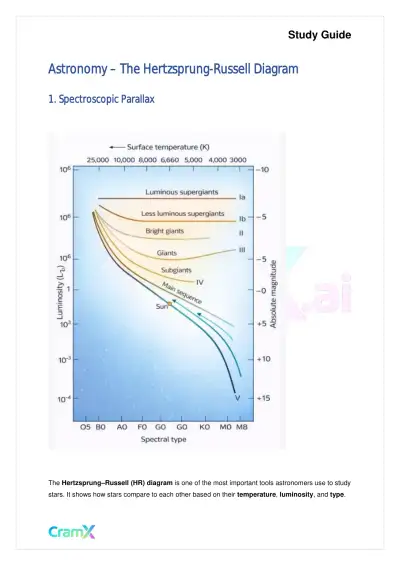 Quick Guides
Astronomy - The Hertzsprung-Russell Diagram
Astronomy
17 pagesMar 2026 Quick Guides
Astronomy - Earth and its Moon
Astronomy
26 pagesMar 2026 Quick Guides
Astronomy - Life in the Universe
Astronomy
9 pagesMar 2026 Quick Guides
Astronomy - The Structure of Stars
Astronomy
19 pagesMar 2026
Study this document with CramX
Once it is in your library, every tool can work from it.