

Solution Manual for Astronomy Today, 9th Edition
- Astronomy
- 361 pages
- Shared February 2025
- 137 downloads
Solution Manual for Astronomy Today, 9th Edition provides expert-verified solutions to help you study smarter.
Preview 31 of 361 pages
See the first 31 pages exactly as they appear in the document.
Page 1 Read page 1 as text
Astronomy Today, 9th Edition Instructor Guide Chapter 1: Charting the Heavens The Foundations of Astronomy 1 Chapter 1: Charting the Heavens The Foundations of Astronomy Outline 1.1 Our Place in Space 1.2 Scientific Theory and the Scientific Method 1.3 The “Obvious” View 1.4 Earth’s Orbital Motion 1.5 The Motion of the Moon 1.6 The Measurement of Distance Summary Chapter 1 begins with a “Big Picture” overview of our place in the Universe. This is followed by a brief introduction to the science of Astronomy and the definition of “Universe.” Common units of measurement that are important to astronomers are introduced, along with the convention of scientific notation. Section 1.2 discusses the scientific method, giving the students an understanding of some of the differences between science and pseudoscience or non-science ways of knowing such as religion. Section 1.3 introduces constellations and the celestial sphere, which serve as a springboard to descriptions in Section 1.4 of the apparent daily and annual motions of celestial bodies such as the Sun, Moon, and stars. Most of these motions are actually illusory, caused by various motions of the Earth. Section 1. 4 also explains the nature and cause of the Earth’s seasons. Section 1.5 deals with the relationship between the Earth and the Moon that causes the phases of the Moon as well as solar and lunar eclipses. Chapter 1 concludes with the concept of parallax and its use in performing measurements of distance and size. Major Concepts The Big Picture — Our Place in the Universe Scientific Theories Testable Simple Elegant Astronomy and the Scientific Method Observation Hypotheses/Explanation Observation/Experimentation Constellations The Celestial Sphere Earth’s Motion Rotation on its Axis (Daily Motion) The Tilt of the Axis and the Seasons Revolution Around the Sun (Yearly Motion) and the Zodiac Precession The Moon’s Orbit Lunar Phases Lunar Eclipses
Page 2 Page 3 Read page 3 as text
Astronomy Today, 9th Edition Instructor Guide Chapter 1: Charting the Heavens The Foundations of Astronomy 2 Solar Eclipses Distance Triangulation and Parallax Sizing Up the Earth Teaching Suggestions and Demonstrations One of the challenges of studying astronomy is developing the ability to view the universe from different perspectives. The biggest challenge is in shifting from the perspective we have from Earth, where we see the Sun and stars rise in the east and set in the west, to the perspective from “outside,” where we “see” Earth spinning on its axis and orbiting the Sun. Models and diagrams are essential to teaching this introductory material, to help your students practice shifting viewpoints. Many students have poorly developed visualization skills, so the more visual aids the better. This chapter contains lots of new vocabulary, so take time to define the new terms. This will likely be students’ first exposure to a formal class in astronomy. They will come to the class with some concrete knowledge, but also with a great deal of misinformation and misconceptions derived from years of exposure to multimedia sources. It is not unusual for people to believe some aspects of what they know as science fiction. Most students are still comfortable with Aristotelian thinking. This chapter provides your first opportunity to slowly move your students toward a new way of thinking — a new perspective. There are many problem areas and misconceptions for students, especially in the early chapters of this text. This is to be expected. Students have few misconceptions about active galaxies because most have never heard of them. Section 1.1 Students almost universally think of the light-year as a unit of time rather than distance. This confusion comes about simply because of the word “year.” Spend some t ime discussing a light-year by first introducing the speed of light. Tell them that light travels at a finite speed and therefore takes time to get to where it’s going. Students may be familiar with “lag time” in a long -distance cell-phone call or in a “live via satellite” interview on the television news; part of this is because the radio signals take time to travel up to the satellites and “bounce around” to their destination . Emphasize “distance” here. Since the speed of light is about 3 10 5 km/s, one light-second is a distance of 3 10 5 km. Next, describe a few examples, such as the fact that light travels fast enough to go around the Earth more than seven times in one second; therefore, one light-second is equivalent to a bit more than seven times the circumference of the Earth. Another example is that the Sun is about 8 light-minutes away. Students are usually intrigued by the idea that if the Sun were to burnout or explode right now, then we would have no way of learning that fact for another 8 minutes. Finally, use the distance to far away galaxies as another example. The galaxies are so distant that it takes millions of years for their light to reach us. Therefore, they are millions of light-years away. This is good conceptual foreshadowing for things to come later in the semester. When we look at distant objects, we see them as they were when their light left them. We see things not as they are “right now,” but as they were when the information — light — left them. The Sun appears to us as it was 8 minutes ago. Distant galaxies appear to us as they were millions of years ago. When we look at distant objects, we are effectively looking back in time. Section 1.2 Since many of your students are likely to have had minimal exposure to science, this section is worth focusing on for class discussions. In introducing the scientific method, refer to Figure 1.6 now as well as throughout the semester. Remind the students that science is a process rather than some fixed set of ideas or laws. Furthermore, it is an iterative process that really has no end, as theories are constantly being re-tested and improved. Therefore, scientific theories are always subject to challenge and change. In fact, it is a good thing when a theory is
Page 4 Read page 4 as text
Astronomy Today, 9th Edition Instructor Guide Chapter 1: Charting the Heavens The Foundations of Astronomy 3 challenged, because it may be an opportunity to enhance our understanding. This is a strength , not a weakness, of science. Ask the students to provide examples of ideas in their own minds that had changed once additional pieces of data or knowledge were made available to them. The foundation of science rests on the fact that it does not rely on the authority of political or religious systems or on the interpretation of text, ancient or otherwise. It relies on a constant process of improvement. When talking about the process of science, it is important to distinguish between facts, the things we observe and measure, and theory, our explanations for those observations. Emphasize that no matter how good, useful, or thorough a theory is, it can never be a fact. The fact is that apples fall from trees; the theory that explains how and why they fall is the theory of gravity. Theories should never be given too much credit, and they should not be sold short. Theories are not just guesses or statements of belief. Theories are our best possible explanations for the things we see happening around us, backed up by data and the hard work of men and women who are striving to understand the universe more completely. To use the phrase “just a theory” is to demean th at hard work. Theories are powerful things, even if they are not facts. Students appreciate it when instructors are candid about the strengths — and limitations —of scientific theories, so don’t be afraid to be honest about the nature of science. Section 1.3 Your students will all have heard of constellations and will probably be able to name at least a few, usually signs of the Zodiac or “big names” like Orion. Emphasize that the stars in a given constellation are probably not physically close to each other in space; they just appear close to each other as seen from Earth. Compare Figures 1.8 and 1.9. Use an analogy with how close buildings may appear to each other when observing a large city from a distance. The stars in the northern part of the sky were grouped together by observers in ancient times, and we continue to use nearly the same groupings (mostly from Eastern Mediterranean cultures) today. You can pass out or project a sky chart without constellations drawn in and challenge students to make up their own. You could even create a writing project in which students research an ancient culture — I usually disallow the Greeks and the Romans to make it challenging — and come up with constellations for that culture. Students may be surprised to find that there are 88 constellations, and that constellations are used to divide the sky into sections, the way that county, state, and national boundaries are used on Earth. It is also interesting to compare names of northern and southern constellations. The northern constellations are mostly traditional, typically named after animals and mythological characters, such as Cygnus (the Swan), Cassiopeia (the Queen), and Orion (the Hunter). The Southern Hemisphere sky includes more modern constellation names such as Telescopium (the Telescope), Microscopium (the Microscope), and Antlia (the Air Pump). Ask your students if they can explain why there is a difference. The constellation names we have inherited today derive from northern- sky observers, mostly in ancient Greece. The northern constellation names, therefore, date from ancient times, but the names from the southern sky date from the travels made by northern explorers to the Southern Hemisphere in more recent times. I find that mythological stories not only give students time to “rest their hands,” but ca n also help refocus their attention and see the connections to the past. The story of Cassiopeia, Cepheus, Andromeda, Cetus, and Perseus is a nice way to show the connections among a “family” of constellations. I also use the myth of Orion and Scorpius to explain the different appearances of the summer and winter skies, as shown in Figure 1.14. The two mortal enemies, placed on opposite ends of the sky, continuously chase each other around. Their “guardians”— Taurus for Orion and Sagittarius for Scorpius — ins ure that they don’t “cheat” and take a shortcut over the Earth. These are all constellations your students can find in the night sky, depending on the time of year you are teaching the course. Provide star charts and encourage your students to find major constellations in the night sky throughout the course.
Page 5 Read page 5 as text
Astronomy Today, 9th Edition Instructor Guide Chapter 1: Charting the Heavens The Foundations of Astronomy 4 The concept of the celestial sphere is an important one. We are missing depth perception when we look out at the night sky, and so we perceive the three-dimensional Universe as a two-dimensional sphere. DEMO — If available, bring in a transparent model of the celestial sphere with Earth inside and point out the north and south celestial poles and the celestial equator. Emphasize that this is not an accurate model of the universe, but a good illustration of the geocentric model. This is a good time to discuss Polaris and clear up any misconceptions; often, introductory astronomy students believe the North Star must be the brightest star in the sky. The ancient Chinese saw Polaris as the Celestial Emperor, and while the Emperor may not be the brightest person in the kingdom, everyone still has to do what he says! Introduce students to right ascension and declination by comparing these to latitude and longitude. Compare the grid lines on the transparent sphere to the grid on the central Earth. Emphasize that the celestial coordinates are attached to the sky. Over the course of a night, stars move from east to west and the coordinate system moves with them. Look up the coordinates of a few well- known stars (including Polaris) and help students determine their positions on the transparent sphere. Ask students to compare the two different methods of describing star locations, by coordinates and by constellation, and discuss the advantages of each. Section 1.4 Students usually know the terms “rotation” and “revolution” but often confuse them. For this reason, I try to avoid their use in class, and encourage students to do the same. It is much simpler and clearer to use “spin” and “orbit,” so try to get yourself in the habit of using these terms. Remember: students will be more impressed by someone who is clear than by someone who “sounds scientific!” Likewise, they will probably know that Earth takes a day to turn on its axis and a year to orbit the Sun, but will not know the difference between a solar day and a sidereal day, or a tropical year and a sidereal year. Use diagrams such as Figure 1.13, to help explain. Models also help. DEMO — Demonstrate rotation and revolution with globes, or bring students to the front of the class to model Earth’s motions. For instance, one student can spin around (slowly) while orbiting another. Ask the class to concentrate on one point on the Earth, say, the spinning student’s nose, and imagine when it is lit and when it is dark. Use this model to explain day and night, sidereal vs. solar days, and why different constellations are visible in the night sky during different months. Figures 1.15 and 1.16 are very important and particularly insightful when used in conjunction with one another. Make sure students understand that Figure 1.16 shows the apparent path of the sun on the celestial sphere, and that this path passes through the constellations of the zodiac, as can be seen by taking the “Earth perspective” in Figure 1.15. If you ask students how many constellations are along the Sun’s path in the zodiac, the common answer will be 12. Although this is true of the “astrological zodiac,” students are usually surprised to learn that there are actually 13 zodiacal constellations, including Ophiuchus. Ask students to use Figure 1.15 to determine what constellation the Sun appears to be in at a certain time of year. Then ask students if they notice any “errors” in those dates. There may be several students who mention that their birthdays are not within the dates shown for their astrological “sign.” This usually serves as a perfect lead -in to the history of the modern calendar, including the concept of precession. DEMO — A gyroscope or top in motion on a table or desk makes a good demonstration of precession. By changing the direction that Earth’s axis is pointing, precession is responsible for the fact that the zodiac constellations no longer correspond to their astrological dates. Another example, the heliacal rising of Sirius — Sirius rising right next to the Sun — was an important date in the ancient Egyptian agricultural calendar, since it signaled the flooding of the Nile. Thanks to precession, this no longer occurs on the same date today. My experience has shown that few students have a good understanding of the cause of the seasons. After presenting a mythological explanation for the seasons — the Greek myth of Pluto and Persephone — I ask students
Page 6 Read page 6 as text
Astronomy Today, 9th Edition Instructor Guide Chapter 1: Charting the Heavens The Foundations of Astronomy 5 to write a brief paragraph explaining why it is cold in winter and hot in summer. This would also make a good “clicker” question. Many students, especially those who have not yet read the text, will say the cause is the varying distance between the Earth and the Sun. I then present four pieces of information demonstrating why this can’t be so. 1. The Earth is closest to the Sun in January. 2. The Earth’s orbit is only a few degrees off from a perfect circle. 3. The tropics are warm all year round. 4. The seasons “flip” when you cross the equator. It is important to attack this misconception with evidence, rather than simply present the correct alternative. These four pieces of evidence may induce some “cognitive dissonance” and help students let go of their deeply rooted misconception and be more open to a better explanation. After all, in science, explanations are refuted with facts, not with alternative explanations. DEMO — Using an overhead projector or flashlight and a tilted globe, show how the angle of sunlight changes as the Earth goes around the Sun. Remember always to have the axis pointing the same direction! Note that not a lot changes in the tropical zone, while the polar regions have the light blocked by the curve of the Earth for half a year. Shine a flashlight directly down on a tabletop or on the floor, and then shine it at an angle to show how the angle of the Sun’s rays affects the distribution of solar heating. Section 1.5 DEMO — When explaining the motions of the Earth, Moon, and Sun, you can bring a common Earth globe to class. An overhead projector or a flashlight will do for the Sun. For the Moon, any sphere that is a quarter diameter of the Earth globe — softballs or baseballs —will work well. The students can be the “fixed” stars. One demonstration can attack the common misconception that the Moon always shows the same face to Earth because the Moon does not spin. Ask a student to sit in a chair and hold a globe of the Earth. Have yourself or another student “orbit” the chair without spinning— say, by always keeping his or her nose pointing at the students playing the stars. Have the student representing the Earth describe what he or she sees. Then have the student representing the Moon orbit again, this time always facing the Earth. Ask the “stars” what they see the Moon doing. Don’t assume your students actually understand the phases of the Moon. Using a whiteboard, chalkboard, or transparency on an overhead projector, draw the orbit of the Moon around the Earth, as in Figure 1.20. Place the Moon at key points in the orbit, represented as a circle. Using one color, shade in the half of the Moon that always faces the Earth. In another color, shade in the half of the Moon that is lit up by the Sun. You may even want to pass out worksheets and have the students do this themselves. Stress to the students that the phase of the Moon depends on how much those two regions coincide. The lecture- tutorial “The Cause of Moon Phases” is also very good for reinforcing these ideas. After defining the basic phases of the Moon, ask questions such as “When does the full moon rise?” or “At what time of day or night is the first quarter moon highest in the sky?” The answer to both questions is sunset. Demonstrate this with your model. Since it is not practical to have each student sit in the “Earth chair,” you may want to take a short movie from that perspec tive, with just one light source illuminating the Moon proxy. As the person holding the Moon model spins in the chair, it will appear to go through phases. DEMO — You can create a simple model to illustrate Moon phases by getting a bunch of small Styrofoam balls a few inches in diameter and some pencils. Stick each sphere onto a pencil and give one to each student or group of students. Darken the room except for a single light source representing the Sun. Have the students spin around so that the Styrofoam b alls “orbit” their heads. Each sphere will appear to go through phases as it orbits a student’s
Page 7 Read page 7 as text
Astronomy Today, 9th Edition Instructor Guide Chapter 1: Charting the Heavens The Foundations of Astronomy 6 head. Have the students pause frequently and note the configurations of the faux celestial bodies. Be sure to have the students hold the balls over their heads so that they do not inadvertently demonstrate eclipses! DEMO — To demonstrate eclipses, use the same Earth globe and sphere for the Moon as at the start of this section. Now set up a true-scale model of this system by placing the Moon at 30 Earth diameters from the Earth. Establish the plane of the ecliptic and raise and lower the Moon by ±10 of its diameters to demonstrate the range of its inclination to the ecliptic (which is ±5° and the Moon is about 0.5° in apparent angular diameter). It is not possible for any textbook picture or diagram to represent realistically the Earth – Moon system to scale. With this model, students will see how easy it is for the lunar shadow to miss Earth during the new Moon phase or how the Moon misses the Earth’s shadow during full Moon phase (the Earth’s shadow being about 2.5 lunar diameters). When describing eclipses, ask students what they would see if they stood on the Moon’s surface while looking in the direction of the Earth or the Sun. Would the lunar surface be in darkness or light? What about the Earth or Sun? Remember that the Sun will appear to be the same size in the sky but Earth will appear four times larger in diameter than the Moon does from Earth. Let the shadow of the Earth globe fall on the Moon model, and note, as Aristotle did, that the curve of the shadow means the Earth is spherical. Section 1.6 Make sure that students understand that the techniques of parallax and triangulation are not just for astronomers. Ask if students have seen surveyors sighting through small telescopes. Relate what surveyors do to what astronomers do to find distance. DEMO — The traditional way of demonstrating parallax is to instruct the students to hold up a finger (or pencil), close one eye, and line their finger up with some object on the far wall of the classroom. When they do the same with the other eye open instead, it lines up at a different position. Ask students to try the exercise several times with their finger at different distances from their eyes to determine the relationship between the distance and the amount of shift. DEMO — A second method of demonstrating parallax is to make marks on the board that represent the fixed stars. Distinguish these stars by color or number. Hold a small ball about 1 m or so in front of the board. With your other hand, prepare to make a mark on the board at the location given to you by two students at the opposite sides of the back of the room. Select a student in the back left part of the room and have them tell you where they see the ball relative to the background stars. Make a mark on the board corresponding to that location. Repeat the procedure by selecting a student at the back of the room on the right side. The two apparent locations will be distinctively different, allowing for a clear demonstration of the concepts related to the geometrical foundations of parallax, namely baseline and parallax angle. Figure 1.30 shows this method applied to astronomy using Earth’s diameter as a baseline. Challenge students to come up with a method in which observers restricted to the surface of the Earth can create an even longer baseline to measure parallaxes of more distant stars. (Observations can be made at different points in Earth’s orbit around the Sun; see Figure 17.1 .) Even with the dia meter of Earth’s orbit as a baseline, the parallax method only works for the stars in the solar neighborhood. Angular measure is very important in astronomy. Discuss More Precisely 1-1 carefully. Emphasize the astronomical connection by discussing why there are 360º in a circle. One reason is that the ancient Babylonians found the number 360 very easy to work with, since it is divisible by so many things. Remind students that the ancients did not have calculators, the decimal point, or even the idea of zero! Also, the Sun takes about 360 days to complete a “circle” in the sky over the course of a year. Thus, the Sun moves about 1º per day. DEMO — Demonstrate angular measure by holding up a penny. At a distance of about 1 m, a penny subtends an angle of about 1º. Students can hold up a penny and see what objects at different distances in the classroom have
Page 8 Read page 8 as text
Astronomy Today, 9th Edition Instructor Guide Chapter 1: Charting the Heavens The Foundations of Astronomy 7 an angular size of about 1º. Have students try this at night and estimate the angular size of the Moon, which, to many students’ surprise, is only half a degree. More Precisely 1-2 discusses finding the distances to (and diameters of) astronomical objects. Go over angular measurements and then try several examples. Many problems throughout the text use the equations in this section, so it is worth spending some time to ensure that students understand. Use the fact that the Sun and Moon have the same angular size to emphasize the dependence of angular size on actual size and distance. The text gives a formula that is useful for angular sizes expressed in degrees: actual diameter angular diameter 57.3 distance Since angular sizes of celestial objects are usually measured in seconds of arc (when they are measurable at all), you may wish to give students an alternate equation. One radian contains 206,265 arc seconds, so the equation becomes: actual diameter angular diameter 206265 distance A fist held out at arm’s length is about 10 across, but that is highly variable. To give students some practice measuring and calculating angular sizes, you can actually have them test out this notion. Have students measure the distance across their fists, and the distance from their eye to their fists. The first piece of data is the actual diameter, and the second is the distance. Students can then calculate the actual angular diameters of their fists. Compile and average the results to see if a fist at arm’s length really is 10º across. You may wish to have the students construct an instrument that can measure angles in the sky more accurately. A simple version of such an instrument, called a “cross staff”, can b e made from just a meter stick (serving as the staff) and a shorter slender object, such as a ruler or length of pipe (the cross). The idea is to place the cross on the staff and perpendicular to it so that it subtends an angle of 20º when viewed from the end of the meter stick. If the cross has an actual size of 20 cm, then a simple calculation reveals that it should be attached to the 57.3-cm point on the meter stick. Have the students come to this conclusion working in small groups rather than just telling them. Once the cross staff is built, it can be used for a variety of purposes: Measuring the angle between the Sun and the Moon, to see how that angle changes with Moon phase. Students could even use those angles to reconstruct the Moon’s orbit. Measuring the height of stars above the horizon. Students are often amazed at how much that altitude can change in just an or two. They can also note the “fixed” altitude of Polaris. Measuring the angular distances between the stars in a constellation, such as Ursa Major or Cassiopeia. Students can note how constant those distances remain, and could even use the distances to construct a star chart. Measure the distance between a planet and some bright stars, to see how the planet moves. I have students buy their own meter sticks, and use whatever they have available for the cross. I feel this gives them more ownership of the device, and they are much more careful and creative with it. The text describes how Eratosthenes was able to calculate the circumference of the Earth using geometry. You may also want to describe how Eratosthenes’ contemporary Aristarchus of Samos was able to find out the relative sizes of the Sun and Moon. As with any three points, at any time the Sun, Moon, and Earth form a triangle.
Page 9 Read page 9 as text
Astronomy Today, 9th Edition Instructor Guide Chapter 1: Charting the Heavens The Foundations of Astronomy 8 During the phases of first and third quarter, one of the angles of that triangle — the one at the Moon — is approximately 90º. This is, of course, a right triangle. The distance from the Earth to the Sun is the hypotenuse of that triangle, and the distance from the Earth to the Moon is one of the sides. Therefore, if we can figure out the value of the angle at the Sun, we can use the trigonometric sine function to find the ration between those two sides of the triangle. Aristarchus did not have the modern sine function, but understood the ratios. Aristarchus measured the angle at the Earth and found it to be about 87º — it is actually much smaller, but Aristarchus’ instruments for measuring angles did not have modern levels of accuracy. This leaves only about 3º for the angle at the Sun, and the sine of 3º is approximately 1/19. This means that the Sun is 19 times farther away from the Earth than the Moon is. This is, of course, off by many orders of magnitude, but the exact numbers are unimportant in this case. However, this also allows us to make a conclusion about the relative sizes of the Sun and Moon. Because the Sun and Moon are roughly the same apparent size, the ratio of their distances from the Earth is the same as the ratio of their actual sizes. So Aristarchus also discovered that the Sun is larger than the Moon, something we take for granted today but was far from obvious to the ancients. Furthermore, since the Earth is only about 3 times the size of the Moon, which can be judged from th e Earth’s shadow during a lunar eclipse, Aristarchus concluded that the Sun is much larger than the Earth. This was completely unsuspected, and led Aristarchus to ultimately assert that the huge Sun had to be orbited by the smaller Earth. This story takes a long time to unfold in class, but it also points out that not everyone in ancient Greece bought into the Heliocentric Model. Sun Moon Earth
Page 10 Read page 10 as text
Astronomy Today, 9th Edition Instructor Guide Chapter 1: Charting the Heavens The Foundations of Astronomy 9 Relevant Lecture-Tutorials Position, p. 1 Motion, p. 3 Seasonal Stars, p. 7 Solar vs. Sidereal Day, p. 11 Ecliptic, p. 13 Star Charts, p. 19 The Cause of Moon Phases, p. 81 Predicting Moon Phases, p. 85 Path of the Sun, p. 89 Seasons , p. 93 Sun Size, p. 113 Student Writing Questions 1. What is the smallest object you have ever seen? The largest? The longest distance you have ever traveled? What is the largest number of objects you have ever knowingly encountered? (You may encounter many bacteria, but not knowingly.) What was the longest you ever spent doing one activity? How do the largest and the smallest of these compare? How do the distances compare to the size of the Earth? To the distance to the Moon? How does your time spent on your longest activity compare to your lifetime? 2. Test your horoscope. Each day, write two or three sentences of the most significant events that occurred to you that day. Cut out or copy your horoscope for that day and save it. Continue this every day for about 3 weeks and make sure you write down your daily events before you read the horoscope. After 3 weeks, check what you wrote against your horoscope for each day and see if there is a match. Count the number of “hits” and “misses.” Discuss the results and whether there is any significance to the number of hits. If you know someone born close to the same day as you, compare your experiences to his or hers. Are horoscopes truly predictive? 3. Describe an ordinary situation in which people regularly apply the scientific method, even though they are not aware they are doing so. Relate the situation to the three basic steps in the scientific method: gather data, form theory, and test theory. 4. If you can, find a location to view the night sky with little interference from city lights. Do this on as clear a night as possible. What do you see? Look all over and make note of the brightest stars. Are there any planets? How can you tell? Is the Moon out? What does it look like? What sort of details can you see on its surface? Chapter Review Answers REVIEW AND DISCUSSION 1. The universe is defined as the sum total of all space, time, energy, and matter. 2. Looking at the data in the text, we can see that the diameter of the Sun is about 100 times that of Earth, about 1,500,000 km for the Sun compared to about 12,000 km for Earth. A galaxy such as the Milky Way is about 100,000 light-years in diameter. Since a light-year is about 10 13 km, this means the Galaxy has a diameter of approximately 10 18 km, or about 10 14 times (100 million million times) the radius of Earth. The
Page 11 Read page 11 as text
Astronomy Today, 9th Edition Instructor Guide Chapter 1: Charting the Heavens The Foundations of Astronomy 10 most distant objects visible define the limits of the visible universe (which is likely only a small part of the entire universe). These objects are about 10 billion light-years away, or 10 23 km. This is 10 19 times (10 billion billion times) the radius of Earth. 3. The scientific method is a process for discovering the best possible explanation as to why something occurs. The process begins when observations lead to the formulation of a hypothesis, a preliminary explanation that makes testable predictions. Investigators gather information — called data — to test the predictions through observation and experimentation. The information is analyzed to find patterns in the data. If the patterns agree with the predictions, the hypothesis is considered a viable theory. If they do not agree, the hypothesis must be discarded or modified. Science therefore relies on measurable quantities and testable predictions to search for answers. By contrast, pseudosciences such as astrology typically make predictions that cannot be tested, and offer explanations that do not fit within a coherent framework of ideas. If a claim is not testable, it cannot be considered scientific. 4. In the common usage of the term, a constellation is a pattern of stars in the sky. Officially, however, a constellation is a section of sky that contains stars, galaxies, nebulae, and many more celestial objects. Just as every section of Earth’s land surface is considered part of a country, every part of the sky is within the borders of a constellation. Constellations are thus useful in naming and locating celestial objects. 5. The motion of the Sun in the s ky is an illusion caused by the Earth’s spin. The Sun appears to rise in the east and move westward throughout the day because the Earth beneath us is spinning eastward, or counterclockwise, as viewed from the north. Therefore, all non-artificial celestial objects have this apparent motion, including the Moon and stars. The motion of the Earth in its orbit around the Sun produces another set of illusions that unfold over the course of the year. The Sun appears to move among the signs of the Zodiac over the course of a year, as the Moon does over the course of a month. The appearance of the night sky gradually changes over the year, as the night side of the Earth points toward different parts of the Galaxy. 6. The Sun is a special object because Earth is in o rbit around it. By comparison, the stars are “fixed,” and we measure Earth’s “true” rotation— the sidereal day — compared to the stars. Over the course of the sidereal day, Earth has moved along a small portion of its orbit. This causes the Sun to appear to move slightly among the stars from our perspective, and so Earth must spin a few minutes more to “catch up” and bring the Sun back to its position from the previous day. Therefore, the solar day is slightly longer than the sidereal day. 7. At any given time d uring the year, we can only see the part of the Galaxy that the “night side” of Earth is facing as it orbits the Sun. In July, this part of the Galaxy includes, for example, the stars of Scorpio. Six months later, Earth has moved over to the other side of the Sun, and the night side of Earth is facing an entirely different section of the Galaxy, with the stars of Orion. We cannot see the stars of Scorpio in January because the Sun is between them and us. 8. Discovered by the Greek astronomer Hipparchus, prece ssion is a slow shift in the orientation of the Earth’s axis of spin. Although Earth’s axis maintains an axis tilt of 23.5 º compared to the axis of the Sun, the axis moves in a circle over the course of 26,000 years. This causes the location of the celestial poles to shift, along with the entire sky. For individual stars, this means that their celestial coordinates change slowly over time. It is caused by the gravitational influence of the Moon and Sun on the spinning Earth. 9. There are seasons on Earth because the rotation axis of Earth is tilted with respect to the axis of the Sun. This tilt means that a given location on Earth receives different angles and intensities of sunlight over the course of Earth’s orbit. When it is summer at your location, the Sun is almost directly overhead at noon. Therefore, the sunlight strikes the ground at almost a 90º angle and is very concentrated. In winter,
Page 12 Read page 12 as text
Astronomy Today, 9th Edition Instructor Guide Chapter 1: Charting the Heavens The Foundations of Astronomy 11 however, the Sun never gets very high, even at noon, and the sunlight comes in at an extreme angle. This indirect sunlight is very diffuse and not efficient at heating. 10. Half of the Moon is lit by the Sun at all times. However, due to the Moon’s motion around Earth, it is not always the same half. The phase of the Moon depends on which portion of the “near” side of the Moon (the side that faces Earth) is lit by the Sun, which in turn is influenced by where the Moon is in its orbit around Earth. If 100% of that side is illuminated, we see a full Moon. If none of the side facing Earth is illuminated, we have a new Moon. 11. A lunar eclipse occurs when the Sun, Earth, and Moon align so that the Moon enters the shadow of the Earth. A solar eclipse occurs when the three objects align so that the shadow of the Moon falls on Earth’s surface. From the perspective of someone in the shadow, the Moon passes in front of the Sun. Eclipses can only occur when the Sun, Moon, and Earth line up in all three dimensions. This occurs rarely because the orbit of the Moon around Earth is not aligned with the orbit of Earth around the Sun. The two orbits form an angle of 5.2º, so most of the time the shadow of the Moon misses the surface of Earth, and the Moon does not fully enter Earth’s shadow. Only on those rare occasions when the three bodies come into alignment and the Moon crosses the plane of Earth’s orbit (the ecliptic) can we have an eclipse. 12. So long as the planet’s moon (or moons) can enter the shadow of the planet, observers on other planets can see their versions of lunar eclipses. Solar eclipses are a different matter: the moon must be close enough or big enough (or both) to have the same apparent size as the Sun or greater. Only then can it completely cover the Sun from the observer’s perspective. This is very possible; for example, we have seen the shadows of the Galilean moons passing over the clouds of Jupiter. 13. Parallax is the apparent shift in a foreground object’s position compared to the background. It is an illusion caused by a change in the observer’s point of view. For example, when we look at our finger with one eye open and then switch eyes, the finger will appear to move against the background. Surveyors use parallax to find the distances to objects. 14. Since parallax is an illusion caused by a change in perspective, a very large change in perspective (called the baseline) is required to see a parallax shift in a distant object. If the baseline is too small compared to the object’s distance, the difference in perspective will not be enough to cause a visible shift. 15. To determine the true diameter of an object from a distance, we need to know how large the object appears to be (the angular diameter) and how far away the object is (distance). CONCEPTUAL SELF-TEST 1. B 2. B 3. D 4. A 5. C 6. A 7. C 8. C 9. A 10. D
Page 13 Read page 13 as text
Astronomy Today, 9th Edition Instructor Guide Chapter 1: Charting the Heavens The Foundations of Astronomy 12 PROBLEMS 1. In 1 second, light travels about 300,000 km. This is almost 80% of the distance to the Moon. 2. (a) 1000 = 1 × 10 3 ; 0.000001 = 1 × 10 – 6 ; 1001 = 1.001 × 10 3 ; 1,000,000,000,000,000 = 1 × 10 15 ; 123,000 = 1.23 × 10 5 ; 0.000456 = 4.56 × 10 – 4 (b) 3.16 × 10 7 = 31,600,000; 2.998 × 10 5 = 299,800; 6.67 × 10 – 11 = 0.0000000000667; 2 × 10 0 = 2 (c) 2 × 10 3 + 10 – 2 = 2000 + 0.01 = 2000.01; (1.99 × 10 30 )/(5.98 × 10 24 ) = 333,000; (3.16 × 10 7 ) × (2.998 × 10 5 ) = 9.47 × 10 12 3. There are 12 constellations in the Zodiac. Since there are 360º in a circle, each constellation in the Zodiac occupies about 30º. The year 10,000 AD is roughly 8000 years from now. Since 8000/26,000 = 0.31, this 8000-year span represents 31% of the total 26,000-year precession cycle. Therefore, the Sun will move 31% of the way around the circle, or 111º. This is a little less than four constellations worth of motion, so the Sun will be well into Scorpio by 10,000 AD. 4. The Moon appears to orbit Earth in 29.5 days (the synodic month). Thus, every day it appears to move 360º/29.5= 12.2º among the stars. Therefore: (a) One hour is 1/24 = 0.042 day, and in that time the Moon will move 12.2º × 0.042 = 0.51º, or about 31 minutes of arc. (b) One minute is 1/60 of an hour, so the motion will be 1/60 of the motion above, or about 31 seconds of arc. (c) Once second is 1/3600 of an hour, so the motion will be 1/3600 of the motion in part a, or about 0.52 seconds of arc. The angular diameter of the Moon is about half a degree, or about 30 minutes of arc. By our calculations above, this means the Moon moves its own diameter in one hour compared to the stars. 5. In this case, we can find the distance using the formula: parallax 1000 km 360 2 D (a) P = 1º, so D = 57,300 km. (b) P = 1/60º, so D = 3,440,000 km. (c) P = 1/3600º, so D = 206,000,000 km. 6. First, we must change the angular size of Venus into degrees. 55 seconds × 1 3600 seconds = 0.0153º Inserting this into the formula for angular size gives actual size actual size angular size 57.3 0.00153 57.3 distance 45,000,000 km
Page 14 Read page 14 as text
Astronomy Today, 9th Edition Instructor Guide Chapter 1: Charting the Heavens The Foundations of Astronomy 13 This gives an actual size of 12,000 km. 7. Since their angular sizes are the same, the Moon’s advantage in distance must be offset by a disadvantage in actual size. The Sun is 391-times farther away (150,000,000/384,000) than the Moon, so the Sun must be 391-times larger than the Moon to compensate. 8. Assuming a thumb diameter of 2 cm and an arm length of 75 cm, we can use the angular size formula. actual size 2 cm angular size 57.3 57.3 1.5 distance 75 cm 9. There are a number of answers to this question, and a number of ways to get an answer. One way is explained here: http://www.npr.org/sections/krulwich/2012/09/17/161096233/which-is-greater-the-number-of-sand-grains- on-earth-or-stars-in-the-sky Suggested Readings Websites There are a huge number of astronomy-based sites on the World Wide Web. Here are a couple devoted to the constellations and their mythology: The Constellations and their Stars — http://www.astro.wisc.edu/~dolan/constellations/ . The “references” section of the site has an extensive list of star myths from many cultures. The Constellations Web Page — http://www.dibonsmith.com/ . http://amazingspace.org/tonights_sky/ is a NASA video about the night sky. This URL always lands on the current month, but you can browse the archive for other constellations during other months. Planet positions and moon phases are also shown. The famous 1977 film “Powers of Ten” can be found on YouTube: https://www.youtube.com/watch?v=0fKBhvDjuy0 Cary and Michael Huang have created the excelle nt Web app “The Scale of the Universe.” Users can zoom in and out from the smallest to the largest scales, and get information about the objects to be found at those scales. The app can be found at http://htwins.net/scale2/ . Well worth a look. One of many videos comparing the sizes of celestial objects is titled “Star Size Comparison 2” : https://www.youtube.com/watch?v=GoW8Tf7hTGA ’ An activity to help students better understand the seasons can be found at http://nationalgeographic.org/activity/the-reason-for-the-seasons/ http://www.mreclipse.com and http://aa.usno.navy.mil/data/docs/LunarEclipse.html give information about eclipses of the moon and sun. The “Crash Course” channel on YouTube has a series about astron omy: https://www.youtube.com/playlist?list=PL8dPuuaLjXtPAJr1ysd5yGIyiSFuh0mIL
Page 15 Read page 15 as text
Astronomy Today, 9th Edition Instructor Guide Chapter 1: Charting the Heavens The Foundations of Astronomy 14 The first five videos are especially relevant to this chapter. The phenomenon of precession can be difficult for students to visualize. A short video demonstrating the precession of the Earth’s axis and its effect on the locations of the Vernal Equinox and the North Celestial Pole is titled “Precession of the earth” : https://www.youtube.com/watch?v=qlVgEoZDjok . Books A number of books are available about the constellations and their mythology. Here is a sampling: Allen, R. H. Star Names: Their Lore and Meaning . New York: Dover Publications, 1990. A reprinting (with corrections) of a work first published in 1899. It has fascinating information and more detail than you will ever need to know. Rey, H. A. The Stars: A New Way to See Them. New York: Houghton Mifflin, 1976. Our modern view of the constellation patterns is due in large part to Rey, the creator of the Curious George series of children’s books. Ridpath, I. Star Tales . Cambridge: Lutterworth Press, 1989. Includes a story for every constellation, although some are quite brief. Stott, C. Celestial Charts, Antique Maps of the Heavens. New York: Crescent Books, 1991. Traces the development of the constellations through beautiful photos of ancient star maps. A striking “coffee table” book. Magazine Articles Be ldea, Cătălin and Joe Cali. “ Chasing totality from the stratosphere .” Sky & Telescope (October 2013). p. 66. A story about observing an eclipse from above ground level. Berman, B. “The o utsider.” Astronomy (October 2003). p. 48. Illuminating article about a modern astronomer. Helpful when discussing the scientific method with students and a good reminder that science is a human endeavor/activity. Relevant to Chapters 1 and 2. Berman, Bob. “Five -five-uh- oh.” Astronomy (May 2000). p. 93. Discusses the effe cts of the “planetary alignment” of May 2000, and provides arguments against astrology. Bordeleau, A. “Polestars of the future.” Sky & Telescope (March 2008). p. 66. Overview of how precession affects the position of the celestial poles. Brown, Jeanette. “It’s just a p hase.” Astronomy (April 1999). p. 76. Describes an activity designed to demonstrate the phases of the moon. Camino, N. and A. Gangui. “Diurnal astronomy: using sticks and threads to find our latitude on Earth. ” Physics Teacher 50:1 (2012), p. 40. A unique way of determining latitude in the daytime. Crossen, Craig . “ The very ancient origins of the water constellations .” Sky & Telescope (March 2015). p. 36. Describes how a section of the sky filled with faint stars acquired a number of water-themed constellations. Cunningham, C. J. “Updating Eratosthenes.” Mercury. (March/April 2003). p. 10. Discusses a method by which students can measure the size of the Earth using the Internet.
Page 16 Read page 16 as text
Astronomy Today, 9th Edition Instructor Guide Chapter 1: Charting the Heavens The Foundations of Astronomy 15 Gurshtein, Alexander A. “In search of the first constellat ions.” Sky & Telescope (June 1997). p. 46. A detailed discussion of the origin and history of constellations. Hirshfeld, A. “The Universe of Archimedes . ” Sky & Telescope (November 2010). p. 32. A discussion of how Archimedes conceptualized astronomical quantities. Krupp, E. C. “Slithering toward s olstice.” Sky & Telescope (June 2000). p. 86. Discusses the symbolism of snakes, serpents, and solstices. Leschak, Peter. “The s ky’s ancient l ight.” Night Sky (January/February 2006). p. 52. Article with a variety of examples of how we look back in time as we look out into space. Livio, M. “Is God a m athematician?” Mercury (January/February 2003). p. 26. Brief discussion of the role played by mathematics in scientific theories. Mallmann, J. A. “Tree leaf sha dows to the Sun’s density: A surprising route. ” Physics Teacher 51:1 (2013). p. 10. Using the images of the Sun created by leaves to calculate some of the Sun’s properties. Paczynski, B. “Astronomy: A problem of d istance.” Nature (January 2004). p. 299. An example of determining distances to astronomical objects (along with associated practical considerations). Panek, Richard. “The astrology c onnection.” Natural History (April 2000). p. 20. Discusses conjunctions and the historical connection between astrology and astronomy. Panek, Richard. “That sneaky s olstice.” Natural History (June 2000). p. 20. Describes the meaning of the solstice, and discusses why the earliest sunrise does not happen on the solstice. Plait, Phil. “The reason for the s easons.” Astronomy (July 1999). p. 75. Brief and accurate description of the cause of the seasons, with good diagrams. Ryan, Jay. “SkyWise: Equinox.” Sky & Telescope (March 2000). p. 114. Comic strip drawing illustrating the equinoxes. Ryan, Jay. “SkyWise: Grego rian c alendar.” Sky & Telescope (February 2000). p. 109. A cartoon strip showing systems of calendars. Ryan, Jay. “SkyWise: Lunar s kies.” Sky & Telescope (April 2000). p. 114. A cartoon strip illustrating the view of the Earth as seen from the Moon. Sadle r, P. M. and C. Night “Daytime celestial navigation for the n ovice. ” Physics Teacher 48:3 (2010). p. 197. Tracing the analemma with simple tools. Sweitzer, J. “Do you b elieve in the Big Bang?” Astronomy (December 2002). p. 34. Discusses “theory” and evidence in general and as applied to the Big Bang Model. Takemae, S., P. Kirwin, and G. McIntosh “Reproducing Eratosthenes’ determination of Earth’s c ircumference on a smaller s cale.” Physics Teacher 51:4 (2013). p. 222 . Illustrating Eratosthenes’ techniq ue on a balloon. Talcott, R. and R. Kelly. “Illustrated: H ow we see the sky.” Astronomy (June 2009). A description of the useful construct of the Celestial Sphere.
Page 17 Read page 17 as text
Astronomy Today, 9th Edition Instructor Guide Chapter 1: Charting the Heavens The Foundations of Astronomy 16 Trefil, James. “Architects of t ime.” Astronomy (September 1999). p. 48. Discusses history of astronomical time keeping, from Stonehenge to pulsars. Vanderbei, Robert and Ruslan Belikov. “Measuring the astronomical unit from your b ackyard.” Sky & Telescope (January 2007). p. 91. Technique for using the parallax of asteroids and planets to determine the value of the astronomical unit. Zeiler, Michael. “The evolving eclipse map. ” Sky & Telescope (November 2012), p. 34. Describes how we can predict the time and place of eclipses.
Page 18 Read page 18 as text
Astronomy Today, 9th Edition Instructor Guide Chapter 2: The Copernican Revolution The Birth of Modern Science 1 Chapter 2: The Copernican Revolution The Birth of Modern Science Outline 2.1 Ancient Astronomy 2.2 The Geocentric Universe 2.3 The Heliocentric Model of the Solar System 2.4 The Birth of Modern Astronomy 2.5 The Laws of Planetary Motion 2.6 The Dimensions of the Solar System 2.7 Newton’s Laws 2.8 Newtonian Mechanics Summary Chapter 2 continues the view from Earth started in the previous chapter by discussing the apparent motions of the planets, which leads to two very important concepts that are introduced in this chapter: the historical development of astronomy and the laws of planetary motion and gravity. The historical context in which these concepts are couched provides a framework for demonstrating the scientific process and for portraying that process as a human endeavor. Although the chapter takes a mostly European view, as is traditional, it does speak to the larger issue of contributions from cultures all over the world and throughout history. Modern astronomy is anything but limited to western contributions; it is a truly international science, as will be seen in later chapters. Chapter 2 is very important, not just for its historical context, but because it describes the ideas of gravity and orbital motion that pervade the rest of the text. There is hardly a chapter that follows that does not make reference to this material and build on it. It is therefore imperative that students understand this material; without this understanding, very little of the following 26 chapters will make sense. The material is also highly relevant to issues of technology and modern life. For example, students often take the many satellites that serve us in orbit for granted, and may have a poor understanding (and some misconceptions) about what it takes to get them in orbit and keep them there. Cartoons as well as some science fiction movies and television programs can promote these misconceptions that have become the “lived reality” of our students. Major Concepts Ancient Astronomy Early Uses of the Sky Astronomy During the “Dark Ages” Motions of the Planets Wanderers Among the Stars Retrograde Motion Geocentric Models of the Universe Aristotle Ptolemy Heliocentric Models and the Birth of Modern Astronomy Copernicus Brahe
Page 19 Read page 19 as text
Astronomy Today, 9th Edition Instructor Guide Chapter 2: The Copernican Revolution The Birth of Modern Science 2 Galileo Kepler’s Laws of Planetary Motion Isaac Newton Laws of Motion Gravity Explaining Orbits and Kepler’s Laws Teaching Suggestions and Demonstrations Section 2.1 Point out to the students that in ancient times, astronomical observations were tightly intertwined with the mythological/spiritual aspects of human life as well as agricultural practices that were important to the well-being of ancient cultures. Food sources, whether animal or vegetable, were found to be dependent on the annual seasonal cycles. Ask the students if they can come up with examples of things in their own lives that are dependent on celestial phenomena, including the Earth’s rotation and the cyclical revolution period as we move around the Sun. When modern farmers plan, they simply look at the modern calendar and consult with technologically advanced meteorological tools such as “ Doppler radar” and weather satellites. Ancient cultures lacked these tools and instead relied on other instruments such as Stonehenge or the Caracol Temple as described in the text. It is worth noting that we have only deduced after the fact that these ancient monuments had astronomical applications; it’s not as if they came with instruction manuals! There are also instances where an ancient site was thought to have astronomical significance that later proved to be spurious, such as the Nazca Lines in South America. Students may be surprised that even today the spiritual components of society can still be intermingled with astronomical phenomena. For example, the Christian holiday of Easter falls on the first Sunday following the first full Moon after the Vernal Equinox. Section 2.2 While a few students might be eager to move on to the black holes and string theory, my experience is that most students enjoy hearing abo ut the history of astronomy. Hearing the stories of some of the “big names” in astronomy, the things they got right, and even the things they got wrong, goes a long way toward “humanizing” science for the students. Talking about wrong turns is especially important, because it demonstrates the power of the scientific process. Be sure to emphasize that “bad” theories are brought down by evidence , not just by “better” theories. People such as Aristotle and Ptolemy were not wrong because they lacked intelligence, they were wrong because they lacked information . A disturbing number of authors depict ancient astronomers in a patronizing manner; for example, some have said that the ancients clung to an idea of an Earth-centered solar system because they wanted a “special place in the universe .” This is not only an arrogant 21st century perspective, it is utterly wrong. Ancient astronomers were rational, mature people who relied on their experiences and information to shape their ideas, just as we do. They could no t “feel” the Earth spinning or orbiting, for example, and so believed that it was stationary beneath a rotating sky. Aristotle himself said that if the Earth were moving, then we should feel the wind from its motion. In addition, they could not see the phenomenon of stellar parallax, and thus concluded that our perspective on the stars did not change because we were not moving. Be sure to give credit to ancient astronomers for being rational people. When talking about the ancient practice of using models to describe the universe, discuss the idea of “Saving the Appearance.” Early astronomers were concerned with creating models of the universe that were capable of providing accurate reproductions of what they were seeing in the sky without a deep regard for
Page 20 Read page 20 as text
Astronomy Today, 9th Edition Instructor Guide Chapter 2: The Copernican Revolution The Birth of Modern Science 3 physical explanation or justification. The need for such justification was simply not part of their tradition, as it is part of ours. One of the ways that Aristotle tried to justify the geocentric view of the universe was with the five classical elements. Four of these elements were found only in our world: earth, water, air, and fire. The fifth element (sometimes called the Aether) was found only outside Earth. It was a perfect, glowing, and unchanging material, unlike the chaotic elements of Earth. An obj ect’s natural motion (what it did when nothing was exerting a force on it) depended on its composition. An object made mostly of earth or water fell downward, and an object made of air or fire rose upward. The celestial objects did neither, but moved in perfect circles around Earth. These ideas seemed reasonable for describing motions in the sky for centuries, until the work of Copernicus, Galileo, and Kepler brought them down. The text notes that not all Greeks subscribed to the geocentric model, and mentions Aristarchus of Samos as an example. Students may be interested to know just how Aristarchus came to the conclusion that the Sun is at the center. It began when Aristarchus undertook a project to measure the relative sizes of the Sun and Moon, and thus add to the earlier work of measuring the size of the Earth done by Eratosthenes (see Chapter 1). He reasoned that at certain times, the Sun, Moon, and Earth would form a right triangle with the right angle at the Moon, like so: To determine exactly when the angle at the Moon was 90º, he built a model of the Earth – Moon – Sun system. He found that when the Moon was half-lit as seen from Earth (first and third quarter) the angle was 90º. He then knew when to go out and measure the angle at the Earth — the angle between the Sun and Moon as seen from Earth. He measured that angle to be about 87º; it is measured with modern instruments to be over 89º. With so little left over for the angle at the Sun, it became clear that the trian gle was of the “long and skinny” variety. The Sun had to be much further away than previously thought. Aristarchus calculated that the Sun was about 19 times farther from Earth than was the Moon. In modern terms we would use the sine function, and say that since sin 3º ≈ 1/19, the hypotenuse (Earth – Sun distance) is about 19 times the side opposite the 3º angle (Earth – Moon distance). This number is actually too small, due to the error in measuring the angle at the Earth, but the implications are what matters here. Since the Sun is much farther than the Moon, it must be proportionately larger, since the two objects have roughly the same angular size (see Section 1.5 ). The size of Earth’s shadow during a lunar eclipse indicates that Earth is about 3 times larger than the Moon. If the Sun is then 19 times larger (or more!) than the Sun Moon Earth
Page 21 Read page 21 as text
Astronomy Today, 9th Edition Instructor Guide Chapter 2: The Copernican Revolution The Birth of Modern Science 4 Moon, then the Sun has to be larger than Earth. An elementary school student knows this today, but 2000 years ago, it was by no means obvious. Aristarchus reasoned that it was ludicrous to expect the Earth to command an object so much larger than itself, and so he placed the Sun at the center of motion. The lack of evidence for the Earth’s motion, however, proved to be more convincing for many people, including Ptolemy. The evolution of our understanding of the structure of the Universe is a remarkable story of the scientific process, in which each successive model took care of some problem of the previous model. In many ways, the history of astronomy is the history of the scientific process itself. One common example of the scientific process at work is Ptolemy’s geocentric model of the Universe; its epicycles and deferents were ultimately overthrown by the conceptually simpler Copernican heliocentric model. Students are often surprised to learn that aesthetics (simplicity, elegance, etc.) are one metric by which a scientific theory is measured. Although the early Copernican heliocentric model made no significant improvements with regard to predictive power, the scientific community at that time eventually accepted it — albeit after some resistance and skepticism. However, since accuracy of predictions is indeed a feature of scientific theories, even the Copernican model had to be modified, as observations revealed more subtle details including the shapes of planetary orbits, which were discovered by Kepler to be ellipses rather than perfect circles. The process of refinement continued when Isaac Newton revealed that the Earth does not technically orbit the Sun, but the Sun and Earth both orbit around a common focus. Section 2.3 Retrograde motion is never obvious to students, and can be hard for them to visualize. Go over Figure 2.9 carefully with students. Emphasize that the foreground of the figure is what’s really happening, and the background is what we see from Earth. Ask the students what the faster-moving Earth is doing to Mars at points 5, 6, and 7. Hopefully they will respond that Earth is “lapping” Mars, just as the faster driver in an automobile race does. Then ask the students what a slower car appears to be doing as they are passing it on the highway. Hopefully they will see how the “backward” motion of Mars is explained by Copernicus’s model. DEMO — First, explain to students that the larger the orbit, the slower the planet moves. Draw some stars across the entire board. Ask a student volunteer to play the role of an outer planet. Have the student walk slowly from right to left (from the perspective of the class). You play the role of the observer on Earth. Without moving, note that the outer planet appears to move from west (right) to east (left). However, if you now walk parallel to the student (letting the student start first) and you move at a faster pace, you will appear to overtake and pass the student. This will be obvious. Now, try it again, but stop both your motions before you pass the student and note the position of the student relative to the background stars on the board several times while passing. If the student walks slowly enough and you walk fast enough, you should get a good retrograde effect. (Try this out first before going into the classroom to find an effective pace to use.) Expand on this idea by showing the roughly circular orbits of the planets and explain how retrograde motion only occurs while Earth is “passing” the outer planet . This will always occur when the outer planet is near opposition. Ask students which planets would have retrograde motion if they were standing on Mercury or Venus. Would other objects appear in retrograde motion or only outer planets? Emphasize that the effect is not unique to viewing from Earth, nor does it only occur in planets. Section 2.4 Before discussing Galileo’s observations with the telescope, give a little background on the prevailing worldview of the time, to help students understand just how dramatic Galileo’s discoveries were. The Aristotelian view maintained that all astronomical objects were made of a perfect and unchanging substance unknown to Earth, and that these celestial bodies orbited Earth in perfect circles. Earth was flawed and chaotic, but heavenly objects were perfect, unblemished, and unchanging. Furthermore, Aristotle’s view had been inextricably linked with
Page 22 Read page 22 as text
Astronomy Today, 9th Edition Instructor Guide Chapter 2: The Copernican Revolution The Birth of Modern Science 5 Christianity through “medieval scholasticism,” so contradicting Aristotle was extremely seri ous since it was equivalent to contradicting the Roman Catholic Church. Galileo’s discoveries gave evidence that objects not only orbited something other than Earth (e.g., Jupiter’s moons, phases of Venus) but also that heavenly bodies were blemished (e.g. , sunspots, mountains on the Moon). Galileo’s experiments with falling bodies also directly contradicted the Aristotelian view that heavier objects fall faster than do lighter ones. You may want to mention that Galileo did not actually invent the telescope, nor was he actually the first to use it to observe the heavens. A Dutch optician named Hans Lippershy first got the idea to look through two lenses at once, allegedly from his children. An Englishman named Thomas Harriot mapped out the surface of the Moon with a telescope a few months before Galileo built one in 1609. It is still amazing that Galileo was able to build his own telescope purely from a physical description, and that he made such meticulous observations that literally revolutionized the discipline of astronomy and helped make it a science. If Jupiter is visible at night when you are teaching the course, encourage your students to view Jupiter through binoculars from a reasonably dark site. The four Galilean moons are visible through binoculars, and students can follow their motions over a week or so to recreate Galileo’s observations. Anyone wishing to experience the sky as Galileo did may wish to purchase a “Galileoscope” (at www.galileoscope.org ) or similar small telescope kit. Even a moderately priced pair of binoculars have optics as good as, or superior to, Galileo’s. However, the man himself had one huge advantage that we cannot match, sadly: four centuries ago the world had incredibly dark skies, even in urban areas! Section 2.5 It will probably surprise students that Galileo and Kepler were contemporaries. In terms of conceptual development, it seems that Galileo built on and provided evidence for Copernicus’s heliocentric model, and th en Kepler refined the heliocentric theory with details about the orbits of the planets. In fact, Galileo and Kepler were working at the same time, and exchanged some correspondence. Galileo was placed under house arrest for promoting the heliocentric model and was forced to declare that it was useful as a mathematical tool only, not as a description of reality. Meanwhile, Kepler was not only assuming that the planets orbit the Sun, but he was describing their actual paths and speeds in those orbits. Why were the results of these two men so differently received? Point out to students the differences in their societies and situations that resulted in these very different climates for scientific research and discussion. Kepler was essentially an agent of the Holy Roman Empire at the time he published his work, while Galileo was mostly supported by private patrons like the Medici family. In addition, note that there was a radical difference in personalities: Galileo was an opinionated and even antagonistic person who frequently alienated the people he was trying to educate; Kepler had humility that bordered on low self-esteem. This difference in personality ultimately brought a lot of grief to Galileo, while Kepler’s more deferential, “here -are-the- facts” approach may have led to quicker acceptance of his conclusions. Throughout your discussion of the historical development and final acceptance of the Copernican system, sprinkle in interesting details of the lives of the people involved. Copernicus’s theory was not even published until he lay on his deathbed because he feared ridicule. It might never have been published without the efforts of his friend, Georg Rheticus. Brahe wore prosthetic metal noses after he had his nose cut off in a duel, and represented himself as an astrologer to get funding for his research. Galileo was a flamboyant character who loved to engage in debate, sometimes too much. Galileo published in Italian, as opposed to Latin, and often expressed his ideas in dialogue form to make them accessible to both the scholar and the “common man . ”
Page 23 Read page 23 as text
Astronomy Today, 9th Edition Instructor Guide Chapter 2: The Copernican Revolution The Birth of Modern Science 6 Galileo was friends with Pope Urban VIII and the Pope offered to fund the publication of one of Galileo’s books. But when Galileo wrote the book, he put some of the Pope’s words in the mouth of a buffoonish character, and made his friend look very bad. Kepler rose up from a life of abject poverty to become an accomplished musician and mathematician. Kepler tried for almost a decade to make the data that he inherited from Brahe fit traditional ideas; it was when he decided to listen only to the data that he made progress. In some ways, Kepler can be seen as the first person to fully employ the “Scientific Method.” Begin your discussion of Kepler’s laws of planetary motion by drawing an ellipse on the bo ard or overhead, using the method shown in Figure 2.15 if possible. Define the various parameters of an ellipse: perihelion, aphelion, semi-major axis, and eccentricity. Show how a circle is the special case of an ellipse with an eccentricity of 0. Have students draw ellipses with the same eccentricities as the planets and point out that most of the planetary orbits are nearly circular (see Table 2.1 for data). Extend Kepler’s second law to comets, and ask students to describe the relative speeds of a comet with a very elliptical orbit when it is close to the Sun and when it is far away. Finally, for Kepler’s third law, pick one or two planets and use the semi -major axes given in Table 2.1 to calculate the periods. Compare to the periods given in the table. Review the mathematical meaning of “squaring” and “cubing.” Many students will confuse a 3 with 3a. The students who are more mathematically aware are often concerned that the units of the third law do not work out correctly. Reassure them that the equation is tailor-made for specific units, and that there are constant terms with a value of 1 that can cancel the units. Finally, point out that one of the weaknesses of Kepler’s laws is that they are empirical; that is, they have plenty of “proof” or evidence, but no physical explanation. The nature of the motion was clear to Kepler, but the cause was mysterious. The explanations would have to wait for Isaac Newton. Section 2.6 Students will find it helpful if you review something as basic as similar triangles here. Draw two triangles with one perhaps two times larger than the other but with the same angles. Show that if you know the angles and the length of one of the sides, then you can easily calculate the lengths of the remaining sides. The ratio of lengths for the known side of the similar triangles will be the same as the ratios of the sides where the length is to be determined. Section 2.7 Newton’s laws of motion are extremely important and not necessarily intuitive. Give plenty of examples of each. For instance, ask students to imagine an airplane trip on a beautiful day with no turbulence. If you throw a peanut up in the air, does it hit the person behind you or fall back in your lap? In addition, consider the motion of Earth. If you jump up in the air, does the wall of the classroom slam into you? (Galileo already had a pretty good idea of the notion of inertia when he argued against the geocentric view and used ships at sea as an example.) Emphasize to students that as far as Newton’s laws are concerned, an object moving at a constant velocity (i.e., in a straight line and at a constant speed) is pretty much the same as an object at rest: both have no net force acting on them, and thus neither is accelerating, or changing velocity. Define acceleration carefully and calculate an acceleration that students can relate to, such as the acceleration of a car merging on the highway. You can use more familiar units at first, such as miles per hour per second, and then convert to the more standard meters per second squared to help students gain a feel for the acceleration due to Earth’s gravity. Students often confuse acceleration and velocity, so be sure to distinguish carefully between the two.
Page 24 Read page 24 as text
Astronomy Today, 9th Edition Instructor Guide Chapter 2: The Copernican Revolution The Birth of Modern Science 7 DEMO — You can demonstrate Newton’s second law and the role of mass by attaching a rope to a rolling chair and asking a student to pull it across the floor. Then sit in the chair and repeat. Ask the student to compare (qualitatively) the force used to accelerate the empty chair with the force applied to the chair with an occupant. DEMO — Use an air track with carts or an air hockey table with pucks to demonstrate Newton’s laws, if possible. Seeing the behavior of objects in a nearly frictionless environment can help students overcome Aristotelian misconceptions about motion. Newton’s law of gravitation is explained at the end of this section. Emphasize that gravity is always attractive and (unlike forces such as the electromagnetic force) is felt by every object in the Universe. Also, note that it is proper to speak of the gravitational force between two objects, not the gravitational force of an object. To examine the significance of the various terms, ask students what would happen to the force of gravity between Earth and the Sun if the mass of Earth doubled or if the distance between them doubled. Note that while we may understand the dependence of gravity on mass —more “pullers” means more pull— the dependence on the square of the distance remains mysterious. To help drive home the factors that influence the gravitational force, I present the students with the following fanciful thought experiment. Imagine that malevolent aliens come to Earth and demand that we capitulate, or else they will turn their “shrink ray” on the Sun and reduce its radius to 1 kilometer. That is enough to turn the Sun into a black hole! Three things could then happen: the Earth could get sucked into the black hole Sun, Earth could go flying off into the void of space, or the Earth could stay in its orbit. Have students briefly weigh the options with a neighbor, then take a poll to see which outcome is most likely, according to the class. Students will probably be surprised that the gravitational force will not change, since none of the important factors — the masses of the Sun and Earth and the distance between their centers —have changed. Black holes are not “cosmic vacuum cleaners” as popular fiction depicts them. You can recall this example later in the semester during your discussion on black holes. Section 2.8 This section serves a summativ e purpose by using Newton’s laws to provide a theoretical foundation for understanding the discoveries of Galileo and Kepler. For example, students often confuse the force of gravity with acceleration due to gravity. Derive the expression for acceleration due to gravity and show that it is consistent with Galileo’s experiments regarding the motion of falling bodies. In addition, emphasize that Earth alone does not “have” gravity— gravity is a force between two objects. For instance, the weight of an object is the force between it and Earth. Use the gravitational formula to compare the weight of a 70-kg person on Earth and the weight of that same person on the Moon. Use Figure 2.23 to help explain to students how gravity is responsible for objects falling and orbiting. Ask your students to picture the Moon as constantly falling towards the Earth, but missing because it has velocity! Alternatively, students could picture the situation as the Moon wanting to head off into space in a straight line, but being pre vented from doing so by the “leash” of gravity. DEMO — To demonstrate orbital motion, whirl a ball around on a string in a horizontal circle. In the demonstration, the tension in the string provides the centripetal force. In the case of a planet, gravity is the centripetal force. Ask students to predict what would happen if the force suddenly “turned off,” and then demonstrate by letting go of the string. This is also a good time to discuss the fact that an object in a circular orbit is constantly accelerating. Although moving at a constant speed, the object is always changing its direction. Reiterate that the speed may remain constant, but the direction change means a change in velocity nonetheless. Any change in velocity means that the acceleration is not zero.
Page 25 Read page 25 as text
Astronomy Today, 9th Edition Instructor Guide Chapter 2: The Copernican Revolution The Birth of Modern Science 8 DEMO — Point out to the student s that Newton’s third law states that you are pulling on the Earth just as strongly as it is pulling on you. Then, tell students to brace themselves as you jump in the air, perhaps off a step or low platform. Ask the students why they did not jerk upwards to meet you, while you certainly fell down to meet the Earth. This can lead to deeper understanding of Newton’s second law, and the distinction between cause (force) and effect (acceleration). Follow this up with a discussion of the orbits in Figure 2.25. To better understand the orbits of objects with different masses, ask the students to imagine a parent whirling a child around. The child makes a big circle, while the parent moves in a much smaller circle. This will be important when discussing the discovery of new “exoplanets” later on. DEMO — Ask your students whether it is possible to throw an object into orbit around the Earth. If they have read the text before coming to lecture they will probably answer “no.” (Orbita l velocity is about 18,000 mph around the Earth.) Next, bet them that you can actually throw an object into orbit and will even demonstrate it in class (brag a little about your fast pitch!). After they express their doubts, throw an object up and across the room so they can easily see the curve of the projectile path. Tell them that the object was in orbit but ran into the Earth! Objects orbit around the center of mass; for all practical purposes, this is the center of the Earth in this case. Draw on the chalkboard what the orbit would have been if the object had not run into the Earth, or use Figure 2.26. By throwing the object harder, it goes further. If thrown fast enough (orbital velocity) it will curve (fall) around the Earth at the same rate the Earth ’s surface curves. Relevant Lecture-Tutorials Kepler’s Second Law , p. 21 Kepler’s Third Law , p. 25 Newton’s Laws and Gravity , p.29 Observing Retrograde Motion, p. 99 Student Writing Questions 1. Look up one of the historical figures mentioned in this chapter. Find out as much as you can about his or her life and the period of time in which he or she lived. Describe what the scientist’s daily life must have been like. In what ways was astronomy a part of the person’s life? 2. Describe what it would be like to live without any gravity. What would be easier? Harder? Impossible? Fun? Annoying? Do you think you would like to live like this for an extended period? 3. Kepler had to fight a legal battle to get access to Tycho Brahe’s observations. What if Kepler had been prevented from gaining that access? Speculate how this might have affected Newton’s work on gravity. Would he still have been successful in formulating his law of gravity? Would he even have worked on this problem? Do you think someone else would have worked on it if Newton had not? Would such a small change in historical events that occurred 400 years ago affect science today? Chapter Review Answers REVIEW AND DISCUSSION 1. Astronomers in the Islamic world preserved the writings and discoveries of the ancient Greeks through the Dark Ages in Europe. They translated the works of ancient astronomers such as Ptolemy and expanded on them; many of the proper names of bright stars are Arabic or Persian in origin. They developed many methods in mathematics, including algebra and trigonometry. Chinese astronomers kept careful records of
Page 26 Read page 26 as text
Astronomy Today, 9th Edition Instructor Guide Chapter 2: The Copernican Revolution The Birth of Modern Science 9 eclipses, comets, and “new” stars, extending back many centuries. They also were likely the first to see sunspots, many years before Galileo. 2. The geocentric model of Aristotle had the Sun, Moon, planets, and stars orbiting a stationary Earth. A modification by Ptolemy had most of the planets moving in small circles called epicycles. The center of these epicycles moved around the Earth in larger circles called deferents. Over the centuries, however, other astronomers further altered the model, and dozens of circles were needed to fully describe the motions of the 7 visible “planets,” which included the Moon and the Sun. Scholars clung to this model for reasons that had nothing t o do with religion or needing a “special place in the Universe.” The y had two very rational reasons for thinking the Earth was stationary at the center. First, there was no sensation of motion, no “wind” as the Earth moved through space. Second, there was no observed change in position of the stars (parallax) as the Earth moved around the Sun. This change in position occurs, but it was not measurable until the mid-1800s. 3. The most obvious flaw in the Ptolemaic model is in its basic premise, since the Earth is not at the center of the solar system, let alone the entire universe. The unquestioned acceptance of perfectly circular orbits is another problem. However, a deeper flaw is that the Ptolemaic model did not attempt to explain why the motions are the way the model depicts them. The model may describe the motions, but it does not explain them. Today we would require any such explanation to be based on fundamental physical laws. 4. Copernicus revived the idea that a Sun-centered (heliocentric) model could explain the complex motions of the bodies of the solar system in a simpler way than a geocentric model. However, it was still flawed in that Copernicus clung uncritically to the idea that the orbits of the planets around the Sun had to be “perfect circles.” 5. A theory is a framework of ideas and assumptions that represents our best possible explanation for things that happen in the real world, backed up by hard data. A good theory can be used to make predictions about future events, in addition to explaining things we already know. Theories are always subject to challenge, and thus can never be proven to be true. They can, however, be proven to be false, meaning they no longer explain the phenomenon adequately. It is notable that theories are refuted by data, not by other theories. As long as a theory survives any attempts at disproving it, it will likely continue to be accepted. 6. Galileo discovered that the planet Venus exhibits phases that would be impossible in Ptolemy’s geocentric model. In addition, the phases of Venus also changed size, indicating that Venus was closer to Earth when a “crescent,” and farther away when close to “full.” This could be most simply explained by saying that Earth and Venus were both orbiting the Sun , with Venus’ orbit entirely inside the Earth’s . In addition, the moons of Jupiter demonstrated that objects could move around a body other than the Earth, that there was more than one “center” of motion . 7. Through years of meticulous observations of the motions of the planets among the stars, Tycho Brahe provided the huge amount of data that was later analyzed by Kepler to produce the laws of planetary motion. 8. First law: The orbits of the planets, including the Earth, are in the shape of an ellipse with the Sun at one focus. Second law: A line connecting the Sun and a planet sweeps out equal areas in equal intervals of time; thus, a planet’s orbital speed is greatest when it is closest to the Sun. Third law: The square of a planet’s orbital period (in years) is proportional to the cube of the semi-major axis of its orbit (in astronomical units).
Page 27 Read page 27 as text
Astronomy Today, 9th Edition Instructor Guide Chapter 2: The Copernican Revolution The Birth of Modern Science 10 9. The astronomical unit, defined as the average distance between the Earth and the Sun, was used to provide an estimate of the distances between the planets long before its actual numerical value was known. By reflecting radar waves off the planet Venus and timing how long it takes them to return, we can determine the distance from Venus to Earth in kilometers. Comparing this to the distance from Venus to Earth in AU, the size of the AU in kilometers could be determined, and with it, the distance between the Earth and the Sun. 10. While Kepler’s laws do an excellent job of describing how the solar system is structured, they do not explain why the planets move as they do. They are justified purely by observational data with no explanation of basic causes. Explanations would have to wait for Newton’s laws. 11. First law of motion: Every object continues in a state of rest or in a state of uniform motion (constant motion in a straight line) unless it is compelled to change that state of motion by an unbalanced force acting on it. Second law of motion: When an unbalanced force ( F ) acts on a body of mass ( m ), the body experiences an acceleration ( a ) equal to the force divided by the mass. Thus, a = F/m , or F = ma . Third law of motion: To every action there is reaction equal in size and opposite in direction to the original action. Law of gravity: Every particle of matter in the Universe attracts every other particle with a force that is directly proportional to the product of the masses of the particles and inversely proportional to the square of the distance between their centers. 12. Newton explained Kepler’s First Law by saying that a planet and the Sun have an attraction for each other. They do not crash into each other because they have been moving from the beginning. You can say that the Earth is indeed “falling” toward the Sun, but keeps missing the Sun due to its motion. Alternatively, you can say that the Earth wants to go flying off in a straight line (Newton’s First Law) but its motion is changed by the unbalanced force of the Sun’s gravity (Newton’s Second Law). Kepler’s Second Law can be explained as follows: as a planet approaches the Sun from aphelion to perihelion, it is moving in the direction of the force of gravity (toward the Sun) and thus it speeds up. From perihelion to aphelion, the planet is moving away from the Sun, in the opposite direction of the gravitational force, and the planet slows down. Kepler’s Third Law is a relationship between the average distance of a planet from the Sun, and the amount of time for the planet to orbit the Sun. Distance from the Sun is an important factor determining the strength of the gravitational force between a planet and the Sun, which in turn controls orbital speed. 13. Earth does move in response to the baseball, but its motion is too small to be noticed, or even measured. The Earth and the baseball pull on each other with equal gravitational force, but because of its greater mass, Earth is harder to accele rate. Thus, by Newton’s second law, the acceleration of the baseball toward Earth is much greater than the acceleration of Earth toward the baseball. 14. The Moon is “falling” toward Earth because of the attractive force of gravity between the two bodies. However, because the Moon has a sufficiently large velocity tangential to that gravitational pull, the two bodies will never collide. The Moon keeps “missing” Earth. By measuring the speed the Moon is traveling to maintain its orbit, we can calculate the strength of the gravitational pull between the Moon and Earth, and then find the Earth’s mass. 15. The escape speed is the speed you must be traveling to get far away enough from a planet or other large object so that its gravitational influence on you becomes too small to matter. As you rise higher above the
Page 28 Read page 28 as text
Astronomy Today, 9th Edition Instructor Guide Chapter 2: The Copernican Revolution The Birth of Modern Science 11 surface of the body, its gravitational pull gets weaker. If you are traveling at the escape speed when you leave the surface, gravity cannot reduce the speed quickly enough to stop you. Therefore, you will not fall back down to the object. CONCEPTUAL SELF-TEST 1. A 2. D 3. B 4. C 5. C 6. A 7. C 8. B 9. C 10. A PROBLEMS 1. We use the equation for angular size here, with the angular size set to 1/60 of a degree. actual diameter 0.0167 57.3 distance distance actual diameter 0.0167 57.3 (a) For the Moon, distance = 384,000 km, so diameter = 110 km. (b) For the Sun, distance = 150,000,000 km, so diameter = 44,000 km. (c) Saturn is 9.5 AU from the Sun, and so is 8.5 AU at its closest distance to Earth. This gives a diameter of 370,000 km. Since that is bigger than Saturn itself is, Saturn just looks like a point to the unaided eye. 2. We can use Kepler’s third law to calculate the semi -major axis from the period. 76 2 = a 3 , so a = 17.9 AU. We double this to get the length of the major axis (35.9 AU) and then subtract the perihelion distance to get the aphelion distance of 35.3 AU, beyond the orbits of all the major planets. 3. The satellite’s perihelion distance will be 0.72 AU and the aphelion distance will be 1 AU. The semi -major axis will be the average of these two values, or 0.86 AU. Using Kepler’s third law, P 2 = a 3 = (0.86) 3 , we get an orbital period for this satellite of 0.798 years, or 291 days. The satellite will travel from aphelion (Earth) to perihelion (Venus) in half this time, or 146 days. 4. Since 1 AU is about 150 million kilometers, 0.7 AU is 105 million kilometers. The round trip of the radar signal would be 1.4 AU = 210,000,000 km, traveling at the speed of light. Therefore, the travel time is: 210,000,000km time 700 seconds = 11.7 minutes 300,000 km/s
Page 29 Read page 29 as text
Astronomy Today, 9th Edition Instructor Guide Chapter 2: The Copernican Revolution The Birth of Modern Science 12 5. During a transit, Mercury is between Earth and the Sun. The aphelion distance of Mercury from the Sun is 0.47 AU, and the perihelion distance of Earth is 0.98 AU. Thus, during transit, the closest Mercury can be to Earth is 0.51 AU, or 76,500,000 km. Using the equation for parallax in Chapter 1 yields: baseline 3000 km parallax = 57.3 57.3 0.0022 distance 76,500,000 km This is about 8.1 arc seconds 6. The formula for the acceleration due to gravity is 2 GM a r . The mass of Earth is 5.97 × 10 24 kg, so the only thing that varies is r, the distance of the object from the Earth’s center. (a) r = 6,500,000 m, so a = 9.43 m/s 2 . (b) r = 7,400,000 m, so a = 7.28 m/s 2 . (c) r = 16,400,000 m, so a = 1.48 m/s 2 7. The speed of the spacecraft in a circular orbit is given by GM v r = 1700 m/s, or 1.7 km/s for the Moon As stated in the text, the escape velocity is the square root of two (1.41) times this, or 2.4 km/s. 8. Assuming a mass of 55 kg for the person, a mass for Earth of 5.97 × 10 24 kg, and a radius for Earth of 6,400,000 m, the law of gravity gives F = 535 N, or 120 pounds. This force is simply your weight. Suggested Readings Web Resources http://www.jpl.nasa.gov/video/index.cfm?id=888 NASA video on the discovery of Jupiter’s moons. The site also offers current information about making observations of Jupiter’s moons. https://solarsystem.nasa.gov/basics/index.php . A series of videos from NASA that can help students better understand the force of gravity and orbits. http://www.wam.umd.edu/~tlaloc/archastro . The Center for Archaeoastronomy. The “Crash Course” channel on YouTube has a series about astronomy: https://www.youtube.com/playlist?list=PL8dPuuaLjXtPAJr1ysd5yGIyiSFuh0mIL Video # 7 is especially relevant to this chapter You can purchase a modern replica of Galileo’s telescope at http://galileoscope.org/ . Books A number of excellent books are available about the history of astronomy. Here is a sampling:
Page 30 Read page 30 as text
Astronomy Today, 9th Edition Instructor Guide Chapter 2: The Copernican Revolution The Birth of Modern Science 13 Aveni, A., Sky Watchers of Ancient Mexico . Austin: University of Texas Press, 1980. A discussion of astronomy in ancient Mesoamerica. Aveni, A. Between the Lines. Austin: University of Texas Press, 2000. Although the Andean Nazca Lines are generally regarded as having no astronomical significance, they are still an interesting study in modern interpretations of ancient monuments. Gribbin, J. The Scientists. New York: Random House, 2002. A 500-year-plus tour of the history of science, featuring many prominent astronomers, to whet the appetite for deeper study. Hadingham, E. Early Man and the Cosmos. Norman: University of Oklahoma Press, 1985. An interesting treatise about ancient astronomy in Britain, Mexico, and southwest America. Hawking, S., ed. On the Shoulders of Giants: The Great Works of Physics and Astronomy. Philadelphia: Running Press, 2002. This immense omnibus features the seminal works of Copernicus, Galileo, Kepler, Newton, and Einstein, with commentary by Dr. Hawking. Johnson, A. Solving Stonehenge. London: Thames and Hudson, Ltd., 2008. A recent attempt to reconstruct the various stages of the construction of Stonehenge, and gain insight as to the site’s intended purpose. Koestler, A. The Sleepwalkers: A History of Man’s Changing Vision of the Universe. New York: Penguin Books, 1990. More information than you will ever need about Copernicus, Brahe, Kepler, Galileo, and Newton. An exhaustive work. Kolb, R. Blind Watchers of the Sky. Reading, MA: Addison Wesley, 1999. A lively historical narrative. The first chapter deals with Renaissance astronomy. The title comes from a remark Tycho Brahe made about his detractors. North, J. Stonehenge: A New Interpretation of Prehistoric Man and the Cosmos. New York: The Free Press, 1996. Further investigation of the ancient megalithic site and its environs. Panek, R. Seeing and Believing: How the Telescope Opened Our Eyes and Minds to the Heavens. New York: Penguin Books, 1999. A brief book, but packed with information about a number of astronomers, including Galileo and Kepler. Walker, C., ed. Astronomy before the Telescope. New York: St. Martin’s Press , 1997. A series of essays on astronomy from ancient times to the early Renaissance. Magazine Articles Berman, B. “The Outsider.” Astronomy (October 2003). p. 48. Illuminating article about a modern astronomer. Helpful when discussing the scientific method with students and a good reminder that science is a human endeavor/activity. Relevant to this chapter and to Chapter 1. Falk, D. “The rise and f all of Tycho Brahe.” Astronomy (December 2003). p. 52. A nice overview of Tycho Brahe, his observatories, and details of his eccentric life. Falk, D. “Did ancient astronomers build Stonehenge?” Astronomy (July 2009). Proposes that the astronomical uses of Stonehenge were not its primary function.
Page 31 Read page 31 as text
Astronomy Today, 9th Edition Instructor Guide Chapter 2: The Copernican Revolution The Birth of Modern Science 14 Falk, D. “Who was Thomas Harriot?” Astronomy (April 2010). The career of one of the early users of the telescope. Gettrust, E. “An extraordinary d emonstration of Newton’s Third Law.” The Physics Teacher (October 2001). p. 392. A description of an apparatus using magnets and force probes to demonstrate that the action and reaction forces are equal in magnitude. Gingerich, O. “ The great Martian catastrophe and how Kepler fixed i t.” Physics Today 64:9 (2011). p. 50. How Kepler dealt with the pr oblems resulting from Mars’ eccentric orbit. Harwit, M. “The growth of astrophysical u nderstanding.” Physics Today (November 2003). p. 38. A historical review of almost 3000 years of inquiry about the universe. Hudon, D. “How Johannes Kepler revolutionized astronomy.” Astronomy (January 2009). A summary of the German astronomer’s outstanding body of work. Kemp, Martin. “Kepler’s c osmos.” Nature (May 14, 1998). p. 123. Describes ancient cultures’ image of the cosmos. Kemp, M. “Maculate moons: Galileo and the lunar m ountains.” Nature (Sept. 9, 1999). p. 116. Discusses Galileo’s observations of features on the Moon. Krupp, E. C. “Designated a uthority.” Sky & Telescope (May 1997). p. 66. Discusses the role of the “official” astronomer in ancient cultures. Krupp, E. C. “From here to eternity: Egyptian astronomy and m onuments.” Sky & Telescope (February 2000). p. 87. Discusses the depiction of the stars and sky in ancient Egyptian monuments. Krupp, E. C. “Stairway to the s tars: The Jantar Mantar, or ‘House of Instruments,’ in Jaipur, India.” Sky & Telescope (September 1995). p. 56. Describes an 18th century Indian monument that was used to track the motions of the Sun. Nadis, S. “Big s cience.” Astronomy (May 2003). p. 46. Explores the trend toward fewer, but larger research projects and the hope for a trend reversal. This is a good contrast when discussing the projects that occupied Brahe/Kepler and Galileo. Panek, R. “Venusian t estimony.” Natural History (June 1999). p. 68. Discusses Galileo’s observa tions of the phases of Venus. Quinn, J. “Stargazing with Galileo.” Night Sky (May/June 2006). p. 44. A guide to reproducing Galileo’s observations with a backyard telescope. Ruiz, M. “Kepler’s Third Law without a c alculator.” The Physics Teacher (December 2004). p. 530. Describes a simple activity for introducing students to Kepler’s third law. Schilling, G. “ Gravitational waves hit prime time. ” Sky & Telescope (December 2015). p. 26. Recent potential detections of gravitational waves may change the way we view gravity. Sherwood, S. “Science controversies past and present . ” Physics Today 64:10 (2011). p. 39. A comparison between the heliocentric controversy and the modern controversy of global warming.
330 more pages in the full document
Unlock it once and it stays in your library, ready to chat with or turn into flashcards.
Unlock the full documentMore Astronomy study materials
See all Quick Guides
Astronomy - Galaxies
Astronomy
17 pagesMar 2026 Quick Guides
Astronomy - A Brief History of Astronomy
Astronomy
10 pagesMar 2026 Quick Guides
Astronomy - The Science of Astronomy
Astronomy
19 pagesMar 2026 Quick Guides
Astronomy - Formation and Evolution of Stars
Astronomy
15 pagesMar 2026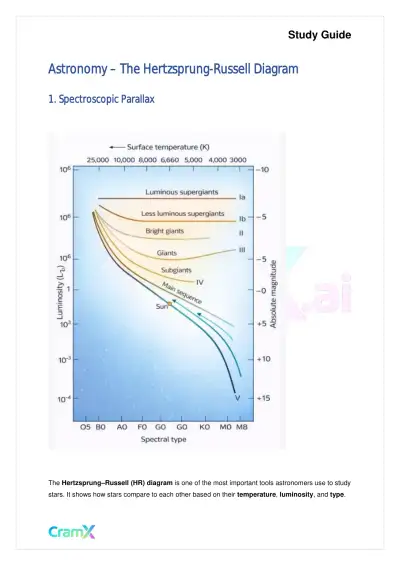 Quick Guides
Astronomy - The Hertzsprung-Russell Diagram
Astronomy
17 pagesMar 2026 Quick Guides
Astronomy - Earth and its Moon
Astronomy
26 pagesMar 2026 Quick Guides
Astronomy - Life in the Universe
Astronomy
9 pagesMar 2026 Quick Guides
Astronomy - The Structure of Stars
Astronomy
19 pagesMar 2026
Study this document with CramX
Once it is in your library, every tool can work from it.