

Solution Manual for Understanding Our Universe, 3rd Edition
- Astronomy
- 159 pages
- Shared May 2025
Solution Manual for Understanding Our Universe, 3rd Edition is your guide to textbook mastery, offering detailed solutions to every chapter's exercises.
Preview 16 of 159 pages
See the first 16 pages exactly as they appear in the document.
Page 1 Read page 1 as text
’S MANUAL Understanding Our Universe T H I R D E D I T I O N Stacy Palen, Laura Kay, and George Blumenthal Ana Larson U N I V E R S I T Y O F W A S H I N G T O N
Page 2 Page 3 Read page 3 as text
v v Contents Preface vii Part I: ’s Manual Chapter 1 | Our Place in the Universe 1 Chapter 2 | Patterns in the Sky—Motions of Earth and the Moon 8 Chapter 3 | Laws of Motion 16 Chapter 4 | Light and Telescopes 23 Chapter 5 | The Formation of Stars and Planets 30 Chapter 6 | Terrestrial Worlds in the Inner Solar System 39 Chapter 7 | Atmospheres of Venus, Earth, and Mars 46 Chapter 8 | The Giant Planets 53 Chapter 9 | Small Bodies of the Solar System 60 Chapter 10 | Measuring the Stars 67 Chapter 11 | Our Star: The Sun 75 Chapter 12 | Evolution of Low-Mass Stars 82 Chapter 13 | Evolution of High-Mass Stars 89 Chapter 14 | Measuring Galaxies 96 Chapter 15 | Our Galaxy: The Milky Way 104 Chapter 16 | The Evolution of the Universe 112 Chapter 17 | Formation of Structure 119 Chapter 18 | Life in the Universe 126 Part II: Answers to Starry Night Workbook Exercises Exercise 1 | The Celestial Sphere 134 Exercise 2 | Earth’s Rotation Period 134
Page 4 Read page 4 as text
Exercise 3 | Motion of the Sun along the Ecliptic 135 Exercise 4 | Motion of the Moon 135 Exercise 5 | Earth and Moon Phases 136 Exercise 6 | Sunrise on Mars 138 Exercise 7 | Precession 140 Exercise 8 | Kepler’s Laws 140 Exercise 9 | Flying to Mars 141 Exercise 10 | The Moons of Jupiter 141 Exercise 11 | The Rings of Saturn 142 Exercise 12 | Pluto and Kuiper Belt Objects 143 Exercise 13 | Asteroids 143 Exercise 14 | The Magnitude Scale and Distances 143 Exercise 15 | Stars and the H-R Diagram 145 Exercise 16 | Nebulae: The Birth and Death of Stars 146 Exercise 17 | Pulsars and Supernova Remnants 146 Exercise 18 | Galaxy Classification 147 Exercise 19 | Quasars and Active Galaxies 147 Exercise 20 | Views of the Milky Way 148 Exercise 21 | Globular Clusters 149 Exercise 22 | The Neighborhood of the Sun 149 Exercise 23 | Beyond the Milky Way 150 Credits 151 vi ◆ Front m atter Contents
Page 5 Read page 5 as text
Learning Astronomy by Doing Astronomy: Collaborative Lecture Activities ▶ This section introduces activities from the Learning Astronomy by Doing Astronomy workbook that are relevant to the chapter. The textbook reference of the associated topic is noted. Interactive Simulations ▶ Textbook author Stacy Palen has created seven Interactive Simulations that pair with selected Explo- ration activities. This section briefly describes each Interactive Simulation associated with the chapter. Check Your Understanding Solutions ▶ This section provides answers and supporting information for all of the in-chapter Check Your Understanding questions. End-of-Chapter Solutions ▶ This section provides worked solutions to Evaluat- ing the News and all of the end-of-chapter questions and problems (Test Your Understanding, Thinking about the Concepts, and Applying the Concepts). Exploration ▶ This section briefly describes the Exploration activ- ity and provides worked solutions to each question. For adopters of The Norton Starry Night Workbook , the answers to the exercises are included at the end of the manual. We hope that you will find the information in this man- ual useful. We welcome your comments, questions, and suggestions (contact your local Norton representative: http://books.wwnorton.com/books/find-your-rep/). Finally, we would like to thank Ethan Dolle of Northern Arizona University and Sean Hendrick of Millersville Uni- versity, whose careful review improved the accuracy and usefulness of this manual. Additional resources: Norton Interactive ’s Guide (IIG) iig.wwnorton.com/unduniv3 Preface For each chapter of the textbook, you will find a corre - sponding chapter in the ’s Manual that contains all or most of the following sections: Notes ▶ This section provides a brief overview of the chapter and a list of major topics discussed. It often includes common misconceptions to address and recommen- dations for additional resources. Discussion Points ▶ This section suggests important discussion topics and activities. The chapter Learning Goal associated with each item is noted. Teaching Chapter-Opening Learning Figure ▶ This section discusses the Active Learning Figure and how you might use the experiment with stu- dents. We also have questions in Smartwork5 that relate to the figure. AstroTour Animations ▶ The AstroTour animations are narrated, conceptual overviews with a consistent structure of Introduction— Explanation—Conclusion. This section of the ’s Manual briefly describes each AstroTour animation associated with the chapter and notes the corresponding section of the textbook. Astronomy in Action Videos ▶ The Astronomy in Action Videos are a series of mini-lectures and demos done by textbook author Stacy Palen. This section of the ’s Manual briefly describes each Astronomy in Action Video associated with the chapter and notes the corre- sponding section of the textbook as well as the length of the video. Teaching Reading Astronomy News ▶ This section provides an alternate article to the one presented in the textbook. The Evaluating the News questions for that article and suggested answers are also included. vii
Page 6 Read page 6 as text
viii ◆ Front m atter Preface This new and searchable online resource is designed to help instructors prepare for lecture in real time. All of the content in this ’s Manual , and more, is located on the IIG. In addition to this manual’s content, you will find: the Test Bank , AstroTour animations, Astronomy in Action videos, Interactive Simulations, Lecture Power- Point slides, all of the textbook’s art, photos, and tables, and Learning Management System Coursepacks (available in Blackboard, Canvas, Desire2Learn, and Moodle formats). Smartwork5 Online Activities and Assessment digital.wwnorton.com/universe3 More than 1,500 questions support Understanding Our Universe , Third Edition—all with answer-specific feedback, hints, and ebook links. Norton offers pre-made assignments for each chapter of the text to make it easy to get started, but Smartwork5 is also fully customizable. Questions include ranking, labeling, and sorting exercises based on book and NASA art, selected end-of- chapter questions, versions of the Explorations (based on AstroTours and new Simulations), and questions that accompany the Reading Astronomy News feature in each textbook chapter. Astronomy in Action video questions focus on overcoming common misconceptions, while Process of Science guided-inquiry assignments take stu- dents through the steps of a discovery and ask them to participate in the decision-making process that led to the discovery.
Page 7 Read page 7 as text
PA RT I : ’s Manual ix
Page 8 Page 9 Read page 9 as text
PA RT I I : Answers to Starry Night Workbook Exercises 133
Page 10 Read page 10 as text
134 students are surprised that the rotation period is not a full 24 hours. A number of the exercises for Starry Night require that the students observe in intervals that are multiples of 1 sidereal day, so it is important that the students learn this concept. ANSWER KEY Activity 1: Circumpolar Constellations 1. From typical latitudes in the continental United States, the circumpolar stars are in the constellations of Camelopardalis, Cassiopeia, Cepheus, Draco, Ursa Major, and Ursa Minor. You might want to point out to students that all the constellations in the Northern Hemisphere are circumpolar as seen from the North Pole. This fact was demonstrated in the exercise on the celestial sphere. Activity 2: Rising and Setting Constellations 2. The answer will depend on the constellation se- lected. Small constellations take about an hour to rise, whereas larger ones (Orion, Pegasus) may take 3 hours or more. Activity 3: Earth’s Rotation Period 3. The students are asked to determine the interval between meridian crossings a few times and average the answer to smooth out any inaccuracies in their measurements. 4. The length of the sidereal day is 23 hours 56 minutes 4 seconds. 5. The average amount by which stars cross the meridian earlier each day is 24 hours minus the length of the sidereal day, or 3 minutes 56 seconds. 6. A star that crosses the meridian at midnight tonight would cross 4 minutes earlier tomorrow night, at 11:56 p.m. Thirty days later, the star would cross the meridian 120 minutes earlier (30 3 4), at 10 p.m. This implies that any particular star will continue to transit earlier and earlier until it is eventually only above the horizon during the day. But also, the star would again EXERCISE 1: THE CELESTIAL SPHERE This exercise illustrates the daily motion of the celestial sphere. It animates the apparent motion of the sky as seen from Earth’s North and South poles. Students will learn the most basic operations of Starry Night : selecting objects to view, changing the orientation of their gaze, and altering the flow of time. ANSWER KEY Activity 1: Directions on the Sky 1. In this view, west is toward the right, and east is toward the left. 2. From the North Pole, the apparent motion is parallel to the horizon. Activity 2: Direction of Rotation 3. From the North Pole, the apparent motion of the sky is counterclockwise. 4. Polaris is located in the constellation of Ursa Minor. Activity 3: View from the South Pole 5. From the South Pole, the apparent motion of the sky is clockwise. 6. The south celestial pole is in the constellation Octans. 7. Stars at the North and South poles appear to move in opposite directions. This is because the point of view of the observer is inverted, so that a counterclockwise motion as seen at the North Pole appears clockwise as seen at the South Pole. EXERCISE 2: EARTH’S ROTATION PERIOD Here, the students will become familiar with the appear- ance of the celestial sphere from an intermediate latitude. The instructor may wish to direct the students to pick a particular viewing location for this exercise. The students will determine Earth’s rotation period by finding the average time between meridian crossings for a star. The exact value of Earth’s rotation period (23 hours 56 minutes 4 seconds), is called the sidereal day. Many The Norton Starry Night Workbook: Exercise Summaries and Activity Answers
Page 11 Read page 11 as text
The Norton Starry Night Workbook: Exercise Summaries and Activity Answers ◆ 135 continue to transit earlier until a year later, when it would again transit at midnight. EXERCISE 3: MOTION OF THE SUN ALONG THE ECLIPTIC This exercise demonstrates that the Sun moves eastward along the ecliptic each day, and asks the students to note which constellation the Sun appears in at different times of the year. The exercise reinforces the concept of Earth’s changing position in its orbit around the Sun, causing constant changes in the apparent position of the Sun in the celestial sphere as viewed from Earth. Most students know something of popular astrology, if only their birth sign. The students will compare the actual direction of the Sun with the locations listed on many cal- endars and see that the dates of the astrological signs have their origins more than 2,000 years ago. ANSWER KEY Activity 1: The Sun and the Zodiac 1. Dates on which the Sun entered the modern constella- tion boundaries: Constellation Date Sun Enters Days Spent Gemini 6/22/2007 29 Cancer 7/21/2007 21 Leo 8/11/2007 37 Virgo 9/17/2007 45 Libra 11/01/2007 22 Scorpius 11/23/2007 7 Ophiuchus 11/30/2007 19 Sagittarius 12/19/2007 32 Capricornus 1/20/2008 28 Aquarius 2/17/2008 24 Pisces 3/12/2008 38 Aires 4/19/2008 25 Taurus 5/14/2008 38 Gemini 6/21/2008 — Allow 6 1 day for the student estimates. Activity 2: Astrological Dates 2 . Students will notice that (a) the current constella- tion boundaries mean that the Sun spends different intervals in the various constellations; (b) there is a difference of about 1 month between the traditional dates and the current dates; and (c) the Sun spends almost 3 weeks in Ophiuchus, which is not one of the traditional zodiacal constellations. Activity 3: Dates in the Distant Past 3. The approximate year that the Sun entered Gemini on May 21 is 900 BC (allow ±1 century). 4. The Sun only appears to pass through the zodiac con- stellations because the ecliptic plane of Earth’s orbit around the Sun lines up with these constellations. The Sun never passes through Ursa Major because that constellation is not in the ecliptic plane. EXERCISE 4: MOTION OF THE MOON This exercise asks the students to measure the synodic and sidereal periods of the Moon and to compare their mea- surements to the values quoted in the reading. The instructor may wish to stress that any set of mea- surements will be accurate only to a particular level. The students should be encouraged to be honest about their measurements and not to try to land on the stated periods. By comparing their values to the actual ones, the students will get a feel for the accuracy of their measurements. There are more accurate ways of measuring the synodic and side- real periods using Starry Night , but this exercise is designed to produce answers accurate only to about a quarter of a day. ANSWER KEY Activity 1: Time of Moonrise on Successive Nights 1. The exact times will depend on the viewing location. The instructor may wish to specify a particular view- ing location so that all students come up with the same times. 2. The average time interval will be about 50 minutes. Activity 2: The Moon’s Sidereal Period 3. The students should derive numbers between 27 and 28 days. In the exercise, they work in steps of 1 day, so the fraction of a day over 27 that they derive will depend on how they interpolate between positions of the Moon on successive nights. 4. The length of the sidereal month is 27.3 days. Activity 3: The Moon’s Synodic Period 5. As in answer 3, the exact value will depend on how the students interpolate. 6. The length of the synodic month is 29.5 days. 7. The difference between the Moon’s sidereal and syn- odic periods is about a little more than 2 days. The synodic period is longer because as the Moon orbits Earth, the Earth-Moon system is moving around the
Page 12 Read page 12 as text
136 ◆ The Norton Starry Night Workbook: Exercise Summaries and Activity Answers Sun. It takes 27.32 days for the Moon to complete one orbit around Earth (sidereal period), but in that time, Earth has moved to a different position in its orbit around the Sun. The Moon must therefore move a little farther in its orbit to line up with the Sun again, making this synodic period 29.5 days. EXERCISE 5: EARTH AND MOON PHASES This exercise explores the relationship between the phases of the Moon as seen from Earth and the phases (shading) of Earth as seen from the Moon. Students will predict Date and Time Moon Phase (shadow = dark) Phase Description Earth Shading (shadow = dark) Shading Description Jan. 9, 2016 22:21:49 UT 1A New Moon 1B Full Earth Jan. 13, 2016 22:06:06 UT 2A Waxing Crescent Moon 2B Waning Gibbous Earth Jan. 16, 2016 21:54:18 UT 3A 1 st Quarter Moon 3B Last/3 rd Quarter Earth Jan. 19, 2016 21:42:30 UT 4A Waxing Gibbous Moon 4B Waning Crescent Earth Jan. 23, 2016 21:26:47 UT 5A Full Moon 5B New Earth Jan. 27, 2016 21:11:03 UT 6A Waning Gibbous Moon 6B Waxing Crescent Earth Jan. 31, 2016 20:55:19 UT 7A Last/3 rd Quarter Moon 7B 1 st Quarter Earth Feb. 4, 2016 20:39:36 UT 8A Waning Crescent Moon 8B Waxing Gibbous Earth the best conditions to observe phases of the Earth from the Moon. ANSWER KEY Activity 1: Moon Phases Activity 2: Earth Phases 1-3. 4. The shading (phases) of Earth appears to be opposite or the reverse of the Moon phase shading. A New Moon is a full Earth for the same date and time. Similarly, a waxing
Page 13 Read page 13 as text
The Norton Starry Night Workbook: Exercise Summaries and Activity Answers ◆ 137 crescent Moon phase is accompanied by a complemen- tary waning gibbous Earth phase. The first quarter Moon features a last/third quarter Earth. A waning crescent Moon is opposed by a waxing gibbous Earth, and so on. 5. To see Earth completely, it should be in its full phase, which corresponds to the new Moon phase. 6. It depends on how well the observers can be protected from the extreme cold on the surface of the Moon, in the total darkness of a new Moon. Observing might not be practical during the extreme cold of the new Moon phase. Since there is no atmosphere on the Moon, heat is conducted only by radiation and conduction. Furthermore, Bruce Crater is near the lunar equator, so the surface experiences the most extreme high temper- atures during the lunar day time such as when there are waxing and waning as phases. The temperature can rise to almost 390K (water boils at 373K) during the daytime, and sink to as low as 95K (water freezes at 273K) in the nighttime. Selecting a phase when the most moderate temperatures occur, around dawn as the Sun first rises for the lunar day, which is a little over 27 Earth days long, might be the best time to observe. This procedure was used during the Apollo lunar landings from 1969 to 1972. 7. Date and Time Moon Phase (shadow = dark) Phase Description Earth Shading (shadow = dark) Shading Description Jan. 9, 2016 22:21:49 UT 1A New Moon 1B Full Earth Jan. 13, 2016 22:06:06 UT 2A Waxing Crescent Moon 2B Waning Gibbous Earth Jan. 16, 2016 21:54:18 UT 3A 1 st Quarter Moon 3B Last/3 rd Quarter Earth Jan. 19, 2016 21:42:30 UT 4A Waxing Gibbous Moon 4B Waning Crescent Earth Jan. 23, 2016 21:26:47 UT 5A Full Moon 5B New Earth Jan. 27, 2016 21:11:03 UT 6A Waning Gibbous Moon 6B Waxing Crescent Earth Jan. 31, 2016 20:55:19 UT 7A Last/3 rd Quarter Moon 7B 1 st Quarter Earth Feb. 4, 2016 20:39:36 UT 8A Waning Crescent Moon 8B Waxing Gibbous Earth
Page 14 Read page 14 as text
138 ◆ The Norton Starry Night Workbook: Exercise Summaries and Activity Answers EXERCISE 6: SUNRISE ON MARS In this exercise, students will observe and document sun- rises and sunsets along with related objects from the surface of mars. Students will also predict the seasons based on the shifting location of the sun along the Martian horizon. ANSWER KEY Activity 1: Sunrises from Mars Sunrise Table: Observation step/ Date Sunrise time List other objects observed near the Sun along the sunrise path to the horizon Sketch of Sun and any objects at sunrise (show and label horizon with directions) Stopped time 1/ 9/13/2015 9/14/2015 22:0:47/ 0:05:03 UT Earth Venus Mercury 30˚ 10˚ 90˚ 80˚ 60˚ 75˚ Sun E E V Me Me 100˚ 0˚ 2/ 3/13/2016 18:06:30 UT/ 20:06:57 UT Mercury Venus 30˚ 10˚ 90˚ 80˚ 60˚ 65˚ E 100˚ 0˚ 3/ 9/13/2016 16:59:37/ 19:04:38 UT Earth Mercury Venus 30˚ 10˚ 108˚ 120˚ 80˚ 90˚ E 100˚ 0˚ 4/ 3/13/2017 14:23:27/ 16:25:18 UT Jupiter Earth Venus Saturn SE 30˚ 10˚ 120˚ 100˚ 103˚ 140˚ 0˚ 5/ 9/13/2017 10:48:36/ 12:52:17 UT Jupiter Saturn Mercury Venus E 30˚ 10˚ 80˚ 90˚ 60˚ 65˚ 100˚ 0˚
Page 15 Read page 15 as text
The Norton Starry Night Workbook: Exercise Summaries and Activity Answers ◆ 139 1. They are the planets rising or setting. The names of these may be seen by rolling the cursor over the ob- jects or by turning on the planet labels. Sunset Table: Observation step/ Date Sunset time List other objects observed near the Sun along the sunset path to the horizon Sketch of Sun and any objects at sunrise (show and label horizon with directions) Stopped time 1/ 9/13/2015 9/14/2015 10:31:17/ 12:31:29 Venus Earth Mercury 30˚ 10˚ 288˚ 320˚ 280˚ Me NW E V 300˚ 0˚ 2/ 3/13/2016 7:28:26/ 9:29:02 UT Earth Mercury Venus 30˚ 10˚ 292˚ 320˚ 280˚ NW 300˚ 0˚ 3/ 9/13/2016 04:39:16/ 6:34:30 UT Earth Jupiter Mercury 30˚ 10˚ 252˚ 270˚ 280˚ 240˚ W 260˚ 0˚ 4/ 3/14/17 2:13:29/ 4:12:50 UT Venus Earth 30˚ 10˚ 252˚ 270˚ 280˚ 240˚ W 260˚ 0˚ 5/ 9/14/17 0:12:27/ 2:28:05 UT Venus Mercury Earth V Me 30˚ 10˚ 293˚ 280˚ NW E 300˚ 320˚ 0˚
Page 16 Read page 16 as text
140 ◆ The Norton Starry Night Workbook: Exercise Summaries and Activity Answers Activity 2: Predicting Seasons from Sunrise/-Set Data 2. Difference a. Summer Solstice 1/3/2016 ------------------- b. Autumnal Equinox 7/4/2016 6 months, 1 day c. Winter Solstice 11/28/2016 4 months, 24 days d. Spring Equinox 5/5/2017 5 months, 7 days e. Summer Solstice 11/20/2017 6 months, 15 days Total 22.6 months 3. Northern Hemisphere. 4. The greater eccentricity of the orbit of Mars causes the seasons to be unequal. EXERCISE 7: PRECESSION Here we focus on the precession of Earth’s rotation axis. The students will measure the angular separation between the north celestial pole (NCP) and Polaris at different epochs and will see that the current separation is close to the smallest possible value. The text emphasizes the effect of precession on the times of the spring and fall equinoxes; we touch on that concept in Exercise 3, on the motion of the Sun along the ecliptic. ANSWER KEY Activity 1: The Distance Between Polaris and the North Celestial Pole 1. The separation in 2007 is about 0 degrees 42 minutes (or 0° 42 9 ). Allow an error of a few minutes, as the stu- dents may land on slightly different positions near the north celestial pole. Activity 2: When Polaris is Closest to the Ncp 2. The minimum separation will occur about the year 2100 and will be approximately 0° 28 9 . 3. This is about 67 percent of the current value. Activity 3: The Separation in the Past 4. In the year AD 1, the separation was almost 12° (about 11° 45 9 )! 5. The following table shows a few bright stars that were closer than Polaris to the north celestial pole in the year AD 1. The last column displays the separation in degrees and minutes. If they ignore the instructions to examine the stars in the stick figures for Ursa Minor and Draco, some students may zoom in and identify faint stars that are much closer to the NCP. Constellation Star Separation Ursa Minor Kochab 8° 20 9 Zeta Ursae Minoris 8° 32 9 Draco Kappa Draconis 9° 10 9 6. Though Polaris was about the same distance from the NCP as Kochab at this time, Polaris is the brighter star. 7. The change in the position of the north celestial pole affects all stars, not just Polaris. The stars stay in the same positions relative to each other, so the constel- lation patterns themselves are not affected, but if the NCP moves away from Polaris, it must move closer to other stars. EXERCISE 8: KEPLER’S LAWS This exercise reinforces a student’s knowledge of Kepler’s laws by creating an asteroid with a semimajor axis of 1 AU, but with a very elongated orbit. In the first part, the stu- dents will calculate the orbital period and then verify it by inspection. They will see that the period is independent of the eccentricity. The elongated orbit for the asteroid makes Kepler’s second law more apparent than it would be for the orbits of the major planets, which are nearly circular. This exercise views the orbits of Earth and the asteroid from a position above Earth’s ecliptic pole. This helps illus- trate that Earth’s distance from the Sun does not vary much during the year. Many students get the opposite impression from figures that show Earth’s orbit from the side, which make it appear much more eccentric, thereby causing con- fusion when they learn the causes of the seasons. ANSWER KEY Activity 1: Kepler’s Third Law 1. The length of the semimajor axis is a = 1 AU. From Kepler’s harmonic law, P 2 = a 3 , so P = 1 year. 2. The orbital period is independent of the eccentricity e . This sometimes surprises students because a circular orbit looks so different from a highly elongated orbit. 3. With a = 4 AU, a 3 = 64, so P = 8 years. Activity 2: The Period of X’s Orbit 4. The period determined by measurement should be very close to 1 year, in agreement with the value from Kepler’s harmonic law.
143 more pages in the full document
Unlock it once and it stays in your library, ready to chat with or turn into flashcards.
Unlock the full documentMore Astronomy study materials
See all Textbook Guides
Solution Manual for Astronomy Today, 9th Edition
Astronomy
361 pages137downloadsFeb 2025 Quick Guides
Astronomy - A Brief History of Astronomy
Astronomy
10 pagesMar 2026 Quick Guides
Astronomy - The Science of Astronomy
Astronomy
19 pagesMar 2026 Quick Guides
Astronomy - Formation and Evolution of Stars
Astronomy
15 pagesMar 2026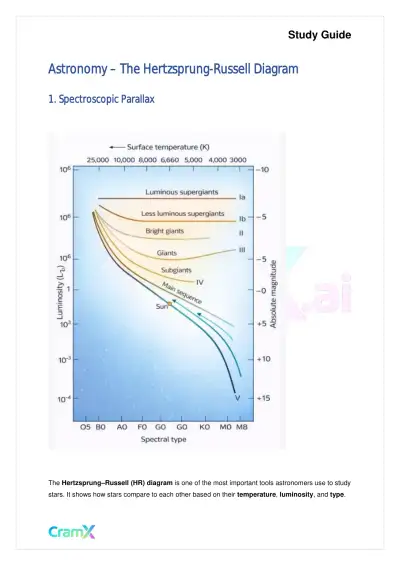 Quick Guides
Astronomy - The Hertzsprung-Russell Diagram
Astronomy
17 pagesMar 2026 Quick Guides
Astronomy - Earth and its Moon
Astronomy
26 pagesMar 2026 Quick Guides
Astronomy - Life in the Universe
Astronomy
9 pagesMar 2026 Quick Guides
Astronomy - The Structure of Stars
Astronomy
19 pagesMar 2026
Study this document with CramX
Once it is in your library, every tool can work from it.