

Test Bank for The Cosmic Perspective, 7th Edition
- Astronomy
- 1910 pages
- Shared May 2025
Test Bank for The Cosmic Perspective, 7th Edition simplifies revision with detailed notes, practice sets, and a strategic study plan.
Preview 16 of 1910 pages
See the first 16 pages exactly as they appear in the document.
Page 1 Read page 1 as text
1 The Cosmic Perspective, 9e (Bennett et al.) Chapter 1 A Modern View of the Universe Section 1.1 1) About where is our solar system located within the Milky Way Galaxy? A) at the center of the galaxy B) about 10 percent of the way from the center of the galaxy to the edge of the galactic disk C) about halfway from the center of the galaxy to the edge of the galactic disk D) near the far edge of the galactic disk E) in the halo of the galaxy above the gala ctic disk Answer: C 2) When we speak of the entir e universe (as opposed to the observable universe), we mean A) all the stars and galaxies that we can see with telescopes. B) all material located within about 14 billion light - years of Earth. C) the sum t otal of all matter and energy. D) all the matter in galaxies, but not the spaces between the galaxies. Answer: C 3) Which of the following is the smallest distance? A) diameter of a typical planet B) 1 light - second C) 1 AU D) diameter of a typical star A nswer: A 4) Which of the following is the largest distance? A) diameter of a typical galaxy B) diameter of Pluto's orbit C) distance to the nearest star (other than our Sun) D) 1 light - year Answer: A 5) Which of the following statements does not use the term light - year in an appropriate way? A) It's ab out 4 light - years from here to Alpha Centauri. B) It will take me light - years to complete this homework assignment. C) A light - year is about 10 trillion kil ometers. D) It will take the Voyager spacecraft about 20,000 years to travel just 1 light - year. E) T he Milky Way Galaxy is about 100,000 light - years in diameter. Answer: B
Page 2 Page 3 Read page 3 as text
2 6) One light - minute is the distance that light travels in one minute. How far is t his, in kilometers? (Recall that the speed of light is 300,000 km/s.) A) 300,000 km B) 18 million k m C) 100 million km D) 1.08 billion km E) 9.46 trillion km Answer: B 7) One light - year is approximately A) the distance from the Sun to Earth. B) the speed at which Earth orbits the Sun. C) 10 trillion kilometers. D) the same as one regular year. Answer: C 8) Light takes approximately one second to travel from Earth to the Moon. This means that the Moon is approximately A) 1 astronomical unit from Earth. B) 1 light - year from Earth. C) 3000 kilometers from Earth. D) 300,000 kilometers from Earth. E) near the top of Earth's atmosphere. Answer: D 9) Sunlight takes about 8.4 minutes to travel from the Sun to Earth. When NASA's New Horizons Spacecraft passed Pluto in 2015, it was about 32 AU from Earth. About how long did it take for transmitted images of P luto to travel from the spacecraft to Earth? A) one Plutonian year B) 4 - 1/2 hours C) 2 - 1/4 days D) 3 weeks E) They arrived almost instantaneously. Answer: C 10) The Voyager 2 Spacecraft is currently on its way out of our solar system at a speed of about 50,000 kilometers per hour. It will reach the distance of the nearest star system (beyond our solar system) in about ______ __ years. A) 100 B) 1000 C) 10,000 D) 100,000 E) 1,000,000 Answer: D
Page 4 Read page 4 as text
3 11) Suppose we look at a photograph of many galaxies. As suming that all galaxies formed at about the same time, which galaxy in the picture is the youngest? A) the one that is farth est away B) the one that is reddest in color C) the one that is bluest in color D) the one that is closest to us E) the one that ap pears smallest in size Answer: A 12) The farthest galaxies visible in Hubble Space Telescope photos are about ________ light - years away. A) 1 million B) 12 million C) 1 billion D) 12 billion E) 12 trillion Answer: D 13) Suppose we imagine the Sun to be about the size of a grapefruit. Which of the following best describes the size and distance of Earth on the same scale? A) Earth is the size of a tip of a ballpoint pen about 1 meter from the Sun. B) Earth is the size of a golf ball about 1 meter from the Sun. C) Earth is the size of a tip of a ballpoint pen about 15 meters from the Sun. D) Earth is the size of a golf ball about 15 meters from the Sun. E) Earth is the size of a marble about 25 miles from the Sun. Answer: C 14) Suppose we imagine the Sun to be about the size of a grapefruit. H ow big an area would the orbits of the eight planets of the solar system cover? A) the size of a typical dorm room B) the size of a typical campus building C) the size of a typical campus D) the size of a small city E ) the size of a western state (e.g., Co lorado) Answer: C 15) Which of the following best describes the Milky Way Galaxy? A) a spiral galaxy with a disk about 100,000 light - years in diameter B) a spiral galaxy with a disk about 1 billion kilometers in di ameter C) a spiral galaxy with a disk about 1000 light - years in diameter D) a spherically shaped galaxy that is about 4 light - years in diameter E) a spherically shaped galaxy that is about 100,000 light - years in diameter Answer: A
Page 5 Read page 5 as text
4 16) If we use 1 mill imeter to re present 1 light - year, about how large in diameter is the Milky Way Galaxy? A) 100 millimeters B) 100 meters C) 1 kilometer D) 100 kilometers E) 1 million millimeters Answer: B 17) How long would it take to count all the stars in the Milky Way Galaxy at a rate of one star per second? A) several days B) several weeks C) several years D) several thousand years E) hundreds of thousands of years Answer: D 18) About how many galaxies are there in the observable universe? A) roughly (within about a factor of 1 0) the same as the number of stars in our galaxy B) a few dozen C) a few thousand D) about as many as the number of grains of sand on all the beaches on Earth E) an infinite number Answer: A 19) If you represented each star by a grain of sand , about how much sand would it take to represent all the stars in the observable universe? A) all the sand in a typical playground sandlot B) all the sand on Miami Beach C) all the sand on the beaches of Cali fornia D) one cubic meter of sand E) all the sa nd on all the beaches on Earth Answer: E 20) Suppose we look at two distant galaxies: Galaxy 1 is twice as far away as Galaxy 2. In that case A) we are seeing Galaxy 1 as it looked at an earlier time in the history of the universe than Galaxy 2. B) we ca n't say anything about these galaxies except for their distances. C) we are seeing Galaxy 1 as it looked at a later time in the history of the universe than Galaxy 2. Answer: A
Page 6 Read page 6 as text
5 21) The distance of Mars from the Sun is about 1.5 AU. How far is this in ki lometers? (You do not need a calculator to answer this question. You do need to know what an AU is, within a factor of 1000.) A) 1.5 150,000,000 km B) 1.5 150,000 km C) 150,000,000,000 / 1.5 km D) 150,000,000 / 1.5 km E) 1.5 150,000,000,000 km Answer: A Section 1.2 1) Shortly after the Big Bang, the chemical composition of the universe was A) almost entirely hydrogen and helium. B) hydrogen only. C) about equal amounts of all the elements. D) about the same a s it is today. Answer: A 2) About what perce ntage of the original hydrogen and he lium of the universe had been converted into heavier elements by the time our solar system was born? A) 20% B) 10% C) 50% D) 2% Answer: D 3) What is nuclear fusion ? A) an explosion caused by putting together two volat ile chemicals B) the process of split ting nuclei to produce energy C) the process of turning matter into pure energy D) the process of combining lightweight nuclei to make heavier nuclei E) a process that only occurs in bombs Answer: D 4) Earth is made m ostly of metals and rocks. Where did most of the elements that make up these materials (carbon, silicon, iron, etc.) form? A) They were produced by the Big Bang. B) They were produced by chemical reactions in interstellar gas clouds. C) They were produced by stars. D) They were produced in ou r Sun. E) They were produced by nuclear fission of uranium and other radioactive materials in space. Answer: C
Page 7 Read page 7 as text
6 5) Why did Carl Sagan say that we are star stuff ? A) The composition of most stars (mostly hydrogen and h elium) is about the same as the compos ition of our bodies. B) Cosmic rays reaching Earth from distant astronomical sources may be one source of mutations that help evolution along. C) Nearly every atom from which we are made once (before the solar system f ormed) was inside of a star. D) Nearly every atom from which we are made was once inside our star, the Sun. E) Sagan thought that all of us have the potential to be movie (or TV) stars like he was. Answer: C 6) The Sun is made primarily of A) hydrogen an d oxygen. B) hydrogen and helium . C) carbon and nitrogen. D) oxygen and carbon. E) nearly equal portions of all the elements. Answer: B 7) Our Sun formed ________ our galaxy formed. A) before B) at the same time that C) billions of years after D) within about 10 million years after A nswer: C 8) In what sense are galaxies cosmic recycling plants? A) Every time one star dies, a new one of exactly the same size and mass is born. B) As a galaxy rotates, its stars cycle around the galaxy center again and again, each time returning to ex actly where they started. C) New stars in galaxies form from gas that has been ejected by previous generations of stars. D) New galaxies are continuously being formed from the remains of older galaxies. Answer: C 9) On the scale of the cosmic calendar, i n which the history of the universe is compressed to 1 year, when did the Sun and Earth form? A) January B) December C) September D) February Answer: C
Page 8 Read page 8 as text
7 10) On the scale of the cosmic calendar, in which the history of the universe is compressed to 1 year, how long has human civilization (i.e., since ancient Egypt) existed? A) about half the year B) about a month C) a few hours D) a few seconds E) less than a m illionth of a second Answer: D 11) On the scale of the cosmic c alendar, in which the history of the universe is compressed into 1 year, when did the dinosaurs become extinct? A) in late December B) in late November C) in late October D) in late September E) in late August Answer: A 12) On the scale of the cosmic cal endar, in which the history of the universe is compressed into 1 year, when did Kepler and Galileo first discover that we live on a planet in a solar system? A) 1 second ago B) 1 day ago C) 1 week ago D) December 25 E) December 30 Answer: A 13) On the sc ale of the cosmic calendar, in which the history of the universe is compressed into 1 year, how long is the average human life span? A) 0.2 millisecond B) 0.2 second C) 2 seconds D) 2 minutes E) 2 hours Answer: B 14) Your textbook discusses the cosmic ca lendar, a model of the history of the universe scaled to a single year. The length of time represented by one month on this cosmic calendar is therefore closest to A) 1 billion years . B) 1 1000 years. C) 10 million years. D) 10 billion years. E) 1 million years. Answer: A
Page 9 Read page 9 as text
8 15) What made most of the oxygen nuclei in the solar system? A) stars B) Nothing makes elements – oxygen has always been present in the universe. C) the Big Bang D) our Sun E) high energy collisions of dust and cosmic rays Answer: A Sec tion 1.3 1) Approximately how fast is a person located at the Earth's equator moving around Earth's axis due to the rotation of the Earth? A) 17,000 km/hr B) 1700 km/hr C) 170 km/hr D) 17 km/hr E) not moving at all Answer: B 2) Earth's rotation causes a person at the North Pole to ________ relative to the center of the Earth. A) move at a speed of about 1670 km/hr B) spin in place once each year C) remain completely stationary D) sp in in place once each day Answer: D 3) The ecliptic plane is A) the pla ne of Earth's orbit around the Sun. B) the plane of the Moon's orbit around Earth. C) the plane of our solar system's orbit around the Milky Way Galaxy. D) a flat disk of material tha t lies between the Sun and Earth. E) the plane defined by Earth's equator . Answer: B 4) We say that Earth has an axis tilt of 23 - 1/2° because this is the angle between Earth's A) rotation axis and a line perpendicular (vertical) to the ecliptic plane. B ) rotation axis and the star Polaris. C) equator and rotation axis. D) ro tation axis and north pole. E) rotation axis and magnetic axis. Answer: A
Page 10 Read page 10 as text
9 5) Patterns of stars in constellations hardly change in appearance over times of even a few thousand years. Why? A) Stars are fixed and never move. B) Stars move, but they move ve ry slowly – only a few kilometers in a thousand years. C) Although most stars move through the sky, the brightest stars do not, and these are the ones that trace the patterns we see in the constellations. D) The stars in our sky actually move rapidly relativ e to us – thousands of kilometers per hour – but are so far away that it takes a long time for this motion to make a noticeable change in the patterns in the sky. E) Stars within a constellation move together as a group, which tends to hide their actual motion and prevent the pattern from changing. Answer: D 6) A bout how long does it take our solar system to complete one orbit around the center of the Milky Way Galaxy? A) 10,000 years B) 1 million years C) 230 million years D) 4 - 1/2 billion years E) 14 billio n years Answer: C
Page 11 Read page 11 as text
10 7) Which of the following correctly lists the described speeds from slowest to fastest? A) Earth's orbital speed about the Sun Earth's speed of rotation on its axis Earth's orbital speed about the Sun typical speeds of stars in the lo cal solar neighborhood relative to us the speed of our s olar system orbiting the center of the Milky Way Galaxy the speeds of very distant galaxies relative to us B) typical speeds of stars in the local solar neighborhood relative to us Earth's speed of rotation on its axis Earth's orbital speed about the Sun the speed of our solar system orbiting the center of the Milky Way Galaxy the speeds of very distant galaxies relative to us C) Earth's speed of rotation on its axis Earth's orbital speed about the S un the speed of our solar system orbiting the center of t he Milky Way Galaxy the speeds of very distant galaxies relative to us typical speeds of stars in the local solar neighborhood relative to us D) Earth's orbital speed about the Sun the speeds of very distant galaxies relative to us Earth's speed of rotation on its axis typical speeds of stars in the local solar neighborhood relative to us the speed of our solar system orbiting the center of the Milky Way Galaxy E) typical speeds of s tars in the local solar neighborhood relative to us the speed of our solar system orbiting the center of the Milky Way Galaxy Earth's orbital speed about the Sun the speeds of very distant galaxies relative to us Earth's speed of rotation on its axis Answe r: A 8) What evi dence leads astronomers to conclude that most of the Milky Way's mass consists of a mysterious dark matter ? A) We observe many dark clouds of gas that block the light of stars behind them. B) The galaxy's rotation indicates that it must contain much more matter than we can observe with our telescopes. C) Observations indicate that most stars are dimmer than the Sun, so we say they are "dark." D) Stars are separated from one another by vast distances, and therefore most places in the gala xy would be dark t o our eyes. Answer: B 9) Most of the mass in the Milky Way Galaxy is located A) in the halo (above/below the disk). B) within the disk. C) in the stars in the spiral arms. D) in the gas and dust. E) in the central bulge of the galaxy. A nswer: A
Page 12 Read page 12 as text
11 10) The amount and distribution of matter in the Milky Way Galaxy is determined by A) counting the number of stars in the galaxy. B) determining the amount of gas and dust in the galaxy. C) studying where stars are located in the Milky Way. D) studying the rotati on of the galaxy. E) adding together the mass of the galaxy's stars and gas. Answer: D 11) What evidence leads astronomers to conclude that the universe contains a mysterious dark e nergy? A) The expansion of the universe is accelerating with time. B) The gravity of distant galaxies is stronger than that of galaxies nearby. C) Studies of galactic motion indicate that there is more matter in the universe than we can account for with st ars and gas. D) Stars shine much more brightly than we would expect from nuclear fusion. E) The existence of such dark energy is the only way to account for evil in the universe. Answer: A 12) From the fact that virtually every galaxy is moving away fr om us and more distant galaxies are moving away from us at a faster rate than closer ones, we conclude that A) the Milky Way Galaxy is expanding. B) we are located at the center of the universe. C) even nearby galaxies will eventually be moving faster than the speed of light. D) the universe is expanding. E) the universe is shr inking. Answer: D 13) What do astronomers mean when they say the universe is expanding? A) Everything in the universe is gradually growing in size. B) Average distances are increasi ng between most galaxies. C) Average distances are increasing between mos t stars. D) The universe is expanding from a single point. Answer: B 14) By s tudying distant galaxies in the 1920s, Hubble made the following important discovery that led us to conclude that the universe is expanding. A) All galaxies contain billions of stars, and all galaxies have spiral shapes. B) All galaxies were born at the sa me time, and all will die at the same time. C) All galaxies outside the Local Group are moving away from us, and the farther away they are, the faster they're going. D) All gala xies outside the Local Group are orbiting the Local Group. E) Galaxies are in m otion throughout the universe, with about equal numbers moving toward us and away from us. Answer: C
Page 13 Read page 13 as text
12 15) Imagine that we put a raisin cake into the oven, with each raisin sep arated from the others by 1 cm. An hour later, we take it out and the distances between raisins are 3 cm. If you lived in one of the raisins and watched the other raisins as the cake expanded, which of the following would you observe? A) All raisins would be moving away from you at the same speed. B) More distant raisins would be movi ng away from you faster. C) More distant raisins would be moving away from you more slowly. D) It depends: If you lived in a raisin near the edge of the cake, you'd see other r aisins moving away from you, but they'd be coming toward you if you lived in a r aisin near the center of the cake. E) The raisins would be expanding too, so you'd never notice any changes in the cake. Answer: B 16) Recall the raisin cake model of the uni verse and its analogy to our expanding universe. Suppose you measure the recessi on velocity (the speed at which any object is moving away from us) of Galaxy A to be 2000 km/s and the recession velocity of Galaxy B to be 6000 km/s. What can you conclude abo ut the relative distances of these two galaxies? A) Galaxy A is 3 times as far f rom us as Galaxy B. B) Galaxy B is 3 times as far from us as Galaxy A. C) Galaxy A is 6 times as far from us as Galaxy B. D) Galaxy B is 6 times as far from us as Galaxy A. E) The relative distances cannot be determined from the information in this problem . Answer: B 17) The reason that we observe more distant galaxies to be moving away from us at higher speeds than nearby galaxies is that A) the more distant galaxies were fl ung outward faster by the Big Bang. B) the more distant galaxies are smaller and less massive, so they can move faster. C) the nearby galaxies are slowed by our own galaxy's gravitational pull. D) there is more space to expand between us and the distant ga laxies. Answer: D 18) How do scientists estimate the age of the universe? A) They look up the answer in a book or they Google it. B) They measure the abundances of radioactive elements in meteorites, and use their half - lives to calculate the age of the meteorites, which are the oldest solids in the solar system. C) They measure the speeds and distances of galaxies, and calculate the time it took for them to travel that distance (away from us). D) They make a guess: no one really knows how old the univers e is. E) They measure how fast the Sun is losing energy, and how much energy it has left to lose. Answer: C
Page 14 Read page 14 as text
13 19) According to astronomers, approximately how old is the universe? A) 14 billion years B) 14 trillion years C) infinite D) 14 million years Ans wer: A 20) According to current scientific estimates, when did the Big Bang occur? A) about 4.5 billion years ago B) about 20 billion years ago C) about 65 million years ago D) about 14 billion years ago E) about 10 billion years ago Answer: D 21) We o bserve that most galaxies are moving away from us. If we could (somehow) communicate with an observer in a distant galaxy, what would that observer say about what it sees? A) Most galaxies are moving away from me, except for yours. B) Most galaxies are mov ing away from me, including yours. C) Most galaxies are moving away from you, and about half are moving towards me. Answer: B Section 1.4 1) Which scientists played a major role in overturning the ancient idea of an Earth - centered u niverse, and about wh en? A) Copernicus, Kepler, and Galileo; about 400 years ago B) Aristotle and Copernicus; about 400 years ago C) Newton and Einstein; about 100 years ago D) Huygens and Newton; about 300 years ago E) Aristotle and Plato; about 2000 year s ago Answer: A Gen eral Chapter Questions 1) One light - year is the distance light travels in one year. The speed of light is about 300,000 km/s (3 × 10 5 km/s). How far is 1 light - year? A) 3 × 10 5 km B) 1.8 × 10 7 km C) 1.08 × 10 9 km D) 9.46 × 10 12 km Ans wer: D
Page 15 Read page 15 as text
14 2) Light tr avels at a speed of 300,000 km/s. About how far is a light - year? A) 10 million meters B) 10 billion km C) 300,000 km D) 10 million km E) 10 trillion km Answer: E 3) Consider how the Moon moves through the Solar System and complete the following sentence. The Moon orbits the Sun A) once a month. B) once a year. C) once a day. Answer: B 4) Suppose you know the speed of a spacecraft in kilometers per second. How would you calculate its speed in kilometers per hour? A) Multiply by 60 and then multiply by 6 0 again. B) Divide by 60 and then divide by 60 again. C) Multiply by 24. D) Divide by 24. Answer: B 5) How many seconds are in one year? (Calculate this, do not look it up.) A) about 380 million (380,000,000, or 3.8 × 10 8 ) B) about 30 million (30,000,000 , or 3 × 10 7 ) C) about 86 thousand (86,000, or 8.6 × 10 5 ) D) about 3600 (3.6 × 10 3 ) Answer: B 6) One light - hour is the distance light travels in one hour. The speed of light is about 300,000 km/s (3 × 10 5 km/s). If Jupiter is 0.72 light hours from the Su n, how far is this? A) 216 thousand km (2.16 × 10 5 km) B) 13 million km (1.3 × 10 7 km) C) 778 million km (7.78 × 10 8 km) D) 1.5 billion km (1.5 × 10 9 km) Answer: C 7) The planet Mars is, on average, about 228 million km from the Sun. How long does it tak e light from the Sun to reach Mars? (Recall that the speed of light is about 300,000 km/s.) A) about 8.4 minutes B) about 12.7 minutes C) about 1.52 light seconds D) about 1.52 hours Answer: B
Page 16 Read page 16 as text
15 8) The Earth has a radius of about 6000 km. How long would it take for an object traveling at the speed of light to circle the Earth? (Recall that the speed of light is 300,000 km/s.) A) 1/300,000 of a second (0.0000033 s) B) 1 /6000 of a second (0.000017 s) C) 1/8 of a second (0.0125 s) D) 1/2 of a second (0.5 s) An swer: C 9) Our solar system is located about 27,000 light - years from the galactic center. About how far does our solar system travel in one orbit? A) 54,000 light - y ears B) 85,000 light - years C) 100,000 light - years D) 170,000 light - years Answer: D 10) A stronomer Alan says the universe is expanding at one rate and Astronomer Wendy says it is expanding at a faster rate. All other things being equal, which astronomer w ould say that the universe is older ? A) Wendy B) Alan C) neither Answer: B 11) Astronome rs have used observations from the Hubble Space Telescope to measure the rate at which the universe is expanding, and have estimated the age of the universe from that measured rate. Suppose the expansion turns out to be faster than current measurements ind icate. In that case, our new estimate for the age of the universe would be A) unaffected. B) younger (less time between now and the Big Bang). C) older (more time between now and the Big Bang). Answer: B 12) You observe two distant galaxies (well outside our Local Group of galaxies). You find that Galaxy W is moving away from us at a speed of 35,000 km/s and Galaxy X is moving away from us at a sp eed of 70,000 km/s. What can you say about the distances to those galaxies? A) Galaxy W is four times as far a s Galaxy X. B) Galaxy W is twice as far as Galaxy X. C) She can't say anything about the distances to Galaxy W or X. D) Galaxy X is four times as far as Galaxy W. E) Galaxy X is twice as far as Galaxy W. Answer: B
1894 more pages in the full document
Unlock it once and it stays in your library, ready to chat with or turn into flashcards.
Unlock the full documentMore Astronomy study materials
See all Textbook Guides
Solution Manual for Astronomy Today, 9th Edition
Astronomy
361 pages137downloadsFeb 2025 Quick Guides
Astronomy - A Brief History of Astronomy
Astronomy
10 pagesMar 2026 Quick Guides
Astronomy - The Science of Astronomy
Astronomy
19 pagesMar 2026 Quick Guides
Astronomy - Formation and Evolution of Stars
Astronomy
15 pagesMar 2026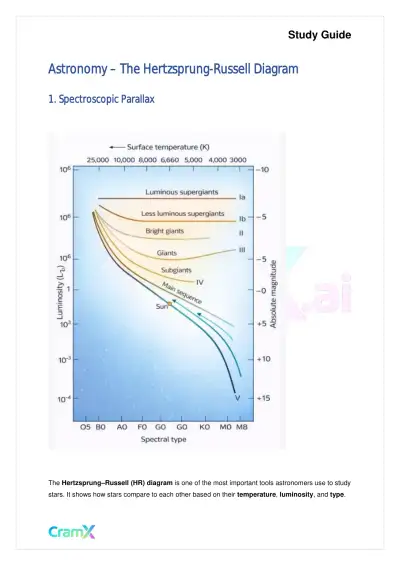 Quick Guides
Astronomy - The Hertzsprung-Russell Diagram
Astronomy
17 pagesMar 2026 Quick Guides
Astronomy - Earth and its Moon
Astronomy
26 pagesMar 2026 Quick Guides
Astronomy - Life in the Universe
Astronomy
9 pagesMar 2026 Quick Guides
Astronomy - The Structure of Stars
Astronomy
19 pagesMar 2026
Study this document with CramX
Once it is in your library, every tool can work from it.