

Microsoft Azure Architect Technologies Study Companion: Exam AZ-300 and AZ-303 (2020)
- Azure Networking Practice Exam
- 879 pages
- Shared May 2025
Study smarter with Microsoft Azure Architect Technologies Study Companion: Exam AZ-300 and AZ-303 (2020), an exam guide designed to improve retention and recall.
Preview 16 of 879 pages
See the first 16 pages exactly as they appear in the document.
Page 1 Page 2 Page 3 Read page 3 as text
Rahul Sahay Microsoft Azure Architect Technologies Study Companion Hands-on Preparation and Practice for Exam AZ- 300 and AZ-303 1st ed. Foreword by Mrinal Pandya
Page 4 Read page 4 as text
Rahul Sahay Bangalore, India Any source code or other supplementary material referenced by the author in this book is available to readers on GitHub via the book’s product page, located at www.apress.com/978-1-4842-6199-6. For more detailed information, please visit www.apress.com/source-code. ISBN 978-1-4842-6199-6 e-ISBN 978-1-4842-6200-9 https://doi.org/10.1007/978-1-4842-6200-9 © Rahul Sahay 2020 This work is subject to copyright. All rights are reserved by the Publisher, whether the whole or part of the material is concerned, specifically the rights of translation, reprinting, reuse of illustrations, recitation, broadcasting, reproduction on microfilms or in any other physical way, and transmission or information storage and retrieval, electronic adaptation, computer software, or by similar or dissimilar methodology now known or hereafter developed. The use of general descriptive names, registered names, trademarks, service marks, etc. in this publication does not imply, even in the absence of a specific statement, that such names are exempt from the relevant protective laws and regulations and therefore free for general use. The publisher, the authors and the editors are safe to assume that the advice and information in this book are believed to be true and accurate at the date of publication. Neither the publisher nor the authors or the editors give a warranty, expressed or implied, with respect to the material contained herein or for any errors or omissions that may have been made. The publisher remains neutral with regard to jurisdictional claims in published maps and institutional affiliations.
Page 5 Read page 5 as text
Distributed to the book trade worldwide by Springer Science+Business Media New York, 233 Spring Street, 6th Floor, New York, NY 10013. Phone 1-800-SPRINGER, fax (201) 348-4505, e-mail orders- ny@springer-sbm.com, or visit www.springeronline.com. Apress Media, LLC is a California LLC and the sole member (owner) is Springer Science + Business Media Finance Inc (SSBM Finance Inc). SSBM Finance Inc is a Delaware corporation.
Page 6 Read page 6 as text
To my parents; to my wife, Nivedita; and to my son, Shivansh. Without their support, this book would not have been completed on time. I would also like to dedicate this book to the readers, who have expressed interest in learning Azure and have shown trust in me by choosing this book to do it.
Page 7 Read page 7 as text
Foreword Since the advent of cloud computing, there have been continuous improvements and additions to the cloud services offered by providers. Microsoft Azure is on the forefront by continuously expanding its set of services and helping organizations meet their business challenges. Microsoft Azure gives businesses the freedom to develop and deploy their solutions on an ever-expanding global network, while allowing them to use the tools and frameworks of their own choice. In addition, continuous innovation by Microsoft not only supports an organization’s product development needs today but also assures support for their product visions of the future. This book was written for professionals who want to design robust solutions using Microsoft Azure for their businesses and products. It will help solution architects translate their business requirements into a cloud solution that not only uses the power of cloud computing on Microsoft Azure but also assures them that their products are scalable and reliable. With the help of this book, I believe that solution architects will be able to master the best cutting-edge technologies on the cloud and will be able to build solutions for tomorrow. Mrinal Pandya
Page 8 Read page 8 as text
Department Manager Kongsberg Digital Bangalore, India
Page 9 Read page 9 as text
Introduction This book covers the material you need to know to take and pass the AZ- 300 exam, Architecting Microsoft Azure Solutions. Yet, the goal of this book is not to just prepare you to take the exam; rather, it is to help you become an Azure expert by being able to plan even the most complex design. As you progress through the chapters of the book, you will see complex scenarios and learn how to execute the equivalent solutions in Azure. Note that the AZ-300 program will eventually be renamed AZ-303. For more updates, visit https://docs.microsoft.com/en- us/learn/certifications/exams/az-300 .
Page 10 Read page 10 as text
Acknowledgments I would like to thank Apress for distributing this top-notch Azure book. Your group’s support for completing the book was truly commendable. Also, I would like to express gratitude to Mrinal Pandya, my supervisor, for writing the foreword for the book. Finally, my gratitude goes to Vidya Vrat Agarwal for giving his time to review the book.
Page 11 Read page 11 as text
Table of Contents Chapter 1: Setting Expectations What Is Azure? What Is Cloud Computing? Types of Cloud Computing Public Private Hybrid Types of Cloud Services Azure Free Account Setting the Budget Azure Subscriptions and Resources Azure Subscription Options Azure Blueprints Azure Accounts Roles and Permissions Azure Policy Subscriptions with Resources Permissions and Reporting Tagging Azure Services Azure Availability Chapter 2: Virtual Machines Creating a VM High Availability Availability Zone
Page 12 Read page 12 as text
Virtual Machine Scale Set Dedicated Hosts High Availability Considerations Creating a Host Group Creating a Dedicated Host Requesting a Quota Increase Setting Up a Bastion Host Chapter 3: ARM Templates Creating a VM with an ARM Template Deploying a VM Chapter 4: Virtual Machine Encryption Creating a Key Vault Creating Keys Enabling Encryption Encrypting an OS Disk Enabling Encryption Using PowerShell Chapter 5: Azure Monitoring Opening Azure Monitor Enabling Guest-Level Monitoring Creating a Baseline for Resources Setting Up Alerts and Metrics Creating an Alert Understanding Metrics Setting Up a Metric Managing Actions Managing Costs
Page 13 Read page 13 as text
Chapter 6: Azure Recommendations Creating a Recommendation Using Log Analytics Chapter 7: Storage Solutions Configuring an Endpoint Configuring a Container Access Keys Shared Access Signatures Using Azure Storage Explorer Setting Up Log Analytics for Storage Setting Up Azure AD Authentication for Storage Replicating Data Setting Up Failover for Storage Accounts Chapter 8: Managing Virtual Networks Creating a Virtual Network Setting Up Public and Private IP Addresses Creating a Route Table Associating a Subnet Creating Application Security Groups Assigning an Application Security Group to a Resource Updating Inbound Rules Chapter 9: Connecting Networks Setting Up Peering Configuring Global Peering Forwarded Traffic VNet Pricing
Page 14 Read page 14 as text
Creating a Gateway Subnet Network Gateways VNet-to-VNet Connection VPN Pricing Virtual Private Networks Point-to-Site Connection Site-to-Site Connection ExpressRoute ExpressRoute Direct Chapter 10: Azure Active Directory Pricing Creating an Azure Active Directory Creating a User Adding Custom Domain Names Creating a Group Using Identity Protection Creating a User Risk Policy Setting Up a Sign-in Risk Policy MFA Registration Policy Setting Up a Self-Service Password Reset Testing the AD Flow Conditional Access Identity Governance Using Access Reviews Creating an Azure AD Hybrid Identity Azure AD B2C
Page 15 Read page 15 as text
Configuring Azure AD B2B Deleting an Active Directory Chapter 11: Implement and Manage Hybrid Identities Azure AD Connect Password Hash Synchronization Pass-Through Synchronization Benefits of Using Pass-Through Authentication Federation Integration Synchronization Azure AD Connect Health Chapter 12: Migrate Servers to Azure Creating a Recovery Service Enabling Resource Providers Creating a New Replication Item Creating a Disaster Recovery Plan Creating a Virtual Network Testing the Failover Strategy Deleting a Recovery Service Chapter 13: Serverless Computing Function App Creating a New Function Testing the Function App Function Integration with Azure Blob Testing the Integrated Function Logic Apps Creating a New Logic App
Page 16 Read page 16 as text
Event Grid Creating a New Event Grid Service Bus Creating a New Service Bus Chapter 14: Load Balancing Creating a Load Balancer Creating Virtual Machines Configuring a Backend Pool Configuring a Health Probe Creating a Load Balancing Rule Configuring a Front-End IP Address Creating a Secondary Health Probe Creating a Second Load Balancing Rule Using Application Gateway Creating a Gateway Editing a Backend Pool Adding a Listener Adding a Path-Based Rule Using Front Door Using Front Door Chapter 15: Multifactor Authentication Adding a Guest User Enabling Multifactor Authentication Setting Up Fraud Alerts Creating a One-Time Bypass Using Role-Based Access Control
863 more pages in the full document
Unlock it once and it stays in your library, ready to chat with or turn into flashcards.
Unlock the full documentMore Azure Networking Practice Exam study materials
See all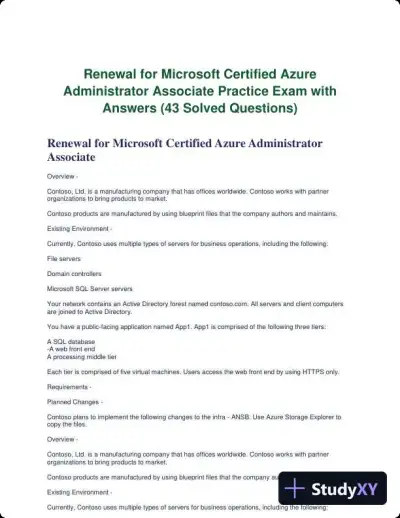 Past Exams
Renewal for Microsoft Certified Azure Administrator Associate Practice Exam with Answers (43 Solved Questions)
Azure Networking Practice Exam
16 pages162downloadsFeb 2025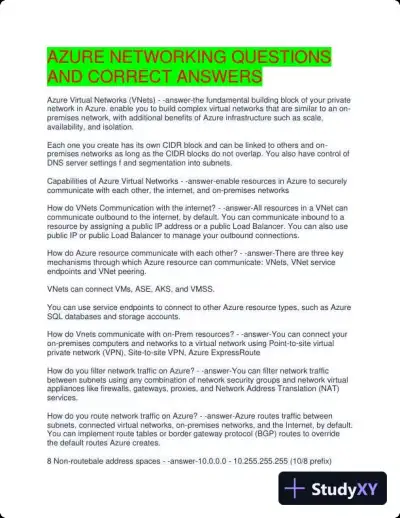 Past Exams
AZURE Networking Practice Exam with Answers (37 Solved Questions)
Azure Networking Practice Exam
7 pages118downloadsFeb 2025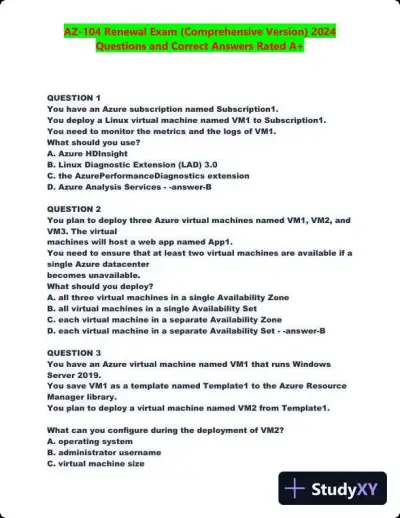 Past Exams
2024 AZ-104 Renewal Comprehensive Exam with Answers (270 Solved Questions)
Azure Networking Practice Exam
115 pages93downloadsFeb 2025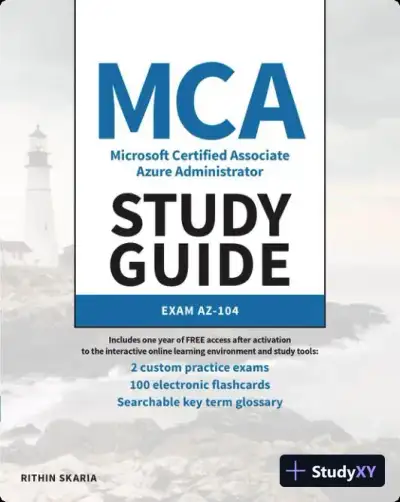 Certification Guides
MCA Microsoft Certified Associate Azure Administrator Study Guide: Exam AZ-104 (2022)
Azure Networking Practice Exam
595 pages93downloadsFeb 2025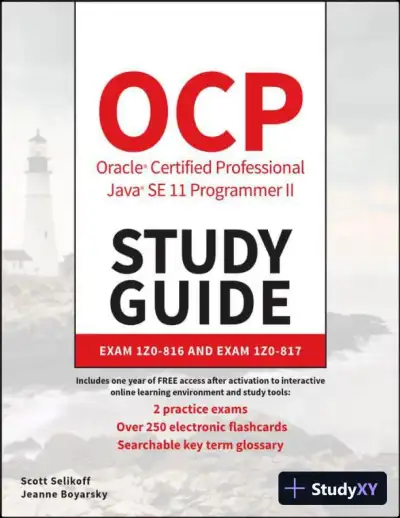 Certification Guides
Study Guide Exam 1Z0-816 and Exam 1Z0-817 (2020)
Azure Networking Practice Exam
996 pages92downloadsFeb 2025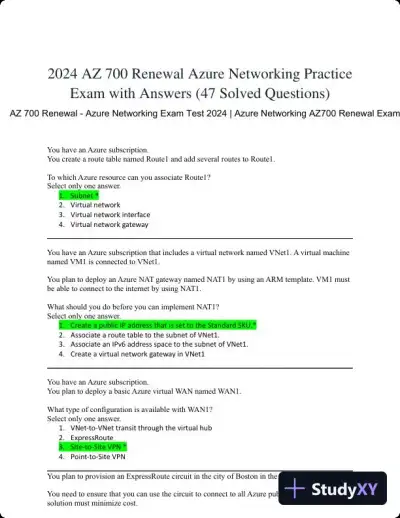 Past Exams
2024 AZ 700 Renewal Azure Networking Practice Exam with Answers (47 Solved Questions)
Azure Networking Practice Exam
13 pages71downloadsFeb 2025 Certification Guides
MCA Microsoft Certified Associate Azure Security Engineer Study Guide: Exam AZ-500 (2022)
Azure Networking Practice Exam
489 pages65downloadsFeb 2025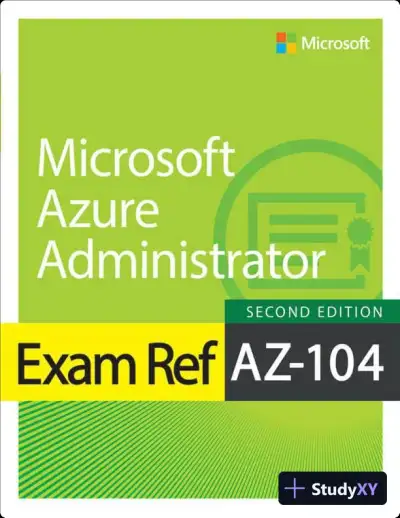 Certification Guides
Exam Ref AZ-104 Microsoft Azure Administrator (2024)
Azure Networking Practice Exam
604 pages59downloadsFeb 2025
Study this document with CramX
Once it is in your library, every tool can work from it.