

Microsoft Azure Security Technologies Certification and Beyond: AZ-500 exam (2021)
- Azure Networking Practice Exam
- 526 pages
- Shared May 2025
Microsoft Azure Security Technologies Certification and Beyond: AZ-500 exam (2021) is your go-to guide for passing the exam, covering critical concepts, solved problems, and exam-style questions.
Preview 16 of 526 pages
See the first 16 pages exactly as they appear in the document.
Page 1 Page 2 Page 3 Read page 3 as text
Microsoft Azure Security Technologies Certification and Beyond Gain practical skills to secure your Azure environment and pass the AZ-500 exam David Okeyode BIRMINGHAM—MUMBAI
Page 4 Read page 4 as text
Microsoft Azure Security Technologies Certification and Beyond Copyright © 2021 Packt Publishing All rights reserved. No part of this book may be reproduced, stored in a retrieval system, or transmitted in any form or by any means, without the prior written permission of the publisher, except in the case of brief quotations embedded in critical articles or reviews. Every effort has been made in the preparation of this book to ensure the accuracy of the information presented. However, the information contained in this book is sold without warranty, either express or implied. Neither the author, nor Packt Publishing or its dealers and distributors, will be held liable for any damages caused or alleged to have been caused directly or indirectly by this book. Packt Publishing has endeavored to provide trademark information about all of the companies and products mentioned in this book by the appropriate use of capitals. However, Packt Publishing cannot guarantee the accuracy of this information. Group Product Manager : Wilson Dsouza Publishing Product Manager : Vijin Boricha Senior Editor : Athikho Sapuni Rishana Content Development Editor : Sayali Pingale Technical Editor : Shruthi Shetty Copy Editor : Safis Editing Project Coordinator : Neil Dmello Proofreader : Safis Editing Indexer : Tejal Daruwale Soni Production Designer : Nilesh Mohite First published: September 2021 Production reference: 1070921 Published by Packt Publishing Ltd. Livery Place 35 Livery Street Birmingham B3 2PB, UK. 978-1-80056-265-3 www.packt.com
Page 5 Read page 5 as text
I am grateful to many people who have helped and supported me through the process of writing this book. To my wife and best friend, Brenda Tao. To my parents, who taught me everything I know (Jacob and Hope Okeyode). And to the three best sisters and encouragers in the world (Pemi, Elizabeth, and Esther). I love you all. – David Okeyode
Page 6 Read page 6 as text
Contributors About the author David Okeyode is a cloud security architect at the Prisma cloud speedboat at Palo Alto Networks. Before that, he was an independent consultant helping companies secure their cloud environments through private expert-level training and assessments. He holds 15 professional certifications across the Azure and AWS platforms, including the Azure Security Engineer, Azure DevOps, and AWS Security Specialist certifications. He has also authored two cloud computing courses for the popular cybersecurity training platform Cybrary. David has over a decade of experience in cybersecurity (consultancy, design, and implementation) and over 6 years of experience as a trainer. He has worked with organizations of different sizes, from start-ups to major enterprises to government organizations. David has developed multiple vulnerable-by-design automation templates that can be used to practice cloud penetration testing techniques. He regularly speaks about cloud security at major industry events, such as Microsoft Future Decoded and the European Information Security Summit. David is married to a lovely girl who makes the best banana cake in the world. They love traveling the world together and intend to do missions in Asia very soon!
Page 7 Read page 7 as text
About the reviewers Dharam Chhatbar is a seasoned information security professional who has more than 11 years of experience in various verticals of InfoSec, delivering impactful and high-quality risk-reduction work. He has helped secure many banks and retail firms and is currently working at a top Fortune 500 company. He holds a master's degree, is a fervent learner, and has earned several global certifications, such as CISSP, GSLC (GIAC), CCSP, CSSLP, GMOB, and some related to the cloud, such as Azure (AZ500), GCP (PCSE), and AWS (SAA). His key competencies include vulnerability management, application security, cloud security, VA/PT, and managing teams/vendors. He has also reviewed the book CISSP (ISC)² Certification Practice Exams and Tests by Ted Jordan. I would like to thank my parents, Bina and Jagdish; my wife, Chaital; and my sister, Hina, for their continued support and encouragement with everything that I do and for motivating me to always achieve my ambitions. Rod Trent is a security CSA for Microsoft and an Azure Sentinel global SME helping customers migrate from existing SIEMs to Azure Sentinel to achieve the promise of better security through improved efficiency without compromise. Rod is a husband, dad, and recently a first-time grandfather. He spends his spare time (if such a thing does truly exist) simultaneously watching episodes of The Six Million Dollar Man and writing KQL queries.
Page 8 Page 9 Read page 9 as text
Table of Contents Preface Section 1: Implement Identity and Access Security for Azure 1 Introduction to Azure Security Technical requirements 4 Shared responsibility model 4 Setting up a practice environment 6 Create a free trial Azure subscription 7 Summary 11 Questions 12 Further reading 12 2 Understanding Azure AD What Azure AD is not (what is Azure AD?) 14 Azure AD versus on-premises AD 14 Azure AD – an identity provider for Microsoft cloud services 14 Azure AD – an identity provider for modern applications 16 Modern authentication protocols 17 Hands-on exercise – review your Azure AD tenant 18 Hands-on exercise – add a custom domain to Azure AD (optional) 21 Azure AD editions 24 Hands-on exercise – sign up for an Azure AD Premium P2 trial 25 Azure AD object management 28 Azure AD users 28 Azure AD groups 29 Azure AD and Azure RBAC roles 30 Service principals 31 Hands-on exercise – Azure AD user creation and group management 31 Hands-on exercise – Azure AD role assignment 39
Page 10 Read page 10 as text
viii Table of Contents Summary 44 Questions 44 Further reading 45 3 Azure AD Hybrid Identity Technical requirements 48 Implementing Azure AD hybrid identity 48 Azure AD Connect 48 Preparing for Azure AD Connect installation 49 Hands-on exercise – deploying an Azure VM hosting an AD domain controller 50 Hands-on exercise – preparing for Azure AD Connect deployment 59 Selecting a hybrid identity authentication method 65 Federation 67 Pass-Through Authentication (PTA) 69 Azure AD Connect deployment options 70 Hands-on exercise – deploying Azure AD Connect PHS 71 Implementing password writeback 85 Summary 86 Questions 86 Further reading 87 4 Azure AD Identity Security Technical requirements 90 Implementing Azure AD Password Protection 90 Hands-on exercise – Configuring the custom banned password list feature of Azure AD Password Protection 93 Securing Azure AD users with multi-factor authentication (MFA) 101 Hands-on exercise – Enabling MFA by changing user state 102 Implementing conditional access policies 108 Conditional access – How policies are evaluated 111 Conditional access best practices 112 Hands-on exercise – Implementing conditional access 113 Protecting identities with Azure AD Identity Protection 122 Identity protection – risk categories 122 Identity protection – detection types 125 Identity protection – risk levels 125 Identity protection – policies 126
Page 11 Read page 11 as text
Table of Contents ix Exercise – Implementing Azure AD Identity Protection 128 Summary 137 Question 137 Further reading 137 5 Azure AD Identity Governance Technical requirements 140 Protecting privileged access using Azure AD Privileged Identity Management (PIM) 140 What is Azure AD PIM? 140 How does Azure AD PIM work? 141 Exercise – Azure AD Privileged Identity Management 142 Configuring PIM access reviews 154 Exercise – Create an access review and review PIM auditing features 155 Summary 162 Questions 163 Further reading 163 Section 2: Implement Azure Platform Protection 6 Implementing Perimeter Security Technical requirements 168 Securing the Azure virtual network perimeter 168 Implementing Azure Distributed Denial of Service (DDoS) Protection 169 Hands-on exercise – provisioning resources for the exercises in Chapters 6 and 7 171 Hands-on exercise – implementing the Azure DDoS protection Standard 178 Implementing Azure Firewall 183 Hands-on exercise – implementing Azure Firewall 184 Implementing a Web Application Firewall (WAF) in Azure 200 Application Gateway WAF 200 Front Door WAF 201 Hands-on exercise – configuring a WAF on Azure Application Gateway 202 Summary 214 Questions 214 Further reading 215
Page 12 Read page 12 as text
x Table of Contents 7 Implementing Network Security Technical requirements 218 Implementing virtual network segmentation 218 Implementing NSGs 218 Implementing ASGs 220 Hands-on exercise – Configuring NSGs and ASGs 221 Implementing platform service network security 230 Firewall for PaaS services (and firewall exceptions) 231 Service endpoints 232 Hands-on exercise: Configuring a firewall and service endpoints on a storage account 233 Securing Azure network hybrid connectivity 242 Implementing Azure Bastion 243 Hands-on exercise: Configuring Azure Bastion 244 Hands-on exercise: Cleaning up resources 248 Summary 249 Question 250 Further reading 250 8 Implementing Host Security Technical requirements 252 Hands-on exercise – provisioning resources for this chapter's exercises 252 Using hardened baseline VM images 256 Protecting VMs from viruses and malware 258 Hands-on exercise deploying the Microsoft Antimalware extension for Azure 260 Implementing system update management for VMs 263 Hands-on exercise – implementing Azure Automation Update Management 264 Implementing vulnerability assessment for VMs 269 Encrypting VM disks with Azure Disk Encryption 271 Hands-on exercise – implementing Azure Disk Encryption 272 Securing management ports with JIT VM access 280 Hands-on exercise – enabling JIT VM access 282 Summary 289 Questions 289 Further reading 290
Page 13 Read page 13 as text
Table of Contents xi 9 Implementing Container Security Technical requirements 292 An overview of containerization in Azure 292 Hands-on exercise – providing resources for the chapter exercises 295 Introducing ACR 299 ACR pricing tiers 300 ACR security best practices 300 Configuring service firewall rules for ACR 301 Restricting access using a private endpoint 303 Using Azure AD RBAC for secure authentication and access control 304 Implementing container image vulnerability and compliance scanning 306 Hands-on exercise – securing ACR 307 Introducing AKS 319 Understanding the AKS architecture 319 AKS security best practices 320 Limiting access to the API server using authorized IP address ranges 320 Implementing a private AKS cluster using a private endpoint 322 Controlling access to cluster resources using Kubernetes RBAC and Azure AD 323 Regularly upgrading the cluster control plane 324 Regularly applying OS updates to worker nodes 326 Implementing pod-managed identities 327 Cleaning up the resources 336 Summary 336 Questions 336 Further reading 337 Section 3: Secure Storage, Applications, and Data 10 Implementing Storage Security Technical requirements 342 Azure Storage overview 342 Azure Blob service hierarchy 343 Azure Files service hierarchy 344 Implementing encryption at rest 344 Implementing encryption in transit 348 Hands-on exercise – provisioning a storage account with encryption in transit enforced 349
Page 14 Read page 14 as text
xii Table of Contents Configuring storage account authorization 358 Protect access to the Storage account keys 359 Grant limited access to using Shared Access Signatures (SAS) 360 Implementing storage account key management with Key Vault 362 Disabling key-based authorization options 364 Disabling anonymous (unauthenticated) Blob access 365 Implementing Azure AD authorization for the Blob service 367 Implementing ADDS or Azure ADDS authentication for Azure Files 367 Hands-on exercise – configuring storage account access controls 368 Implementing Azure Defender for Storage 379 Cleaning up resources 379 Summary 380 Question 380 Further reading 380 11 Implementing Database Security Technical requirements 382 Database options in Azure 382 Azure SQL deployment options 383 Implementing defense in depth for Azure SQL 384 Protecting Azure SQL against unauthorized network connections 385 Implementing IP firewall rules 386 Implementing server-level firewall rules 386 Implementing database-level firewall rules 387 Implementing Azure SQL private endpoints 388 Hands-on exercise – provisioning resources for chapter exercises 389 Hands-on exercise – implementing network access control 396 Protecting Azure SQL against unauthorized user access 401 Hands-on exercise – implementing Azure AD authentication and authorization 402 Protecting Azure SQL against vulnerabilities 409 Enabling Azure SQL database auditing 410 Implementing Azure Defender for SQL 410 Protecting Azure SQL against data leakage and theft (database encryption) 412 Implementing Transparent Data Encryption (TDE) – encryption at rest 412 Implementing encryption in transit 413 Implementing Azure SQL Database Always Encrypted 414 Hands-on exercise – implementing Always Encrypted 415
Page 15 Read page 15 as text
Table of Contents xiii Cleaning up resources 419 Summary 419 Question 419 Further reading 420 12 Implementing Secrets, Keys, and Certificate Management with Key Vault Technical requirements 422 Introducing Azure Key Vault 422 Understanding secrets, keys, and certificates 423 Understanding Key Vault pricing tiers 424 Managing access to Key Vault 425 Hands-on exercise – managing access to Key Vault resources 428 Protecting Key Vault resources 439 Hands-on exercise – protecting Key Vault resources 441 Cleaning up resources 444 Summary 444 Question 445 Further reading 445 13 Azure Cloud Governance and Security Operations Technical requirements 448 Implementing Azure cloud governance 448 Understanding management groups 448 Understanding Azure Policy 450 Understanding Azure RBAC 455 Hands-on exercise – implementing management groups and Azure Policy 460 Understanding logging and monitoring 464 Azure Service Health 464 Azure Monitor 465 Log Analytics 470 Addressing cloud security challenges with Security Center 471 Cloud Security Posture Management 472 Cloud Compliance Posture Management 472 Threat protection 474 Managing security operations with Azure Sentinel 475 Data collection 476 Detecting threats 478 Investigating incidents 478 Responding to incidents 478 Hands-on exercise – implementing Azure Sentinel 478 Cleaning up resources 485 Summary 485 Questions 486 Further reading 486
Page 16 Read page 16 as text
xiv Table of Contents Assessments Chapter 1 – Introduction to Azure Security 489 Chapter 2 – Understanding Azure AD 489 Chapter 3 – Azure AD Hybrid Identity 490 Chapter 4 – Azure AD Identity Security 490 Chapter 5 – Azure AD Identity Governance 490 Chapter 6 – Implementing Perimeter Security 490 Chapter 7 – Implementing Network Security 491 Chapter 8 – Implementing Host Security 491 Chapter 9 – Implementing Container Security 491 Chapter 10 – Implementing Storage Security 491 Chapter 11 – Implementing Database Security 491 Chapter 12 – Implement Secrets, Keys, and Certificate Management with Key Vault 492 Chapter 13 – Azure Cloud Governance and Security Operations 492 Other Books You May Enjoy Index
510 more pages in the full document
Unlock it once and it stays in your library, ready to chat with or turn into flashcards.
Unlock the full documentMore Azure Networking Practice Exam study materials
See all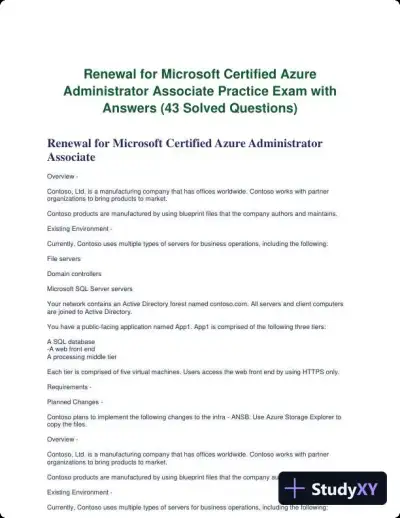 Past Exams
Renewal for Microsoft Certified Azure Administrator Associate Practice Exam with Answers (43 Solved Questions)
Azure Networking Practice Exam
16 pages162downloadsFeb 2025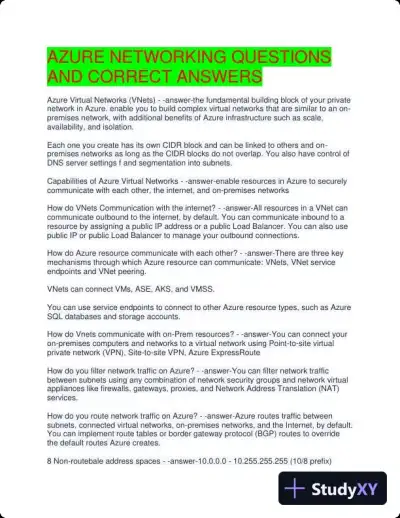 Past Exams
AZURE Networking Practice Exam with Answers (37 Solved Questions)
Azure Networking Practice Exam
7 pages118downloadsFeb 2025 Certification Guides
MCA Microsoft Certified Associate Azure Administrator Study Guide: Exam AZ-104 (2022)
Azure Networking Practice Exam
595 pages93downloadsFeb 2025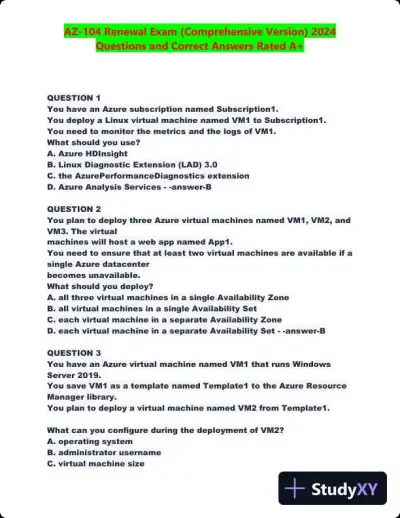 Past Exams
2024 AZ-104 Renewal Comprehensive Exam with Answers (270 Solved Questions)
Azure Networking Practice Exam
115 pages93downloadsFeb 2025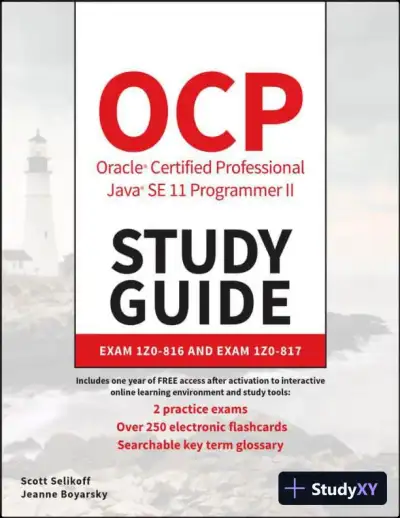 Certification Guides
Study Guide Exam 1Z0-816 and Exam 1Z0-817 (2020)
Azure Networking Practice Exam
996 pages92downloadsFeb 2025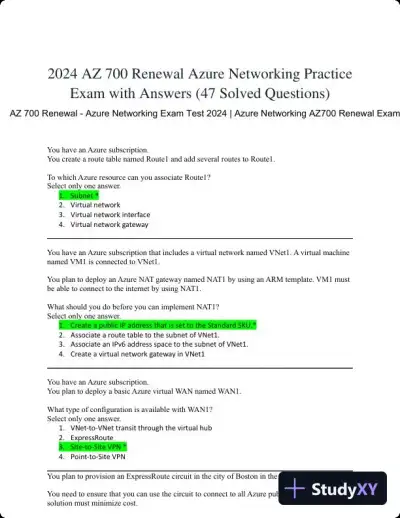 Past Exams
2024 AZ 700 Renewal Azure Networking Practice Exam with Answers (47 Solved Questions)
Azure Networking Practice Exam
13 pages71downloadsFeb 2025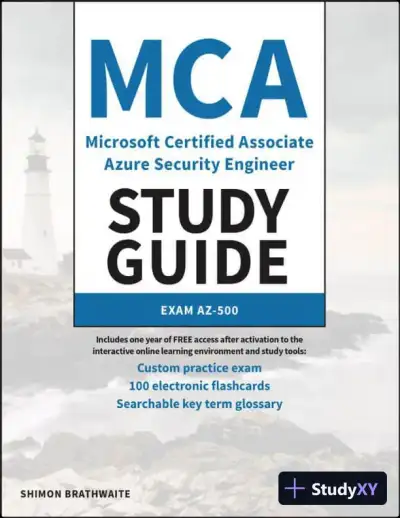 Certification Guides
MCA Microsoft Certified Associate Azure Security Engineer Study Guide: Exam AZ-500 (2022)
Azure Networking Practice Exam
489 pages65downloadsFeb 2025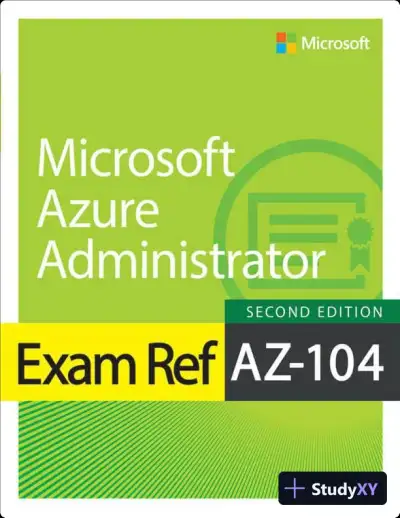 Certification Guides
Exam Ref AZ-104 Microsoft Azure Administrator (2024)
Azure Networking Practice Exam
604 pages59downloadsFeb 2025
Study this document with CramX
Once it is in your library, every tool can work from it.