

Solution Manual For Chemistry: Principles and Reactions, 8th Edition
- Chemistry
- 270 pages
- Shared May 2025
Solution Manual For Chemistry: Principles and Reactions, 8th Edition makes textbook problem-solving simple, with detailed answers that make learning fun.
Preview 16 of 270 pages
See the first 16 pages exactly as they appear in the document.
Page 1 Read page 1 as text
| | | | | | | Contents Preface v Lecture Schedule vii Chapter 1 Matter and Measurements 1 Chapter 2 Atoms, Molecules, and Ions 11 Chapter 3 Mass Relations in Chemistry; Stoichiometry 21 Chapter 4 Reactions in Aqueous Solution 37 Chapter 5 Gases 49 Chapter 6 Electronic Structure and the Periodic Table 61 Chapter 7 Covalent Bonding 71 Chapter 8 Thermochemistry 83 Chapter 9 Liquids and Solids 95 Chapter 10 Solutions 105 Chapter 11 Rate of Reaction 119 Chapter 12 Gaseous Chemical Equilibrium 133 Chapter 13 Acids and Bases 147 Chapter 14 Equilibria in Acid-Base Solutions 161 Chapter 15 Complex Ions and Precipitation Equilibra 177 Chapter 16 Spontaneity of Reaction 189 Chapter 17 Electrochemistry 201 Chapter 18 Nuclear Reactions 219 Chapter 19 Complex Ions 229 Chapter 20 Chemistry of the Metals 237 Chapter 21 Chemistry of the Nonmetals 245 Chapter 22 Organic Chemistrry 255 Chapter 23 Organic Polymers: Natural and Synthetic 265 iii
Page 2 Page 3 Read page 3 as text
| | | | | | | Preface This manual starts off with a section entitled “Lecture Schedule,” which you may find helpful in adapting the text to your class schedule. Beyond that, the manual is organized by text chapters. For each chapter, we include three different features: 1. “Lecture Notes,” which suggest the amount of time that we devote to each chapter and the topics we emphasize. Included are detailed lecture outlines (from our own lectures) that may serve as a guide for your lectures. At a minimum, they indicate how we cover topics and how successive topics can be integrated. 2. A list of demonstrations illustrating topics in the chapter. These are taken from three sources: • The manual Tested Demonstrations in Chemistry (1994), Volumes I and II, compiled and edited by by George Gilbert by arrangement with the Journal of Chemical Education. These are coded as “GILB” with the experiment number (e.g., M 12) • Chemical Demonstrations (1983-1992), Volumes 1-4, published by Bassam Shakashiri with many collaborators and contributors. These are listed as “SHAK” followed by the volume and page reference. • Demonstrations described in the Journal of Chemical Education with the journal reference. 3. Answers and detailed solutions to: • The summary problem at the end of each chapter • Odd numbered text problems • Challenge problems at the end of each problem set Note that Appendix 6 has answers to all the even-numbered problems. Detailed solutions to many of these problems are in the Student Solutions Manual available from Cengage Learning, Brooks/Cole. v
Page 4 Read page 4 as text
| | | | | | | Lecture Schedule Unlike other general chemistry texts, ours can be covered in its entirety in a one-year course. A reasonable schedule appears below. Further comments on the time you should devote to each chapter are in the body of this manual. The underlying assumption is that you are teaching 14-week semesters with two 50-minute lectures per week. If three class periods are devoted to examinations each semester, that leaves 25 for covering material. On that basis, you are able to complete Chapter 10 (Solutions) in the first semester. The seond semester will then start with Chapter 11 (Rate of Reaction). FIRST SEMESTER SCHEDULE Week Lecture Topic 1 1 Chapter 1 (Matter and Measurements) 2 Chapter 1 2 3 Chapter 2 (Atoms, Molecules, and Ions) 4 Chapter 2 3 5 Chapter 3 (Mass Relations in Chemistry; Stoichiometry) 6 Chapter 3 4 7 Chapter 3 8 EXAM I 5 9 Chapter 4 (Reactions in Aqueous Solution) 10 Chapter 4 6 11 Chapter 4 12 Chapter 5 (Gases) 7 13 Chapter 5 14 Chapter 6 (Electronic Structure and the Periodic Table) 8 15 Chapter 6 16 Chapter 6 9 17 EXAM II 18 Chapter 7 (Covalent Bonding) 10 19 Chapter 7 20 Chapter 7 11 21 Chapter 8 (Themochemistry) 22 Chapter 8 12 23 Chapter 9 (Liquids and Solids) 24 Chapter 9 13 25 Chapter 9 26 EXAM III 14 27 Chapter 10 (Solutions) 28 Chapter 10 vii
Page 5 Read page 5 as text
viii Lecture Schedule SECOND SEMESTER SCHEDULE Week Lecture Topic 1 1 Chapter 11 (Rate of Reaction) 2 Chapter 11 2 3 Chapter 11 4 Chapter 12 (Gaseous Chemical Equilibrium) 3 5 Chapter 12 6 Chapter 13 (Acids and Bases) 4 7 Chapter 13 8 Chapter 13 5 9 EXAM I 10 Chapter 14 (Equilibria in Acid-Base Solutions) 6 11 Chapter 14 12 Chapter 15 (Complex Ions) 7 13 Chapter 15 14 Chapter 16 (Precipitation Equilibria) 8 15 Chapter 17 (Spontaneity of Reaction) 16 Chapter 17 9 17 EXAM II 18 Chapter 18 (Electrochemistry) 10 19 Chapter 18 20 Chapter 18 11 21 Chapter 19 (Nuclear Chemistry) 22 Chapter 20 (Chemistry of the Metals) 12 23 Chapter 20 24 EXAM III 13 25 Chapter 21 (Chemistry of the Nonmetals) 26 Chapter 21 14 27 Chapter 22 (Organic Chemistry) 28 Chapter 23 (Organic Polymers: Natural and Synthetic)
Page 6 Read page 6 as text
Lecture Schedule ix If you want to use lecture time for review, for going over assigned problems, or for doing a large number of demonstrations, you will have trouble keeping up with this schedule. As you’ve almost certainly learned by now, the solution to this problem is not to talk faster. Judicious deletions work better. It’s been said, and wisely, that the secret of giving a good lecture is knowing what to leave out. Possible candidates include: • Introductory material on matter in Chapter 1 and atomic theory in Chapter 2. The chances are your students have been exposed to this material more than once in high school and understood it reasonably well the first time. • Boyle’s and Charles’s laws in Chapter 5. We start the chapter by writing the ideal gas law and go on from there. • The First Law discussion in Chapter 8. Quite frankly, this has very little to do with chemistry. Students will not be irreparably damaged if they are unaware of the distinction between H and E . • The discussion of colligative properties in Chapter 10 could be shortened. Raoult’s law could easily be omitted. • Reaction mechanisms in Chapter 11. Students have a lot of trouble with this. We are not sure it is worth the effort. • Polyprotic acids in Chapter 13. • The Second Law discussion in Chapter 17. Beyond these selective omissions, some instructors may want to delete one or another of the descriptive chapters at the end of the text (Chapters 20–22). If, in that way, you can squeeze out a couple of lectures, they can well be spent on Chapter 12 (three lectures instead of two) and Chapter 19 (two lectures instead of one). Textbook authors sometimes tell you that chapters can be covered in almost any order, depending on your preference. This isn’t really true for this textbook, or any other with structural integrity. It can be done, but only with very careful additions and deletions of material. Suppose, for example, you want to cover Precipitation Equilibria (Chapter 16) immediately after Acid-Base Equilibria (Chapter 14). Keep in mind that an understanding of formation constants (Complex Ions, Chapter 15) is assumed when methods of dissolving precipitates are considered in Section 16.2 of Chapter 16.
Page 7 Read page 7 as text
1 | | | | | | | | MATTER AND MEASUREMENTS LECTURE NOTES This material ordinarily requires two lectures (100 minutes), allowing for a 10–15 minute introduction to the course in the first lecture. If you’re in a hurry, this can be cut to 1 1 2 lectures by discussing only quantitative material (significant figures, unit conversions, density, solubility). A few points to keep in mind: • Virtually all of your students will be familiar with the metric system and prefixes. It may be worth discussing the rationale for SI, but you don’t have to dwell on it. • Students readily learn the rules of significant figures, but typically ignore them after Chapter 1. It may help to emphasize that these are common-sense (albeit, approximate) rules for estimating experimental error. • Many (typically, the weaker) students resist using conversion factors, preferring instead a rote method. It may be useful to point out that conversion factors will be a recurring tool throughout the text, so are well worth learning at this point. • Students often have trouble with solubility calculations. The approach in the text involves conversions (Example 1.8). The solubility is considered to be a conversion factor relating grams of solute to grams of solvent. Lecture 1 I. Types of Substances A. Elements Cannot be broken down into simpler substances. Examples: nitrogen, lead, sodium, arsenic. Symbols: N, Pb, Na, As. B. Compounds Contain two or more elements with fixed mass percents. Glucose: 40.00% C, 6.71% H, 53.29% O. Sodium chloride: 39.34% Na, 60.66% Cl. C. Mixtures Homogeneous (solutions) vs. heterogeneous. Separation by filtration, distillation. II. Measured Quantities A. Length Base unit is the meter. 1 km = 10 3 m; 1 cm = 10 2 m; 1 mm = 10 3 m; 1 nm = 10 9 m. Dimensions of very tiny particles will be expressed in nanometers. 1
Page 8 Read page 8 as text
2 Chapter 1 B. Volume 1 L = 10 3 mL = 10 3 cm 3 = 10 3 m 3 . Buret, pipet, volumetric flask. C. Mass 1 kg = 10 3 g; 1 mg = 10 3 g. Two different kinds of balances will be used in the lab. An analytical balance ( ± 0 . 001 g) should be used only for accurate, quantitative work. D. Temperature t F = 1 . 8 t C + 32 ; T K = t C + 273 . 15 . Convert 68 F to C and K: t C = (68 32 ) / 1 . 8 = 20 C T K = 293 Lecture 2 III. Experimental Error; Significant Figures Suppose an object is weighed on a crude balance to ± 0 . 1 g and the mass is found to be 23.6 g. This quantity contains three significant figures, that is, three experimentally significant digits. With an analytical balance, the mass might be 23.582 g (five significant figures). A. Counting significant figures 1. Volume of liquid = 24.0 mL; three significant figures. Zeroes at the end of the measured quantity are significant when they follow nonzero digits. 2. Volume = 0.0240 L; three significant figures (note that 0.0240 L = 24.0 mL). Zeroes at the beginning of a measured quantity are not significant when they precede nonzero digits. B. Multiplication and division Keep only as many significant figures as there are in the least precise quantity. Density of a piece of metal weighing 36.123 g with a volume of 13.4 mL = ? density = 36 . 123 g 13 . 4 mL = 2 . 70 g / mL C. Addition and subtraction Keep only as many digits after the decimal point as there are in the least precise quantity. Add 1.223 g of sugar to 154.5 g of coffee: total mass = 1 . 2 g + 154 . 5 g = 155 . 7 g Note that the rule for addition and subtraction does not apply to significant figures. The number of significant figures may well decrease after subtraction. mass beaker + sample = 52 . 169 g (five significant figures) mass empty beaker = 52 . 120 g (five significant figures) mass sample = 0 . 049 g (two significant figures) D. Exact numbers One liter means 1.000000... L.
Page 9 Read page 9 as text
Matter and Measurements 3 IV. Conversion Factors A. One-step conversion A rainbow trout is measured to be 16.2 inches long. What is its length in centimeters? length in cm = 16.2 in ⇥ 2 . 54 cm 1 in = 41 . 1 cm Note the cancellation of units. To convert from centimeters to inches, use the conversion factor 1 in = 2 . 54 cm. (Here, there are exactly 2.54 cm in one inch.) B. Multiple conversion factors A thrown baseball has speed 89.6 miles per hour. What is its speed in meters per second? 1 mile = 1.609 km = 1 . 609 ⇥ 10 3 m; 1 h = 3600 s speed = ✓ 89 . 6 mile h ◆ ⇥ ⇣ 1 . 609 ⇥ 10 3 m mile ⌘ ⇥ ✓ 1 h 3600 s ◆ = 40 . 0 m / s V. Properties of Substances Distinguish between intensive and extensive, and between chemical and physical. A. Density An empty flask weighs 22.138 g. Pipet 5.00 mL of octane into the flask, producing a total mass of 25.598 g. What volume is occupied by ten grams of octane? d = 3 . 460 g / 5 . 00 mL = 0 . 692 g / mL V = 10 . 00 g ⇥ 1 mL 0 . 692 g = 14 . 5 mL Note that for density calculations, 1 mL = 1 cm 3 . B. Solubility This is often expressed as grams of solute per 100 g of solvent. Solubility of sugar at 20 C = 210 g sugar/100 g water. A solution containing 210 g sugar/100 g water is saturated. A solution containing less than 210 g sugar/100 g water is unsaturated. A solution containing more than 210 g sugar/100 g water is supersaturated. 1. How much water is required to dissolve 52 g of sugar at 20 C? 52 g sugar ⇥ 100 g water 210 g sugar = 25 g water
Page 10 Read page 10 as text
4 Chapter 1 2. A solution at 20 C contains 25 g sugar and 125 g water. Is it unsaturated, saturated or super- saturated? mass sugar / 100 g water = 25 g sugar 125 g water ⇥ 100 g water = 20 g sugar (unsaturated) DEMONSTRATIONS 1. Scientific method: GILB H 29 2. Decomposition of mercury(II) oxide: GILB A 8 3. Separation of a mixture: GILB A 14 4. Reaction of sodium with chlorine: GILB A 24, A 25; SHAK 1 61; J. Chem. Educ. 73 539 (1996) 5. Chromatography: GILB Q 3, Q 13 6. Significant figures: J. Chem. Educ. 69 497 (1992) 7. Density of liquids: GILB C 13; SHAK 3 229 8. Supersaturation: GILB F 11; SHAK 1 27 SUMMARY PROBLEM (a) K, Mn, O (b) density, melting point, solubility, color (c) mass = 2 . 703 g cm 3 ⇥ 48 . 7cm 3 = 132 g (d) 2 . 703 g cm 3 ⇥ 1 lb 454 g ⇥ (2 . 54) 3 cm 3 1 3 in 3 ⇥ (12) 3 in 3 1 ft = 169 lb/ft 3 (e) F = 9 5 ( C) + 32 = 9 5 (2 . 40 ⇥ 10 2 ) + 32 = 464 F (2 . 40 ⇥ 10 2 ) + 273 = 513 K (f) 38 . 5 g H 2 O ⇥ 6 . 38 g KMnO 4 100 g H 2 O = 2 . 46 g KMnO 4 (g) At 60 C: 65 . 0 g H 2 O ⇥ 25 g KMnO 4 100 g H 2 O = 16 g KMnO 4 The solution is unsaturated. At 20 C: 65 . 0 g H 2 O ⇥ 6 . 38 g KMnO 4 100 g H 2 O = 4 . 15 g KMnO 4 can be dissolved. The solution is supersaturated.
Page 11 Read page 11 as text
Matter and Measurements 5 (h) 55 . 0 g H 2 O ⇥ 25 g KMnO 4 100 g H 2 O = 14 g KMnO 4 can be dissolved at 60 C. Yes, all the KMnO 4 added will dissolve. 55 . 0 g H 2 O ⇥ 6 . 38 g KMnO 4 100 g H 2 O = 3 . 51 g KMnO 4 can be dissolved at 20 C. No, not all the KMnO 4 will dissolve. 10.0 g - 3.51 g = 6.5 g KMnO 4 will remain undissolved. PROBLEMS 1. (a) mixture (b) element (c) mixture (d) compound 3. (a) solution (b) solution (c) heterogeneous mixture 5. (a) distillation (b) filtration (c) gas chromatography 7. (a) Ti (b) P (c) K (d) Mg 9. (a) mercury (b) silicon (c) sodium (d) iodine 11. (a) balance (b) thermometer (c) graduated cylinder 13. t F = 1 . 8(52 ) + 32 = 126 F; t K = 52 + 273 . 15 = 325 K 15. t C = (85 . 0 32) ⇥ 5 9 = 29.4 C ; solid 17. (a) 3 (b) ambiguous (c) 4 (d) exact (e) 5 19. (a) 7.49 g (b) 298.69 cm (c) 1 ⇥ 10 1 lb (d) 12.0 oz 21. (a) 1 . 325 ⇥ 10 2 cm (b) 8 . 83 ⇥ 10 4 km (c) 6 . 432 ⇥ 10 9 nm 23. (c) 25. 10,000: ambiguous 1 . 71 ⇥ 10 5 ft 2 : 3 $22.00: exact 20%: ambiguous 27. (a) 80.0 (b) 0.7615 (c) 14.712 (d) 0.03 (e) 1.5 ⇥ 10 22
Page 12 Read page 12 as text
6 Chapter 1 29. 4 ⇡ (4 . 30 cm) 3 3 = 333 cm 3 ; 4 ⇡ (4 . 33 cm) 3 3 = 3 . 40 ⇥ 10 2 cm 3 ; 7 cm 3 31. (a) 303 m = 0.303 km < 303 ⇥ 10 3 km (b) 500 g = 0 . 500 kg (c) 1 . 50 cm 3 = 1 . 50 ⇥ 10 21 nm 3 > 1 . 50 ⇥ 10 3 nm 3 33. (a) 22 . 3 mL ⇥ 1 L 10 3 mL = 2 . 23 ⇥ 10 2 L (b) 22 . 3 cm 3 ⇥ 1 in 3 (2 . 54 cm) 3 = 1 . 36 in 3 (c) 22 . 3 mL ⇥ 1 L 10 3 mL ⇥ 1 . 057 qt 1 L = 0 . 0236 qt 35. (a) 19 . 2 hands ⇥ 1 3 ft 1 hand = 6 . 40 ft (b) 17 . 8 hands ⇥ 1 3 ft 1 hand ⇥ 12 in 1 ft ⇥ 1 m 39 . 37 in = 1 . 81 m (c) 20 . 5 hands ⇥ 1 3 ft 1 hand + 3 . 0 ft = 9 . 8 ft 37. 2 . 0 acre ⇥ 4 . 356 ⇥ 10 4 ft 2 1 acre ⇥ (12) 2 in 2 1 ft 2 ⇥ 1 m 2 (39 . 37) 2 in 2 ⇥ 1 hectare 10 4 m 2 = 0 . 81 hectare 39. 5 . 0 mi 1 mile ⇥ 0 . 25 min 1 Eng lap = 1.2 min 0 . 50 km ⇥ 1 mi 1 . 609 km ⇥ 5 . 0 min 1 mi = 1.6 min 41. (a) 3 . 0 qt plasma ⇥ 1 L 1 . 057 qt ⇥ 1000 mL 1 L ⇥ 0 . 080 mL alcohol 100 mL plasma = 2 . 3 mL (b) 3 . 0 qt plasma ⇥ 1 L 1 . 057 qt ⇥ 1000 mL 1 L ⇥ 0 . 10 mL alcohol 100 mL plasma = 2 . 8 mL (c) 2 . 8 mL 2 . 3 mL = 0 . 5 mL 43. 235 kJ 250 mL ⇥ 10 3 J 1 kJ ⇥ 1 cal 4 . 18 J ⇥ 1 kcal 10 3 cal ⇥ 1000 mL 1 . 057 qt ⇥ 1 qt 4 cups = 53 . 2 kcal / cup 45. 252 g 0 . 750 ⇥ 225 mL = 1 . 49 g / mL
Page 13 Read page 13 as text
Matter and Measurements 7 47. V methanol = 43 . 7 g ⇥ 1 mL 0 . 791 g = 55 . 2 mL , V slug = 59 . 7 mL 55 . 2 mL = 4 . 5 mL Therefore, d slug = 25 . 17 g 4 . 5 mL = 5 . 6 g / mL 49. (8 . 0 ⇥ 7 . 0 ⇥ 0 . 75) ft 3 ⇥ (12) 3 in 3 1 ft 3 ⇥ (2 . 54) 3 cm 3 1 in 3 ⇥ 1 . 00 g 1 cm 3 ⇥ 1 kg 1000 g = 1 . 2 ⇥ 10 3 kg 51. Volume of air = volume of room V = 55 kg O 2 ⇥ 1000 g 1 kg ⇥ 1 L 1 . 31 g ⇥ 100 L 21 L = 2 . 0 ⇥ 10 5 L 53. At 30 C: maximum amount of MgSO 4 that can be dissolved = 25 . 0 g H 2 O ⇥ 38 . 9 g MgSO 4 100 g H 2 O = 9.72 g The solution is unsaturated. (9.50 + 1.00 g) - 9.72 = 0.78 g will precipitate out 55. (a) 46 g H 2 O ⇥ 16 g NaHCO 3 100 g H 2 O = 7 . 4 g NaHCO 3 can be dissolved 9.2 g in the mixture > 7.4 g, thus the solution is not homogeneous. 9.2 g – 7.4 g = 1.8 g NaHCO 3 are undissolved. (b) 9 . 2 g NaHCO 3 ⇥ 100 g H 2 O 9 . 6 g NaHCO 3 = 96 g H 2 O needed to dissolve 96 g 46 g = 5 . 0 ⇥ 10 1 g H 2 O needs to be added. 57. 57.0 g 25.0 g = 32.0 g of Pb(NO 3 ) 2 dissolves in 64.0 g H 2 O at 10 C. Solubility is 32 . 0 g Pb(NO 3 ) 2 64 . 0 g H 2 O = 1 . 00 g Pb NO 3 ) 2 2 . 00 g H 2 O = 50 . 0 g Pb(NO 3 ) 2 100 . 0 g H 2 O 59. (a) physical (b) physical (c) physical (d) chemical 61. V = 35 ft ⇥ 43 ft ⇥ 28 in ⇥ 1 ft 12 in = 3 . 5 ⇥ 10 3 ft 3 3 . 5 ⇥ 10 3 ft 3 ⇥ (12 in) 3 (1 ft) 3 ⇥ (2 . 54 cm) 3 (1 in) 3 = 9 . 9 ⇥ 10 7 cm 3 mass = 9 . 9 ⇥ 10 7 cm 3 ⇥ (0 . 35 g) (1 cm) 3 ⇥ 1 lb 453 . 6 g = 7 . 7 ⇥ 10 4 lbs
Page 14 Read page 14 as text
8 Chapter 1 63. 108 carats ⇥ 0 . 200 g 1 carat ⇥ 1 lb 454 g = 0 . 0476 lb 0 . 0476 lb ⇥ 1 cm 3 3 . 51 g ⇥ 454 g 1 lb ⇥ 1 in 3 (2 . 54) 3 cm 3 = 0 . 376 in 3 65. 153 . 2 g ⇥ 1 cm 3 4 . 55 g = 33 . 7 cm 3 = V; 33.7 = ⇡ r 2 (7 . 75); r = 1.18 cm; d = 2.35 cm 67. (a) Chemical properties show the behavior of the species in a reaction; physical properties are intrinsic qualities. (b) Distillation vaporizes the liquid; filtration removes the solid. (c) The solute is a component of the solution. 69. The bottom layer is Hg; the middle layer is Pb; the top layer is ethyl alcohol. 71. (a) ⇡ 115 g; supersaturated (b) ⇡ 30 g; unsaturated (c) Dissolve 30 g of compound in 100 g H 2 O. 73. (a) See Figure in the answers to the problems in Appendix 5. (b) y x = 100 J 0 J 78 C ( 117 . 0 C) = 0.512 (c) 60 J (d) J = 0.51( C) + 60 74. 31 . 5 gal ⇥ 4 qt 1 gal ⇥ 1 L 1 . 057 qt ⇥ 10 3 m 3 1 L ⇥ 1 km 3 10 9 m 3 = 1 . 2 ⇥ 10 10 km 3 area = 1 . 2 ⇥ 10 10 km 3 100 nm ⇥ 1 ⇥ 10 12 nm 1 km = 1 . 2 km 2 75. V = 12 . 0 g ⇥ 1 cm 3 2 . 70 g = ⇡ (0 . 254 cm) 2 ` ; ` = 21 . 9 cm 76. 8 . 50 ⇥ 10 3 L 1 d ⇥ 1 m 3 10 3 L ⇥ 7 . 0 ⇥ 10 6 g Pb 1 m 3 ⇥ 0 . 75 ⇥ 0 . 50 ⇥ 365 d 1 yr = 8 . 1 ⇥ 10 3 g Pb
Page 15 Read page 15 as text
Matter and Measurements 9 78. mass of Hg in cylinder B = 145.20 g mass of Hg + metal in cylinder A = 92.60 g mass of metal = 145.20 g 92.60 g = 52.60 g volume of cylinder A = volume of cylinder B = volume of Hg in cylinder B = 145.2 g ÷ 13.6 g/mL = 10.7 mL mass of Hg in cylinder A = 92.60 g – 52.60 g = 40.0 g volume of Hg in cylinder A = 40.0 g ÷ 13.6 g/mL = 2.94 mL volume of metal = volume of cylinder A - volume of Hg in cylinder A = 10.7 mL 2.94 mL = 7.76 mL density of metal = 52.60 g/7.76 mL = 6.78 g/mL
Page 16 Read page 16 as text
2 | | | | | | | | ATOMS, MOLECULES AND IONS LECTURE NOTES Students find this material relatively easy to assimilate; it’s almost entirely qualitative. On the other hand, there’s a lot of memorizing (sorry, learning) to do. This chapter is coverable in two lectures. Some general observations: • Material in Sections 2.1–2.3 is generally well covered in high-school chemistry courses; no need to dwell on it. • Students need to know the molecular formulas of the elements (Figure 2.13), the charges of ions with noble-gas structures and the names and formulas of the common polyatomic ions (Table 2.2). The charges of transition-metal ions will be covered later, in Chapter 4. • Naming compounds requires students to distinguish between ionic and molecular substances. It helps to point out that binary molecular compounds are composed of two nonmetals. Almost all ionic compounds contain a metal cation combined with a nonmetal anion or negatively charged polyatomic ion. The flow charts shown in Figures 2.18 and 2.19 should help visual learners. • The periodic table will be discussed in greater detail later in the text (Chapter 6). Lecture 1 I. Atomic Theory A. Elements Postulates: Elements consist of tiny particles called atoms, which retain their identity in reactions. In a compound, atoms of two or more elements combine in a fixed ratio of small whole numbers (e.g., 1:1, 2:1, etc.). B. Components relative mass relative charge location proton 1 +1 nucleus neutron 1 0 nucleus electron 0.0005 1 outside C. Atomic number It is the number of protons in the nucleus or the number of electrons in a neutral atom. This is characteristic of a particular element: all H atoms have one proton, all He atoms have two protons, etc. 11
254 more pages in the full document
Unlock it once and it stays in your library, ready to chat with or turn into flashcards.
Unlock the full documentMore Chemistry study materials
See all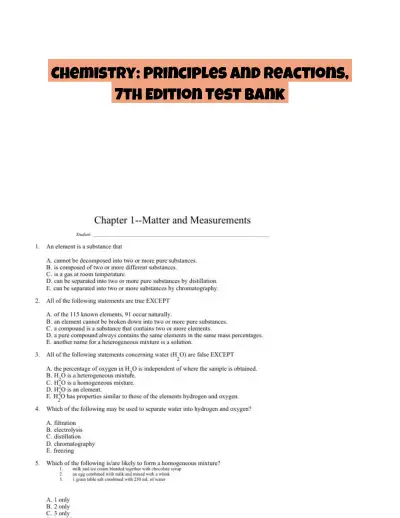 Exam Guides
Chemistry: Principles And Reactions, 7th Edition Test Bank
Chemistry
620 pagesMay 2025 Class Notes
Lecture Notes for Laboratory Manual for Principles of General Chemistry , 10th Edition
Chemistry
225 pages151downloadsFeb 2025 Exam Guides
Test Bank For Essentials of Biology, 3rd Edition
Chemistry
639 pages151downloadsFeb 2025 Textbook Guides
Solution Manual For Introduction to Chemistry, 4th Edition
Chemistry
35 pages150downloadsFeb 2025 Textbook Guides
Solution Manual for Chemistry A Molecular Approach, 4th Edition
Chemistry
103 pages94downloadsFeb 2025 Exam Guides
Test Bank for Financial Accounting, 11th Edition
Chemistry
730 pages87downloadsFeb 2025 Exam Guides
Test Bank For Chemistry: An Introduction to General, Organic, and Biological Chemistry 13th Edition Test Bank
Chemistry
513 pages77downloadsFeb 2025 Textbook Guides
Solution Manual for Financial Accounting, 3rd Edition
Chemistry
835 pages54downloadsFeb 2025
Study this document with CramX
Once it is in your library, every tool can work from it.