
Solution Manual for Electrical Engineering: Principles and Applications, 7th Edition

Master your textbook with Solution Manual for Electrical Engineering: Principles and Applications, 7th Edition, offering detailed solutions to every question.

Seller Steve
Contributor
4.3
33
10 months ago
Preview (16 of 688 Pages)
100%
Log in to unlock

Page 1

Solution Manual for Electrical Engineering: Principles and Applications, 7th Edition - Page 1 preview image

Loading page ...

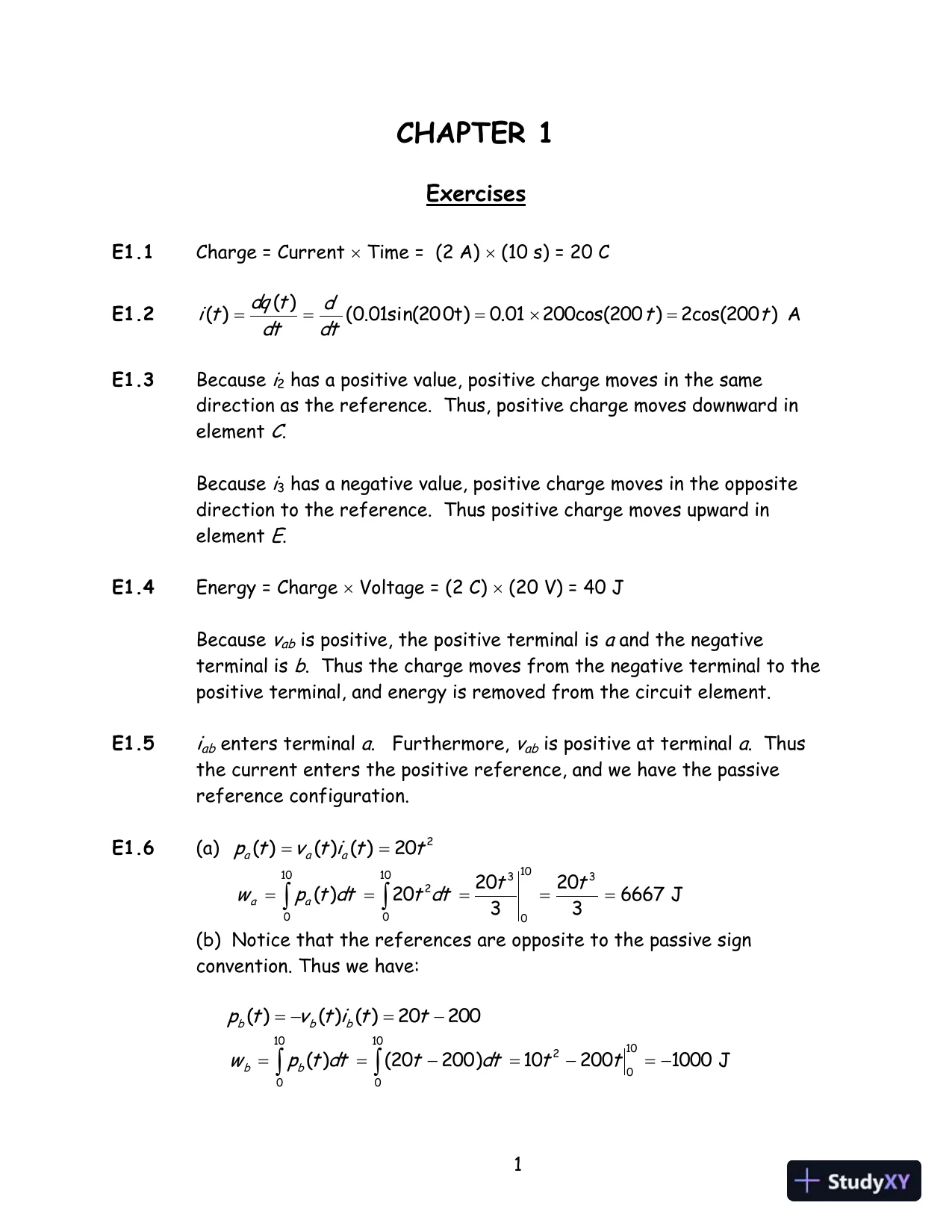
1CHAPTER 1ExercisesE1.1Charge = CurrentTime = (2 A)(10 s) = 20 CE1.2A)2cos(200)200cos(2000.010t)0.01sin(20()()(ttdtddttdqtiE1.3Becausei2has a positive value, positive charge moves in the samedirection as the reference.Thus, positive charge moves downward inelementC.Becausei3has a negative value, positive charge moves in the oppositedirection to the reference.Thus positive charge moves upward inelementE.E1.4Energy = ChargeVoltage = (2 C)(20 V) = 40 JBecausevabis positive, the positive terminal isa and the negativeterminal isb. Thus the charge moves from the negative terminal to thepositive terminal, and energy is removed from the circuit element.E1.5iabenters terminala.Furthermore,vabis positive at terminala. Thusthe current enters the positive reference, and we have the passivereference configuration.E1.6(a)220)()()(ttitvtpaaaJ666732032020)(310031001002ttdttdttpwaa(b)Notice that the references are opposite to the passive signconvention. Thus we have:20020)()()(ttitvtpbbbJ100020010)20020()(1002100100ttdttdttpwbb

Page 2

Solution Manual for Electrical Engineering: Principles and Applications, 7th Edition - Page 2 preview image

Loading page ...

Page 3

Solution Manual for Electrical Engineering: Principles and Applications, 7th Edition - Page 3 preview image

Loading page ...

2E1.7(a)Sum of currents leaving = Sum of currents enteringia= 1 + 3 = 4 A(b)2 = 1 + 3 +ibib= -2 A(c)0 = 1 +ic+ 4 + 3ic= -8 AE1.8ElementsA andB are in series. Also, elementsE,F, andG are in series.E1.9Go clockwise around the loop consisting of elementsA,B, andC:-3 - 5 +vc= 0vc= 8 VThen go clockwise around the loop composed of elementsC,D andE:-vc- (-10) +ve= 0ve= -2 VE1.10ElementsE andF are in parallel; elementsA andB are in series.E1.11The resistance of a wire is given byALRρ.Using4/2dAandsubstituting values, we have:4/)106.1(1012.16.9236LL = 17.2 mE1.12RVP2144/2PVRA833.0144/120/RVIE1.13RVP2V8.15100025.0PRVmA8.151000/8.15/RVIE1.14Using KCL at the top node of the circuit, we havei1=i2.Then, using KVLgoing clockwise, we have -v1-v2= 0; butv1= 25 V, so we havev2= -25 V.Next we havei1=i2=v2/R = -1 A. Finally, we haveW25)1()25(22ivPRandW.25)1()25(11ivPsE1.15At the top node we haveiR=is= 2A. By Ohm’s law we havevR= RiR= 80V. By KVL we havevs= vR= 80 V.Thenps= -vsis= -160 W (the minus signis due to the fact that the references forvsandisare opposite to thepassive sign configuration).Also we haveW.160RRRivP

Page 4

Solution Manual for Electrical Engineering: Principles and Applications, 7th Edition - Page 4 preview image

Loading page ...

3ProblemsP1.1Broadly, the two objectives of electrical systems are:1. To gather, store, process, transport and present information.2. To distribute, store, and convert energy between various forms.P1.2Four reasons that non-electrical engineering majors need to learn thefundamentals of EE are:1. To pass the Fundamentals of Engineering Exam.2. To be able to lead in the design of systems that containelectrical/electronic elements.3. To be able to operate and maintain systems that containelectrical/electronic functional blocks.4. To be able to communicate effectively with electrical engineers.P1.3Eight subdivisions of EE are:1. Communication systems.2. Computer systems.3. Control systems.4. Electromagnetics.5. Electronics.6. Photonics.7. Power systems.8. Signal Processing.P1.4Responses to this question are varied.P1.5(a) Electrical current is the time rate of flow of net charge through aconductor or circuit element. Its units are amperes, which are equivalentto coulombs per second.(b)The voltage between two points in a circuit is the amount of energytransferred per unit of charge moving between the points.Voltage hasunits of volts, which are equivalent to joules per coulomb.

Page 5

Solution Manual for Electrical Engineering: Principles and Applications, 7th Edition - Page 5 preview image

Loading page ...

4(c) The current through an open switch is zero.The voltage across theswitch can be any value depending on the circuit.(d) The voltage across a closed switch is zero.The current through theswitch can be any value depending of the circuit.(e) Direct current is constant in magnitude and direction with respect totime.(f) Alternating current varies either in magnitude or direction with time.P1.6(a) A conductor is anagolous to a frictionless pipe.(b) An open switch is anagolous to a closed valve.(c) A resistance is anagolous to a constriction in a pipe or to a pipe withfriction.(d) A battery is analogous to a pump.P1.718191025.6ectroncoulomb/el1060.1coulomb/s1secondperElectronsP1.8*The reference direction forabipoints froma tob.Becauseabihas anegative value, the current is equivalent to positive charge movingopposite to the reference direction.Finally since electrons have negativecharge, they are moving in the reference direction (i.e., froma tob).For a constant (dc) current, charge equals current times the timeinterval. Thus,C.15s)(3A)5(QP1.9The positive reference forv is at the head of the arrow, which isterminala. The positive reference forvbais terminalb.Thus, we haveV.12vvbaAlso,i is the current entering terminala, andibais thecurrent leaving terminala.Thus, we haveA.2baiiThus, currententers the positive reference and energy is being delivered to the device.P1.10To stop current flow, we break contact between the conducting parts ofthe switch, and we say that the switch is open. The corresponding fluid

Page 6

Solution Manual for Electrical Engineering: Principles and Applications, 7th Edition - Page 6 preview image

Loading page ...

5analogy is a valve that does not allow fluid to pass through. Thiscorresponds to a closed valve.Thus, a closed valve is analogous to anopen switch.P1.11*  A332tdtddttdqtiP1.12(a) The sine function completes one cycle for each2radian increase inthe angle. Because the angle is,200tone cycle is completed for eachtime interval of 0.01 s.The sketch is:C0318.0)200cos()200/10()200sin(10)((b)005.00005.00005.00tdttdttiQC0)200cos()200/10()200sin(10)((c)01.0001.0001.00tdttdttiQP1.13*coulombs2|22)(000ttedtedttiQP1.14A633)()(22tteedtddttdqtiP1.15The number of electrons passing through a cross section of the wire persecond issecondelectrons/10375.9106.1151919N

Page 7

Solution Manual for Electrical Engineering: Principles and Applications, 7th Edition - Page 7 preview image

Loading page ...

6The volume of copper containing this number of electrons is3102919m10375.91010375.9volumeThe cross sectional area of the wire is262m10301.34dAFinally, the average velocity of the electrons ismm/s2840.0volumeAuP1.16*The charge flowing through the battery iscoulombs10432)seconds360024()amperes5(3Qand the stored energy isjoules10184.5)12()10432(Energy63QV(a) Equating gravitational potential energy, which is mass times heighttimes the acceleration due to gravity, to the energy stored in the batteryand solving for the height, we havekm6.178.93010184.5Energy6mgh(b) Equating kinetic energy to stored energy and solving for velocity, wehavem/s9.587Energy2mv(c) The energy density of the battery isJ/kg108.1723010184.536which is about 0.384% of the energy density of gasoline.P1.17coulombs40)seconds20()amperes2(timecurrentQjoules200)10(20)(EnergyQVBecauseibais positive, if the current were carried by positive charge itwould be entering terminalb.Electrons enter terminala. The energy istaken from the element.

Page 8

Solution Manual for Electrical Engineering: Principles and Applications, 7th Edition - Page 8 preview image

Loading page ...

7P1.18joules104.149106.1gainselectronThe1919P1.19*coulombs108.1)seconds000,36()amperes5(timecurrent5Qjoules1016.2)12()101.8(Energy65QVP1.20If the current is referenced to flow into the positive reference for thevoltage, we say that we have the passive reference configuration.Usingdouble subscript notation, if the order of the subscripts are the samefor the current and voltage,we have a passive reference configuration.P1.21*(a)P-vaia= 30 WEnergy is being absorbed by the element.(b)Pvbib= 30 WEnergy is being absorbed by the element.(c)P-vDEiED= -60 WEnergy is being supplied by the element.P1.22The amount of energy isJ.30V)(10C)(3QVWBecause thereference polarity is positive at terminala and the voltage value isnegative, terminalb is actually the positive terminal.Because the chargemoves from the negative terminal to the positive terminal, energy isremoved from the device.P1.23*C50V)(12J)(600VwQ.To increase the chemical energy stored in the battery, positive chargeshould move from the positive terminal to the negative terminal, in otherwords froma tob. Electrons move fromb toa.P1.24    W20tetitvtp00joules20|20)(EnergytedttpThe element absorbs the energy.

Page 9

Solution Manual for Electrical Engineering: Principles and Applications, 7th Edition - Page 9 preview image

Loading page ...

8P1.25W)200sin(50)(a)(tivtpababJ1592.0)200cos()200/50()200sin(50)((b)005.00005.00005.00tdttdttpwπππJ0)200cos()200/50()200sin(50)((c)01.0001.0001.00tdttdttpwP1.26*kWh500$/kWh0.12$60RateCostEnergyW694.4h2430kWh500TimeEnergyPA787.51204.694VPI%64.8%1004.69460ReductionP1.27(a)P60 W delivered to element A.(b)A.elementfromtakenW60P(c)P60 W delivered to elementA.P1.28*(a).elementfromtakenW60AP(b).elementtodeliveredW60AP(c).elementfromtakenW60APP1.29The power that can be delivered by the cell isW.12.0vipIn 75hours, the energy delivered iskWhr.0.009Whr9pTWThus theunit cost of the energy is$/kWhr56.55)009.0/()50.0(Costwhich is463 times the typical cost of energy from electric utilities.

Page 10

Solution Manual for Electrical Engineering: Principles and Applications, 7th Edition - Page 10 preview image

Loading page ...

9P1.30The current supplied to the electronics isA.968.36.12/50/vpiThe ampere-hour rating of the battery is the operating time to dischargethe battery multiplied by the current.Thus, the operating time ishours.2.25/100iTThe energy delivered by the battery iskWh.1.26wh1260)2.25(50pTWNeglecting the cost ofrecharging, the cost of energy for 300 discharge cycles is$/kWh.1984.0)26.1300/(75CostP1.31A node is a point that joins two or more circuit elements.All pointsjoined by ideal conductors are electrically equivalent.Thus, there arefour nodes in the circuit at hand:P1.32The sum of the currents entering a node equals the sum of the currentsleaving.P1.33The currents in series-connected elements are equal.P1.34For a proper fluid analogy to electric circuits, the fluid must beincompressible. Otherwise the fluid flow rate out of an element could bemore or less than the inward flow. Similarly the pipes must be inelasticso the flow rate is the same at all points along each pipe.P1.35*ElementsA andB are in series. Also, elementsE andF are in series.

Page 11

Solution Manual for Electrical Engineering: Principles and Applications, 7th Edition - Page 11 preview image

Loading page ...

10P1.36(a)ElementsC andD are in series.(b)Because elementsC andD are in series, the currents are equal inmagnitude. However, because the reference directions are opposite, thealgebraic signs of the current values are opposite.Thus, we havedcii.(c)At the node joining elementsA,B, andC, we can write the KCLequationA413cabiii.Also we found earlier thatA.1cdiiP1.37*At the node joining elements A and B, we have.0baiiThus,A.2aiFor the node at the top end of element C, we have3cbii.Thus,A1ci.Finally, at the top right-hand corner node, we have.3deiiThus,A4di.ElementsA and B are in series.P1.38*findweKCL,ApplyingA.4andA,5A,3A,2givenareWehdbaiiiiA1abciiiA5hceiiiA3dafiiiA7hfgiiiP1.39A.1andA,5A,3A,1givenareWehgcaiiiiApplying KCL, we findA2acbiiiA4hceiiiA7afdiiiA6hgfiiiP1.40If one travels around a closed path adding the voltages for which oneenters the positive reference and subtracting the voltages for which oneenters the negative reference, the total is zero.P1.41(a) ElementsA andB are in parallel.(b) Because elementsA andB are in parallel, the voltages are equal inmagnitude. However because the reference polarities are opposite, thealgebraic signs of the voltage values are opposite.Thus, we have.bavv(c) Writing a KVL equation while going clockwise around the loopcomposed of elementsA, C andD, we obtain.0cdavvvSolving forcvand substituting values, we findV.7cvAlso we haveV.2abvv

Page 12

Solution Manual for Electrical Engineering: Principles and Applications, 7th Edition - Page 12 preview image

Loading page ...

11P1.42*Summing voltages for the lower left-hand loop, we have,0105avwhich yieldsV.5avThen for the top-most loop, we have,015acvvwhich yieldsV.10cvFinally, writing KCL around theoutside loop, we have,05bcvvwhich yieldsV.5bvP1.43We are givenV.6andV,10V,7V,5hfbavvvvApplying KVL, wefindV12badvvvV1hfacvvvvV8dcaevvvvV2hegvvvV7ecbvvvP1.44*Applying KCL and KVL, we haveA1daciiiA2abiiV6adbvvvV4dcvvThe power for each element isW20aaAivPW12bbBivPW4ccCivPW4ddDivP0Thus,DCBAPPPPP1.45(a) In Figure P1.28, elementsC,D, andE are in parallel.(b) In Figure P1.33, no element is in parallel with another element.(c) In Figure P1.34, elementsC andD are in parallel.P1.46The points and the voltages specified in the problem statement are:Applying KVL to the loopabca, substituting values and solving, we obtain:0accbabvvv0155acvV10acv

Page 13

Solution Manual for Electrical Engineering: Principles and Applications, 7th Edition - Page 13 preview image

Loading page ...

12Similiarly, applying KVL to the loopabcda, substituting values and solving,we obtain:0dacdcbabvvvv010155cdvV20cdvP1.47(a) The voltage between any two points of an ideal conductor is zeroregardless of the current flowing.(b) An ideal voltage source maintains a specified voltage across itsterminals.(c) An ideal current source maintains a specified current through itself.P1.48Four types of controlled sources and the units for their gain constantsare:1. Voltage-controlled voltage sources. V/V or unitless.2. Voltage-controlled current sources. A/V or siemens.3. Current-controlled voltage sources. V/A or ohms.4. Current-controlled current sources. A/A or unitless.P1.49Provided that the current reference points into the positive voltagereference, the voltage across a resistance equals the current throughthe resistance times the resistance. On the other hand, if the currentreference points into the negative voltage reference, the voltage equalsthe negative of the product of the current and the resistance.P1.50*

Page 14

Solution Manual for Electrical Engineering: Principles and Applications, 7th Edition - Page 14 preview image

Loading page ...

13P1.51P1.52The resistance of the copper wire is given byALRCuCu,and theresistance of the tungsten wire isALRWW.Taking the ratios of therespective sides of these equations yieldsCuWCuWRR.Solving forWRand substituting values, we haveΩ1.58)1072.1()10(5.44(0.5)88-CuWCuWRRρρP1.53P1.54P1.55*1001001002121PVRpowerinreduction19%aforW81100902222RVP

Page 15

Solution Manual for Electrical Engineering: Principles and Applications, 7th Edition - Page 15 preview image

Loading page ...

14P1.56The power delivered to the resistor is)4exp(5.2/)()(2tRtvtpand the energy delivered isJ625.045.2)4exp(45.2)4exp(5.2)(000tdttdttpwP1.57The power delivered to the resistor is)4cos(25.125.1)2(sin5.2/)()(22ttRtvtpand the energy delivered isJ5.12)4sin(425.125.1)4cos(25.125.1)(100100100ttdttdttpwP1.58Equation 1.10 gives the resistance asALRρ(a) Thus, if the length of the wire is doubled, the resistance doubles to.1(b) If the diameter of the wire is doubled, the cross sectional areaA isincreased by a factor of four. Thus, the resistance is decreased bya factor of four to 0.125.P1.59(a) The voltage across the voltage source is 10 V independent of thecurrent. Thus, we havev10 which plots as a vertical line in theviplane.(b) The current source hasi2 independent ofv, which plots as ahorizontallinein thevi plane.(c) Ohm's law givesiv/5.(d) Applying Ohm's law and KVL, we obtain105ivwhich is equivalentto22.0vi.(e) Applying KCL and Ohm's law, we obtain obtain105ivwhich isequivalent to22.0vi.

Page 16

Solution Manual for Electrical Engineering: Principles and Applications, 7th Edition - Page 16 preview image

Loading page ...

15The plots for all five parts are shown. (Parts d and e have the same plot.)P1.60*(a) Not contradictory.(b) A 2-A current source in series with a 3-A current source iscontradictory because the currents in series elements must be equal.(c) Not contradictory.(d) A 2-A current source in series with an open circuit is contradictorybecause the current through a short circuit is zero by definition andcurrents in series elements must be equal.(e) A 5-V voltage source in parallel with a short circuit is contradictorybecause the voltages across parallel elements must be equal and thevoltage across a short circuit is zero by definiton.P1.61The power for each element is 20 W. The current source delivers powerand the voltage source absorbs it.
Preview Mode

This document has 688 pages. Sign in to access the full document!