
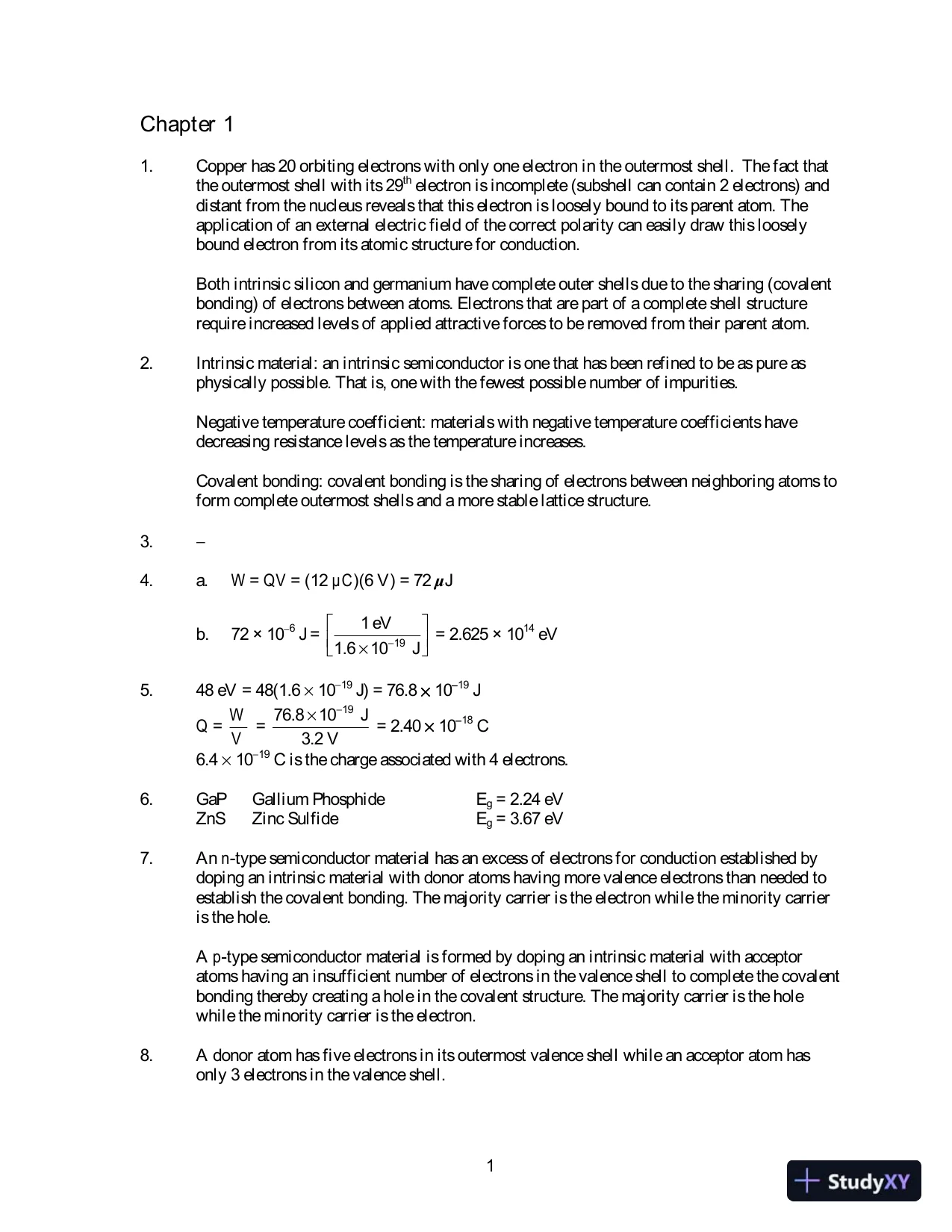
 1Chapter 11.Copper has 20 orbiting electrons with only one electron in the outermost shell. The fact thatthe outermost shell with its 29thelectron is incomplete (subshell can contain 2 electrons) anddistant from the nucleus reveals that this electron is loosely bound to its parent atom. Theapplication of an external electric field of the correct polarity can easily draw this looselybound electron from its atomic structure for conduction.Both intrinsic silicon and germanium have complete outer shells due to the sharing (covalentbonding) of electrons between atoms. Electrons that are part of a complete shell structurerequire increased levels of applied attractive forces to be removed from their parent atom.2.Intrinsic material: an intrinsic semiconductor is one that has been refined to be as pure asphysically possible. That is, one with the fewest possible number of impurities.Negative temperature coefficient: materials with negative temperature coefficients havedecreasing resistance levels as the temperature increases.Covalent bonding: covalent bonding is the sharing of electrons between neighboring atoms toform complete outermost shells and a more stable lattice structure.3.4.a.W=QV= (12μC)(6 V) =72μJb.72 × 106J =191 eV1.610J=2.625 × 10¹⁴eV5.48 eV = 48(1.61019J) =76.81019JQ=WV=1976.810J3.2 V=2.401018C6.41019C is the charge associated with 4 electrons.6.GaPGallium PhosphideEg=2.24 eVZnSZinc SulfideEg=3.67 eV7.Ann-type semiconductor material has an excess of electrons for conduction established bydoping an intrinsic material with donor atoms having more valence electrons than needed toestablish the covalent bonding. The majority carrier is the electron while the minority carrieris the hole.Ap-type semiconductor material is formed by doping an intrinsic material with acceptoratoms having an insufficient number of electrons in the valence shell to complete the covalentbonding thereby creating a hole in the covalent structure. The majority carrier is the holewhile the minority carrier is the electron.8.A donor atom has five electrons in its outermost valence shell while an acceptor atom hasonly 3 electrons in the valence shell.
Preview Mode
This document has 394 pages. Sign in to access the full document!