
Solution Manual for Electronics for Electricians, 7th Edition

Solution Manual for Electronics for Electricians, 7th Edition simplifies complex textbook exercises with easy-to-understand solutions and step-by-step guides.

Michael Davis
Contributor
4.3
41
10 months ago
Preview (16 of 58 Pages)
100%
Log in to unlock

Page 1

Solution Manual for Electronics for Electricians, 7th Edition - Page 1 preview image

Loading page ...

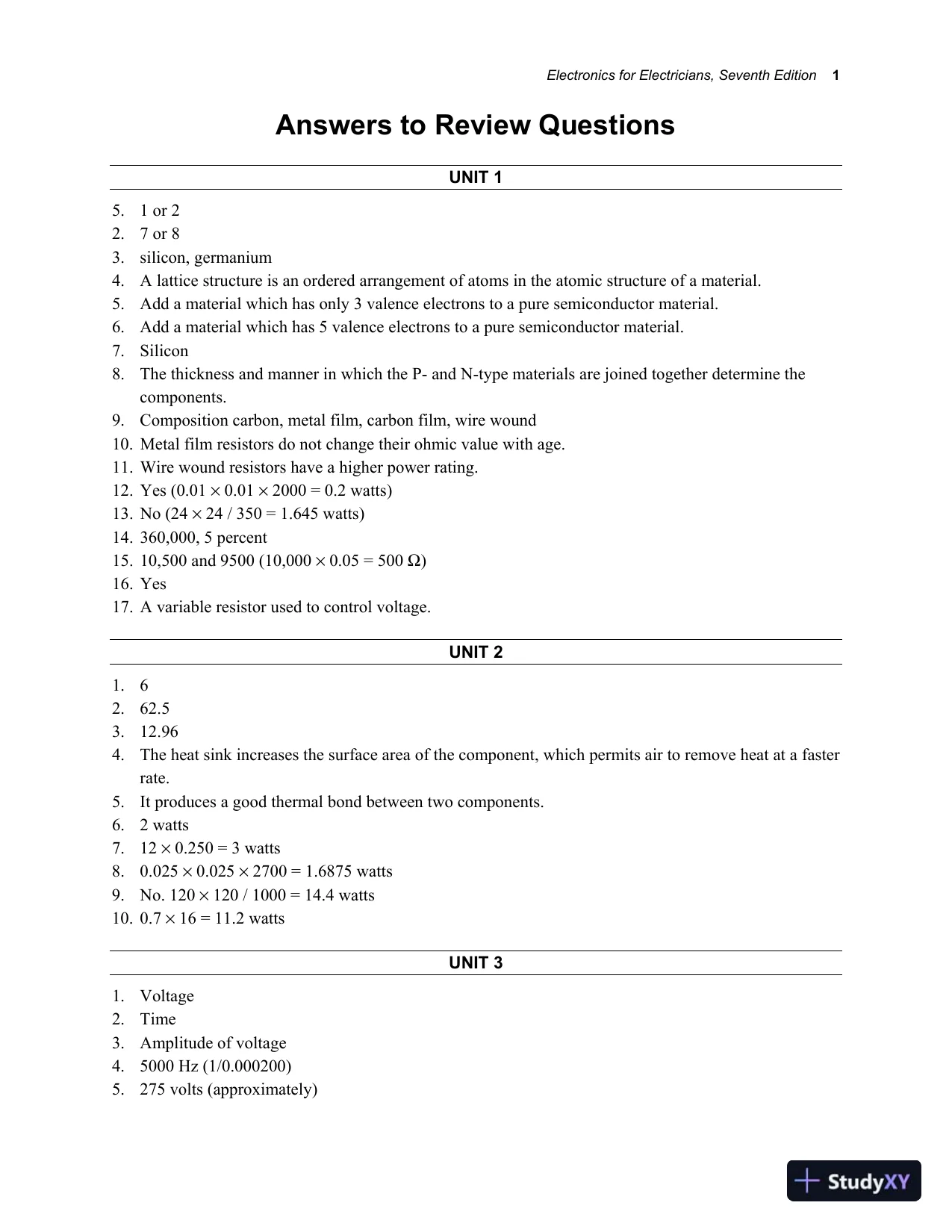
Electronics for Electricians, Seventh Edition1Answers to Review QuestionsUNIT 15.1 or 22.7 or 83.silicon, germanium4.A lattice structure is an ordered arrangement of atoms in the atomic structure of a material.5.Add a material which has only 3 valence electrons to a pure semiconductor material.6.Add a material which has 5 valence electrons to a pure semiconductor material.7.Silicon8.The thickness and manner in which the P- and N-type materials are joined together determine thecomponents.9.Composition carbon, metal film, carbon film, wire wound10.Metal film resistors do not change their ohmic value with age.11.Wire wound resistors have a higher power rating.12.Yes (0.01×0.01×2000 = 0.2 watts)13.No (24×24 / 350 = 1.645 watts)14.360,000, 5 percent15.10,500 and 9500 (10,000×0.05 = 500Ω)16.Yes17.A variable resistor used to control voltage.UNIT 21.62.62.53.12.964.The heat sink increases the surface area of the component, which permits air to remove heat at a fasterrate.5.It produces a good thermal bond between two components.6.2 watts7.12×0.250 = 3 watts8.0.025×0.025×2700 = 1.6875 watts9.No. 120×120 / 1000 = 14.4 watts10.0.7×16 = 11.2 wattsUNIT 31.Voltage2.Time3.Amplitude of voltage4.5000 Hz (1/0.000200)5.275 volts (approximately)

Page 2

Solution Manual for Electronics for Electricians, 7th Edition - Page 2 preview image

Loading page ...

Page 3

Solution Manual for Electronics for Electricians, 7th Edition - Page 3 preview image

Loading page ...

2Electronics for Electricians, Seventh Edition6.30 volts peak, 6250 Hz7.To show the position of the trace if it is off the display8.The alternate mode alternates sweeps between channel 1 and channel 2. The cop mode alternates thesweep between the two channels several times during one sweep.9.It will burn a spot on the face of the CRT.10.It permits the oscilloscope to trigger on the positive or negative half of the waveform.11. 5 MΩ(20,000×250)12.9600Ω(20,000×12 = 240,000Ω) (1/10,000 + 1/240,000 = 1/0.000104167)13.Digital ohmmeter14.2.09 mA (4.6/2200)15. Digital voltmeterUNIT 41.22.Silicon and germanium3.0.6 to 0.74.Positive5.The amount of voltage it can hold off in the reverse direction.6.The diode should show continuity through it when the positive lead of the ohmmeter is connected to theanode but not to the cathode.UNIT 51.Light-emitting diode2.DC3.1.7 volts4.Light being emitted by the device5.2000Ω6.0.45 volts7.Arrows point away from the device when the symbol represents an LED. Arrows point toward thedevice when the symbol represents a photodiode.8.The photodiode can operate at a greater speed.9.In darkness10.The light would be turned on during the daylight hours and off at night.UNIT 61.A device that changes AC voltage into DC voltage.2.The half-wave rectifier3.The two-diode type of rectifier4.The bridge rectifier5.8.1 volts (18/2 = 9, 9×0.9 = 8.1)6.The two-diode type

Page 4

Solution Manual for Electronics for Electricians, 7th Edition - Page 4 preview image

Loading page ...

Electronics for Electricians, Seventh Edition37.32.4 volts (26×0.9 = 32.4)8.The cathode endsUNIT 71.Half wave2.63.Three-phase half-wave rectifier4.243.15 volts (208×1.169 = 243.15)5.756 volts (560×1.35 = 756)UNIT 81.Single-phase half-wave rectifier2.Three-phase bridge rectifier3.A capacitor4.An inductor or choke5.Parallel with the load6.Series with the load7.It limits the current inrush when the power supply is first turned on.8.50.9 volts (36×1.414 = 50.9)9.Decrease10.Increase11.512.A transformer that has its primary and secondary windings physically and electrically separated fromeach other.13.Inductors and capacitors14.Metal-oxide varistor or MOV15.JoulesUNIT 91.A zener diode is designed to operate with current flow through it in the reverse direction and a junctiondiode is not.2.It is destroyed.3.Voltage regulator4.500Ω(7/0.014 = 500)5.Parallel6.It causes a tunneling effect of charged current carriers through the depletion zone at the diode junction.7.Reverse biased8.Because they have only two states of operation, on or off.9.Schottky diode10.By controlling the amount of reverse voltage applied to the diode.11.By separating two semiconductor regions with an intrinsic region.

Page 5

Solution Manual for Electronics for Electricians, 7th Edition - Page 5 preview image

Loading page ...

4Electronics for Electricians, Seventh Edition12.By connecting it reverse biased13.IMPATTUNIT 101.32.NPN and PNP3.Silicon can withstand more heat.4.The 2N registry5.Anodes6.The emitter lead7.The collector lead8.The amount of base–emitter current9.The amount of collector–emitter current10.PositiveUNIT 111.About 0.7 volts2.About 0.3 volts3.By supplying it with more base–emitter current than is needed to turn it completely on4.The transistor can handle more current without overheating when it has a lower voltage drop.5.It has a lower frequency response.UNIT 121.To preset or precondition2.Enough base current is permitted to flow through the transistor to turn it half on.3.The transistor must be biased to permit it to reproduce both halves of the AC waveform.4.6 volts5.25 (25/0.5 = 50)UNIT 131.By connecting the emitter of one transistor to the base of another transistor.2.Beta3.6666.67 (0.100/0.000015 = 6666.67)4.The transistor used to drive or furnish base current to the other transistor.5.300μA (1.5/5000 = 0.000300)UNIT 141.20,000 MΩ2.Junction field effect transistor3.Positive

Page 6

Solution Manual for Electronics for Electricians, 7th Edition - Page 6 preview image

Loading page ...

Electronics for Electricians, Seventh Edition54.DE-MOSFET and E-MOSFET5.MOSFET6.E-MOSFET7.JFETUNIT 151.A circuit used to produce a certain amount of current as opposed to a certain amount of voltage.2.The resistance is measured by passing a known amount of current through it and measuring the voltagedrop.3.The amount of current flow and the multiplication factor are changed.4.4–20 mA5.It eliminates the problem of wire resistance.UNIT 161.Thyristor2.Emitter, base 1, and base 23.Base 14.By the RC time constant5.Because it is produced by a discharging capacitor6.Phase shifting an SCR7.The operating voltage of the PUT can be set and the operating voltage of a UJT cannot.8.PositiveUNIT 171.42.Silicon-controlled rectifier3.Anode, cathode, and gate4.The gate current5.The amount of current flow must drop below the holding current level before the SCR will turn off.6.27.The GTO can be turned off with a negative gate pulse and the SCR cannot.8.10 to 20 timesUNIT 181.DC2.The AC waveform dropping back to 0 volt3.The SCR can be controlled as to when it will turn on and permit current to flow through it.4.90 degrees5.Earlier than 90 degrees

Page 7

Solution Manual for Electronics for Electricians, 7th Edition - Page 7 preview image

Loading page ...

6Electronics for Electricians, Seventh EditionUNIT 191.Changing the phase of one thing in reference to another2.The voltage applied to the gate and the voltage applied to the anode must be phase shifted.3.A transformer4.A capacitor5.To gain complete control of the SCRUNIT 201.For phase shifting SCRs2.To provide low voltage for the UJT3.DC4.DC5.Resistor R16.Because the pulses produced by the UJT are independent of the voltage applied to the anode of the SCRUNIT 211.Single-phase bridge rectifier2.They force the gates to share the current pulse delivered by the UJT.3.A two-diode type of full-wave rectifier4.Because both halves of the AC waveform must pass through one of the SCRs5.Half-wave DCUNIT 221.120 volts AC2.12-volt battery3.Double-pole, single-throw switch4.Used as a pilot light to indicate that the power is turned on5.Used to indicate that the alarm has been armed6.A key-locked switch7.Closed8.It is used to kill the voltage spike produced by the coil of relay K1 when the power is turned off.UNIT 231.To phase shift a triac2.AC3.Negative resistance4.It is a bidirectional device.5.It is a voltage-sensitive switch.

Page 8

Solution Manual for Electronics for Electricians, 7th Edition - Page 8 preview image

Loading page ...

Electronics for Electricians, Seventh Edition7UNIT 241.AC2.MT23.DC since the diode will permit only one-half of the triac to be fired4.Either direction5.They would be connected in parallel facing in opposite directions with their gate leads connected together.UNIT 251.Separate the gate pulses from MT1 and MT2.2.The diac3.To gain complete control of the AC waveform applied to the triac.4.The value of C1 and R25.It is used to limit current flow in the gate circuit of the triac if all the resistance should be adjusted out ofresistor R2.UNIT 261.It is connected in series with the load.2.The bridge rectifier forces the current to flow through an SCR or transistor in only one direction.3.The triac sometimes fires on one-half of the AC waveform before the other. This causes a DC voltage tobe applied to the load.4.The current flow through an inductive load is limited mostly by inductive reactance. When a DCvoltage is applied, the current flow is limited only by the amount of wire resistance.5.The transistor controls the output voltage by varying the amplitude of the waveform and not bychopping it as the SCR does.UNIT 271.A triac2.A power transistor3.The load side of the relay is optically isolated from the control side.4.Optoisolation and reed relay5.No, it connects the load to the line in the same manner as a magnetic relay.UNIT 281.A device used to convert DC into AC.2.At a lower frequency the inductive reactance of the stator winding is less. Voltage must be reduced toprevent excessive current from flowing in the stator.3.It more closely approximates a sine wave.4.Square wave5.The turns of wire on the transformer and the applied voltage

Page 9

Solution Manual for Electronics for Electricians, 7th Edition - Page 9 preview image

Loading page ...

8Electronics for Electricians, Seventh EditionUNIT 291.It must be converted to alternating current.2.A two-diode type of full-wave rectifier3.Square wave AC4.It is used to filter the DC voltage.UNIT 301.They change immediately.2.They delay changing back.3.The resistance of the coil and the capacitance of C14.Delay on de-energize5.It is used to prevent a voltage spike from being induced into the circuit by coil K1 when the power isturned off.6.It permits capacitor Ct to be charged immediately when switch S1 is closed.UNIT 311.They delay changing position.2.They return to their normal position immediately.3.The resistance of Rt and the capacitance of C14.It is used to produce a spike voltage when the UJT turns on and discharges capacitor C1.5.Switch S1 must be opened.UNIT 321.An on-delay timer turns on and stays on until it is turned off. The pulse timer turns on and then turnsitself off again after some amount of time.2.It is used to provide the pulse needed to turn on the relay.3.It adjusts the amount of time between the pulses and then turns the relay on.4.It adjusts the amount of time the relay remains turned on before it turns back off again.5.A transistor used to steal the base current from some other transistor and therefore keep it turned off.UNIT 331.Pin #12.Less than one-third of Vcc3.3 to 16 volts4.No5.It activates the discharge and keeps the timer from operating.6.The trigger is used to turn the discharge off.7.On

Page 10

Solution Manual for Electronics for Electricians, 7th Edition - Page 10 preview image

Loading page ...

Electronics for Electricians, Seventh Edition9UNIT 341.It permits the timer to retrigger when voltage applied to pin #6 drops below one-third of Vcc.2.The on time is determined by the capacitance of C1 and the combined resistance of R1 and R2.3.The off time is determined by the capacitance of C1 and the resistance of R2.4.It causes the timer to remain on longer.5.It causes the timer to remain on for a shorter period of time.6.Pin #5 does not affect the off time of the timer.UNIT 351.It is used to connect the relay coil to the line.2.It is a kickback diode used to kill any spike voltages produced by coil K1 when the power is turned off.3.It is a stealer transistor used to keep transistor Q1 turned off when pin #3 of the 555 timer is turned on.4.It is used as a latch to keep the timer turned off after relay K1 has been turned on.5.It is used as a short time delay for transistor Q1.6.The values of capacitor C1 and resistors R1 and R2UNIT 361.It is used to keep capacitor C1 from discharging through resistors R2 and R1.2.The reset pin must be connected to a voltage that is greater than two-thirds of Vcc in order for the timerto operate.3.The values of capacitor C1 and resistor R24.The values of capacitor C1 and resistors R3 and R45.It limits the amount of base current to transistor Q1.UNIT 371.A power supply which has both a positive voltage as compared to ground and a negative voltage ascompared to ground.2.A center-tapped transformer3.Aboveground3.1.Two bridge rectifiers can be used by connecting the positive output of one rectifier to the negativeoutput of the other. This connection becomes circuit ground.2.The secondaries of the two transformers can be connected series aiding. The junction of the twosecondaries becomes the center tap. A bridge rectifier is then used to provide above- andbelowground voltages.4.The positive terminalUNIT 381.It permits the op amp to have high input impedance.2.2 MΩ3.With a negative feedback loop

Page 11

Solution Manual for Electronics for Electricians, 7th Edition - Page 11 preview image

Loading page ...

10Electronics for Electricians, Seventh Edition4.It reduces the gain and makes the amplifier more stable.5.R1 + R2/R1 = 750 + 15,000/750 = 15,750/750 = 216.R2/R1 = 100,000/1200 = 83.3UNIT 391.Low2.About +2.5 volts3.It permits adjustment of the level at which the amplifier changes the state of the output voltage.4.High5.No. The 15-volt output of the op amp can never overcome the breakdown voltage of the zener diode.UNIT 401.Yes2.Noninverting input3.Voltage divider4.T = 2RC, T = 2×4700×0.0000001, T = 0.00094F = 1/T, F = 1/0.00094, F = 1063.8 Hz5.An oscillator produces positive and negative pulses which last the same length of time. A pulsegenerator’s pulses are generally not the same length of time.UNIT 411.Because of internal impedance of the power supply2.It means that the impedance changes.3.It means that the regulator is connected in series with the load.4.It means that the regulator is connected in parallel with the load.5.It must have resistance connected in series with the load and regulator.6.The gain of the circuit7.By sensing the voltage drop across a low value of resistance connected in series with the load.UNIT 421.40510(convert lights to binary number) (110010101) (changed to decimal number)(256 + 128 + 16 + 4 + 1 = 405)2.1318(89/8 = 11 with a remainder of 1) (11/8 = 1 with a remainder of 3) (1/8 = 0 with a remainder of 1)3.D3F16(Divide the binary number into groups of 4 digits.) (1101 0011 1111) (Convert the binarynumbers to equivalent hexadecimal numbers.)4.1111000102(Change the octal number to the equivalent binary number using groups of 3 binary digits.)(7 = 111, 4 = 100, 2 = 010)5.Binary (11011001012) (869/2 = 434r1) (434/2 = 217r0) (217/2 = 108r1) (108/2 = 54r0) (54/2 = 27r0)(27/2 = 13r1) (13/2 = 6r1) (6/2 = 3r0) (3/2 = 1r1) (1/2 = 0r1)Octal (15458) (869/8 = 108r5) (108/8 = 13r4) (13/8 = 1r5) (1/8 = 0r1)Hexadecimal (36516) (869/16 = 54r5) (54/16 = 3r6) (3/16 = 0r3)

Page 12

Solution Manual for Electronics for Electricians, 7th Edition - Page 12 preview image

Loading page ...

Electronics for Electricians, Seventh Edition116.50768(Convert A3E16to decimal.) (A3E16= 262210) (Convert 262210to octal.)7.F316= 24310(F = 15) (15×16 = 240) (3×1 = 3) (240 + 3 = 243)8.155110(Convert lights into binary number in groups of 3.) (101 = 5, 100 = 4, 001 = 1, 111 = 7)(Octal number is 54178.) (Convert octal number to decimal.) (7×1 = 7) (1×8 = 8) (64×4 = 256)(512×5 = 2560) (2560 + 256 + 8 + 7 = 283110)9.B0F16(Group binary numbers into groups of 4.) (1011 = B, 0000 = 0, 1111 = F)10.283110(Convert B0F to decimal.) (B = 11) (11×256 = 2816) (F = 15) (15×1 = 15)(2816 + 15 = 2831)UNIT 431.Resistor transistor logic, diode transistor logic, and transistor transistor logic2.CMOS3.All inputs must be high.4.Any high input will produce a high output.5.Any low input will produce a high output.6.All inputs must be low to produce a high output.7.A device which has only two states, high or low8.In relay logic, there is one input and multiple outputs. In gate logic, there are multiple inputs and oneoutput.9.Either, but not both, of the inputs must be high to produce a high output.10.It means to invert the output.UNIT 441.To ensure good contact when the switch operates.2.Because relay circuits are slow acting and computer circuits are fast acting.3.InvertingUNIT 451.A solar cell produces a voltage in the presence of light. A cad cell exhibits a change of resistance in thepresence or absence of light.2.0.5 volt3.About 50Ω4.It permits the cad cell to operate as a digital device.5.The cad cell was connected to the noninverting input instead of the inverting input.UNIT 461.It is used to adjust the light sensitivity of the circuit.2.It is used to produce an inverted output from that of the operational amplifier.3.It is a kick back diode used to kill the induced voltage spike produced by coil CR.4.The capacitance of capacitor C5 and the combined resistance of resistors R10 and R115.It permits the trigger of timer “A” to receive a low pulse.

Page 13

Solution Manual for Electronics for Electricians, 7th Edition - Page 13 preview image

Loading page ...

12Electronics for Electricians, Seventh EditionUNIT 471.A set of contacts connected in parallel with the start button2.The overload heater3.A feedback is connected from the output of the AND gate to the input of the OR gate.4.Because it can have an indeterminate state5.Because they have a drop in output voltage when taken low through a resistorUNIT 481.It resets to lock so that the combination must be started over.2.High3.It indicates when the output of the lock is high or low.4.It limits the amount of current flow through the LED.5.The bounceless switch circuitUNIT 491.When a constant current is passed through a pn junction, its voltage drop is proportional to temperature.2.Decrease3.Linear4.Change the connections of the inverting and noninverting inputs.5.DPDT Switch

Page 14

Solution Manual for Electronics for Electricians, 7th Edition - Page 14 preview image

Loading page ...

Electronics for Electricians, Seventh Edition13Answers to Laboratory ExercisesLABORATORY EXERCISE #1 (Unit 1)10. 37.711. 26.612. 26.615. 60 Hz17. 60 Hz19. 56.520. 4021. 4023. 60 Hz25. 75.426. 53.327. 53.329. 60 HzLABORATORY EXERCISE #2 (Unit 4)3.0.6 to 0.74.34 mA6.0.6 to 0.77.5.1 mA10. 12 volts11. 0LABORATORY EXERCISE #3 (Unit 5)2.1.7LABORATORY EXERCISE #4 (Unit 6)2.24 VAC3.(VAC×0.9/2 = VDC)24×0.9 = 21.6 and 21.6 ÷ 2 = 10.84.10.85.7.128.(VAC×0.9 = VDC) 12×0.9 = 10.89.10.8

Page 15

Solution Manual for Electronics for Electricians, 7th Edition - Page 15 preview image

Loading page ...

14Electronics for Electricians, Seventh Edition10.12.2413.21.614.21.615.LABORATORY EXERCISE #5 (Unit 7)3.1435.9.286 volts11.LABORATORY EXERCISE #6 (Unit 8)3.C1VOLTS1μF10.525μF15.0100μF16.0150μF16.2200μF16.25.C1VOLTS10μF10.550μF12.3100μF13.2500μF15.31000μF15.5LABORATORY EXERCISE #7 (Unit 9)3.E1A1A2120.030.05120.040.04120.050.03120.060.02

Page 16

Solution Manual for Electronics for Electricians, 7th Edition - Page 16 preview image

Loading page ...

Electronics for Electricians, Seventh Edition15LABORATORY EXERCISE #8 (Unit 10)1.5.BASECURRENT(A2)COLLECTORCURRENT(A1)VOLTAGEDROPIMPEDANCE0(SWITCHOPEN)020 V20μA1.4 mA18.4 V13,143Ω40μA3.2 mA16.4 V5125Ω60μA5.6 mA14V2500Ω80μA8mA11.4 V1425ΩLABORATORY EXERCISE #9 (Unit 11)3.0.2 to 0.3LABORATORY EXERCISE #10 (Unit 12)4.9.55.72 millivolts6.131.9LABORATORY EXERCISE #11 (Unit 13)3.A1 = 4.6μAA2 = 0.9 A4.195.67.A1 = 50μAA2 = 0.9A8.18,000LABORATORY EXERCISE #12 (Unit 14)2.0.073.1.54.0.95.0.66.0.25LABORATORY EXERCISE #13 (Unit 15)4.RESISTANCE100 OHMS1000 OHMS2200 OHMS3000 OHMSCURRENT1 mA1 mA1 mA1 mAVOLTS0.112.23
Preview Mode

This document has 58 pages. Sign in to access the full document!