

Solution Manual For Solid State Electronic Devices, 6th Edition
- Electrical Engineering & Electronics
- 162 pages
- Shared May 2025
Solution Manual For Solid State Electronic Devices, 6th Edition helps you navigate your textbook with ease, offering answers to every question.
Preview 16 of 162 pages
See the first 16 pages exactly as they appear in the document.
Page 1 Read page 1 as text
Chapter 1 Solutions Prob. 1.1 Which semiconductor in Table 1-1 has the largest Eg? the smallest? What is the corresponding N’ How is the column III component related to Eg? largest Eg: ZnS, 3.6 eV 1.24 A= ——=0.344 356 wm smallest Eg: InSb, 0.18 eV 124 A= —"—=6.89 ois om Al compounds E, > corresponding Ga compounds Eg > the corresponding In compounds Eg Prob. 1.2 Find packing fraction of fcc unit cell. nearest atom separation = REN =3.54A tetrahedral radius = 1.77A volume of each atom =23.14A° number of atoms per cube= 6-1 + 8-1 =4 atoms 3 packing fraction = BIKA =0.74=74% (54) + StudyXY
Page 2 Read page 2 as text
Downloaded from StudyXY.com ® + StudyXY Sd Ye. o> \ | iF ’ pr E \ 3 S Stu dy Anything This ContentHas been Posted On StudyXY.com as supplementary learning material. StudyXY does not endrose any university, college or publisher. Allmaterials posted are under the liability of the contributors. wv 8) www.studyxy.com
Page 3 Read page 3 as text
Prob. 1.3 Label planes. z z 643) | 212) « y x wy . X y Zz X y Zz 2 3 4 2 4 2 1/2 1/3 1/4 1/2 1/4 1/2 6 4 3 2 1 2 Prob. 1.4 Calculate densities of Si and GaAs. The atomic weights of Si, Ga, and As are 28.1, 69.7, and 74.9, respectively. Si: a=5.43-10" cm, 8 atoms/cell 8 atoms = 8 = 5-107 15 a (5:43-10%m) domsity S107 BIE ensity = ——& > =233-£ RT RTE ES GaAs: a=5.65-10° cm, 4 each Ga, As atoms/cell Ea. SE RT aN 2 (5.65-10%m) densi 2.22-107 15.(69.7 +74.9)-%; 533 ensity = — ew > 7J/mol _ 5338 y 6.02-10% 2; Es + StudyXY
Page 4 Read page 4 as text
Prob. 1.5 For InSb, find lattice constant, primitive cell volume, (110) atomic density. La =1.44A + 136A =2.84 a=6.47A 3 FCC unit cell has 4 lattice points .. volume of primitive cell = = =67.7A° area of (110) plane = 2a’ . 4.242.122 density of In atoms = —=—2 = 2 =3.37-10" 1; 2a a on same number of Sb atoms =3.37-10" 1; Prob. 1.6 Find density of sc unit cell. nearest atom separation =2-2.5A =5A number of atoms per cube= 8-1 =1 atom 542-5 mass of one atom = ——— mL =9.](* _£_ 6.02107 om om L 9.10% _& density = latom 9-107 gp = 0.072%; (4) ’ E Prob. 1.7 Draw <110> direction of diamond lattice. (Pr-—-1L IRs ~ =) This view is tilted slightly from (110) to show the ! ) ZA ae 2 , alignment of atoms. The open channels are \ 17 hi y hexagonal along this direction. [} WN) [ Od po XE Xp dd I) SUS oy eo: Lagi gv anise) Zins + StudyXxy
Page 5 Read page 5 as text
Prob. 1.8 Show bcc lattice as interpenetrating sc lattices. SOVat rl Voip dir gad © View direction The shaded points are one sc lattice. The open points are the interpenetrating sc lattice located a/2 behind the plane of the front shaded points. Prob. 1.9 : (a) Find number of Si atoms/cm’ on (100) surface. fee lattice with a = 5.434 1 number atoms per (100) surface=4-4 +1=2 atoms a=5.43A 5 | atoms per (100) surface area = ———— =6.78-10" 1; (5.434) (b) Find the nearest neighbor distance in InP. a 4 . 2? | NERS 2 fee lattice with a = 5.87A nearest neighbor distance = 22-288 pais + StudyXY
Page 6 Read page 6 as text
Prob. 1.10 Find NaCl density. Na”: atomic weight 23g/mol, radius 14 CI’: atomic weight 35.5g/mol, radius 1.84 unit cell with a =2.8A by hard sphere approximation . lstoms D3 4 latms.355.L Y% Na and % Cl atoms per unit cell = FE Ba +355 =4.86-107 5 6.02107 stems ; 1078 density = 486-1075 =22-L (2.8-10%cm)’ J; a The hard sphere approximation is comparable with the measured 2.172% density. Prob. 1.11 Find packing fraction, B atoms per unit volume, and A atoms per unit area. 2A oO OO Note: The atoms are the same size and touch each Eo other by the hard sphere approximation. (5) 0. O58 radii of A and B atoms are then 1A 4A Sh Oo 0 number of A atoms per unit cell =8-1 =1 aA number of B atoms per unit cell = 1 volume of atoms per unit cell = 1-4. (14) + 1-4. (14)° = &A° volume of unit cell = (4A)° = 64A° =A on acking fraction = 2—— = — =0.13=13% packing 68 24 ° B atoms volume density = te =1.56-10" 15 number of A atoms on (100) plane =4-1 =1 A atoms (100) aerial density = ~2°% _ 65.10% 1 (44) E | + studyxy
Page 7 Read page 7 as text
Prob. 1.12 A Find atoms/cell and nearest neighbor distance for sc, bce, and fec lattices. O O sc: atoms/cell =8-1 =1 at ©; C } a nearest neighbor distance =a ava 2 al! . bee: atoms/cell =8-3 +1=2 O oo O AEA 5 O e 25 nearest neighbor distance = a3 0] a 2 2 O% Oo 2 ab te ® ® z O O fee: atoms/cell =8-3 +6-1 =4 Vac Y% A a esi TOL TOL she? nearest neighbor distance = A O 2 2 a “1 5 Fl z Prob. 1.13 Draw cubes showing four {111} planes and four {110} planes. <4 Ee RT {111} pl 4 I-A . anes 7 é P Vi L77 V4 7 Ee ars <= W/L [7 LTT 727 LF 707) Ng {110} planes . ERK ps: . 77/8 weld, lf a, PON
Page 8 Read page 8 as text
Prob. 1.14 : Find fraction occupied for sc, bee, and diamond lattices. sc: atoms/cell =8-1 =1 O O nearest neighbour =a => radius = : Totes” a 4n (a) _ ma’ ] atom sphere volume = =) =— O O YT a unit cell volume = a’ ©, ©) LE fraction occupied = — = =0.52 0 0 bec: atoms/cell =8-§ +1=2 a-% a O O nearest neighbour = el > radius = Sl Mo] O . 3.2% 9 ) atom sphere volume = hud a3 = wie @, ©, 3 4 16 % a 3 2 unit cell volume = a’ : Bb 72 eli > . 2 . 52 fraction occupied = ——10 = zh =0.68 22 a diamond: atoms/cell = 4 (fcc) + 4 (offset foc) = 8 4 /] lattice, . . al2 nearest neighbour = a3 -> atom radius = a3 O ‘ =o] . ’ . a3 7 O atom sphere volume = w= = LEE / | JV O a unit cell volume = a* a oN n3a® 4 _ 0 g. rN __ SN . 128 7-3 fraction occupied = ——=&— = —— =0.34 EN a 16 rv ) _ —
Page 9 Read page 9 as text
Prob. 1.15 Calculate densities of Ge and InP. The atomic weights of Ge, In, and P are 72.6, 114.8, and 31, respectively. Ge: a=5.66-10" cm, 8 atoms/cell 8 aloms = SE Ba =4.41-10 15 a (5.6610 cm) Lo 441-10” 15. 72.65%; _ . density = TIL =532% GaAs: 2a=5.87-10" cm, 4 each In, P atoms/cell Ao 4 jesi0ty 2 (5.87-10%m) 1.98-10% 1; (114.8+31)%; density = ———= —————~"= =4.79-£, 6.02-10% 1; em Prob. 1.16 Sketch diamond lattice showing four atoms of interpenetrating fcc in unit cell.. S S $ $ a OO OO S > 4 S (25) & () Lule Lg) JENS EN dg TOR SON ox all ol il N 5 ) —— S N ig LIPS 4 S (I 0. EN O OW —_ ad OL S S $ $5 $$ S$” (CHE (HY (CH O Full interpenetrating Lattice Four Interpenetrating Atoms in Unit Cell + Studyxy
Page 10 Read page 10 as text
Prob. 1.17 Find AlSb,As. to lattice match InP and give band gap. Lattice constants of A1Sb, AlAs, and InP are 6.14A, 5.66A, and 5.874, respectively from Appendix III. Using Vegard’s Law, 6.14A x + 5.66A-(1-x)=5.87A —» x=0.44 AlSbo.44As 56 lattice matches InP and has E;~1.9eV from Figure 1-13. Find InyGay.. P to lattice match GaAs and give band gap. Lattice constant of InP, GaP, and GaAs are 5.87A, 5.454, and 5.654, respectively from Appendix III. Using Vegard’s Law, 5.87A x +5.45A-(1-x) = 5.654 —> x=048 Ino 43Gay 52P lattice matches GaAs and has E;=2.0eV from Figure 1-13. Prob. 1.18 Find weight of As (k;=0.3) added to 1kg Si in Czochralski growth for 10” em doping. atomic weight of As = 74.9%; 1 0 1. C,=k,-C, =10"1; —» C = —= =333.10" 1; om 03 ES assume As may be neglected for overall melt weight and volume 1000g 1 =429.2cm’® Si 2.33% 3.33-10° ZL + 429.2cm’ = 1.43-10'*As atoms 10" . & 143:107atoms - 74955 _ | g 104g As=18-107kg As 6.02-10% some I~ StudyXY
Page 11 Read page 11 as text
Chapter 2 Solutions Prob. 2.1 (a&b) Sketch a vacuum tube device. Graph photocurrent I versus retarding voltage V. “for several light intensities. | hv | light [] intensity Fa Vo v Note that V, remains same for all intensities. (¢) Find retarding potential. A=2440A=0.244pm D=4.09¢V V, =hy-@=120VoHm gy 124eVepm oo 5 08eV - 4.096V ~ 16V- Aum) 0.244pm Prob. 2.2 . Show third Bohr postulate equates to integer number of DeBroglie waves fitting within © circumference of a Bohr circular orbit. 222 2 2 ALN RIL GI A P—. mq’ 4me,r T _ Amen’ nh’ 4ner’ or, _ oR BET mi? of wm? me? aa q mr,’ q mr,” mv’ mv’, m*v2r,? =n? mvt, =nh p, =nh isthe third Bohr postulate + StudyXY B : SE — S—
Page 12 Read page 12 as text
Prob. 2.3 (a) Find generic equation for Lyman, Balmer, and Paschen series. 4 4 ap= foo i - — 222 A 32n’e’n’R’ 32n’e’n,’h he — mq*(n,’- n’) - mq‘ (n,’- n’) Lr 32’n’n’mn’ 8e.’n’n,’h? a= 8e,’n’n,’h’ he _ 8s 'Kc n/n; mg'@,’-n’) mq* nn’ a= 8(8.85-10™ £)*. (6.63-107Js)* 2.998-10° = n/n)’ 9.11-10%'kg - (1.60-10°C)* n,’-n? 2.2 2.2 A=91110°m- 282 —g 14. n,"-ny n, -n; n,=1 for Lyman, 2 for Balmer, and 3 for Paschen (b) Plot wavelength versus n for Lyman, Balmer, and Paschen series. — LyMANSERES [ PASCHENSERES | [oT oo T n2q | ned) [etme] [nT 2 T no [ n"2(n%29) pironan2s) [2 | a T 3 T7415 | [3 To T78 113 | 025 | [6 1 26 1 16 | "1406 | 2811 | [4 116 1 6 [107 | oz | [6 1 38 1 27 T1200 | 10932 | [5 1 2 1 24 | 104 | 040 | 7 1 #1 40 | 410s | does | LYMANLIMIT 911A I 5 [0 J 70 | 1 | oss | o010 | [nT 0% T n24 [ anrain2a) [e114 n med) PASCHEN LIMIT ~~ 8199A 8 Te 15 T 720 | 6560 | HE 2 =x TT we 6 16 | a [as | 100] [7 1 40 1 45 1 23 | oes | BALMERLIMIT ~~ 3644A Prob. 2.4 m-q* Show equation 2-17 corresponds to equation 2-3. That is show c¢-R = TER From 2-17 and solution to 2.3, 2.998-10° = 1 vy = 5 _29%10: =a 1] 9.11-10°m. Je mm n,n, From 2-3, vy mek | 5-1 | =2.008.10 m.1.097.107 3 L-L|= 320-1058 LL n,n, no,” mn, n,n, — StudyXY
Page 13 Read page 13 as text
Prob. 2.5 (a) Find Apx for Ax=IA. h h 6.63-10™J 5 Ap, -Ax=— > Ap, = ——=""—_"~ =503.107 kn PT TT Ax 4mi0'm : (b) Find At for AE=1eV. 15 AE-At= a > At= _h_414107eV:s =3.30-10"% 4r 4m-AE 4n-leV Prob. 2.6 Find wavelength of 100eV and 12keV electrons. Comment on electron microscopes compared to visible light microscopes. E=imv’ > v= ZEB m \-34 r= hh ___h _ _663107T's po =E7.491.10"F .m p mv V2.Em 2.91110%kg For 100eV, A=E*.491.10"J .m = (100eV-1.602-10™ 2) -4.91-10"F :m = 1.23-10™m = 1.234 For 12keV, A=E*.491-107F m= (1.2-10%V-1.602-10%° 2) 4.91.10) :m=1.12-10"'m = 0.1124 The resolution on a visible microscope is dependent on the wavelength of the light which is around 50004; so, the much smaller electron wavelengths provide much better resolution. Prob. 2.7 Show that 7 is the average lifetime in exponential radioactive decay. The probability of finding an atom in the stable state at time tis N(t)=N, -¢™. This is analogous to the probability of finding a particle at position x for finding the average. feta, OE ——CE feat ’ 0 This may also be found by mimicking the diffusion length calculation (Equations 4-37 to 4-39). — StudyXY a EE SE oo
Page 14 Read page 14 as text
Prob. 2.8 Find the probability of finding an electron at x<0. Is the probability of finding an electron at x>0 zero-or non-zero? Is the classical probability of finding an electron at x>6 zero or non? The energy barrier at x=0 is infinite; so, there is zero probability of finding an electron at x<0 (|¢|’=0). However, it is possible for electrons to tunnel through the barrier at 5<x<6; s0, the probability of finding an electron at x>6 would be quantum mechanically greater than zero (|y|*>0) and classical mechanically zero. - | v=10v H Pa By SH | ™ Bi o.... 050 £3 LJ x (nm, Prob. 2.9 Find 4-p’+2-p; +E Sor P(x, y,z,t) = A-e/ OF m » 2 : fa Lg i0x3y-40 (22) A. l10x3y-40 4, j ox (0.2) = _ J 100-7 fl Al £TU0RBY-40 J(10xs3 v4) g © ’ 2 | A". gr i0x3y-4y ( h a ) A. el10x3y49 3, j oz (0.2) _ = _ J -0 fl Af er i10x3y-49, 1 i(10%13 3-4) dz Tar Lg I0xI3y-49 (22 Jacorerorna j or (By== VIF) uy , fl Aff TIX YA A034) 3 4opre2.pp+E = 400%" PE — m 9.11-107'kg — StudyXY . _— SE _
Page 15 Read page 15 as text
Prob. 2.10 Find the uncertainty in position (Ax) and momentum (Ap). L W(x,t) = Eom IX) eh ang fe “Wdx =1 AL L J K 2% TX (x) = [#" x wax = £ [x-sin? (5 )os = 0.5L (from problem note) 0 L 0 L RU 2%, (wx 2 (x ) = [§3 -x-Wdx = = fx -sin®| — |dx = 0.28" (from problem note) [4] L 0 L Ax=[(x®) - (x) =Jo.28% (0.5L? =0.17L Ap > tom 4m- Ax L Prob. 2.11 Calculate the first three energy levels for a 1 od quantum well with infinite walls. 2,2 32 10342 I 2 SS (2253 Ua SR Te 2:m-L 8-9.11-10™- (107) E, =6.03-10%T = 0.377eV E, =4-0.377eV = 1.508eV E; =9-0.377¢V =3.393eV Prob. 2.12 Show schematic of atom with 1s’ 25° 2p" and atomic weight 21. Comment on its reactivity. nucleus with . . . 8 protons and This atom is chemically reactive because 13 neutrons the outer 2p shell is not full. It will tend \ 2 electrons in 1s to try to add two electrons to that outer wm, i . shell. ’ ix 2 electrons in 2s Tk hd 4 electrons in 2p & = proton ’ @ = neturon . e = electron I~ StudyXY
Page 16 Read page 16 as text
Chapter 3 Solutions Prob. 3.1 Calculate the approximate donor binding energy for Gads (€,=13.2, m* = 0.067m,). From Equation 3-8 and Appendix II, at . . 31, . . "194 E=—wd 4 >= _0.067:0.11: 107 ke)-(1.6- 107°C)" O11 10 ke) 1.6.10 © > =8.34:107T = 52 meV 8:(c,€,)*h’ 8-(8.85-10™ E .13.2)%.(6.63-10™]s) Prob. 3.2 Plot Fermi function for Er=1eV and show the probability of an occupied state AE above Er is equal to the probability of an empty state AE below Epso f(E, +AE) =1-f(E,-AE). use f(E)= — and kT=0.025%eV 1+e st E(eV] E-Er)/kT f(E 1 0.75 -9.6525 0.99994 0s 0.90 3.8610 | 097939 | - 0.95 -1.9305 0.87330 _ 08 0.98 0.7722 0.68399 eo 1.00 0.0000 0.50000 02 1.02 0.7722 0.31600 2 1.05 1.9305 0.12669 A on py 1.10 3.8610 0.02061 ’ wn : 1.25 9.6525 0.00006 occupation probability above E;, = f(E.+AE) = ER 1+ekT empty probability below E, = 1 - f(E,- AB) =1- — T+e -am 1 ek 1 1 L-fBAR)=1- — 5 = ——5 = 5 — = —3 = {E+E : T+e XT 14eX M4] I+4eiT This shows that the probability of an occupied state AE above Ey is equal to the probability of an empty state AE below Eg. — StudyXY
146 more pages in the full document
Unlock it once and it stays in your library, ready to chat with or turn into flashcards.
Unlock the full documentMore Electrical Engineering & Electronics study materials
See all Textbook Guides
Solution Manual for Microwave Circuit Design A Practical Approach Using ADS, 1st Edition
Electrical Engineering & Electronics
121 pages154downloadsFeb 2025 Exam Guides
Power System Analysis And Design, 6th Edition Test Bank
Electrical Engineering & Electronics
40 pages132downloadsFeb 2025 Textbook Guides
Solution Manual For Electronics Fundamentals: A Systems Approach, 1st Edition
Electrical Engineering & Electronics
278 pages93downloadsFeb 2025 Textbook Guides
Electronic Commerce, 12th Edition Solution Manual
Electrical Engineering & Electronics
134 pagesMay 2025 Textbook Guides
Solution Manual for Signals and Systems using MATLAB , 3rd Edition
Electrical Engineering & Electronics
538 pagesMay 2025 Document
HW4_Solution
Electrical Engineering & Electronics
17 pagesFeb 2026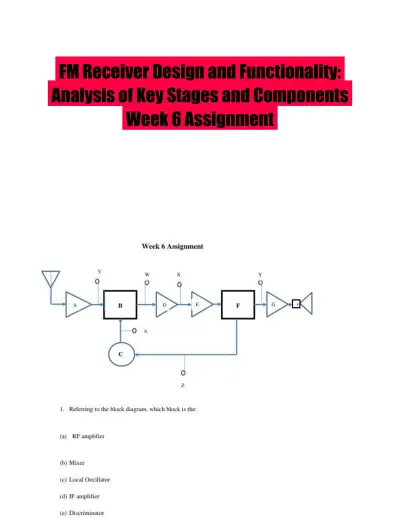 Solved Assignments
FM Receiver Design and Functionality: Analysis of Key Stages and Components Week 6 Assignment
Electrical Engineering & Electronics
5 pagesMay 2025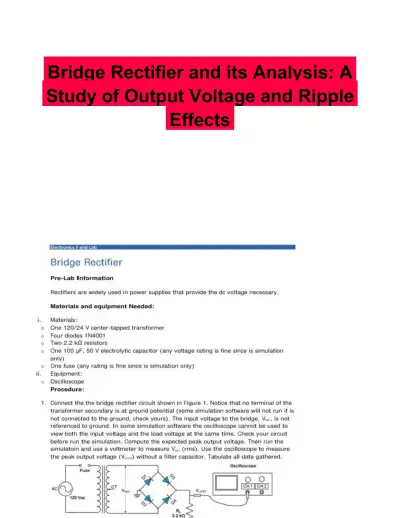 Solved Assignments
Bridge Rectifier and its Analysis: A Study of Output Voltage and Ripple Effects
Electrical Engineering & Electronics
3 pagesMay 2025
Study this document with CramX
Once it is in your library, every tool can work from it.