

Differential Equations - Power Series
- Mathematics
- Texas A&M University
- 18 pages
- Shared March 2026
Preview 6 of 18 pages
See the first 6 pages exactly as they appear in the document.
Page 1 Read page 1 as text
Study Guide Differential Equations – Power Series 1. Solutions of Differential Equations In this section, we learn how power series can be used to solve differential equations. This method is especially useful when standard techniques don’t work or when solutions cannot be written using familiar elementary functions. We’ll start with first - order equations , then move on to second - order equations , using several examples along the way. 1.1 Power Series Solutions for First - Order Equations A key fact from calculus is that power series can be differentiated term by term within their interval of convergence. Because of this, we can try solving a differential equation by assuming the solution has the form The idea is simple: 1. Assume a power series solution. 2. Differentiate the series as needed. 3. Substitute into the differential equation. 4. Match coefficients to find a recurrence relation for the coefficients ( c n ) . Example 1: Solving ( y' - xy = 0 ) Step 1: Assume a power series solution Differentiate:
Page 2 Read page 2 as text
Study Guide Step 2: Substitute into the equation Substituting into ( y' - xy = 0 ) gives: Write out the first few terms and combine like powers of ( x ) . This leads to an equation where each coefficient must equal zero . Step 3: Find the recurrence relation From the pattern, we obtain: • ( c 1 = 0 ) • For ( n ≥ 2 ) : This recurrence relation determines all coefficients from ( c 0 ) . Step 4: Write the solution All coefficients with odd indices are zero. The solution becomes: This series can be written compactly as: Step 5: Recognize the function This power series is the expansion of . So the solution is: This confirms that the power series method agrees with the exact solution.
Page 3 Read page 3 as text
Study Guide Example 2: Solving an Initial Value Problem ] Step 1: Assume a power series Substitute into the equation and combine like terms. Step 2: Match coefficients This produces the relations: • ( c 1 = c 0 ) • ( c 2 = (1/2)(1 + c 0 ) ) • For ( n ≥ 3 ) : Step 3: Apply the initial condition Using ( y(0) = 1 ) , we get: Substituting back gives the solution: Step 4: Express in closed form (optional) This series simplifies to: You can verify that this function satisfies both the differential equation and the initial condition.
Page 4 Read page 4 as text
Study Guide 1.2 Moving to Second - Order Equations Power series methods also work for second - order linear differential equations , but the process is more involved. Any homogeneous second - order linear equation can be written as: 1.3 Ordinary Points vs. Singular Points Let ( x 0 ) be a point of interest. • If both ( p(x) ) and ( q(x) ) are analytic at ( x 0 ) , then ( x 0 ) is called an ordinary point . • If either function is not analytic at ( x 0 ) , then ( x 0 ) is a singular point . Because the power series method is much simpler at ordinary points, we focus on those. Example 3: A Second - Order IVP Step 1: Assume a power series Substitute ( y ) , ( y' ) , and ( y'' ) into the equation. Step 2: Re - index and combine series To combine terms, all series must involve the same power of ( x ) . This requires re - indexing some sums. Once combined, the equation becomes a single power series equal to zero.
Page 5 Read page 5 as text
Study Guide Step 3: Set coefficients equal to zero This produces: • A condition relating ( c 2 ) and ( c 0 ) • A recurrence relation for ( c (n+2) ) in terms of ( c n ) Step 4: Apply initial conditions From: • ( y(0) = 2 = c 0 = 2 ) • ( y'(0) = 3 = c 1 = 3 ) All remaining coefficients follow from the recurrence relation. The final solution is: Example 4: Power Series Solution of In this example, we’ll find a power series solution centered at ( x = 0 ) . The process is longer than earlier examples, but the steps are the same — just more algebra. Step 1: Assume a power series solution As usual, we start by assuming the solution has the form From this, we compute the derivatives:
Page 6 Read page 6 as text
Study Guide Step 2: Substitute into the differential equation Substitute ( y ) , ( y' ) , and ( y'' ) into After substitution, the equation becomes a sum of several power series involving different powers of ( x ) . At this stage, the expression looks complicated — but that’s normal. Step 3: Rewrite everything in terms of powers of ( x n ) To combine all terms into one single summation , every series must involve the same power of ( x ) . This requires re - indexing some of the sums so that each one is written in terms of ( x n ) . Once this is done, all terms can be combined into a single power series. Step 4: Combine into a single series After re - indexing and simplifying, the equation takes the form: Step 5: Set coefficients equal to zero For this equation to hold for all values of ( x ) , every coefficient must be zero. This gives: • ( c 1 + 2c 2 = 0 ) • ( 2c 2 + 6c 3 = 0 ) and for ( n ≥ 2 ) , the recurrence relation:
12 more pages in the full document
Unlock it once and it stays in your library, ready to chat with or turn into flashcards.
Unlock the full documentMore Mathematics study materials
See all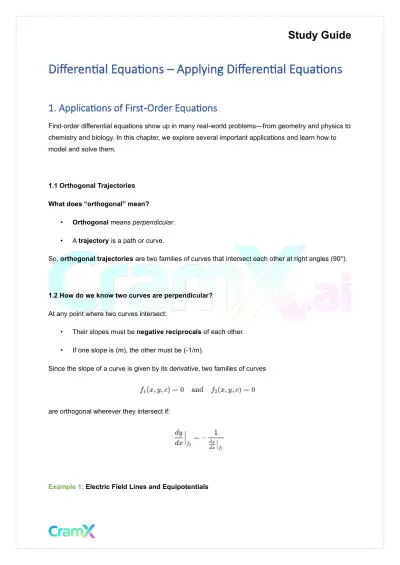 Quick Guides
Differential Equations - Applying Differential Equations
Mathematics
35 pagesMar 2026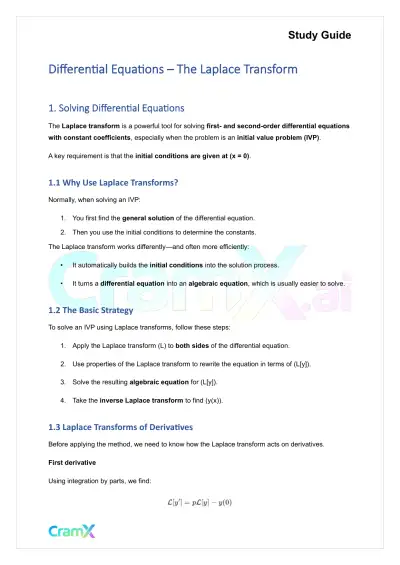 Quick Guides
Differential Equations - The Laplace Transform
Mathematics
27 pagesMar 2026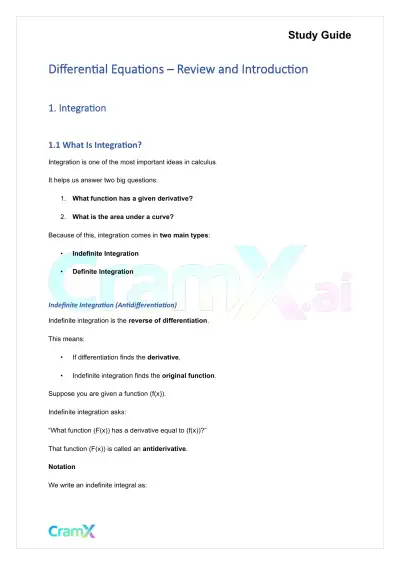 Quick Guides
Differential Equations - Review and Introduction
Mathematics
35 pagesMar 2026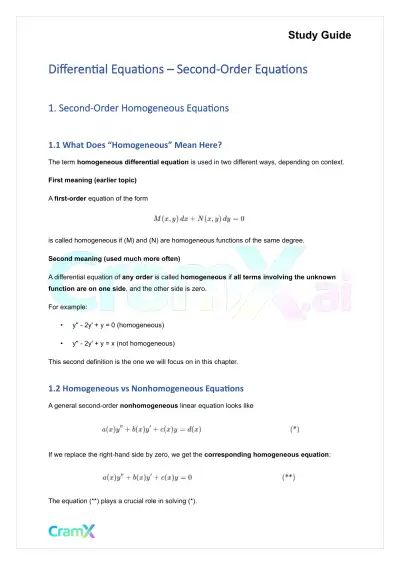 Quick Guides
Differential Equations - Second-Order Equations
Mathematics
45 pagesMar 2026 Quick Guides
Differential Equations - First-Order Equations
Mathematics
38 pagesMar 2026 Exam Guides
Test Bank for Precalculus, 6th Edition
Mathematics
1051 pages175downloadsFeb 2025 Textbook Guides
Solution Manual For Introduction To Management Science, 11th Edition
Mathematics
437 pages167downloadsFeb 2025 Textbook Guides
Solution Manual For Derivatives Markets, 3rd Edition
Mathematics
358 pages143downloadsFeb 2025
Study this document with CramX
Once it is in your library, every tool can work from it.