

Differential Equations - Review and Introduction
- Mathematics
- Texas A&M University
- 35 pages
- Shared March 2026
Preview 10 of 35 pages
See the first 10 pages exactly as they appear in the document.
Page 1 Read page 1 as text
Study Guide Differential Equations – Review and Introduction 1. Integration 1.1 What Is Integration? Integration is one of the most important ideas in calculus. It helps us answer two big questions: 1. What function has a given derivative? 2. What is the area under a curve? Because of this, integration comes in two main types : • Indefinite Integration • Definite Integration Indefinite Integration (Antidifferentiation) Indefinite integration is the reverse of differentiation . This means: • If differentiation finds the derivative , • Indefinite integration finds the original function . Suppose you are given a function ( f(x) ) . Indefinite integration asks: “What function ( F(x) ) has a derivative equal to ( f(x) ) ?” That function ( F(x) ) is called an antiderivative . Notation We write an indefinite integral as:
Page 2 Read page 2 as text
Study Guide • The integral sign ( ∫ ) means integrate • ( f(x) ) is the function being integrated • ( dx ) shows that ( x ) is the variable of integration Since many functions can have the same derivative, we always add a constant of integration , written as + C . Definite Integration (Area Under a Curve) Definite integration has a geometric meaning . It is used to calculate the area between: • The curve ( y = f(x) ) • The x - axis • Two vertical lines ( x = a ) and ( x = b ) In simple words, it tells us how much area lies under the curve between two points. Notation • ( a ) is the lower limit • ( b ) is the upper limit • The result is a number , not a function
Page 3 Read page 3 as text
Study Guide Figure 1 1.2 How Indefinite and Definite Integrals Are Connected At first glance, these two types of integration seem very different: • Indefinite integration gives a family of functions • Definite integration gives a single numerical value So why are they both called “integration”? The connection comes from one of the most important results in calculus. 1.3 The Fundamental Theorem of Calculus The Fundamental Theorem of Calculus (FTC) explains the deep link between: • Differentiation • Integration It has two parts . 1.4 Fundamental Theorem of Calculus – Part I If a function ( f(t) ) is continuous, then:
Page 4 Read page 4 as text
Study Guide 1.5 Fundamental Theorem of Calculus – Part II If ( f(x) ) is continuous and has an antiderivative ( F(x) ) , then: This shows that area under a curve can be found using antiderivatives . Example: Indefinite Integration Evaluate Solution We integrate each term separately: Final Answer Here, C is the constant of integration. 1.6 Common Differentiation and Integration Formulas To solve integrals efficiently, it’s important to remember standard formulas. These formulas show: • A function • Its derivative • Its corresponding integral
Page 5 Read page 5 as text
Study Guide They include: • Powers • Exponential functions • Logarithmic functions • Trigonometric functions • Inverse trigonometric functions This table is best placed at the end so students can: • Refer to it while solving problems • Use it as a quick revision sheet
Page 6 Read page 6 as text
Study Guide Summary • Indefinite integrals find antiderivatives • Definite integrals calculate area • The Fundamental Theorem of Calculus connects both ideas • Integration is a powerful tool used throughout mathematics, physics, and engineering 2. Techniques of Indefinite Integration When basic integration formulas are not enough, we use special techniques to evaluate integrals. In this chapter, we focus on two important methods: 1. Integration by Substitution 2. Integration by Parts Let’s learn them one at a time with clear examples. 2.1 Integration by Substitution Integration by substitution is the most commonly used technique . It is especially helpful when the integrand contains a complicated expression . Main Idea • Replace a complicated part of the integrand with a single variable , usually ( u ) . • If the differential ( du ) also appears (or can be made to appear), the integral becomes easy. If after substitution the integral simplifies nicely, your choice of ( u ) is correct. Example 1: Evaluate
Page 7 Read page 7 as text
Study Guide Step 1: Choose a substitution Let Step 2: Differentiate Step 3: Rewrite the integral Step 4: Integrate Example 2: Integrate Let Then: Substitute back:
Page 8 Read page 8 as text
Study Guide Example 3: Evaluate Rewrite: Let Then: Example 4: Evaluate Let Then: Example 5: Determine Let
Page 9 Read page 9 as text
Study Guide Then: 2.2 Integration by Parts Sometimes substitution does not simplify the integral. This happens when the integrand is a product of two functions . For such cases, we use integration by parts . Formula for Integration by Parts From the product rule: Integrating both sides: Example 6: Integrate Here, substitution does not help, so we use integration by parts. Choose:
Page 10 Read page 10 as text
Study Guide Apply the formula: Example 7: Integrate Let: Then: Example 8: Evaluate Let: Then:
25 more pages in the full document
Unlock it once and it stays in your library, ready to chat with or turn into flashcards.
Unlock the full documentMore Mathematics study materials
See all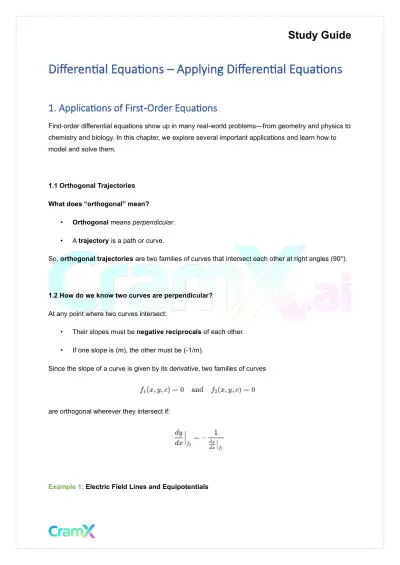 Quick Guides
Differential Equations - Applying Differential Equations
Mathematics
35 pagesMar 2026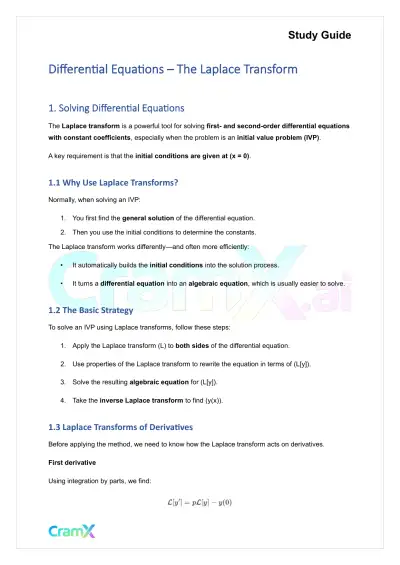 Quick Guides
Differential Equations - The Laplace Transform
Mathematics
27 pagesMar 2026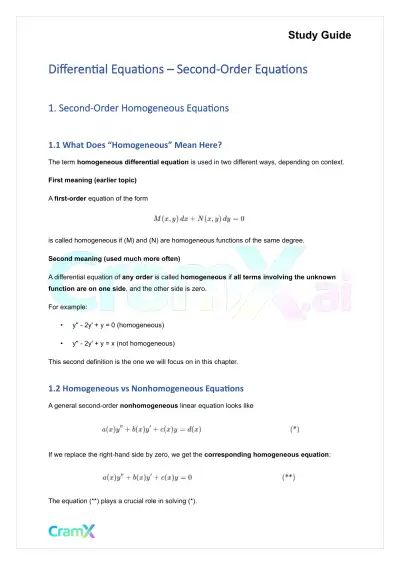 Quick Guides
Differential Equations - Second-Order Equations
Mathematics
45 pagesMar 2026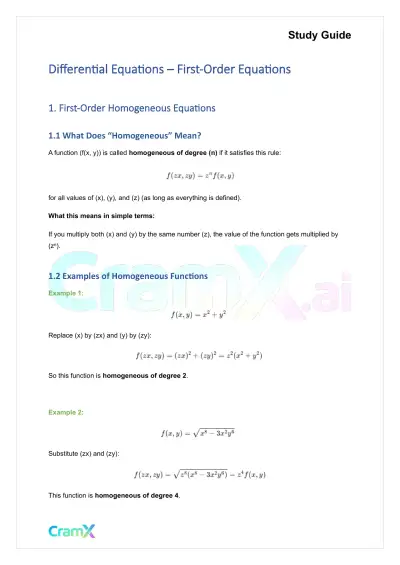 Quick Guides
Differential Equations - First-Order Equations
Mathematics
38 pagesMar 2026 Quick Guides
Differential Equations - Power Series
Mathematics
18 pagesMar 2026 Exam Guides
Test Bank for Precalculus, 6th Edition
Mathematics
1051 pages175downloadsFeb 2025 Textbook Guides
Solution Manual For Introduction To Management Science, 11th Edition
Mathematics
437 pages167downloadsFeb 2025 Textbook Guides
Solution Manual For Derivatives Markets, 3rd Edition
Mathematics
358 pages143downloadsFeb 2025
Study this document with CramX
Once it is in your library, every tool can work from it.