

Geometry - Polygons
- Mathematics
- Texas A&M University
- 34 pages
- Shared March 2026
Preview 10 of 34 pages
See the first 10 pages exactly as they appear in the document.
Page 1 Read page 1 as text
Study Guide Geometry – Polygons 1. Angle Sum of Polygons 1.1 Breaking Polygons into Triangles Figure 1 When you have a polygon with four or more sides , there’s a helpful trick you can use: Draw all possible diagonals from one vertex . When you do this, the polygon is divided into several non - overlapping triangles . This process is called triangulation . Why is this useful? Because we already know something important: The interior angles of a triangle always add up to 180° . So if we know how many triangles are formed, we can find the total interior angle sum of the polygon. 1.2 How Many Triangles Are Formed? If a polygon has n sides , drawing diagonals from one vertex will divide it into: Notice: The number of triangles is always two less than the number of sides .
Page 2 Read page 2 as text
Study Guide Theorem 39: Interior Angle Sum Formula If a convex polygon has n sides , then its interior angle sum is: This formula works for any convex polygon . Example: A 7 - Sided Polygon A 7 - sided polygon is divided into: So the interior angle sum is: 1.3 Exterior Angles of a Polygon Now let’s talk about exterior angles . Figure 2 The (non - straight) exterior angles of a polygon. An exterior angle is formed when you extend one side of a polygon. The angle formed outside the shape (next to the interior angle) is the exterior angle. Each vertex of a polygon has one exterior angle.
Page 3 Read page 3 as text
Study Guide Theorem 40: Exterior Angle Sum If a polygon is convex , then: The sum of the exterior angles, one at each vertex, is always 360° . No matter how many sides the polygon has, the total is: Example 1: Find the Interior Angle Sum of a Decagon A decagon has 10 sides . Use the formula: Example 2: Find the Exterior Angle Sum of a Convex Nonagon A nonagon has 9 sides. But remember: The sum of the exterior angles of any convex polygon is always: So the answer is simply:
Page 4 Read page 4 as text
Study Guide Example 3: Find Each Interior Angle of a Regular Hexagon Figure 3 An interior angle of a regular hexagon. A regular polygon has: • All sides equal • All interior angles equal A hexagon has 6 sides . Method 1: Use the Interior Angle Sum Formula First find the total interior angle sum: Since it’s regular, all 6 angles are equal. Each interior angle measures:
Page 5 Read page 5 as text
Study Guide Method 2: Use Exterior Angles Because the hexagon is regular, all exterior angles are equal. We know the sum of exterior angles is: So each exterior angle is: Since an interior angle and its exterior angle form a straight line: So each interior angle is again: Key Ideas to Remember • A polygon can be divided into ( n - 2 ) triangles. • Interior angle sum formula: S = (n - 2) × 180° • The sum of exterior angles (one per vertex) is always 360° . • In a regular polygon, all angles are equal. • Interior angle + exterior angle = 180°. Summary When finding interior angle sums: 1. Count the number of sides. 2. Use ( (n - 2) × 180°). When finding each interior angle of a regular polygon: 1. Find the total interior sum. 2. Divide by the number of sides. Or: 1. Divide 360° by the number of sides to find each exterior angle. 2. Subtract from 180° to find each interior angle.
Page 6 Read page 6 as text
Study Guide 2. Special Quadrilaterals Not all quadrilaterals are the same. They may look similar, but their properties (special features) are different. Some quadrilaterals: • Have one pair of parallel sides • Have two pairs of parallel sides • Have right angles • Have special relationships between sides and angles 2.1 Trapezoid A trapezoid is a quadrilateral with exactly one pair of opposite sides parallel . Important Vocabulary • The parallel sides are called the bases . • The nonparallel sides are called the legs . • A segment joining the midpoints of the legs is called the median of the trapezoid . • A segment drawn perpendicular to the bases is called the altitude . • The length of the altitude is called the height . Figure 1 A trapezoid with its median and an altitude.
Page 7 Read page 7 as text
Study Guide Understanding the Diagram In the diagram: • AB and CD are the bases (parallel sides). • XY is an altitude (it is perpendicular to the bases). • The length of XY is the height. • MN is the median (it connects the midpoints of the legs). 2.2 Parallelogram A parallelogram is a quadrilateral with both pairs of opposite sides parallel . Each pair of parallel sides is called a pair of bases . A segment drawn perpendicular between a pair of bases is called the altitude of the parallelogram . Because a parallelogram has two pairs of parallel sides , it has two possible heights — one for each pair of bases. The symbol ▱ is often used to represent a parallelogram. Figure 2 A parallelogram with its bases and associated heights. Understanding the Diagram In ▱ ABCD: • XY is an altitude to bases AB and CD . • JK is an altitude to bases AD and BC . • The length of XY is the height when AB and CD are bases. • The length of JK is the height when AD and BC are bases.
Page 8 Read page 8 as text
Study Guide 2.3 Theorems About Parallelograms Parallelograms have many important properties. These are essential for solving geometry problems. Theorem 41 A diagonal of a parallelogram divides it into two congruent triangles . In ▱ ABCD, if diagonal BD is drawn: Figure 3 Two congruent triangles created by a diagonal of a parallelogram. Theorem 42 Opposite sides of a parallelogram are congruent. In ▱ ABCD: Theorem 43 Opposite angles of a parallelogram are congruent.
Page 9 Read page 9 as text
Study Guide Theorem 44 Consecutive (next to each other) angles of a parallelogram are supplementary. That means they add up to: So: • ∠ A and ∠ B are supplementary • ∠ B and ∠ C are supplementary • ∠ C and ∠ D are supplementary • ∠ A and ∠ D are supplementary Figure 4 A parallelogram. Theorem 45 The diagonals of a parallelogram bisect each other . That means they cut each other in half. In ▱ ABCD:
Page 10 Read page 10 as text
Study Guide Figure 5 The diagonals of a parallelogram bisect one another. Summary Trapezoid • One pair of parallel sides • Bases, legs, median, altitude, height Parallelogram • Two pairs of parallel sides • Opposite sides are equal • Opposite angles are equal • Consecutive angles are supplementary • Diagonals bisect each other • A diagonal creates two congruent triangles 3. Proving that Figures Are Parallelograms In geometry, you won’t always be told that a shape is a parallelogram. Often, you will need to prove it using certain properties. Fortunately, there are several theorems that help us test whether a quadrilateral is a parallelogram. Let’s go through them one by one.
24 more pages in the full document
Unlock it once and it stays in your library, ready to chat with or turn into flashcards.
Unlock the full documentMore Mathematics study materials
See all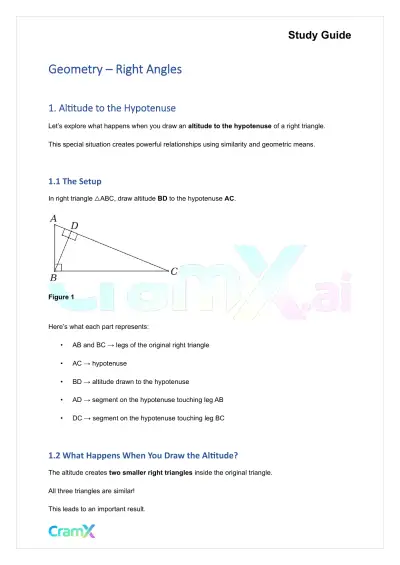 Quick Guides
Geometry - Right Angles
Mathematics
27 pagesMar 2026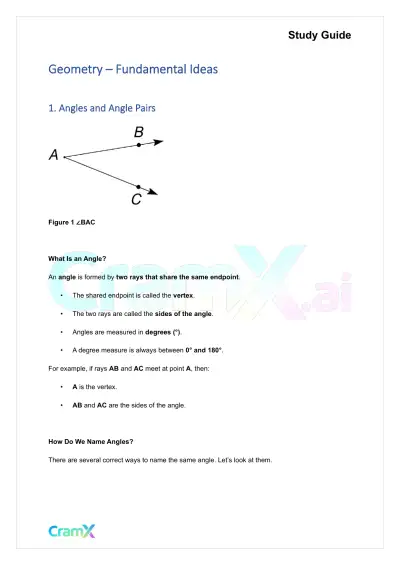 Quick Guides
Geometry - Fundamental Ideas
Mathematics
42 pagesMar 2026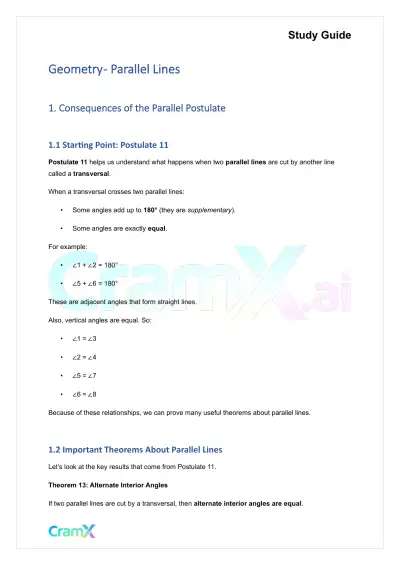 Quick Guides
Geometry - Parallel Lines
Mathematics
22 pagesMar 2026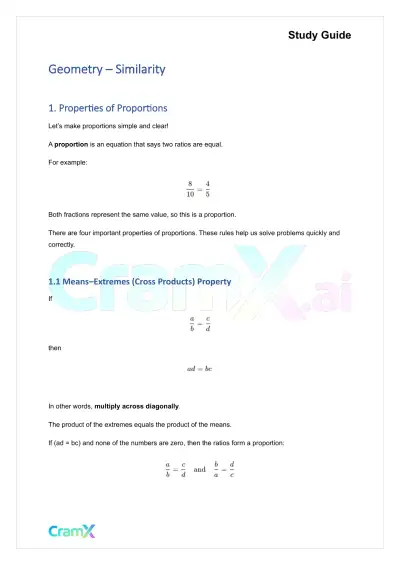 Quick Guides
Geometry - Similarity
Mathematics
36 pagesMar 2026 Quick Guides
Geometry - Triangles
Mathematics
49 pagesMar 2026 Quick Guides
Geometry - Perimeter and Area
Mathematics
32 pagesMar 2026 Quick Guides
Geometry - Circles
Mathematics
48 pagesMar 2026 Quick Guides
Geometry - Coordinate Geometry
Mathematics
29 pagesMar 2026
Study this document with CramX
Once it is in your library, every tool can work from it.