

Geometry - Similarity
- Mathematics
- Texas A&M University
- 36 pages
- Shared March 2026
Preview 10 of 36 pages
See the first 10 pages exactly as they appear in the document.
Page 1 Read page 1 as text
Study Guide Geometry – Similarity 1. Properties of Proportions Let’s make proportions simple and clear! A proportion is an equation that says two ratios are equal. For example: Both fractions represent the same value, so this is a proportion. There are four important properties of proportions. These rules help us solve problems quickly and correctly. 1.1 Means – Extremes (Cross Products) Property If then In other words, multiply across diagonally . The product of the extremes equals the product of the means. If ( ad = bc ) and none of the numbers are zero, then the ratios form a proportion:
Page 2 Read page 2 as text
Study Guide Example 1: Solve Find ( a ) if Step 1: Cross multiply. Step 2: Solve. Example 2: Solve Is ( 3:4 = 7:8 ) a proportion? If it were true, cross products would match: This is not true, so it is not a proportion. Example 3: Means – Extremes Switching Property If is a proportion, then switching the means or the extremes still gives a true proportion. For example, if
Page 3 Read page 3 as text
Study Guide then we can switch: Both new statements are still proportions. Example 4: Solve If find the ratio (x/y). Switch the means (5 and ( y ) ): So the ratio of ( x ) to ( y ) is 5 to 4 . 1.2 Upside - Down Property If then you can flip both fractions: If a proportion is true, its reciprocal is also true.
Page 4 Read page 4 as text
Study Guide Example 5: Solve If find (a/b). Step 1: Rewrite using ratios. Step 2: Flip both sides (Property 3). So, 1.4 Denominator Addition/Subtraction Property If then and This property allows you to add or subtract the numerator and denominator in a special way.
Page 5 Read page 5 as text
Study Guide Example 6: Solve If find ( 13/8 ). Since ( 13 = 5 + 8 ) , use Property 4: Example 7: Geometry Application Figure 1 Using the Segment Addition Postulate. Suppose in a figure: We want to find (AC/BC).
Page 6 Read page 6 as text
Study Guide Using the Segment Addition Postulate : Now apply Property 4: Example 8: Real - World Application A map scale says: 3 cm on the map = 5 actual miles If two cities are 10 cm apart on the map, how far apart are they in real life? Let ( x ) = actual distance. Set up the proportion: Cross multiply: Solve: So, the cities are 16⅔ miles apart .
Page 7 Read page 7 as text
Study Guide Summary Proportions are powerful tools. They help us: • Solve equations • Compare ratios • Work with geometry • Solve real - world problems like maps and scaling 2. Similar Polygons 2.1 What Are Similar Polygons? Figure 1 Similar quadrilaterals. Two polygons that have the same shape are called similar polygons . We use the symbol ~ to show similarity. For example: Notice this is different from the congruence symbol ( ≅ ). • Congruent figures are the same shape and size. • Similar figures are the same shape, but not necessarily the same size.
Page 8 Read page 8 as text
Study Guide 2.2 What Must Be True? When two polygons are similar, both of these facts must be true: 1. Corresponding angles are equal. 2. Corresponding sides are proportional. (Their ratios are equal.) Both conditions are required. If even one fails, the polygons are not similar . Example 1: Similar Quadrilaterals Figure 2 Quadrilaterals that are not similar to one another. Even though the ratios of corresponding sides are equal, corresponding angles are not equal (90° ≠ 120°, 90° ≠ 60°). Figure 3 Quadrilaterals that are not similar to one another. Suppose: This tells us something very important.
Page 9 Read page 9 as text
Study Guide • Corresponding Angles Are Equal • ∠ A = ∠ E • ∠ B = ∠ F • ∠ C = ∠ G • ∠ D = ∠ H The order of the letters matters! It tells you which angles match. • Corresponding Sides Are Proportional Each side in the first quadrilateral matches a side in the second one. 2.3 When Polygons Are NOT Similar It’s possible for one condition to be true without the other. But remember — both must be true for similarity. Case 1: Side Ratios Are Equal, but Angles Are Not Even if corresponding sides have equal ratios, the polygons are not similar if the angles don’t match. For example: • One angle is 90° • The corresponding angle is 120° Since 90° ≠ 120°, the polygons are not similar . Case 2: Angles Are Equal, but Side Ratios Are Not Sometimes all corresponding angles are equal, but the side lengths are not proportional.
Page 10 Read page 10 as text
Study Guide For example: Since the side ratios are not equal, the polygons are not similar , even though the angles match. Example 1: Solve Figure 4 Similar quadrilaterals. In Figure 4, suppose: We are asked to: (a) Find m ∠ E (b) Find x (a) Finding m ∠ E Angle E corresponds to angle A. Since corresponding angles of similar polygons are equal: If ∠ A = 90°, then:
26 more pages in the full document
Unlock it once and it stays in your library, ready to chat with or turn into flashcards.
Unlock the full documentMore Mathematics study materials
See all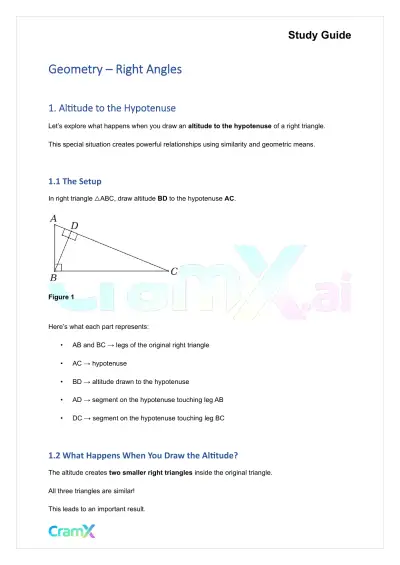 Quick Guides
Geometry - Right Angles
Mathematics
27 pagesMar 2026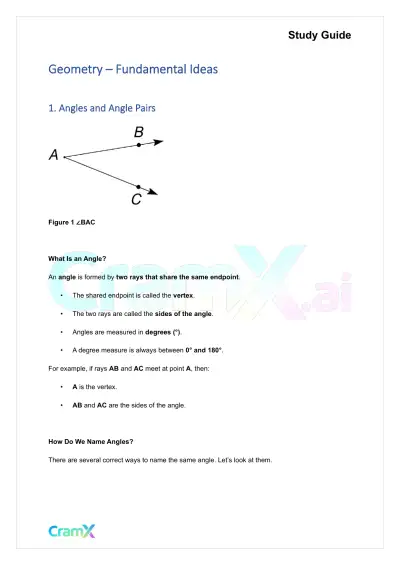 Quick Guides
Geometry - Fundamental Ideas
Mathematics
42 pagesMar 2026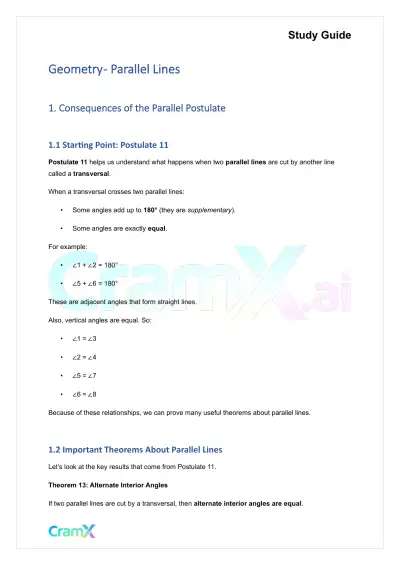 Quick Guides
Geometry - Parallel Lines
Mathematics
22 pagesMar 2026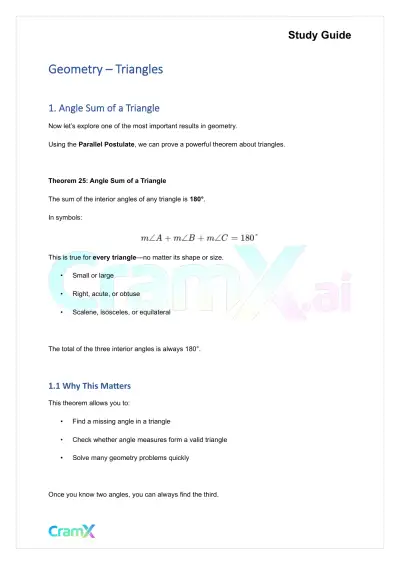 Quick Guides
Geometry - Triangles
Mathematics
49 pagesMar 2026 Quick Guides
Geometry - Perimeter and Area
Mathematics
32 pagesMar 2026 Quick Guides
Geometry - Circles
Mathematics
48 pagesMar 2026 Quick Guides
Geometry - Polygons
Mathematics
34 pagesMar 2026 Quick Guides
Geometry - Coordinate Geometry
Mathematics
29 pagesMar 2026
Study this document with CramX
Once it is in your library, every tool can work from it.