

Geometry - Triangles
- Mathematics
- Texas A&M University
- 49 pages
- Shared March 2026
Preview 10 of 49 pages
See the first 10 pages exactly as they appear in the document.
Page 1 Read page 1 as text
Study Guide Geometry – Triangles 1. Angle Sum of a Triangle Now let’s explore one of the most important results in geometry. Using the Parallel Postulate , we can prove a powerful theorem about triangles. Theorem 25: Angle Sum of a Triangle The sum of the interior angles of any triangle is 180° . In symbols: This is true for every triangle — no matter its shape or size. • Small or large • Right, acute, or obtuse • Scalene, isosceles, or equilateral The total of the three interior angles is always 180°. 1.1 Why This Matters This theorem allows you to: • Find a missing angle in a triangle • Check whether angle measures form a valid triangle • Solve many geometry problems quickly Once you know two angles, you can always find the third.
Page 2 Read page 2 as text
Study Guide Example 1 If: • m ∠ A = 40° • m ∠ B = 60° Find m ∠ C. Step 1: Use the Triangle Sum Theorem Step 2: Substitute the Known Values Step 3: Combine What You Know Step 4: Solve for the Missing Angle Final Answer
Page 3 Read page 3 as text
Study Guide Summary In any triangle: • Add the two known angles. • Subtract their sum from 180°. • The result is the missing angle. This rule is simple — but it’s one of the most useful tools in geometry. 2. Exterior Angle of a Triangle Now let’s look at another important triangle idea: exterior angles . What Is an Exterior Angle? Figure 1 Exterior angle of a triangle. An exterior angle of a triangle is formed when you extend one side of the triangle. Here’s what happens: • Start with a triangle. • Extend one side beyond a vertex. • The angle formed outside the triangle (next to an interior angle) is called an exterior angle . Important: It’s not the straight angle formed by the extension. It’s the angle outside the triangle that is adjacent to an interior angle . In the diagram, ∠ BCD is an exterior angle of △ ABC.
Page 4 Read page 4 as text
Study Guide 2.1 Why Exterior Angles Matter Exterior angles are directly connected to the interior angles of the triangle. We already know: We also know that ∠ 3 and ∠ 4 form a straight line, so: Using these facts, we can prove something powerful. 2.2 Theorem 26: Exterior Angle Theorem An exterior angle of a triangle is equal to the sum of the two remote (nonadjacent) interior angles . In simple terms: The “remote” interior angles are the two inside angles that are not next to the exterior angle. So in the diagram: 2.3 Why This Is Useful This theorem lets you: • Find missing angles quickly • Solve triangle problems faster • Avoid adding all three interior angles every time You only need the two remote interior angles!
Page 5 Read page 5 as text
Study Guide Example 1: Solve In the figure: • m ∠ 1 = 30° • m ∠ 2 = 100° Find m ∠ 4. Step 1: Use the Exterior Angle Theorem Step 2: Substitute the Values Step 3: Add Final Answer Summary Whenever you see an exterior angle of a triangle: • Look at the two interior angles that are not next to it. • Add them together. • That sum equals the exterior angle. This is one of the most helpful shortcuts in triangle geometry!
Page 6 Read page 6 as text
Study Guide 3. Classifying Triangles by Sides or Angles Triangles can be grouped in two different ways: 1. By their sides 2. By their angles Some triangles may fit into one category from each group. For example, a triangle could be both isosceles (by sides) and acute (by angles). Let’s look at each type clearly and simply. 3.1 Classifying Triangles by Their Sides This method looks at how many sides are equal. 1. Equilateral Triangle Figure 1 Equilateral triangle An equilateral triangle has all three sides equal in length. In diagrams, small slash marks on the sides show they are equal. Because all sides are equal, something else is true: All the angles are equal too.
Page 7 Read page 7 as text
Study Guide 2. Isosceles Triangle An isosceles triangle has at least two sides equal in length. Figure 2 Isosceles triangles That means: • It could have exactly two equal sides. • Or it could have three equal sides (which would also make it equilateral). In most problems, when you see matching marks on two sides, you’re looking at an isosceles triangle. 3. Scalene Triangle Figure 3 Scalene triangle A scalene triangle has all three sides different lengths. No sides are equal. This also means none of the angles are equal.
Page 8 Read page 8 as text
Study Guide 3.2 Classifying Triangles by Their Angles Now let’s look at triangles based on their angle measures. 1. Right Triangle Figure 4 Right triangle A right triangle has one right angle (90°). You’ll usually see a small square marking the 90° angle in a diagram. Only one angle can be 90° in a triangle. 2. Obtuse Triangle Figure 5 Obtuse triangle
Page 9 Read page 9 as text
Study Guide An obtuse triangle has one obtuse angle . An obtuse angle is: • Greater than 90° • Less than 180° Only one angle in a triangle can be obtuse. 3. Acute Triangle Figure 6 Acute triangle. An acute triangle has all three angles less than 90° . Every angle is acute. 4. Equiangular Triangle Figure 7 Equiangular triangle An equiangular triangle has all three angles equal . Since the sum of a triangle’s angles is 180°, we can figure out something important.
Page 10 Read page 10 as text
Study Guide 3.3 Theorem 27 Each angle of an equiangular triangle measures 60° . Why? Because: So if all three angles are equal, each one must be 60°. Helpful Connections Here’s an important relationship: • Every equilateral triangle is also equiangular . • Every equiangular triangle is also equilateral . That means: If all sides are equal → all angles are 60°. If all angles are 60° → all sides are equal. Summary By Sides: • Equilateral → 3 equal sides • Isosceles → at least 2 equal sides • Scalene → no equal sides By Angles: • Right → one 90° angle • Obtuse → one angle greater than 90° • Acute → all angles less than 90° • Equiangular → all angles equal (each 60°)
39 more pages in the full document
Unlock it once and it stays in your library, ready to chat with or turn into flashcards.
Unlock the full documentMore Mathematics study materials
See all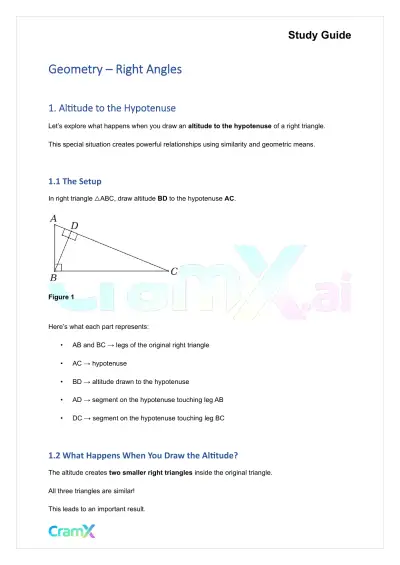 Quick Guides
Geometry - Right Angles
Mathematics
27 pagesMar 2026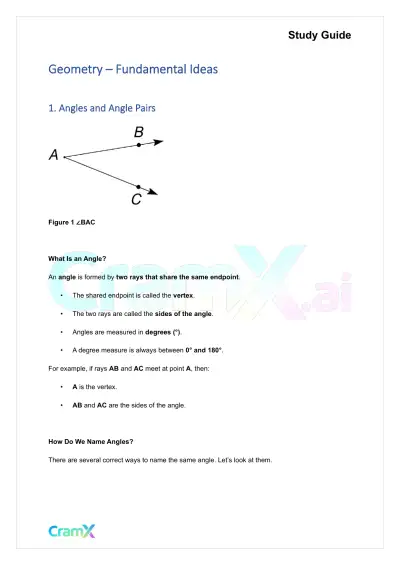 Quick Guides
Geometry - Fundamental Ideas
Mathematics
42 pagesMar 2026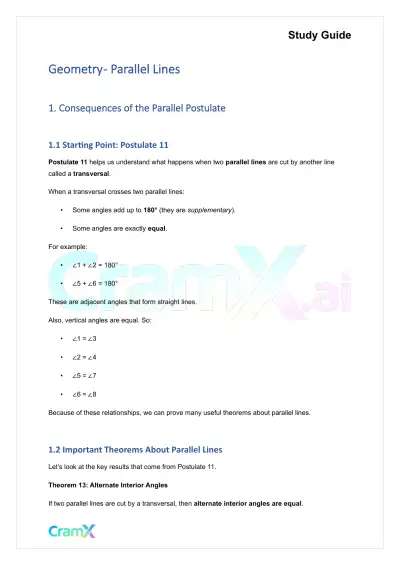 Quick Guides
Geometry - Parallel Lines
Mathematics
22 pagesMar 2026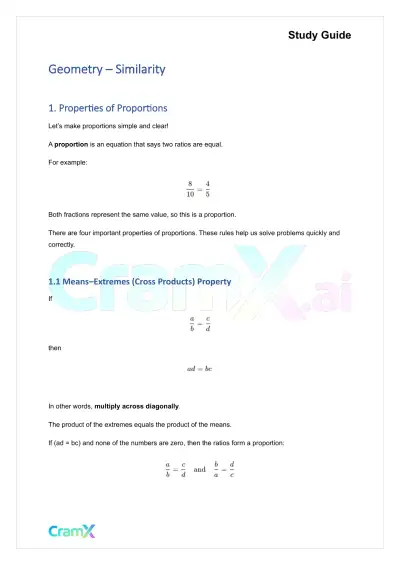 Quick Guides
Geometry - Similarity
Mathematics
36 pagesMar 2026 Quick Guides
Geometry - Perimeter and Area
Mathematics
32 pagesMar 2026 Quick Guides
Geometry - Circles
Mathematics
48 pagesMar 2026 Quick Guides
Geometry - Polygons
Mathematics
34 pagesMar 2026 Quick Guides
Geometry - Coordinate Geometry
Mathematics
29 pagesMar 2026
Study this document with CramX
Once it is in your library, every tool can work from it.