

Trigonometry - Polar Coordinates and Complex Numbers
- Mathematics
- Texas A&M University
- 24 pages
- Shared March 2026
Preview 8 of 24 pages
See the first 8 pages exactly as they appear in the document.
Page 1 Read page 1 as text
Study Guide Trigonometry – Polar Coordinates and Complex Numbers 1. Geometry of Complex Numbers Complex numbers aren’t just abstract symbols — they can be drawn, measured, and visualized . In this chapter, we’ll explore how complex numbers work geometrically and how to move between rectangular and polar forms. 1. 1 What Is a Complex Number? A complex number can be written in the form • (a) and (b) are real numbers • (i) is the imaginary unit, where (i 2 = - 1) Every complex number represents a point in a plane , called the complex plane . 1.2 The Complex Plane The complex plane looks like a regular coordinate plane, but with a special meaning: • The x - axis is called the real axis • The y - axis is called the imaginary axis A complex number (a + b i ) is plotted as the point (a, b) Example 1 : Plotting Complex Numbers Plot the following complex numbers:
Page 2 Read page 2 as text
Study Guide Figure 1 Complex numbers plotted in the complex plane. • (4 - 2i) • ( - 3 + 2i) • ( - 5 - 3i) Each number becomes a point: • (4 - 2i → (4, - 2)) • ( - 3 + 2i → ( - 3, 2)) • ( - 5 - 3i → ( - 5, - 3)) These points are placed in the complex plane just like coordinates in algebra. 1.3 Polar Form of Complex Numbers Instead of using coordinates ((x, y)), we can describe a complex number using: • Distance from the origin (called the modulus ) • Angle from the positive x - axis (called the argument or amplitude )
Page 3 Read page 3 as text
Study Guide The Modulus (Absolute Value) For a complex number The modulus is This is simply the distance from the origin to the point ((x, y)). The Argument (Angle) The argument of a complex number is the angle ( θ) formed between: • the positive x - axis • the line connecting the origin to the point 1.4 Writing Complex Numbers in Polar Form Using trigonometry: • (x = r cos θ) • (y = r sin θ) So a complex number can be written as: This is called the polar form of a complex number. Sometimes you’ll see: written as cis ( θ ) .
Page 4 Read page 4 as text
Study Guide 1.5 Conjugate of a Complex Number If Then the conjugate of (z) is: The conjugate reflects the point across the real axis. Example 2 : Converting to Polar Form Convert (5 - 3i) to polar form. Figure 2 Drawing for Example 2. Step 1: Find the modulus Step 2: Find the reference angle This gives a reference angle of about (31 ° ).
Page 5 Read page 5 as text
Study Guide Step 3: Adjust for the quadrant Since (5 - 3i) lies in the fourth quadrant : Final Answer 1.6 Multiplying Complex Numbers in Polar Form To multiply two complex numbers: • Multiply their moduli • Add their angles If and Then: Example 3 : Product Formula This rule comes from expanding the expressions and using trigonometric identities. The result always simplifies nicely into another polar form. 1 . 7 Dividing Complex Numbers in Polar Form To divide two complex numbers: • Divide their moduli • Subtract their angles
Page 6 Read page 6 as text
Study Guide If and Then: Example 4 : Quotient Formula If and find the quotient Step 1: Write the Quotient Start by dividing: Factor out constants:
Page 7 Read page 7 as text
Study Guide Step 2: Multiply by the Conjugate To simplify the denominator, multiply by the conjugate of So we multiply top and bottom by this expression. Step 3: Simplify the Denominator This is a difference of squares: And we know the identity: So the denominator becomes: That makes things much simpler! Step 4: Multiply the Numerator Now multiply: Distribute carefully: Since ( i 2 = - 1 ), this becomes:
Page 8 Read page 8 as text
Study Guide Step 5: Recognize the Trig Identities Use these identities: So the expression becomes: Final Answer Example 5 : Putting It All Together Let: Product Quotient Since negative angles can be rewritten:
16 more pages in the full document
Unlock it once and it stays in your library, ready to chat with or turn into flashcards.
Unlock the full documentMore Mathematics study materials
See all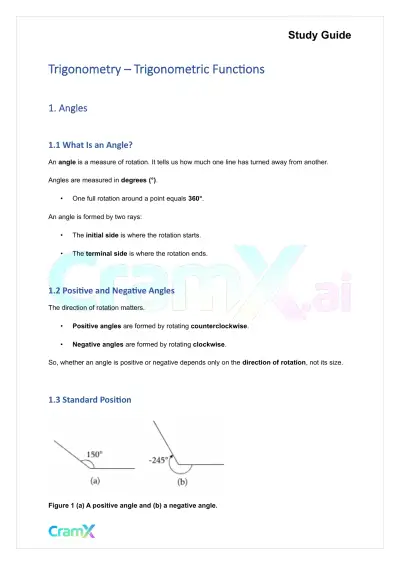 Quick Guides
Trigonometry - Trigonometric Functions
Mathematics
36 pagesMar 2026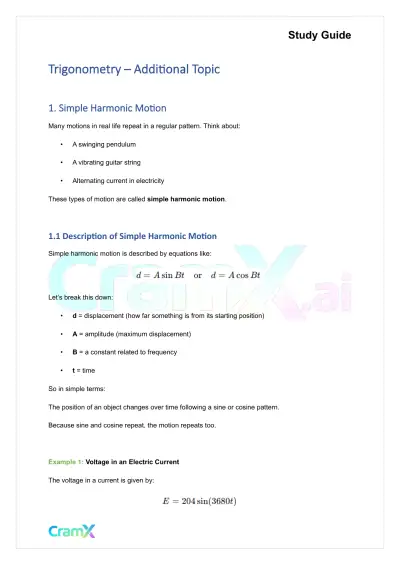 Quick Guides
Trigonometry - Additional Topic
Mathematics
18 pagesMar 2026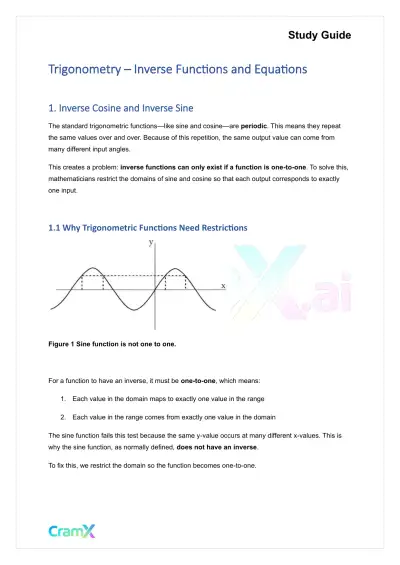 Quick Guides
Trigonometry - Inverse Functions and Equations
Mathematics
30 pagesMar 2026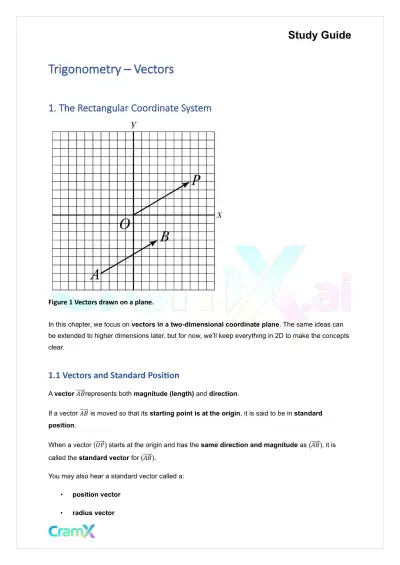 Quick Guides
Trigonometry - Vectors
Mathematics
20 pagesMar 2026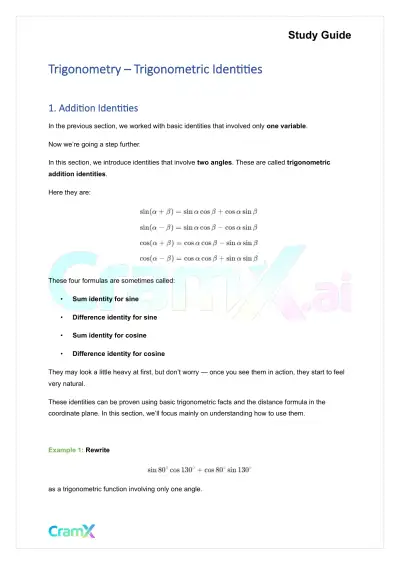 Quick Guides
Trigonometry - Trigonometric Identities
Mathematics
33 pagesMar 2026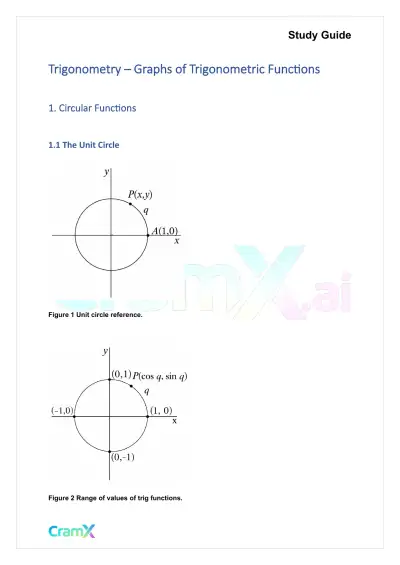 Quick Guides
Trigonometry - Graphs of Trigonometric Functions
Mathematics
59 pagesMar 2026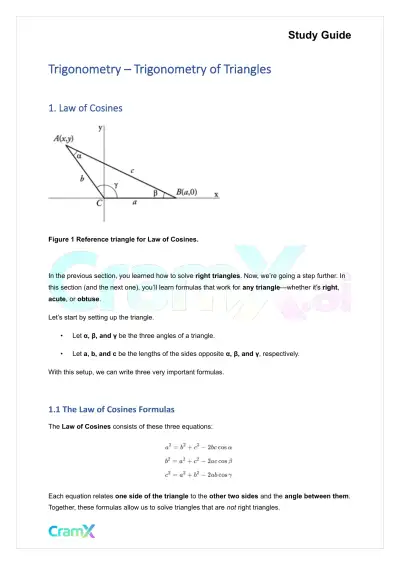 Quick Guides
Trigonometry - Trigonometry of Triangles
Mathematics
62 pagesMar 2026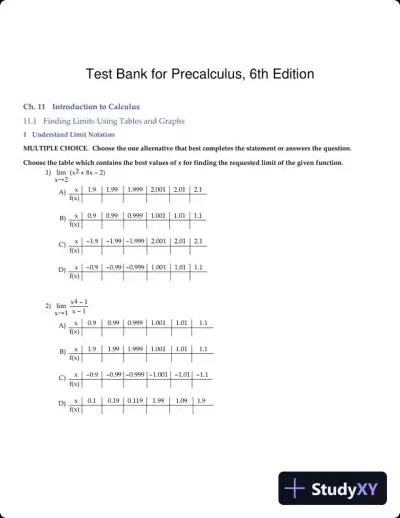 Exam Guides
Test Bank for Precalculus, 6th Edition
Mathematics
1051 pages175downloadsFeb 2025
Study this document with CramX
Once it is in your library, every tool can work from it.