

Trigonometry - Additional Topic
- Mathematics
- Texas A&M University
- 18 pages
- Shared March 2026
Preview 6 of 18 pages
See the first 6 pages exactly as they appear in the document.
Page 1 Read page 1 as text
Study Guide Trigonometry – Additional Topic 1. Simple Harmonic Motion Many motions in real life repeat in a regular pattern. Think about: • A swinging pendulum • A vibrating guitar string • Alternating current in electricity These types of motion are called simple harmonic motion . 1.1 Description of Simple Harmonic Motion Simple harmonic motion is described by equations like: Let’s break this down: • d = displacement (how far something is from its starting position) • A = amplitude (maximum displacement) • B = a constant related to frequency • t = time So in simple terms: The position of an object changes over time following a sine or cosine pattern. Because sine and cosine repeat, the motion repeats too. Example 1: Voltage in an Electric Current The voltage in a current is given by:
Page 2 Read page 2 as text
Study Guide where: • (E) is in volts • (t) is in seconds We are asked to find (E) when: Use ( π = 3.1416 ) . Step 1: Substitute the Value of t Step 2: Reduce the Angle Since sine is periodic it repeats every (2 π), we reduce 993.6 by subtracting multiples of (2 π). After removing 158 full rotations of (2 π), we are left with: So now we evaluate: Step 3: Calculate Final Answer
Page 3 Read page 3 as text
Study Guide Example 2: Motion of a Pendulum The horizontal displacement of a pendulum is: We are given: We need to find (K). Step 1: Substitute the Values Using ( π = 3.1416 ) : Step 2: Evaluate the Sine So the equation becomes: Final Answer This means the amplitude (maximum displacement) of the pendulum is about 12 cm.
Page 4 Read page 4 as text
Study Guide Summary Simple harmonic motion follows sine or cosine patterns. Amplitude (A or K) tells you the maximum displacement. The motion repeats because sine and cosine are periodic. You can reduce large angles using the fact that sine repeats every (2 π). 2. The Expression M sin Bt + N cos Bt Figure 1 Reference graph for y = M sin Bt + N cos Bt . Sometimes a trigonometric function is written like this: At first, this looks complicated. But here’s the good news: Any expression of this form can be rewritten as a single sine function: So these two forms are equivalent . They describe the same motion — just written differently. This result comes from the sum identity for sine . How Are the Constants Related? If:
Page 5 Read page 5 as text
Study Guide then it can be rewritten as: where: This value is very important. Key Relationships Let: Then: From this, you can determine the angle (C). Important Properties Once written in the form: we can easily identify: • Amplitude:
Page 6 Read page 6 as text
Study Guide • Period: • Frequency: • Phase Shift: This makes the function much easier to analyze. Example 1: Convert: Figure 2 Drawing for Example 1. into the form: Then find the amplitude, period, frequency, and phase shift.
12 more pages in the full document
Unlock it once and it stays in your library, ready to chat with or turn into flashcards.
Unlock the full documentMore Mathematics study materials
See all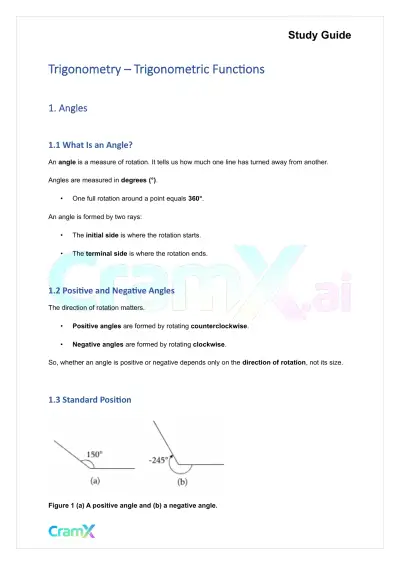 Quick Guides
Trigonometry - Trigonometric Functions
Mathematics
36 pagesMar 2026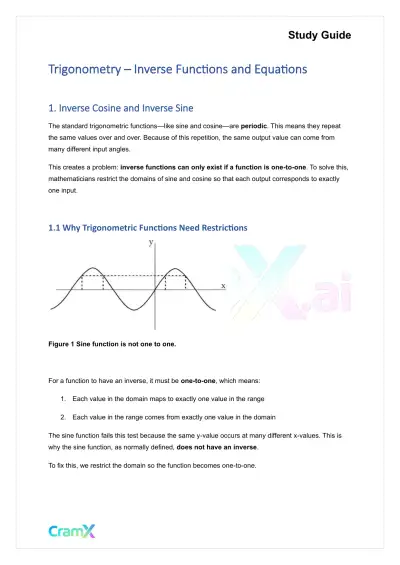 Quick Guides
Trigonometry - Inverse Functions and Equations
Mathematics
30 pagesMar 2026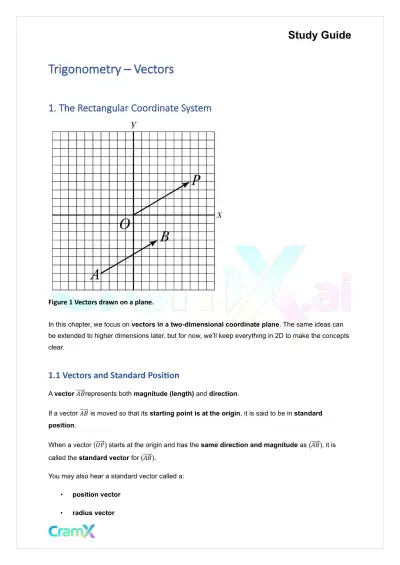 Quick Guides
Trigonometry - Vectors
Mathematics
20 pagesMar 2026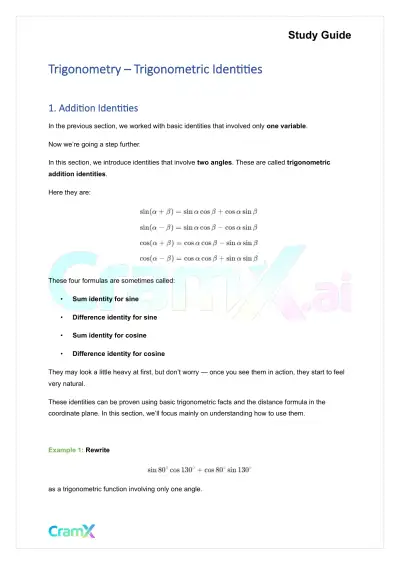 Quick Guides
Trigonometry - Trigonometric Identities
Mathematics
33 pagesMar 2026 Quick Guides
Trigonometry - Graphs of Trigonometric Functions
Mathematics
59 pagesMar 2026 Quick Guides
Trigonometry - Polar Coordinates and Complex Numbers
Mathematics
24 pagesMar 2026 Quick Guides
Trigonometry - Trigonometry of Triangles
Mathematics
62 pagesMar 2026 Exam Guides
Test Bank for Precalculus, 6th Edition
Mathematics
1051 pages175downloadsFeb 2025
Study this document with CramX
Once it is in your library, every tool can work from it.