

Trigonometry - Graphs of Trigonometric Functions
- Mathematics
- Texas A&M University
- 59 pages
- Shared March 2026
Preview 10 of 59 pages
See the first 10 pages exactly as they appear in the document.
Page 1 Read page 1 as text
Study Guide Trigonometry – Graphs of Trigonometric Functions 1. Circular Functions 1. 1 The Unit Circle Figure 1 Unit circle reference. Figure 2 Range of values of trig functions.
Page 2 Read page 2 as text
Study Guide The equation draws a circle on the coordinate plane. This circle is called the unit circle . • Its center is at the origin ( 0,0 ) . • Its radius is 1 unit. The unit circle is extremely important because it helps us understand trigonometric and circular functions in a visual way. 1.2 From Angles to Numbers In regular trigonometry, functions like sine and cosine take angles as inputs. Their outputs are real numbers . Circular functions work a little differently: • Their inputs are real numbers (measured in radians ). • These numbers represent arc lengths along the unit circle. • Their outputs are still real numbers. They are called circular functions because the values come from moving around a circle . 1.3 How Radians Fit In Radians connect angles to circles naturally. • The radian measure of an angle is based on arc length , not degrees. • Because arc length depends on the circle, radians are perfect for circular functions. • On the unit circle , arc length and angle measure match exactly. This is why trigonometric functions defined on the unit circle lead directly to circular functions.
Page 3 Read page 3 as text
Study Guide 1.4 Defining Sine and Cosine Using the Unit Circle Start with the unit circle (x 2 + y 2 = 1). 1. Begin at point A(1, 0) on the positive x - axis. 2. Let (q) be any real number. 3. Move |q| units along the circle: o Counterclockwise if (q > 0) o Clockwise if (q < 0) 4. You arrive at a point (P(x, y ) . Now define: • sin q = y • cos q = x So, sine is the y - coordinate and cosine is the x - coordinate of point (P). 1.5 Other Circular (Trigonometric) Functions Once sine and cosine are defined, the other functions are built from them: These definitions match what you learned in trigonometry — just written in terms of circular functions. 1.6 Domain of Circular Functions Because you can move any distance around the unit circle: • The domain of sine and cosine is all real numbers . • Positive values move counterclockwise. • Negative values move clockwise. So, (sin q) and (cos q) exist for every real number (q) .
Page 4 Read page 4 as text
Study Guide 1.7 Range of Circular Functions While the domain is unlimited, the range is not. • Sine and cosine are coordinates on the unit circle. • All x - and y - values on the unit circle lie between −1 and 1. Therefore: This means the range of both sine and cosine is from −1 to 1. 1.8 Why Circular Functions Matter Circular functions: • Connect geometry and algebra • Explain why trigonometric values repeat • Make radians feel natural and meaningful • Are essential for advanced math, physics, and engineering Understanding them through the unit circle makes everything clearer and more intuitive. Example 1 : When Does the Sine Value Equal 1? Question: Which values of (x), between ( - 2 π) and (2 π), make the sine function equal to 1? In other words, we are looking for all values of (x) in this interval such that:
Page 5 Read page 5 as text
Study Guide Figure 3 Drawing for Example 1. Step 1: Think About the Unit Circle On the unit circle, the sine of an angle corresponds to the y - coordinate of a point on the circle. So asking when (sin x = 1) is the same as asking: When is the point on the unit circle at a height of 1 ? Step 2: Identify Where Sine Equals 1 The y - coordinate is equal to 1 only at the top of the unit circle , which is the point: This means we want all values of (x) that land us at this point. Step 3: Find the Correct Angle Measures Starting from ( 1, 0 ) and moving around the unit circle: • The first time we reach ( 0, 1 ) is at
Page 6 Read page 6 as text
Study Guide • If we continue moving around the circle clockwise, we reach the same point again at Both of these values lie between ( - 2 π) and (2 π ). Step 4: State the Final Answer The values of (x) for which the sine function has a value of 1 in the given interval are: Example 2 : When Does the Cosine Value Equal −1? Question: Which values of (x), between ( - 2 π) and (2 π), make the cosine function equal to ( - 1)? In mathematical terms, we are solving: Figure 4 Drawing for Example 2.
Page 7 Read page 7 as text
Study Guide Step 1: Connect Cosine to the Unit Circle On the unit circle, the cosine of an angle corresponds to the x - coordinate of a point on the circle. So asking when (cos x = - 1) is the same as asking: When is the point on the unit circle all the way to the left , at an x - value of ( - 1)? Step 2: Identify the Key Point The x - coordinate equals ( - 1) at exactly one point on the unit circle: This is the leftmost point on the circle. Step 3: Find the Angle Values Starting from ( 1, 0 ) and moving around the unit circle: • Moving counterclockwise, you reach ( - 1, 0 ) at • Moving clockwise, you reach the same point at Both values are within the interval ( - 2 π ≤ x ≤ 2 π ). Step 4: State the Final Answer The values of (x) for which the cosine function has a value of ( - 1) in the given interval are:
Page 8 Read page 8 as text
Study Guide Example 3 : Finding All Six Circular Functions Given: The point lies on the unit circle . The arc length from point (A(1,0 ) to point (P) is (q) units. Question: What are the values of the six circular (trigonometric) functions of (q)? Step 1: Use the Coordinates of the Point On the unit circle: • The x - coordinate gives the cosine value • The y - coordinate gives the sine value So, directly from point (P): Step 2: Find Tangent Tangent is defined as sine divided by cosine: Substitute the values:
Page 9 Read page 9 as text
Study Guide Step 3: Find Cotangent Cotangent is the reciprocal of tangent (or cosine divided by sine): Step 4: Find Secant Secant is the reciprocal of cosine: Step 5: Find Cosecant Cosecant is the reciprocal of sine: Step 6: Summary of All Six Values
Page 10 Read page 10 as text
Study Guide Step 7: Understanding the Signs The signs of the trigonometric functions depend on which quadrant the point lies in. Summary • Sine represents the vertical position on the unit circle. • The maximum value of sine is 1 . • This value occurs whenever the angle places the point at the top of the circle . • Cosine represents the horizontal position on the unit circle. • The minimum value of cosine is − 1 .
49 more pages in the full document
Unlock it once and it stays in your library, ready to chat with or turn into flashcards.
Unlock the full documentMore Mathematics study materials
See all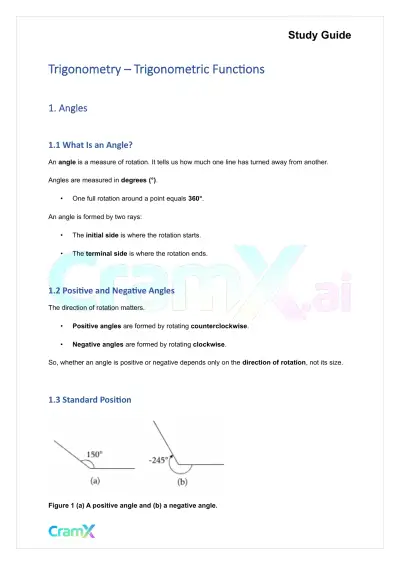 Quick Guides
Trigonometry - Trigonometric Functions
Mathematics
36 pagesMar 2026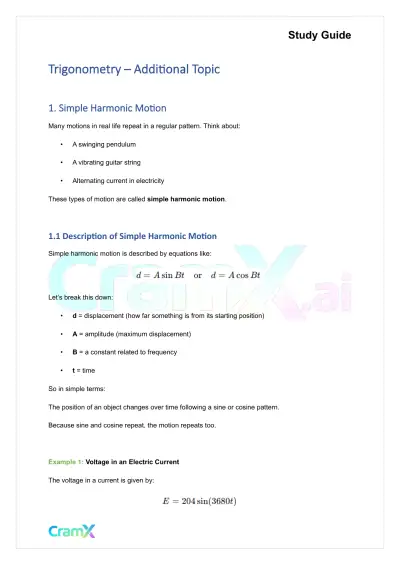 Quick Guides
Trigonometry - Additional Topic
Mathematics
18 pagesMar 2026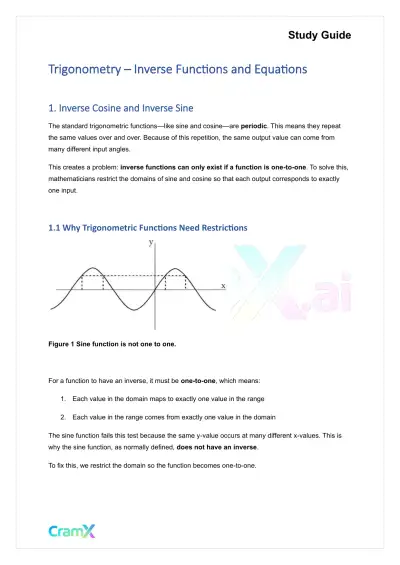 Quick Guides
Trigonometry - Inverse Functions and Equations
Mathematics
30 pagesMar 2026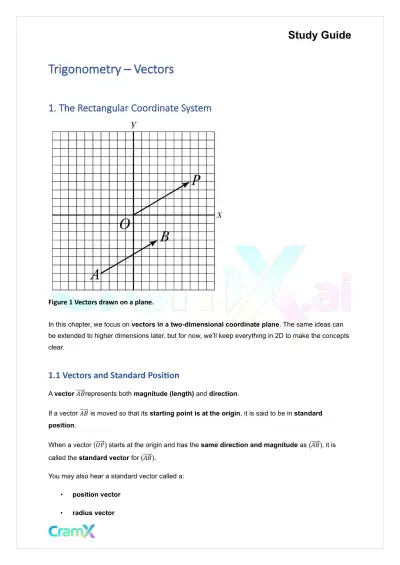 Quick Guides
Trigonometry - Vectors
Mathematics
20 pagesMar 2026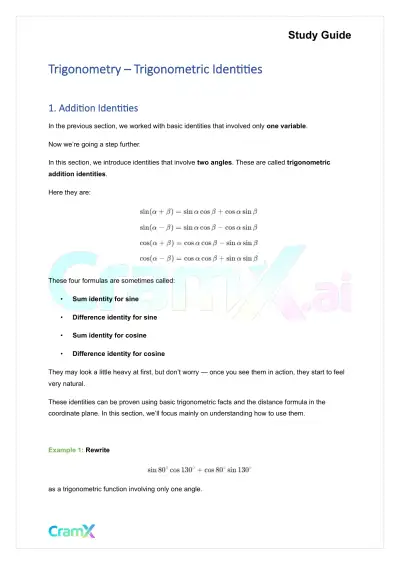 Quick Guides
Trigonometry - Trigonometric Identities
Mathematics
33 pagesMar 2026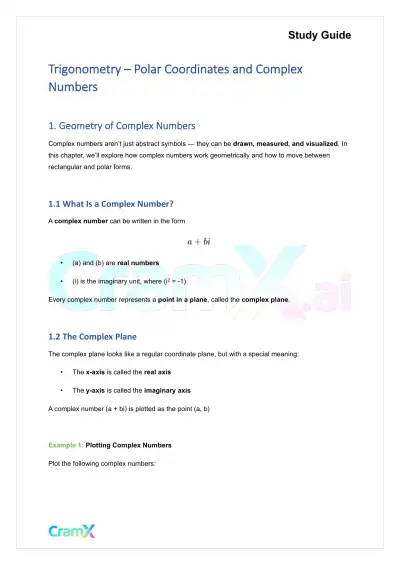 Quick Guides
Trigonometry - Polar Coordinates and Complex Numbers
Mathematics
24 pagesMar 2026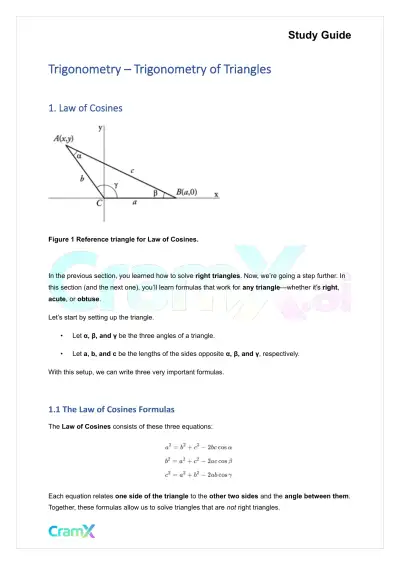 Quick Guides
Trigonometry - Trigonometry of Triangles
Mathematics
62 pagesMar 2026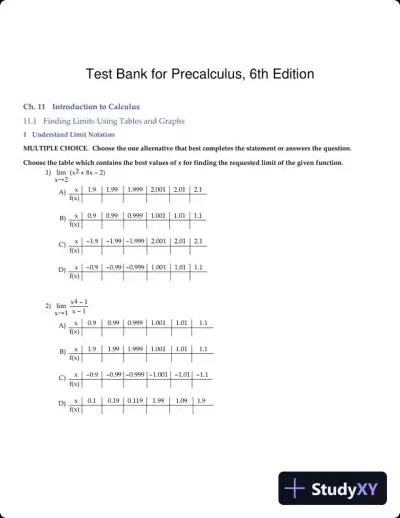 Exam Guides
Test Bank for Precalculus, 6th Edition
Mathematics
1051 pages175downloadsFeb 2025
Study this document with CramX
Once it is in your library, every tool can work from it.