

Trigonometry - Inverse Functions and Equations
- Mathematics
- Texas A&M University
- 30 pages
- Shared March 2026
Preview 9 of 30 pages
See the first 9 pages exactly as they appear in the document.
Page 1 Read page 1 as text
Study Guide Trigonometry – Inverse Functions and Equations 1. Inverse Cosine and Inverse Sine The standard trigonometric functions — like sine and cosine — are periodic . This means they repeat the same values over and over. Because of this repetition, the same output value can come from many different input angles. This creates a problem: inverse functions can only exist if a function is one - to - one . To solve this, mathematicians restrict the domains of sine and cosine so that each output corresponds to exactly one input. 1. 1 Why Trigonometric Functions Need Restrictions Figure 1 Sine function is not one to one. For a function to have an inverse, it must be one - to - one , which means: 1. Each value in the domain maps to exactly one value in the range 2. Each value in the range comes from exactly one value in the domain The sine function fails this test because the same y - value occurs at many different x - values. This is why the sine function, as normally defined, does not have an inverse . To fix this, we restrict the domain so the function becomes one - to - one.
Page 2 Read page 2 as text
Study Guide 1.2 Restricting the Cosine Function Figure 2 Graph of restricted cosine function. To define the inverse cosine function, we restrict the domain of cosine to: This restricted function is written as Cos x (note the capital “C”). Properties of the Restricted Cosine Function On this interval, cosine decreases smoothly and never repeats values. 1.3 The Inverse Cosine Function The inverse cosine function is defined as the inverse of the restricted cosine function.
Page 3 Read page 3 as text
Study Guide Figure 3 Graph of inverse cosine function. It is written as: This means: (y) is the angle between (0) and ( π) whose cosine is (x). Domain and Range of Inverse Cosine Important Cosine Identities These identities are only true when the domain restrictions are followed:
Page 4 Read page 4 as text
Study Guide 1.4 Restricting the Sine Function The process for sine is very similar. Figure 4 Graph of restricted sine function. To make sine one - to - one, we restrict its domain to: This restricted function is written as Sin x (capital “S”). Properties of the Restricted Sine Function On this interval, sine increases smoothly without repeating values.
Page 5 Read page 5 as text
Study Guide 1.5 The Inverse Sine Function The inverse sine function is defined as the inverse of the restricted sine function. Figure 5 Graph of inverse sine function. It is written as: This means: (y) is the angle between - ( π/2) and ( π/2) whose sine is (x). Domain and Range of Inverse Sine • Domain: ( - 1 ≤ x ≤ 1) • Range: - ( π/2) ≤ y ≤ π/2 Important Sine Identities Again, these identities depend on the restrictions:
Page 6 Read page 6 as text
Study Guide 1.6 Graphical Relationship Between Functions and Their Inverses The graphs of a function and its inverse are always mirror images of each other across the line: Figure 6 Symmetry of inverse sine and cosine. This is true for: • (y = cos x and y = cos - 1 x) • (y = sin x and y = sin - 1 x) This symmetry helps explain why the domain of one becomes the range of the other , and vice versa. Example 1: Evaluating an Inverse Cosine Problem Find the exact value of:
Page 7 Read page 7 as text
Study Guide Figure 7 Drawing for Example 1. Step 1: Understand what inverse cosine means If: then this means: For inverse cosine, the angle must be between (0) and ( π ) . Step 2: Identify the reference angle We know: Since the cosine value is negative , the angle must be in Quadrant II (within the allowed range).
Page 8 Read page 8 as text
Study Guide Step 3: Find the correct angle Final Answer Example 2: Evaluating an Inverse Sine Problem Find the exact value of: Figure 8 Drawing for Example 2.
Page 9 Read page 9 as text
Study Guide Step 1: Understand what inverse sine means If: then: For inverse sine, the angle must be between - ( π/2) and ( π/2) Step 2: Identify the angle We know: This angle lies within the allowed interval. Final Answer c Example 3: Using an Inverse Identity Problem Find the exact value of:
21 more pages in the full document
Unlock it once and it stays in your library, ready to chat with or turn into flashcards.
Unlock the full documentMore Mathematics study materials
See all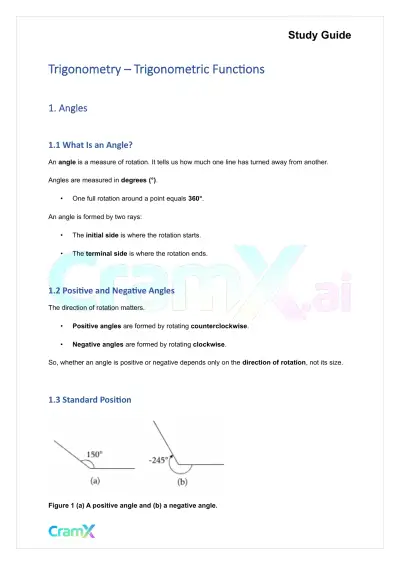 Quick Guides
Trigonometry - Trigonometric Functions
Mathematics
36 pagesMar 2026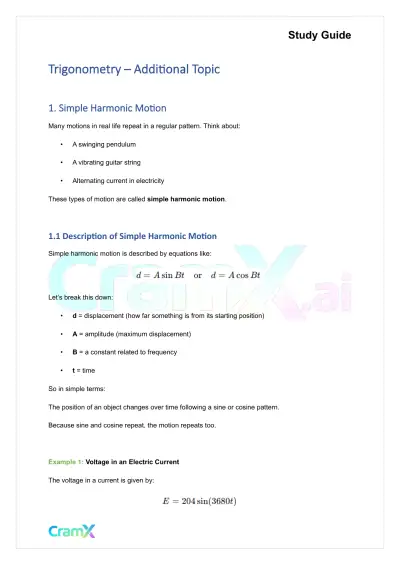 Quick Guides
Trigonometry - Additional Topic
Mathematics
18 pagesMar 2026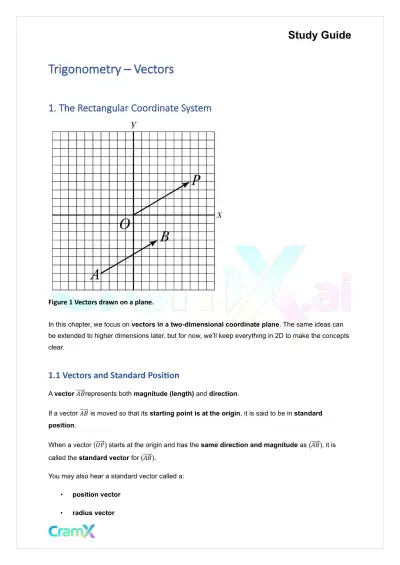 Quick Guides
Trigonometry - Vectors
Mathematics
20 pagesMar 2026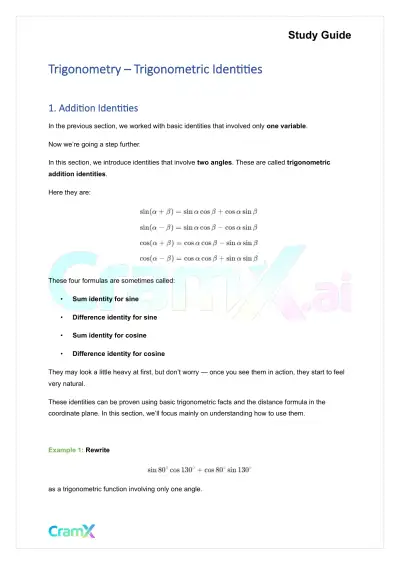 Quick Guides
Trigonometry - Trigonometric Identities
Mathematics
33 pagesMar 2026 Quick Guides
Trigonometry - Graphs of Trigonometric Functions
Mathematics
59 pagesMar 2026 Quick Guides
Trigonometry - Polar Coordinates and Complex Numbers
Mathematics
24 pagesMar 2026 Quick Guides
Trigonometry - Trigonometry of Triangles
Mathematics
62 pagesMar 2026 Exam Guides
Test Bank for Precalculus, 6th Edition
Mathematics
1051 pages175downloadsFeb 2025
Study this document with CramX
Once it is in your library, every tool can work from it.