

Trigonometry - Trigonometric Functions
- Mathematics
- Texas A&M University
- 36 pages
- Shared March 2026
Preview 10 of 36 pages
See the first 10 pages exactly as they appear in the document.
Page 1 Read page 1 as text
Study Guide Trigonometry – Trigonometric Functions 1. Angles 1.1 What Is an Angle? An angle is a measure of rotation. It tells us how much one line has turned away from another. Angles are measured in degrees ( °) . • One full rotation around a point equals 360° . An angle is formed by two rays: • The initial side is where the rotation starts. • The terminal side is where the rotation ends. 1.2 Positive and Negative Angles The direction of rotation matters. • Positive angles are formed by rotating counterclockwise . • Negative angles are formed by rotating clockwise . So, whether an angle is positive or negative depends only on the direction of rotation , not its size. 1.3 Standard Position Figure 1 ( a) A positive angle and ( b) a negative angle.
Page 2 Read page 2 as text
Study Guide An angle is said to be in standard position when: • Its initial side lies along the positive x - axis . • The vertex of the angle is at the origin ( 0, 0) . Placing angles in standard position helps us describe and compare them more easily. 1.4 Quadrantal Angles Figure 2 Types of Angles
Page 3 Read page 3 as text
Study Guide Some angles have their terminal side exactly on one of the coordinate axes . These are called quadrantal angles . Examples include: • 0° • 90° • 180° • 270° • Any angle whose terminal side lies directly on the x - axis or y - axis 1.5 Angles in the Four Quadrants If an angle in standard position is not quadrantal , then its terminal side lies in one of the four quadrants of the coordinate plane. Here’s how angles are classified based on where the terminal side ends up: • First Quadrant : Terminal side is between the positive x - axis and positive y - axis • ( Example: 40°) • Second Quadrant : Terminal side is between the positive y - axis and negative x - axis • ( Example: −260°) • Third Quadrant : Terminal side is between the negative x - axis and negative y - axis • ( Example: 210°) • Fourth Quadrant : Terminal side is between the negative y - axis and positive x - axis • ( Example: −50°)
Page 4 Read page 4 as text
Study Guide 1.6 Understanding Angles in Standard Position When an angle is drawn in standard position , its vertex is at the origin ( 0, 0) and its initial side lies along the positive x - axis . From there, the angle opens either counterclockwise ( positive angles) or clockwise ( negative angles) . Where the terminal side of the angle ends tells us which quadrant the angle is in. Example 1: Identifying the Quadrant of an Angle
Page 5 Read page 5 as text
Study Guide Figure 3 Angles coterminal with 30° 1.7 What Does Coterminal Mean? Two angles are called coterminal if: • They are in standard position , and • They share the same terminal side . In other words, they may look different, but they end in exactly the same place .
Page 6 Read page 6 as text
Study Guide 1.8 Coterminal Angles and Full Rotations A full rotation around a circle is 360° . So, you can create coterminal angles by adding or subtracting 360° . General Rule: All angles that are coterminal with an angle ( d° ) can be written as: where ( n ) is any integer ( positive, negative, or zero). Example: Angles Coterminal with 30° All the angles below share the same terminal side as 30° , even though they look very different: Even though these angles involve multiple rotations, they all end in the same position . 1.9 What Does “Coterminal” Mean? Two angles are called coterminal angles if they: • Start at the same initial side • End at the same terminal side This happens when the angles differ by a whole number multiple of 360° . In general: where n is any integer ( positive, negative, or zero). Example 2: Are 200° and 940° Coterminal? To check if two angles are coterminal, subtract one from the other and see if the result is a multiple of 360°. If 940° and 200° were coterminal:
Page 7 Read page 7 as text
Study Guide Subtract 200° from both sides: Since 740 is not a multiple of 360 , there is no whole number value of n . Conclusion: 200° and 940° are not coterminal angles. Example 3: Name Five Angles Coterminal with −70° To find coterminal angles, add or subtract multiples of 360°. Starting with −70°: • −70° + ( 1 × 360°) = 290° • −70° + ( 2 × 360°) = 650° • −70° + ( 3 × 360°) = 1010° • −70° + ( − 1 × 360°) = − 430° • −70° + ( − 2 × 360°) = − 790° All of these angles share the same terminal side as −70°, so they are coterminal. 1.10 Degrees, Minutes, and Seconds Angle measurements are not always whole degrees. Fractional angles can be written in two main ways: • As decimal degrees , such as 34.25° • Using degrees, minutes, and seconds ( DMS) 1.11 Understanding Minutes and Seconds The degree is divided into smaller units: • 1 degree ( °) = 60 minutes ( ′) • 1 minute ( ′) = 60 seconds ( ″)
Page 8 Read page 8 as text
Study Guide In symbols: • 1° = 60′ • 1′ = 60″ 1.12 Converting Between Forms Example 4: Write 34°15′ Using Decimal Degrees Convert minutes to degrees by dividing by 60. Example 5: Write 12°18′44″ Using Decimal Degrees Convert minutes and seconds step by step. Example 6: Write 81.293° Using Degrees, Minutes, and Seconds Start with the whole number part: Convert the decimal part to minutes: So: Convert the decimal minutes to seconds:
Page 9 Read page 9 as text
Study Guide Final Answer: Summary • Coterminal angles differ by multiples of 360° • Minutes and seconds are smaller units of degrees • You can convert between decimal degrees and DMS by multiplying or dividing by 60 • These conversions are essential for accuracy in geometry and trigonometry 2. Functions of Acute Angles 2.1 Why Similar Triangles Matter Trigonometry is built on the idea of similar triangles , first studied by Euclid. Two triangles are similar if: • Their corresponding angles are equal, and • Their corresponding sides are in the same ratio. Because all right triangles have a 90° angle , any two right triangles that share another equal angle must be similar. This means the ratios of their corresponding sides are the same , even if the triangles are different sizes. This idea leads directly to trigonometric ratios . 2.2 Naming Angles Angles are usually represented using lowercase Greek letters . The most common ones are: • α ( alpha) • θ ( theta) The letter used doesn’t change the math — it’s just a name for the angle.
Page 10 Read page 10 as text
Study Guide 2.3 Measuring Angles Angles can be measured in degrees or radians . The relationship between them is: • 180° = π radians • 1° = π / 180 radians • 1 radian = 180° / π You’ll often switch between these units in trigonometry, so it’s important to know these conversions. 2.4 Triangles and the Circle To define trigonometric ratios, we often use a right triangle placed inside a circle with equation: Figure 1 Reference triangles. In this triangle: • r is the hypotenuse • x is the side adjacent to the angle • y is the side opposite the angle
26 more pages in the full document
Unlock it once and it stays in your library, ready to chat with or turn into flashcards.
Unlock the full documentMore Mathematics study materials
See all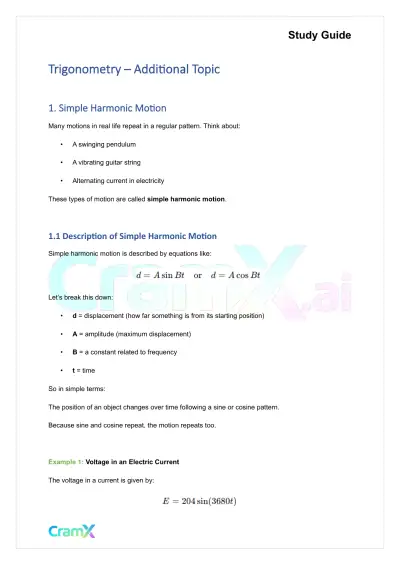 Quick Guides
Trigonometry - Additional Topic
Mathematics
18 pagesMar 2026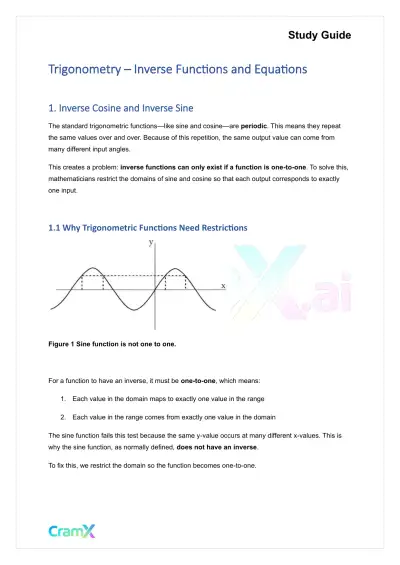 Quick Guides
Trigonometry - Inverse Functions and Equations
Mathematics
30 pagesMar 2026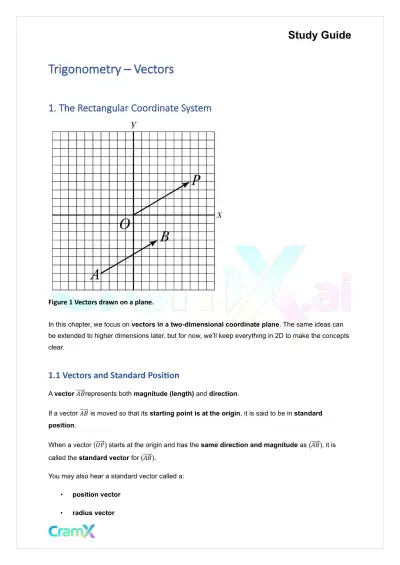 Quick Guides
Trigonometry - Vectors
Mathematics
20 pagesMar 2026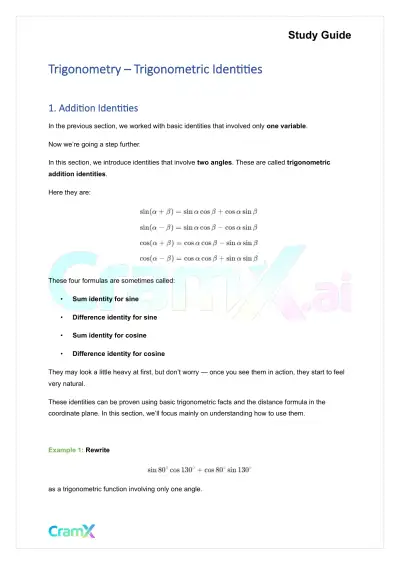 Quick Guides
Trigonometry - Trigonometric Identities
Mathematics
33 pagesMar 2026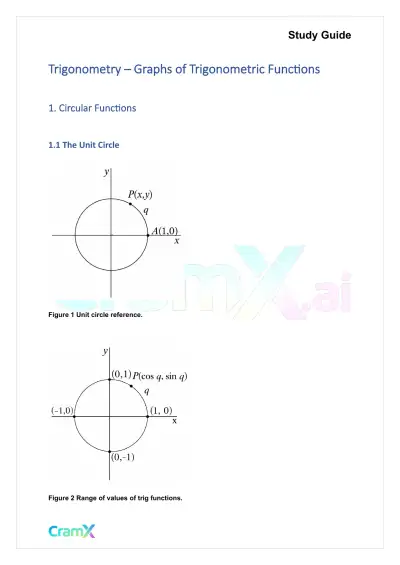 Quick Guides
Trigonometry - Graphs of Trigonometric Functions
Mathematics
59 pagesMar 2026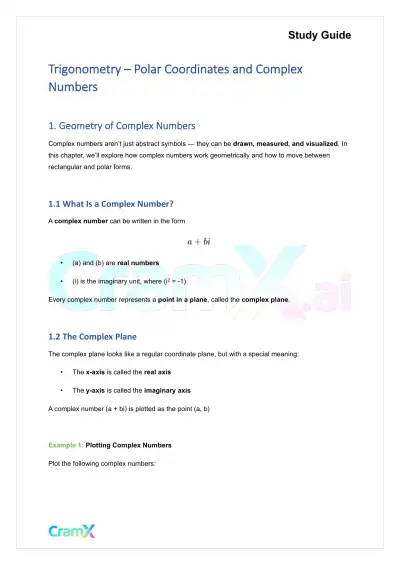 Quick Guides
Trigonometry - Polar Coordinates and Complex Numbers
Mathematics
24 pagesMar 2026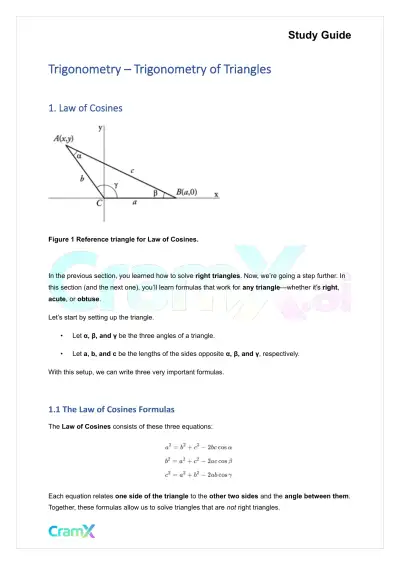 Quick Guides
Trigonometry - Trigonometry of Triangles
Mathematics
62 pagesMar 2026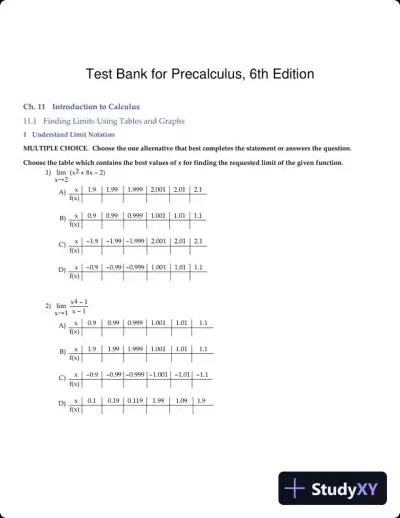 Exam Guides
Test Bank for Precalculus, 6th Edition
Mathematics
1051 pages175downloadsFeb 2025
Study this document with CramX
Once it is in your library, every tool can work from it.