

Microbiology, An Introduction , 10th Edition Test Bank
- Microbiology
- 452 pages
- Shared May 2025
Microbiology, An Introduction , 10th Edition Test Bank makes learning easy with a structured format, concise explanations, and plenty of practice material.
Preview 16 of 452 pages
See the first 16 pages exactly as they appear in the document.
Page 1 Read page 1 as text
Exam Name___________________________________ MULTIPLE CHOICE. Choose the one alternative that best completes the statement or answers the question. 1) Which of the following organisms lack cell walls? 1) A) Plantae B) Animalia C) Bacteria D) Fungi Answer: B Explanation: A) B) C) D) 2) Classification of organisms in the three domains is based on 2) A) Nutritional type. B) Number of cells. C) Nucleus. D) Cell wall. E) Type of cell. Answer: E Explanation: A) B) C) D) E) 3) Who was the first to observe microorganisms with a microscope? 3) A) Koch B) van Leeuwenhoek C) Pasteur D) Hooke E) Weizmann Answer: B Explanation: A) B) C) D) E) 4) Which of the following statements about insect control by microorganisms is true? 4) A) The insects develop resistance to the microorganisms. B) This technique is just as dangerous as the use of chemical pesticides. C) The microorganisms are specific for the insect pest. D) The microorganisms may cause disease in other animals. E) The microorganisms are permanent in the environment. Answer: C Explanation: A) B) C) D) E) 1
Page 2 Page 3 Read page 3 as text
5) You are observing a cell through a microscope and note that it has no apparent nucleus. You conclude that it most likely 5) A) Has a cellulose cell wall. B) Has a peptidoglycan cell wall. C) Moves by pseudopods. D) Is a plant cell. E) Is part of a multicellular animal. Answer: B Explanation: A) B) C) D) E) 6) Which of the following findings was essential for Jenner's vaccination process? 6) A) Someone who recovers from a disease will not acquire that disease again. B) A weakened microorganism may produce immunity. C) A weakened microorganism will not cause disease. D) Vaccination provides immunity. E) Disease is caused by viruses. Answer: B Explanation: A) B) C) D) E) 7) Which of the following is NOT a domain in the three - domain system? 7) A) Bacteria B) Eukarya C) Archaea D) Animalia Answer: D Explanation: A) B) C) D) 8) Which of the following CANNOT be made by using recombinant DNA technology? 8) A) Pharmaceutical drugs B) Life C) Human hormones D) Pest - resistant crops E) Vaccines Answer: B Explanation: A) B) C) D) E) 2
Page 4 Read page 4 as text
9) Which of the following does NOT belong with the others? 9) A) Protista B) Animalia C) Helminthes D) Fungi E) Plantae Answer: A Explanation: A) B) C) D) E) 10) Who proved that microorganisms cause disease? 10) A) van Leeuwenhoek B) Fleming C) Pasteur D) Koch E) Semmelweis Answer: D Explanation: A) B) C) D) E) 11) Which of the following processes in making blue jeans is incorrectly matched? 11) A) Plastic N bacterial PHA B) Blue dye N E. coli indigo C) Cotton N fungal hyphae D) Debleaching N bacterial enzyme E) Stone - washed N fungal enzyme Answer: C Explanation: A) B) C) D) E) 12) Regarding Pasteur's experiments with the S - neck flask, which of the following statements is true? 12) A) Any possibility of contamination was removed. B) There was a food source involved. C) All microorganisms were killed before beginning. D) There was air involved. E) All of the above. Answer: E Explanation: A) B) C) D) E) 3
Page 5 Read page 5 as text
13) Who observed cells in plant material? 13) A) Lister B) Hooke C) Koch D) Pasteur E) van Leeuwenhoek Answer: B Explanation: A) B) C) D) E) 14) Archaea differ from bacteria in that archaea 14) A) Use organic compounds for food. B) Reproduce by binary fission. C) Are prokaryotic. D) Lack peptidoglycan. E) Lack nuclei. Answer: D Explanation: A) B) C) D) E) 15) Which of the following is t he best definition of biotechnology ? 15) A) The curing of diseases B) The use of living organisms to make desired products C) The use of microorganisms in sewage treatment D) The development of recombinant DNA technology E) Bacterial production of foods Answer: B Explanation: A) B) C) D) E) 16) Which of the following pairs is mismatched? 16) A) Vaccine N a preparation of microorganisms B) Penicillin N antibiotic C) Normal microbiota N harmful D) Pathogen N disease causing E) Chemotherapy N treatment of disease Answer: C Explanation: A) B) C) D) E) 4
Page 6 Read page 6 as text
17) Which of the following pairs is mismatched? 17) A) Winogradsky N microbial ecology B) Jenner N immunology C) Lancefield N immunology D) Weizmann N virology E) Jacob and Monod N microbial genetics Answer: D Explanation: A) B) C) D) E) 18) You are looking at a white cottony growth on a culture medium. Microscopic examination reveals it is multicellular. Which of the following conclusions about this organism is false? 18) A) It is a bacterium. B) It has cell walls. C) It is eukaryotic. D) It has DNA enclosed in a nucleus. E) It absorbs organic nutrients. Answer: A Explanation: A) B) C) D) E) 19) A multicellular organism that has a mouth and lives in an animal host is a(n) 19) A) Fungus. B) Bacterium. C) Helminth. D) Alga. E) Virus. Answer: C Explanation: A) B) C) D) E) 20) A multicellular organism that has chitin cell walls and absorbs organic material is a(n) 20) A) Fungus. B) Helminth. C) Alga. D) Virus. E) Bacterium. Answer: A Explanation: A) B) C) D) E) 5
Page 7 Read page 7 as text
21) Bacteria differ from viruses in that bacteria 21) A) Can live without a host. B) Have DNA and RNA. C) Are composed of cells. D) All of the above. Answer: D Explanation: A) B) C) D) 22) Regular use of antibacterial cleaning products 22) A) Prevents occurrence of infections. B) Prevents bacteria from growing. C) Is necessary for good health. D) Promotes survival of bacteria that are resistant. E) A, B, and D Answer: D Explanation: A) B) C) D) E) 23) Which of the following pairs is mismatched? 23) A) Lister N aseptic surgery B) van Leeuwenhoek N germ theory C) Hooke N cell theory D) Jenner N vaccines E) Pasteur N fermentation Answer: B Explanation: A) B) C) D) E) 24) Which of the following statements about fungi is true? 24) A) All grow using sunlight and carbon dioxide. B) All are prokaryotic. C) All are multicellular. D) All are plants. E) All require organic material for growth. Answer: E Explanation: A) B) C) D) E) 6
Page 8 Read page 8 as text
25) Which of the following pairs is mismatched? 25) A) Microbial ecologist N studies bacteria that degrade oil B) Virologist N studies human immunodeficiency virus C) Molecular biologist N studies recombinant DNA D) Immunologist N studies ecology of Legionella pneumophila E) Microbial physiologist N studies fermentation of sourdough bread Answer: D Explanation: A) B) C) D) E) 26) Who disproved the theory of spontaneous generation? 26) A) van Leeuwenhoek B) Koch C) Virchow D) Pasteur E) Hooke Answer: D Explanation: A) B) C) D) E) 27) Which of the following is a scientific name? 27) A) Leprosy bacterium B) Mycobacterium leprae C) Hansen's bacillus D) Acid - fast bacteria Answer: B Explanation: A) B) C) D) 28) Which of the following pairs is mismatched? 28) A) Ehrlich N chemotherapy B) Koch N aseptic surgery C) Jenner N vaccination D) Pasteur N proof of biogenesis Answer: B Explanation: A) B) C) D) 7
Page 9 Read page 9 as text
29) Which of the following statements is false? 29) A) All fungi have nuclear membranes. B) All bacteria lack nuclear membranes. C) All viruses are parasites. D) All protozoa are unicellular. E) All fungi are multicellular. Answer: E Explanation: A) B) C) D) E) 30) Which one of the following does NOT belong with the others? 30) A) Bacteria B) Fungi C) Archaea D) Eukarya Answer: B Explanation: A) B) C) D) 31) Which one of the following does NOT belong with the others? 31) A) Peptidoglycan B) Chitin C) Nucleus D) Cellulose Answer: C Explanation: A) B) C) D) 32) Regarding the experiments that "proved" spontaneous generation, which of the following statements is probably true? 32) A) Excess carbon dioxide was present. B) Air was lacking. C) Microorganisms were already present. D) Too much heat was applied. E) The food source could not support life. Answer: C Explanation: A) B) C) D) E) 8
Page 10 Read page 10 as text
33) In the name Escherichia coli, coli is the 33) A) Specific epithet. B) Kingdom. C) Genus. D) Domain. E) Discoverer. Answer: A Explanation: A) B) C) D) E) 34) An agent that reproduces in cells but is NOT composed of cells and contains RNA as its genetic material is a(n) 34) A) Bacterium. B) Virus. C) Helminth. D) Alga. E) Fungus. Answer: B Explanation: A) B) C) D) E) 35) A nucleated, green cell that moves by means of flagella is a(n) 35) A) Alga. B) Virus. C) Bacterium. D) Helminth. E) Fungus. Answer: A Explanation: A) B) C) D) E) 36) Which of the following is a scientific name? 36) A) Streptococcus pyogenes B) Streptococci C) IGAS D) Group A streptococcus E) Flesh - eating bacteria Answer: A Explanation: A) B) C) D) E) 9
Page 11 Read page 11 as text
37) Which of the following lack a nucleus? 37) A) Protozoa B) Animalia C) Bacteria D) Fungi E) None of the above Answer: C Explanation: A) B) C) D) E) 38) Which of the following is NOT an example of biotechnology? 38) A) Bacterial production of French bread B) Bacterial production of vinegar C) Bacterial production of human insulin D) Bacterial production of yogurt E) Bacterial degradation of a dead animal Answer: E Explanation: A) B) C) D) E) 39) Which of the following statements is true? 39) A) Bacteria cannot move. B) Viruses cannot reproduce outside a host cell. C) Protozoa have rigid cell walls. D) Algae are parasites. E) Fungi are plants. Answer: B Explanation: A) B) C) D) E) 40) Which of the following requirements was NOT necessary for Pasteur to disprove spontaneous generation? 40) A) Keeping microorganisms out B) Providing a food source that would support growth C) Identifying bacteria D) Supplying air E) Removing microorganisms that were initially present Answer: C Explanation: A) B) C) D) E) 10
Page 12 Read page 12 as text
41) Which of the following statements about viruses is false? 41) A) They cannot reproduce themselves. B) They lack cells. C) They have both DNA and RNA. D) They are parasites. E) They cannot metabolize nutrients. Answer: C Explanation: A) B) C) D) E) 42) Fungi differ from bacteria in that fungi 42) A) Have DNA. B) Are cellular. C) Have cell walls. D) Spoil food. E) Have a nucleus. Answer: E Explanation: A) B) C) D) E) 43) Which of the following statements about biofilms is false? 43) A) Biofilms in your body protect mucous membranes from harmful microbes. B) Biofilms on medical implants cause infections. C) Biofilms on rocks provide food for animals. D) Compared to free - living bacteria, biofilms are more sensitive to antibiotics. E) Biofilms in pipes block the flow of water. Answer: D Explanation: A) B) C) D) E) 44) Which of the following statements about protozoa is false? 44) A) All are unicellular. B) All are eukaryotic. C) They have rigid cell walls. D) All have complex cells. E) They are classified by their method of locomotion. Answer: C Explanation: A) B) C) D) E) 11
Page 13 Read page 13 as text
45) Which of the following groups include members that lack DNA? 45) A) Fungi B) Protozoa C) Bacteria D) Helminths E) Viruses Answer: E Explanation: A) B) C) D) E) ESSAY. Write your answer in the space provided or on a separate sheet of paper. 46) Paul Berg received the Nobel Prize for developing the procedure for incorporating fragments of animal DNA into bacteria. List some reasons why his work was a major contribution to science. Answer: 47) List two examples of biotechnology that involve recombinant DNA technology and two examples that do not. Answer: 48) In 1835 Bassi showed that a fungus caused a silkworm disease, and in 1865 Pasteur discovered that a protozoan caused another silkworm disease. Why do we use Koch's postulates instead of "Bassi's" or "Pasteur's" postulates? Answer: 12
Page 14 Read page 14 as text
Answer Key Testname: C1 1) B 2) E 3) B 4) C 5) B 6) B 7) D 8) B 9) A 10) D 11) C 12) E 13) B 14) D 15) B 16) C 17) D 18) A 19) C 20) A 21) D 22) D 23) B 24) E 25) D 26) D 27) B 28) B 29) E 30) B 31) C 32) C 33) A 34) B 35) A 36) A 37) C 38) E 39) B 40) C 41) C 42) E 43) D 44) C 45) E 46) 47) 48) 13
Page 15 Read page 15 as text
Exam Name___________________________________ MULTIPLE CHOICE. Choose the one alternative that best completes the statement or answers the question. 1) Assume Saccharomyces cerevisiae is grown in a nutrient medium containing the radioisotope 35 S. After a 48 - hour incubation, the 35 S would most likely be found in the S. cerevisiae 's 1) A) Carbohydrates. B) Nucleic acids. C) Proteins. D) Lipids. E) Water. Answer: C Explanation: A) B) C) D) E) 2) An E. coli culture that has been growing at 37 ° C is moved to 25 ° C. Which of the following changes must be made in its plasma membrane? 2) A) The number of unsaturated chains must increase. B) The number of phosphate groups must increase. C) The number of saturated chains must increase. D) The viscosity must increase. E) No changes are necessary. Answer: A Explanation: A) B) C) D) E) 3) The antimicrobial drug imidazole inhibits sterol synthesis. This would most likely interfere with 3) A) Prokaryotic plasma membranes. B) Genes. C) Fungal cell walls. D) Bacterial cell walls. E) Eukaryotic plasma membranes. Answer: E Explanation: A) B) C) D) E) 1
Page 16 Read page 16 as text
Figure 2.2 4) Use Figure 2.2 to answer the following question. Archaea differ from bacteria in the composition of the cell membrane lipids. Archaea have ether - bonded lipids, shown in part ________ of Figure 2.2, and bacteria have ester - bonded lipids, shown in part ________ of Figure 2.2. 4) A) b; c B) b; a C) d; c D) c; d E) a; d Answer: B Explanation: A) B) C) D) E) 5) What is the type of bond holding hydrogen and oxygen atoms in the H 2 O molecule? 5) A) Ionic bond B) Hydrogen bond C) Covalent bond Answer: C Explanation: A) B) C) 2
436 more pages in the full document
Unlock it once and it stays in your library, ready to chat with or turn into flashcards.
Unlock the full documentMore Microbiology study materials
See all Past Exams
2024-2025 Boards: Microbiology - Vandy's Review PP Exam with Answers (55 Solved Questions)
Microbiology
22 pages171downloadsFeb 2025 Exam Guides
Test Bank For Microbiology: A Systems Approach, 3rd Edition
Microbiology
546 pages124downloadsFeb 2025 Exam Guides
Test Bank for Foundations In Microbiology, 9th Edition
Microbiology
338 pages120downloadsFeb 2025 Textbook Guides
Solution Manual For Microbiology: An Introduction, 13th Edition
Microbiology
298 pages36downloadsFeb 2025 Exam Guides
Test Bank For Microbiology with Diseases by Taxonomy, 6th Edition
Microbiology
532 pagesMay 2025 Quick Guides
Microbiology - DNA and Gene Expression
Microbiology
15 pagesMar 2026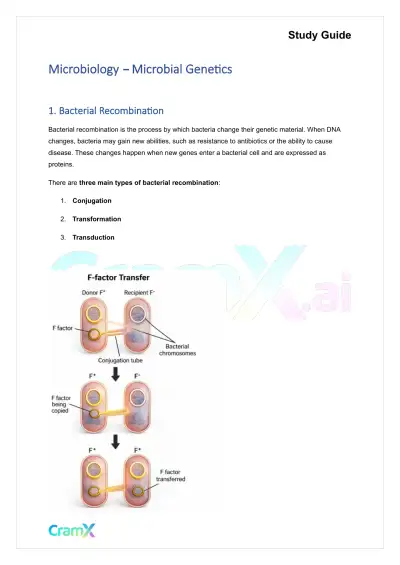 Quick Guides
Microbiology - Microbial Genetics
Microbiology
13 pagesMar 2026 Past Exams
Microbiology Practice Exam With Answers (1000 Solved Questions)
Microbiology
156 pagesMay 2025
Study this document with CramX
Once it is in your library, every tool can work from it.