

Microbiology Final Exam With Answers (14 Solved Questions)
- Microbiology
- 4 pages
- Shared May 2025
Microbiology Final Exam With Answers provides an exam simulation experience with past test questions and expert solutions.
Preview 2 of 4 pages
See the first 2 pages exactly as they appear in the document.
Page 1 Read page 1 as text
Straighterline Microbiology Final Exam Practice BIO250_Saylor_V5 Practice Questions 1. In the nitrogen cycle, which of the following steps involves removal of nitrogen from the atmosphere by bacteria? a. Ammonification b. Denitrification c. Nitrification d. Nitrogen fixation Answer is d. In nitrogen fixation, nitrogen is removed from the atmosphere by nitrogen-fixing bacteria and converted to ammonia 2. If enough H + ions are added to pure water to raise the H + concentration of the solution to ten times higher than the original concentration, what is the resulting OH - concentration of the solution? a. 10 -5 M b. 10 -6 M c. 10 -7 M d. 10 -8 M Answer is d. The H + concentration would be 10 -6 M, resulting in the OH - being 10 -8 M 3. Fungi are able to reproduce asexually by creating conidiospores and sponrangiospores. Which of the following is an accurate explanation for why it is advantageous that they are also capable of sexual reproduction? a. Asexually produced offspring are more likely to compete for resources and will kill off the parental fungi b. Fungi normally produce sexually but produce asexually in harsh conditions such as severe drought c. Offspring from two parents may have variations in form and function that contribute to survival of the species. d. Sexual reproduction produces more offspring at a faster rate than spore formation Answer is c. Sexually produced offspring have traits from both parents and may develop variations that give them an advantage for survival. 4. In a laboratory bacterial cell culture that had been infected by a virus, plaques are areas in which a. Bacterial cells are resistant to the virus and have not been infected b. There is no nutrient available for the bacteria to grow c. The virus has spread and left behind the remains of dead cells d. The virus has not yet spread to the area of cells Answer is c. Plaques are areas in which the bacteria have been destroyed by the virus and all that remain are dead cells 5. The sun’s energy is delivered as discrete packets that travel as waves and are called a. ATP b. Carotenoids c. NADP d. Photons Answer is d. 6. Which of the following is a characteristic of aerobic respiration?
Page 2
2 more pages in the full document
Unlock it once and it stays in your library, ready to chat with or turn into flashcards.
Unlock the full documentMore Microbiology study materials
See all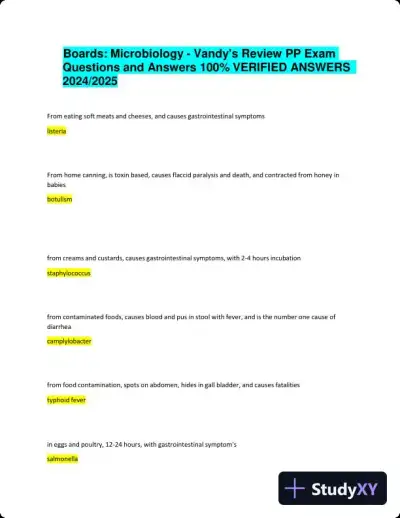 Past Exams
2024-2025 Boards: Microbiology - Vandy's Review PP Exam with Answers (55 Solved Questions)
Microbiology
22 pages171downloadsFeb 2025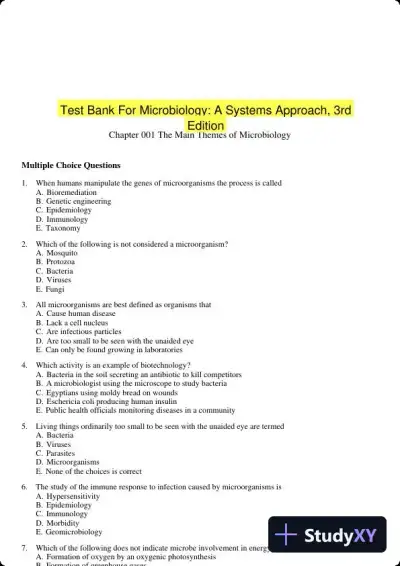 Exam Guides
Test Bank For Microbiology: A Systems Approach, 3rd Edition
Microbiology
546 pages124downloadsFeb 2025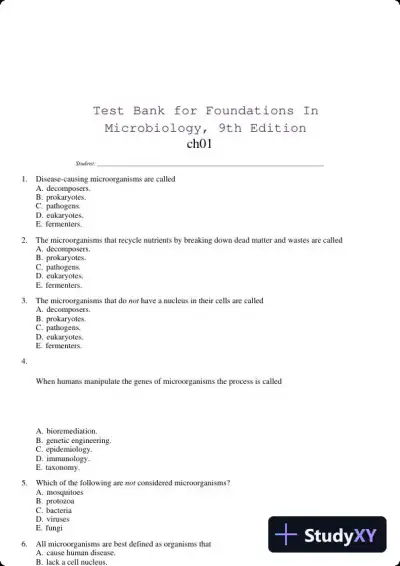 Exam Guides
Test Bank for Foundations In Microbiology, 9th Edition
Microbiology
338 pages120downloadsFeb 2025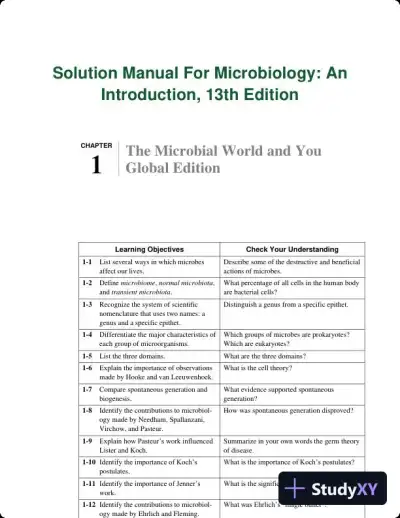 Textbook Guides
Solution Manual For Microbiology: An Introduction, 13th Edition
Microbiology
298 pages36downloadsFeb 2025 Exam Guides
Test Bank For Microbiology with Diseases by Taxonomy, 6th Edition
Microbiology
532 pagesMay 2025 Quick Guides
Microbiology - DNA and Gene Expression
Microbiology
15 pagesMar 2026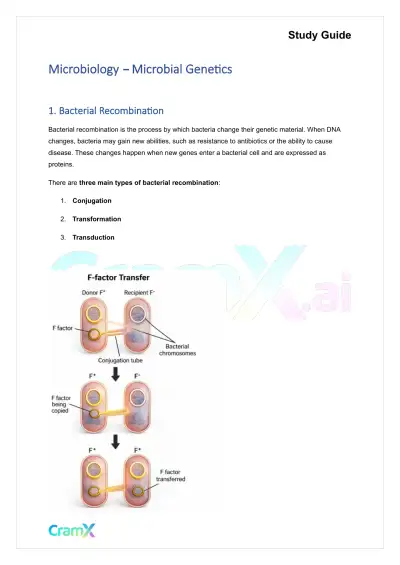 Quick Guides
Microbiology - Microbial Genetics
Microbiology
13 pagesMar 2026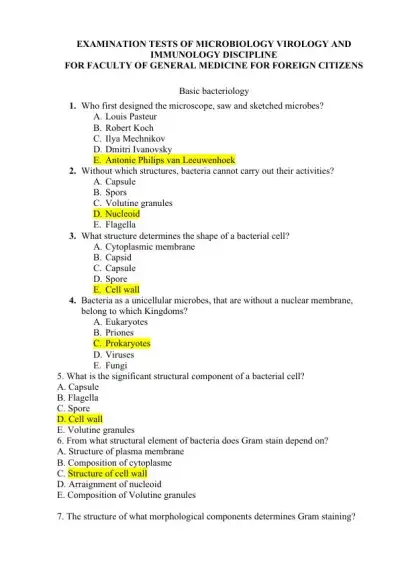 Past Exams
Microbiology Practice Exam With Answers (1000 Solved Questions)
Microbiology
156 pagesMay 2025
Study this document with CramX
Once it is in your library, every tool can work from it.