

Microbiology - The Host Parasite Relationship
- Microbiology
- Texas A&M University
- 9 pages
- Shared March 2026
Preview 3 of 9 pages
See the first 3 pages exactly as they appear in the document.
Page 1 Read page 1 as text
Study Guide Microbiology – The Host Parasite Relationship 1. Infection and Disease A delicate balance exists between disease - causing microorganisms and the body’s defense systems. When the body’s defenses are strong enough to control or destroy invading microbes, the person remains healthy . However, when the microorganisms overcome these defenses, disease develops. Once disease occurs, the outcome can vary. An infected person may: • Recover completely • Suffer temporary damage • Experience permanent injury • In severe cases, die The final result depends on many factors, including the type of microorganism, the strength of the host’s defenses, and how quickly treatment begins. 1.1 Pathology – The Study of Disease The scientific study of disease is called pathology . The word comes from the Greek pathos , meaning suffering . Pathology focuses on several important aspects of disease: • Etiology – the cause of disease o The microorganism responsible is called the etiologic agent • Pathogenesis – the process by which disease develops • Structural and functional changes – how tissues and organs are altered during disease 1.2 Infection vs Disease The terms infection and disease do not mean the same thing.
Page 2 Read page 2 as text
Study Guide • Infection refers to the invasion of body tissues by microorganisms • Disease is a disturbance of normal health caused by microorganisms living and multiplying in the tissues It is important to note that infection can occur without disease . For example, microorganisms normally found on the skin are considered an infection, but they do not usually cause illness. Figure 1 The balance between health and disease. The condition of the human body depends on interactions between host (the body) and parasite (the infectious microorganism). When the human body wins the battle for supremacy, the result is health and the rejection of disease . 1.3 The Normal Flora The normal flora refers to microorganisms that normally live on or in the body at sites where the body contacts the environment. • Much of the normal flora is permanent • Some microorganisms are transient , meaning they remain for a short time and then disappear
Page 3 Read page 3 as text
Study Guide Normal flora is commonly found on: • Skin • Mouth • Intestines • Respiratory tract 1.4 Symbiotic Relationships The general term for a relationship between two living organisms is symbiosis , which means living together . There are several types of symbiotic relationships between the body and microorganisms. Types of Symbiosis • Commensalism o One organism benefits o The other is neither helped nor harmed • Mutualism o Both organisms benefit from the relationship • Parasitism o One organism benefits o The other is harmed The relationship between the human body and its normal flora may fall into any of these categories. 1.5 Opportunistic Organisms Some members of the normal flora are known as opportunistic organisms . • These organisms are potentially pathogenic • Under normal conditions, they do not cause disease • When the host’s defenses are weakened, they may cause serious infections Such individuals are called compromised hosts .
6 more pages in the full document
Unlock it once and it stays in your library, ready to chat with or turn into flashcards.
Unlock the full documentMore Microbiology study materials
See all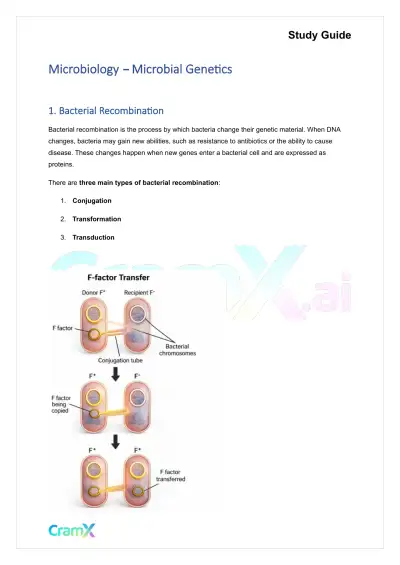 Quick Guides
Microbiology - Microbial Genetics
Microbiology
13 pagesMar 2026 Quick Guides
Microbiology - DNA and Gene Expression
Microbiology
15 pagesMar 2026 Quick Guides
Microbiology - Diseases of the Digestive System
Microbiology
15 pagesMar 2026 Quick Guides
Microbiology - Microbial Metabolism
Microbiology
16 pagesMar 2026 Quick Guides
Microbiology - Food Microbiology
Microbiology
13 pagesMar 2026 Quick Guides
Microbiology - Prokaryotes and Eukaryotes
Microbiology
13 pagesMar 2026 Quick Guides
Microbiology - Microbial Cultivation and Growth
Microbiology
15 pagesMar 2026 Quick Guides
Microbiology - Control of Microbial Growth
Microbiology
22 pagesMar 2026
Study this document with CramX
Once it is in your library, every tool can work from it.