

Microbiology - Food Microbiology
- Microbiology
- Texas A&M University
- 13 pages
- Shared March 2026
Preview 4 of 13 pages
See the first 4 pages exactly as they appear in the document.
Page 1 Read page 1 as text
Study Guide Microbiology – Food Microbiology 1. Food Preservation Food preservation includes methods used to prevent food spoilage and protect food from harmful microorganisms . These methods work in three main ways: 1. Keeping microorganisms out of food 2. Removing microorganisms already present 3. Slowing or stopping the growth of microorganisms in food Using the right preservation method helps food stay safe, fresh, and nutritious for longer periods. 1. 1 Preventing Contamination The first step in food preservation is preventing microorganisms from entering food in the first place. This is done by: • Sterilizing and sanitizing equipment • Maintaining cleanliness during food preparation • Sealing foods in protective packaging Microorganisms can also be removed by: • Filtering or sedimenting liquid foods • Washing fruits and vegetables • Trimming contaminated parts from meat and poultry 1.2 Heat Preservation Heat is one of the most effective ways to preserve food because it kills microorganisms .
Page 2 Read page 2 as text
Study Guide Key Factors in Heat Treatment • The number of microorganisms present (microbial load) • The type of microorganism o Bacterial spores are much more resistant than active (vegetative) cells • Acidity of the food (higher acidity increases effectiveness) Types of Heat Treatments There are three main heat - based preservation methods: 1. Pasteurization o 62°C for 30 minutes or o 72°C for 15 – 17 seconds This reduces harmful microbes without seriously affecting food quality. 2. Hot Filling o Liquids and juices are boiled o Then poured into containers while hot 3. Canning (Steam Under Pressure) o Uses high heat and pressure to kill even resistant microorganisms The effectiveness of heat is measured using thermal death time , which is the time needed at a specific temperature to kill a certain number of microorganisms. Steps in the Canning Process • Food is washed to remove dirt • Blanching briefly heats food to stop enzyme activity • Damaged sections are removed • Food is sealed in cans • Cans are heated in a retort at controlled temperature and time
Page 3 Read page 3 as text
Study Guide 1.3 Low - Temperature Preservation Cold temperatures slow microbial growth by reducing enzyme activity , but they do not kill all microorganisms. Refrigeration Some bacteria, called psychrophiles , can still grow in the cold. Common examples belong to: • Pseudomonas • Alcaligenes • Micrococcus • Flavobacterium Fungi can also grow at refrigerator temperatures. Freezing • Slow freezing and quick freezing are used for long - term storage • Freezing reduces microbial numbers but does not eliminate them • Ice crystals damage microbial cells • Increased solute concentration in unfrozen water causes protein damage 1.4 Chemical Preservation Certain chemicals slow or stop microbial growth and are safe for human consumption. Common preservatives include: • Propionic acid • Sorbic acid • Benzoic acid • Sulfur dioxide Some antibiotics , such as tetracycline, are used to preserve meats where regulations allow. These residues usually disappear during storage and cooking.
Page 4 Read page 4 as text
Study Guide Natural Preservatives Many foods naturally preserve themselves: • Sauerkraut uses lactic and acetic acids • Fermented milk products (yogurt, sour cream) rely on acids produced by bacteria These traditional methods have been used for centuries. 1.5 Drying Drying preserves food by removing water , which microorganisms need to survive. Methods include: • Sun drying • Belt, tunnel, and cabinet dryers (used in industry) • Freeze - drying (lyophilization) , which removes moisture while keeping food lightweight and stable 1.6 Radiation Preservation Radiation can reduce microbial contamination without heating food. • Ultraviolet (UV) radiation is used to disinfect food surfaces • Ionizing radiation (such as gamma rays) is used for certain fruits, vegetables, and spices, following safety regulations Key Takeaway Food preservation works by controlling microorganisms through heat, cold, chemicals, drying, and radiation. Understanding how these methods function helps ensure food safety, reduce waste, and protect public health.
9 more pages in the full document
Unlock it once and it stays in your library, ready to chat with or turn into flashcards.
Unlock the full documentMore Microbiology study materials
See all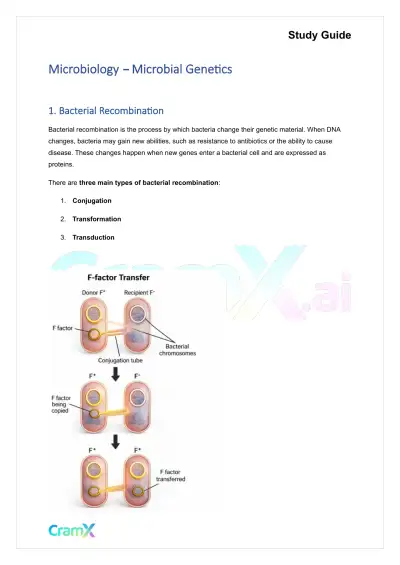 Quick Guides
Microbiology - Microbial Genetics
Microbiology
13 pagesMar 2026 Quick Guides
Microbiology - DNA and Gene Expression
Microbiology
15 pagesMar 2026 Quick Guides
Microbiology - Diseases of the Digestive System
Microbiology
15 pagesMar 2026 Quick Guides
Microbiology - Microbial Metabolism
Microbiology
16 pagesMar 2026 Quick Guides
Microbiology - Prokaryotes and Eukaryotes
Microbiology
13 pagesMar 2026 Quick Guides
Microbiology - Microbial Cultivation and Growth
Microbiology
15 pagesMar 2026 Quick Guides
Microbiology - The Chemical Basis of Microbiology
Microbiology
13 pagesMar 2026 Quick Guides
Microbiology - Control of Microbial Growth
Microbiology
22 pagesMar 2026
Study this document with CramX
Once it is in your library, every tool can work from it.