

Microbiology - Microbial Metabolism
- Microbiology
- Texas A&M University
- 16 pages
- Shared March 2026
Preview 5 of 16 pages
See the first 5 pages exactly as they appear in the document.
Page 1 Read page 1 as text
Study Guide Microbiology – Microbial Metabolism 1. Cellular Respiration Microorganisms need energy to grow, move, and carry out life processes. Some microorganisms, such as cyanobacteria , can capture energy from sunlight through photosynthesis and store it in carbohydrates. The main carbohydrate produced during photosynthesis is glucose . However, many microorganisms — such as non - photosynthetic bacteria, fungi, and protozoa — cannot make their own food. These organisms must obtain preformed carbohydrates from the environment. To release energy from these carbohydrates, they use a process called cellular respiration . 1.1 What Is Cellular Respiration? Cellular respiration is the process by which microorganisms break down carbohydrates, especially glucose, to release energy. During this process: • Glucose is broken down step by step • Energy is captured and stored as ATP (adenosine triphosphate) • Carbon dioxide (CO ₂ ) is released as a waste product • Oxygen is used as the final acceptor of electrons The ATP produced is used later for cellular activities. The carbon dioxide released can be reused by photosynthetic organisms to make new carbohydrates. 1.2 Major Stages of Cellular Respiration Cellular respiration occurs in four main stages : 1. Glycolysis 2. Krebs cycle 3. Electron transport system 4. Chemiosmosis
Page 2 Read page 2 as text
Study Guide Figure 1 An overview of the processes of cellular respiration showing the major pathways and the places where ATP is synthesized . Glycolysis Glycolysis is the first stage of cellular respiration. Key Features • Occurs in the cytoplasm • Does not require oxygen (anaerobic) • Involves multiple enzyme - controlled steps
Page 3 Read page 3 as text
Study Guide What Happens in Glycolysis? • One glucose molecule (6 carbons) is broken into two pyruvic acid molecules (3 carbons each) • 2 ATP molecules are used early in the process • 4 ATP molecules are produced later Net Energy Gain • Net gain: 2 ATP molecules In addition: • 2 NADH molecules are produced • NADH carries high - energy electrons to later stages For some anaerobic organisms, glycolysis is the only source of energy , but it is inefficient because much energy remains in pyruvic acid. Krebs Cycle (Citric Acid Cycle) After glycolysis, cellular respiration continues with the Krebs cycle , also called: • Citric acid cycle • Tricarboxylic acid (TCA) cycle Location • Bacterial cells : cell membrane • Eukaryotic cells : mitochondria Mitochondria have: • An outer membrane • A highly folded inner membrane called cristae , which holds important enzymes for ATP production
Page 4 Read page 4 as text
Study Guide Preparation Step: Pyruvic Acid to Acetyl - CoA Before entering the Krebs cycle: • Each pyruvic acid molecule loses one carbon as CO ₂ • The remaining two carbons combine with coenzyme A • This forms acetyl - CoA • NADH is produced in the process Events in the Krebs Cycle • Acetyl - CoA combines with oxaloacetic acid to form citric acid • Citric acid undergoes a series of enzyme - controlled reactions • During these reactions: o NADH and FADH ₂ are formed o ATP is produced o Carbon dioxide is released Energy Yield (per glucose) • 2 ATP molecules • Many NADH molecules • Some FADH ₂ molecules • 6 CO ₂ molecules released in total At the end of the cycle, oxaloacetic acid is regenerated and ready to start the cycle again. Electron Transport System (ETS) The electron transport system is where most energy is released. Location • Bacteria : cell membrane • Eukaryotes : cristae of mitochondria
Page 5 Read page 5 as text
Study Guide What Happens? • NADH and FADH ₂ donate electrons • Electrons pass through a chain of cytochromes and coenzymes • Energy from electrons is used to pump protons (H ⁺ ) across the membrane Each: • NADH moves about 6 protons • FADH ₂ moves about 4 protons The final electron acceptor is oxygen , which combines with electrons and protons to form water (H ₂ O) . Without oxygen: • Electrons cannot flow • ATP cannot be produced • Cellular respiration stops Chemiosmosis Chemiosmosis is the stage where ATP is actually synthesized. How It Works • Proton pumping creates a proton gradient • Protons flow back through special protein channels • Energy from proton movement is used to convert ADP + phosphate into ATP ATP Yield • Prokaryotes: 36 ATP molecules • Eukaryotes: 34 ATP molecules • Plus 2 ATP from glycolysis Total ATP per Glucose • Prokaryotes: 38 ATP • Eukaryotes: 36 ATP
11 more pages in the full document
Unlock it once and it stays in your library, ready to chat with or turn into flashcards.
Unlock the full documentMore Microbiology study materials
See all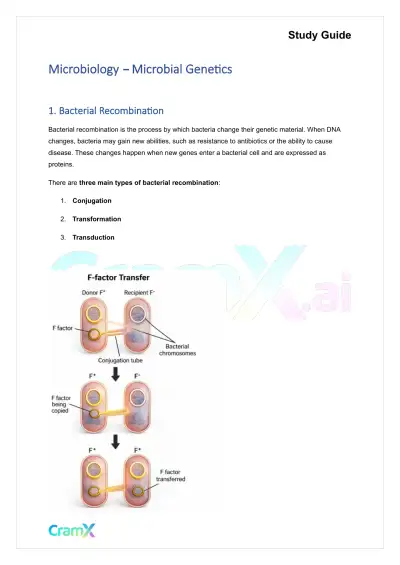 Quick Guides
Microbiology - Microbial Genetics
Microbiology
13 pagesMar 2026 Quick Guides
Microbiology - DNA and Gene Expression
Microbiology
15 pagesMar 2026 Quick Guides
Microbiology - Diseases of the Digestive System
Microbiology
15 pagesMar 2026 Quick Guides
Microbiology - Food Microbiology
Microbiology
13 pagesMar 2026 Quick Guides
Microbiology - Prokaryotes and Eukaryotes
Microbiology
13 pagesMar 2026 Quick Guides
Microbiology - Microbial Cultivation and Growth
Microbiology
15 pagesMar 2026 Quick Guides
Microbiology - The Chemical Basis of Microbiology
Microbiology
13 pagesMar 2026 Quick Guides
Microbiology - Control of Microbial Growth
Microbiology
22 pagesMar 2026
Study this document with CramX
Once it is in your library, every tool can work from it.