

Microbiology - Prokaryotes and Eukaryotes
- Microbiology
- Texas A&M University
- 13 pages
- Shared March 2026
Preview 4 of 13 pages
See the first 4 pages exactly as they appear in the document.
Page 1 Read page 1 as text
Study Guide Microbiology – Prokaryotes and Eukaryotes 1. Eukaryotic Cells Eukaryotic cells are generally larger and more complex than prokaryotic cells. A key feature that sets them apart is the presence of membrane - bound organelles — specialized structures that carry out specific jobs inside the cell. These organelles act like compartments, keeping different metabolic activities organized and efficient. Many microorganisms, including protozoa, unicellular algae, and fungi , have eukaryotic cells. 1.1 The Nucleus: The Control Center Every eukaryotic cell has a well - defined nucleus . It is made mainly of protein and DNA (deoxyribonucleic acid) . • DNA is arranged into linear structures called chromosomes . • When chromosomes are not clearly visible, they are referred to as chromatin . • Specific working sections of chromosomes are called genes , which carry instructions for cell functions. Nuclear Proteins and Division DNA is supported by special proteins known as histones , which help package and organize it. DNA replication in eukaryotic cells occurs during mitosis . Nuclear Envelope and Pores The nucleus is surrounded by a nuclear envelope , a double membrane similar to the cell membrane. This envelope has pores , allowing communication between the nucleus and the cytoplasm. Nucleolus Inside the nucleus are one or more dense regions called nucleoli (singular: nucleolus). The nucleolus is rich in RNA and is the site where ribosomes are assembled before moving into the cytoplasm.
Page 2 Read page 2 as text
Study Guide 1.2 Cellular Organelles: Specialized Cell Structures The fluid inside the cell is called the cytoplasm (or cytosol ). Floating within it are many organelles, each with a specific role. Endoplasmic Reticulum (ER) The endoplasmic reticulum is a network of membranes spread throughout the cytoplasm. • Rough ER has ribosomes attached and is involved in protein synthesis . • Smooth ER lacks ribosomes and is involved in other metabolic activities. Eukaryotic ribosomes are 80S ribosomes , where amino acids are linked together to form proteins. The spaces inside the ER membranes are called cisternae . Golgi Apparatus The Golgi body (Golgi apparatus) consists of flattened, stacked sacs. • It modifies, processes, and packages proteins and lipids . • The edges of Golgi sacs often form secretory vesicles , which carry materials to their final destination in or outside the cell. Lysosomes and Peroxisomes • Lysosomes are enzyme - filled sacs derived from the Golgi apparatus. o They digest food particles and recycle worn - out cell components. • Peroxisomes also contain enzymes and help break down harmful substances inside the cell. Mitochondria: The Powerhouses Mitochondria are the sites where most cellular energy is released. • Energy is stored as adenosine triphosphate (ATP) . • Because of this role, mitochondria are often called the “powerhouses of the cell.”
Page 3 Read page 3 as text
Study Guide Vacuoles Some protozoa contain a large contractile vacuole . • It may occupy more than 75% of the cell interior . • Its main function is to remove excess water and prevent the cell from bursting. Cytoskeleton The cytoskeleton is a network of protein fibers that gives the cell its shape and internal organization. It includes: • Microtubules • Microfilaments • Intermediate filaments All are made of protein subunits and help with movement, transport, and structural support. Flagella and Cilia Many eukaryotic cells have flagella or cilia for movement. • Flagella are long, whip - like structures that propel the cell. • Cilia are shorter, more numerous, and move in coordinated waves. Both structures have a characteristic 9 + 2 arrangement of microfilaments . A well - known example of a ciliated protozoan is Paramecium . The Cell Wall Some eukaryotes, especially fungi and algae , have a cell wall outside the cell membrane. • Fungal cell walls contain chitin and some cellulose. • Algal cell walls contain cellulose only . Cell walls: • Provide support and protection • Help cells resist mechanical pressure • Are not selective , unlike cell membranes
Page 4 Read page 4 as text
Study Guide The Cell Membrane The eukaryotic cell membrane follows the fluid mosaic model , similar to prokaryotic membranes. Functions include: • Regulating movement of substances into and out of the cell • Maintaining the internal environment of the cytoplasm However, unlike prokaryotic membranes, it: • Does not contain metabolic enzymes • Does not participate in DNA replication 1.3 Transport Across the Cell Membrane For cells to survive, materials must move across the membrane. This happens in several ways: Diffusion • Movement of molecules from high concentration to low concentration • Occurs randomly along a concentration gradient Osmosis • Diffusion of water only • Occurs across a semipermeable membrane Facilitated Diffusion • Uses membrane proteins • Moves substances down the concentration gradient • Requires no energy Active Transport • Moves substances from low concentration to high concentration • Goes against the concentration gradient • Requires energy , usually from ATP
9 more pages in the full document
Unlock it once and it stays in your library, ready to chat with or turn into flashcards.
Unlock the full documentMore Microbiology study materials
See all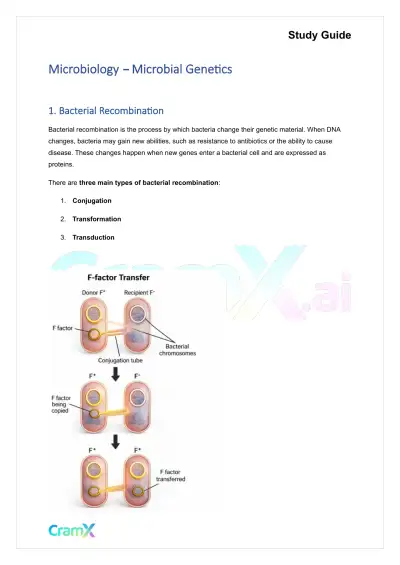 Quick Guides
Microbiology - Microbial Genetics
Microbiology
13 pagesMar 2026 Quick Guides
Microbiology - DNA and Gene Expression
Microbiology
15 pagesMar 2026 Quick Guides
Microbiology - Diseases of the Digestive System
Microbiology
15 pagesMar 2026 Quick Guides
Microbiology - Microbial Metabolism
Microbiology
16 pagesMar 2026 Quick Guides
Microbiology - Food Microbiology
Microbiology
13 pagesMar 2026 Quick Guides
Microbiology - Microbial Cultivation and Growth
Microbiology
15 pagesMar 2026 Quick Guides
Microbiology - The Chemical Basis of Microbiology
Microbiology
13 pagesMar 2026 Quick Guides
Microbiology - Control of Microbial Growth
Microbiology
22 pagesMar 2026
Study this document with CramX
Once it is in your library, every tool can work from it.