

Test Bank For Burtons Microbiology for the Health Sciences, 9th Edition
- Microbiology
- 176 pages
- Shared May 2025
Test Bank For Burtons Microbiology for the Health Sciences, 9th Edition provides targeted exam strategies, ensuring you approach each question with clarity and precision.
Preview 16 of 176 pages
See the first 16 pages exactly as they appear in the document.
Page 1 Read page 1 as text
1. Which of the following individuals is considered to be the “Father of Microbiology”? A) Anton van Leeuwenhoek B) Louis Pasteur C) Robert Koch D) Rudolf Virchow 2. The microorganisms that usually live on or within a person are collectively referred to as A) germs. B) indigenous microflora. C) nonpathogens. D) opportunistic pathogens. 3. Microorganisms that live on dead and decaying organic material are known as A) indigenous microflora. B) parasites. C) pathogens. D) saprophytes. 4. The study of algae is called A) algaeology. B) botany. C) mycology. D) phycology. 5. The field of parasitology involves the study of which of the following types of organisms? A) arthropods, bacteria, fungi, protozoa, and viruses B) arthropods, helminths, and certain protozoa C) bacteria, fungi, and protozoa D) bacteria, fungi, and viruses
Page 2 Page 3 Read page 3 as text
6. Rudolf Virchow is given credit for proposing which of the following theories? A) abiogenesis B) biogenesis C) germ theory of disease D) spontaneous generation 7. Which of the following microorganisms are considered obligate intracellular pathogens? A) chlamydias, rickettsias, Mycobacterium leprae , and Treponema pallidum B) Mycobacterium leprae and Treponema pallidum C) Mycobacterium tuberculosis and viruses D) rickettsias, chlamydias, and viruses 8. Which one of the following statements is true? A) Koch developed a rabies vaccine. B) Microorganisms are ubiquitous. C) Most microorganisms are harmful to humans. D) Pasteur conducted experiments that proved the theory of abiogenesis. 9. Which of the following are even smaller than viruses? A) chlamydias B) prions and viroids C) rickettsias D) cyanobacteria 10. Which of the following individuals introduced the terms “aerobes” and “anaerobes”? A) Anton van Leeuwenhoek B) Louis Pasteur C) Robert Koch D) Rudolf Virchow
Page 4 Read page 4 as text
Use the following to answer questions 11-15: Match the following names with the correct phrases. a. Anton van Leeuwenhoek b. Robert Koch c. Louis Pasteur d. Rudolf Virchow e. Alexandre Emil Jean Yersin 11. Developed vaccines for anthrax and rabies. 12. Proposed the theory of biogenesis. 13. Discovered the etiologic agent of plague. 14. The first person to observe live bacteria and protozoa. 15. Developed an experimental procedure that could be used to prove that a specific microorganism is the cause of a specific infectious disease. Use the following to answer questions 16-20: Match the following items with the correct statements. a. pathogens b. nonpathogens c. opportunistic pathogens d. indigenous microflora e. saprophytes
Page 5 Read page 5 as text
16. Organisms that live on dead or decaying organic matter. 17. Microorganisms that do not cause disease. 18. Microorganisms that usually do not cause disease, but can cause disease under certain circumstances. 19. The microorganisms that live on us and in us. 20. The most common causes of infectious diseases or microbial intoxications. 21. All infectious diseases are caused by pathogens. A) True B) False 22. Pathogens greatly outnumber nonpathogens. A) True B) False 23. Using microorganisms to clean up the environment is known as bioremediation. A) True B) False 24. Microorganisms are essential in the field of genetic engineering. A) True B) False
Page 6 Read page 6 as text
25. Microorganisms probably appeared on earth about 3.5 million years ago. A) True B) False 26. Anton van Leeuwenhoek's experiments helped to prove that microorganisms cause disease. A) True B) False 27. Louis Pasteur and Robert Koch made significant contributions to the “Germ Theory of Disease.” A) True B) False 28. Pasteurization is a process that kills all microorganisms present in the liquid being pasteurized. A) True B) False 29. Microorganisms contribute more oxygen to our atmosphere than plants do. A) True B) False 30. Infectious diseases that are transmitted from animals to humans are known as zoonoses. A) True B) False Use the following to answer questions 31-34: Match the following names with the correct statements.
Page 7 Read page 7 as text
a. Robert Koch b. Louis Pasteur c. Rudolf Virchow d. Antony van Leeuwenhoek 31. This German scientist proposed the theory of biogenesis—that life can arise only from preexisting life. 32. This Dutchman built single lens microscopes as a hobby and is believed to be the first person to see live bacteria and protozoa. 33. This German physician developed a step-by- step scientific method to prove that a particular microorganism causes a particular disease and contributed to what is known as “the germ theory of disease.” 34. This French scientist discovered that microorganisms are responsible for fermentations, contributed to disproving abiogenesis, and contributed to what is known as “the germ theory of disease.” Answer Key 1. A 2. B 3. D 4. D 5. B 6. B 7. D 8. B 9. B 10. B 11. c 12. d 13. e
Page 8 Read page 8 as text
5. B 6. B 7. D 8. B 9. B 10. B 11. c 12. d 13. e 14. a 15. b 16. e 17. b 18. c 19. d 20. a 21. A 22. B 23. A 24. A 25. B 26. B 27. A 28. B 29. A 30. A 31. c 32. d 33. a 34. b
Page 9 Read page 9 as text
1. A millimeter is equivalent to how many nanometers? A) 1,000 B) 10,000 C) 100,000 D) 1,000,000 2. Assume that a pinhead is 1 mm in diameter. How many spherical bacteria (cocci), lined up side-by-side, would fit across the pinhead. (Hint: Use information from Table 2-1.) A) 100 B) 1,000 C) 10,000 D) 100,000 3. What is the length of an average rod-shaped bacterium (bacillus)? A) 3 μ m B) 3 nm C) 0.3 mm D) 0.03 mm 4. What is the total magnification when using the high-power (high-dry) objective of a compound light microscope equipped with a × 10 ocular lens? A) 40 B) 50 C) 100 D) 400 5. How many times better is the resolution of the transmission electron microscope than the resolution of the unaided human eye? A) 1,000 B) 10,000 C) 100,000 D) 1,000,000
Page 10 Read page 10 as text
www.nursingtestbanks.me 5. transmission electron microscope than the resolution of the unaided human eye? A) 1,000 B) 10,000 C) 100,000 D) 1,000,000 6. How many times better is the resolution of the transmission electron microscope than the resolution of the compound light microscope? A) 100 B) 1,000 C) 10,000 D) 100,000 7. How many times better is the resolution of the transmission electron microscope than the resolution of the scanning electron microscope? A) 100 B) 1,000 C) 10,000 D) 100,000 8. The limiting factor of any compound light microscope (i.e., the thing that limits its resolution to 0.2 μ m) is the: A) number of condenser lenses it has. B) number of magnifying lenses it has. C) number of ocular lenses it has. D) wavelength of visible light. 9. Which one of the following individuals is given credit for developing the first compound microscope? A) Anton van Leeuwenhoek B) Hans Jansen C) Louis Pasteur D) Robert Hooke
Page 11 Read page 11 as text
10. A compound light microscope differs from a simple microscope in that the compound light microscope contains more than one: A) condenser lens. B) magnifying lens. C) objective lens. D) ocular lens. Use the following to answer questions 11-15: Match the following items with the correct phrases. a. 10 b. 100 c. 1,000 d. 1,000,000 e. 1,000,000,000 11. The number of nanometers in a micrometer. 12. The resolving power of the compound light microscope is __________ times better than the resolving power of the unaided eye. 13. The number of micrometers in a millimeter. 14. The resolving power of the transmission electron microscope is __________ times better than the resolving power of the scanning electron microscope. 15. The resolving power of the transmission electron microscope is __________ times better than the resolving power of the unaided eye.
Page 12 Read page 12 as text
www.nursingtestbanks.me Use the following to answer questions 16-20: Match the following items with the correct phrases. a. 0.2 nm b. 20 nm c. 0.2 μ m d. 1 μ m e. 0.2 mm 16. The width of a typical coccus. 17. The resolving power of the unaided eye. 18. The resolving power of the scanning electron microscope. 19. The resolving power of the transmission electron microscope. 20. The resolving power of the compound light microscope. 21. Anton van Leeuwenhoek is given credit for developing the first compound light microscope. A) True B) False 22. The wavelength of visible light limits the size of objects that can be seen with the compound light microscope. A) True B) False
Page 13 Read page 13 as text
23. The resolving power of compound light microscopes can be improved by adding additional magnifying lenses. A) True B) False 24. A brightfield microscope can be converted to a darkfield microscope by replacing the condenser on a brightfield microscope with a darkfield condenser. A) True B) False 25. Transmission electron microscopes are used to study surface features. A) True B) False 26. Primary syphilis is usually diagnosed in the clinical microbiology laboratory by the use of a scanning electron microscope. A) True B) False 27. A magnifying glass could be considered a simple microscope. A) True B) False 28. The total magnification achieved when the oil immersion lens is used is 1,000 × . A) True B) False 29. Fluorescence microscopy is often used in immunology laboratories. A) True B) False
Page 14 Read page 14 as text
www.nursingtestbanks.me 29. Fluorescence microscopy is often used in immunology laboratories. A) True B) False 30. The resolving power of electron microscopes is much better than that of compound light microscopes because the wavelength of electrons is much longer than that of visible light. A) True B) False 31. The approximate resolving power of the unaided human eye is: A) 0.2 cm. B) 0.2 mm. C) 0.2 μ m. D) 0.2 nm. 32. The approximate resolving power of the compound light microscope is: A) 0.2 cm. B) 0.2 mm. C) 0.2 μ m. D) 0.2 nm. 33. The reason that better resolution cannot be achieved with the compound light microscopes used in the lab (i.e., the limiting factor of the compound light microscope) is the: A) “high-tech” capabilities of the company that we purchased them from. B) manner in which the objective lenses were ground. C) fact that the eyepiece (ocular) magnification is only × 10. D) wavelength of visible light.
Page 15 Read page 15 as text
34. The total magnification achieved in the laboratory when using the high-power (high- dry) objective of the compound light microscope is: A) 40 × . B) 100 × . C) 400 × . D) 1,000 × . 35. The total magnification achieved in the laboratory when using the oil immersion objective of the compound light microscope is: A) 40 × . B) 100 × . C) 400 × . D) 1,000 × . 36. Which one of the following statements is not true? A) The scanning electron microscope is used to examine the surfaces of various objects and its resolving power is approximately 20 nm. B) The transmission electron microscope is used to examine very thin sections of various specimens and its resolving power is approximately 1,000 times better than the resolving power of the unaided human eye. C) 0.5 mm = 500 μ m = 500,000 nm. D) Better resolution can be achieved using transmission electron microscopes than can be achieved using scanning electron microscopes. 37. The unit of measure usually used to describe bacterial size is: A) millimeters. B) micrometers. C) nanometers. D) angstroms.
Page 16 Read page 16 as text
www.nursingtestbanks.me 37. The unit of measure usually used to describe bacterial size is: A) millimeters. B) micrometers. C) nanometers. D) angstroms. Answer Key 1. D 2. B 3. A 4. D 5. D 6. B 7. A 8. D 9. B 10. B 11. c 12. c 13. c 14. b 15. d 16. d 17. e 18. b 19. a 20. c 21. B 22. A 23. B 24. A 25. B 26. B 27. A 28. A 29. A 30. B 31. B 32. C 33. D 34. C 35. D 36. B 37. B
160 more pages in the full document
Unlock it once and it stays in your library, ready to chat with or turn into flashcards.
Unlock the full documentMore Microbiology study materials
See all Past Exams
2024-2025 Boards: Microbiology - Vandy's Review PP Exam with Answers (55 Solved Questions)
Microbiology
22 pages171downloadsFeb 2025 Exam Guides
Test Bank For Microbiology: A Systems Approach, 3rd Edition
Microbiology
546 pages124downloadsFeb 2025 Exam Guides
Test Bank for Foundations In Microbiology, 9th Edition
Microbiology
338 pages120downloadsFeb 2025 Textbook Guides
Solution Manual For Microbiology: An Introduction, 13th Edition
Microbiology
298 pages36downloadsFeb 2025 Exam Guides
Test Bank For Microbiology with Diseases by Taxonomy, 6th Edition
Microbiology
532 pagesMay 2025 Quick Guides
Microbiology - DNA and Gene Expression
Microbiology
15 pagesMar 2026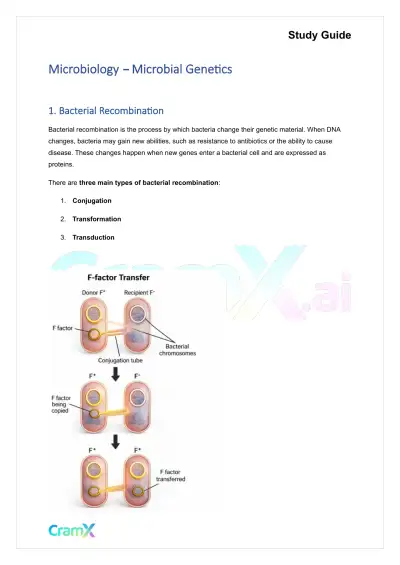 Quick Guides
Microbiology - Microbial Genetics
Microbiology
13 pagesMar 2026 Past Exams
Microbiology Practice Exam With Answers (1000 Solved Questions)
Microbiology
156 pagesMay 2025
Study this document with CramX
Once it is in your library, every tool can work from it.