

Test Bank For Microbiology: A Human Perspective, 6th Edition
- Microbiology
- 420 pages
- Shared May 2025
Test Bank For Microbiology: A Human Perspective, 6th Edition is an easy-to-use exam guide, packed with the most commonly asked test questions.
Preview 16 of 420 pages
See the first 16 pages exactly as they appear in the document.
Page 1 Read page 1 as text
Chapter 01 - Humans and the Microbial World 1 - 1 Chapter 01 Humans and the Microbial World Multiple Choice Questions 1. The scientist usually considered the first to see microorganisms, which he called "animalcules", was A. Redi B. van Leeuwenhoek C. Pasteur D. Tyndall 2. The word "Animalcule" was coined by A. Pasteur. B. van Leeuwenhoek. C. Redi. D. Tyndall. 3. The idea of Spontaneous Generation postulated that A. organisms could evolve into the next generation of organisms. B. organisms could spontaneously combust. C. organisms could spontaneously arise from other living organisms. D. living organisms could spontaneously arise from non - living material. 4. Which of these scientist(s) was/were involved in, among other things, investigating the idea of spontaneous generation? A. Redi B. van Leeuwenhoek C. Pasteur D. Escherich E. Redi AND Pasteur
Page 2 Page 3 Read page 3 as text
Chapter 01 - Humans and the Microbial World 1 - 2 5. The work of Tyndall and Cohn A. supported the idea of spontaneous generation. B. was used to explain why others investigating spontaneous generation had obtained results that were opposite of those obtained by Pasteur. C. showed that microbes caused disease. D. allowed scientists to see microorganisms. 6. The structures present in the hay infusions used in experiments on Spontaneous Generation that made them difficult to sterilize are A. chlorophyll. B. toxins. C. organelles. D. endospores. 7. The opposite results obtained by scientists apparently doing the same experiments in investigating spontaneous generation A. shows the importance of repeating experiments. B. shows the importance of exactly duplicating experimental conditions. C. led to further experiments that ultimately furthered knowledge. D. All of the choices are correct. 8. If while investigating Spontaneous Generation, Pasteur had his laboratory located in a stable A. the results would, most likely, have supported the idea of spontaneous generation. B. the results would, most likely, have not supported the idea of spontaneous generation. C. this would have had no effect on his results. D. this would have shown his love of horses. 9. Cellulose is a major component of plants and is only directly digested by A. herbivores. B. carnivores. C. termites. D. microorganisms.
Page 4 Read page 4 as text
Chapter 01 - Humans and the Microbial World 1 - 3 10. Plants are dependent on microorganisms A. providing oxygen. B. providing water. C. changing atmospheric nitrogen to a usable form. D. providing carbohydrates. 11. Microorganisms are involved in A. causing disease. B. curing/treating disease. C. preparing food. D. cleaning up pollutants. E. All of the choices are correct. 12. Bacteria have been used for food products A. for several thousand years. B. since the middle ages. C. since the late 1800s D. since the 1950s 13. Microorganisms are involved in A. production of medicinal products. B. transforming atmospheric nitrogen to a form useful to plants. C. food production. D. pollution cleanup. E. All of the choices are correct. 14. Bioremediation refers to A. rehabilitating wayward bacteria. B. using bacteria to clean up pollutants. C. vaccine development. D. monitoring newly discovered disease organisms.
Page 5 Read page 5 as text
Chapter 01 - Humans and the Microbial World 1 - 4 15. The Golden Age of Medical Microbiology A. occurred during the late 1800's to early 1900's. B. started in the 1990's with the advent of genetic engineering. C. is a time when the knowledge of and techniques to work with bacteria blossomed. D. was when people realized that diseases could be caused by invisible agents. E. occurred during the late 1800's to early 1900's, is a time when the knowledge of and techniques to work with bacteria blossomed AND was when people realized that diseases could be caused by invisible agents. 16. Newly emerging or re - emerging diseases A. may be due to changing lifestyles. B. are exemplified by Lyme Disease and toxic shock syndrome. C. may reflect a breakdown in sanitation/social order. D. may be related to global cooling. E. may be due to changing lifestyles, are exemplified by Lyme Disease and toxic shock syndrome AND may refect a breakdown in sanitation/social order. 17. Lyme Disease is an example of a disease A. that is due to changing lifestyles. B. that is due to a decline in vaccinations. C. that is due to a mutation. D. that is due to climate change. 18. The outbreak of measles within the last few years was due to A. mutation of the virus. B. change in the environment. C. a decline in vaccination of children in the previous years. D. increase in sensitivity of detection techniques.
Page 6 Read page 6 as text
Chapter 01 - Humans and the Microbial World 1 - 5 19. Smallpox A. has been eliminated. B. still occasionally occurs in third world countries. C. probably only had a human reservoir. D. was dealt with by vaccination. E. has been eliminated, AND was dealt with by vaccination. 20. Smallpox A. aided European domination of New World Nations. B. has not occurred anywhere in the world since 1977. C. has potential as a weapon of bioterrorism. D. has killed millions of people. E. All of the choices are correct. 21. Diseases such as ulcers and cardiovascular disease A. have been shown to be, or may be due to, a bacterial infection. B. are solely due to lifestyle. C. are solely due to genetics. D. are due to new mutations in bacteria. 22. Bacteria are useful to study because A. they produce protein in a similar manner to more complex organisms. B. they replicate DNA in a similar manner to more complex organisms. C. they produce energy in a similar manner to more complex organisms. D. they are grown quickly, easily, and cheaply. E. All of the choices are correct. 23. Bacteria A. are not found on our bodies. B. are only found on small select parts of our bodies. C. provide protection to us from disease by covering our bodies. D. always cause disease when growing on our bodies.
Page 7 Read page 7 as text
Chapter 01 - Humans and the Microbial World 1 - 6 24. Bacteria are present on the body A. only during disease - causing infections. B. constantly. C. only in certain restricted areas. D. never. 25. Bacteria are good models to use because they A. are large in size. B. share many biochemical/physiological properties with more complicated organisms. C. can be assembled into multicellular organisms. D. have complicated growth requirements. 26. Which is usually true of Bacteria? A. They are found as rods, spheres, or spirals. B. They reproduce by binary fission. C. They contain rigid cell walls made of peptidoglycan. D. They are found as single cells. E. All of the choices are correct. 27. Which is usually true of Archaea? A. They are found as rods, spheres, or spirals. B. They reproduce by binary fission. C. They contain rigid cell walls. D. They are found as single cells. E. All of the choices are correct. 28. Which is not usually true of Archaea? A. They are found as rods, spheres, or spirals. B. They reproduce by binary fission. C. They contain rigid cell walls. D. They are found as single cells. E. They contain peptidoglycan as part of their cell walls.
Page 8 Read page 8 as text
Chapter 01 - Humans and the Microbial World 1 - 7 29. Some Archaea are commonly found in A. meteors. B. boiling hot springs. C. the Great Salt Lake. D. your refrigerator. E. boiling hot springs AND the Great Salt Lake. 30. The cell types which lack a membrane bound nucleus are found in the A. eukaryotes. B. prokaryotes. C. archaea. D. protista. E. prokaryotes AND archaea. 31. The prokaryotic cell scheme is found in A. Bacteria. B. Archaea. C. Eucarya. D. All of the choices are correct. E. Bacteria AND Archaea. 32. Eucarya A. consist of only multicellular organisms. B. have a more complex internal structure than Archaea or Bacteria. C. have a simpler internal structure than Archaea or Bacteria. D. have a membrane around the DNA. E. have a more complex internal structure than Archaea or Bacteria AND have a membrane around the DNA.
Page 9 Read page 9 as text
Chapter 01 - Humans and the Microbial World 1 - 8 33. Which group(s) below contain single - celled and multicellular organisms? A. algae B. fungi C. protozoa D. All of the choices are correct. E. algae AND fungi 34. Organisms A. may be classified in four domains. B. may be classified in three domains. C. probably do not have a common ancestor. D. have never shared genes between domains. E. may be classified in three domains, probably do not have a common ancestor AND have never shared genes between domains. 35. The system by which organisms are named is referred to as A. systematics. B. naming. C. nomenclature. D. cladistics. 36. The scientific name of an organism includes its A. family and genus. B. first name and last name. C. genus and species. D. domain. E. genus and species AND domain.
Page 10 Read page 10 as text
Chapter 01 - Humans and the Microbial World 1 - 9 37. Which is/are the correct form(s)? A. Staphylococcus aureus B. Staphylococcus aureus C. staphylococcus aureus D. S. aureus E. Staphylococcus aureus AND S. aureus 38. Which of these may pertain to the term strain? A. E . coli 0157:H7 B. E . coli C. minor variation of a species D. major variation of a species E. E . coli 0157:H7 AND minor variation of a species 39. Viroids A. are naked pieces of RNA. B. are naked pieces of DNA. C. are known to cause neurodegenerative diseases in animals. D. are composed of protein encasing DNA. E. are known to cause neurodegenerative diseses in animals AND are composed of protein encasing DNA. 40. Outside a cell, viruses are A. running a small number of biochemical reactions. B. synthesizing proteins necessary for entry into the host. C. inactive. D. constructing a cell membrane known as an envelope. E. running a small number of biochemical reactions AND synthesizing proteins necessary for entry into the host.
Page 11 Read page 11 as text
Chapter 01 - Humans and the Microbial World 1 - 10 41. Viruses may only be grown A. in inanimate chemical growth media. B. in living cells. C. at body temperature. D. in darkness. 42. Viruses are in the group A. Viridaeae. B. Eukarya. C. Archaea. D. Bacteria. E. None of the choices is correct. 43. Viruses A. are obligate intracellular parasites. B. are single - celled organisms. C. consist of only proteins. D. are in the Domain Archaea. E. are obligate intracellular parasites AND are single - celled organisms. 44. Viruses are often referred to as A. infectious agents. B. eubacteria. C. archaebacteria. D. cellular agents. 45. Viruses, viroids and prions all A. operate intracellularly. B. may be considered acellular agents of disease. C. contain DNA. D. infect only animals. E. operate intracellularly AND may be considered acellular agents of disease.
Page 12 Read page 12 as text
Chapter 01 - Humans and the Microbial World 1 - 11 46. Both viruses and viroids are A. capable of independent reproduction. B. obligate intracellular parasites. C. interdependent with one another for reproduction. D. larger than most bacteria in size. 47. Prions A. are only composed of RNA. B. are only composed of DNA. C. are only composed of protein. D. cause diseases in plants. E. are only composed of RNA AND cause diseases in plants. 48. The smallest organism is probably determined by A. the number of molecules necessary for its growth and replication. B. the size of the molecules necessary for its growth and replication. C. its membrane. D. its volume. E. the number of molecules necessary for its growth and replication AND the size of the molecules necessary for its growth and replication. 49. A new organism was found that was unicellular and 1 cm long. The "large" size of this organism alone would A. mean that it could not be a bacteria. B. mean that it had to be a protista. C. mean little. D. mean that it had to be in the domain Eukarya.
Page 13 Read page 13 as text
Chapter 01 - Humans and the Microbial World 1 - 12 50. Although it is said that the twentieth century was the Age of Physics, it is predicted that the twenty - first century will be the age of A. chemistry. B. computers. C. microbial biodiversity. D. mathematics. Matching Questions 51. Which of the following best matches the description: 1. Was the first to see microscopic organisms Redi 2 2. Disproved spontaneous generation for "large" organisms Cohn 4 3. Showed the importance of the hay infusion in the results concerning spontaneous generation van Leeuwenhoek 1 4. Discovered the heat - resistant form of bacteria Tyndall 3 5. Disproved spontaneous generation for "small" organisms Pasteur 5 52. Which of the following best matches the description: 1. Has a rigid cell wall made of peptidoglycan eukaryotes 4 2. May use flagella to move prokaryotes 1 3. Has membrane - bound organelles eukaryotes and prokaryotes 2 4. Has a nuclear membrane eukaryotes 3 5. Has a cytoskeleton eukaryotes 5 True / False Questions 53. Spontaneous generation referred to the idea that organisms came from other organisms. FALSE 54. The human body only contains bacteria during illness. FALSE
Page 14 Read page 14 as text
Chapter 01 - Humans and the Microbial World 1 - 13 55. Bacteria and Eucarya both contain membrane - bound organelles. FALSE 56. The scientific name of an organism indicates its domain. FALSE 57. Viroids are naked pieces of DNA that infect plants. FALSE 58. Viruses simultaneously contain DNA, RNA and protein. FALSE 59. Viruses, viroids, and prions are obligate intracellular agents. TRUE 60. Viruses and bacteria are both based on the unit of a cell. FALSE 61. The size of an organism determines its domain. FALSE 62. Archaea are very similar to Bacteria and have rigid cell walls made of peptidoglycan. FALSE
Page 15 Read page 15 as text
Chapter 01 - Humans and the Microbial World 1 - 14 63. Thiomargarita namibiensis could not be a eukaryote because it is only 1mm in width. FALSE Essay Questions 64. What would likely have been the results of Pasteur's experiments on Spontaneous Generation if his laboratory had been housed in a stable? Most likely the results would have supported spontaneous generation. Pasteur used boiling to "sterilize" the media. In other environments, such as stables, it would be more likely that heat resistant forms of bacteria (endospores) would be present in the media. Therefore, upon incubation, both types of flasks would show growth. This result would be consistent with the idea of spontaneous generation. 65. What are determining factors in limiting the size of a cell? The smallest size a cell may attain would be determined by the number and size of the various molecules necessary for metabolism, growth and replication. It appears that mycoplasma is the smallest free living organism. The largest size a cell may attain would be limited by the surface area versus volume of the cell. The volume of a cell increases much faster than surface area. Since the amount of material that enters/leaves the cell is dependent on the surface area, the requirements of the volume would soon outstrip the ability of the cell to bring it in through the available surface area. 66. Why is the study of bacteria important? Bacteria may be used as models to gain insight into the workings of more complex organisms. They may be grown quickly, cheaply and relatively easily. They perform many of the same physiological/metabolic/biochemical functions as the more complex organisms using the common molecules of DNA, RNA, and protein. They are intimate companions of our bodies. Bacteria cause disease. They protect against disease. They contribute to a number of fundamental processes without which life would be more difficult to maintain i.e., nitrogen fixation, antibiotic production, genetic engineering, cellulose degradation, food production, and chemical production.
Page 16 Read page 16 as text
Chapter 02 - The Molecules of Life 2 - 1 Chapter 02 The Molecules of Life Multiple Choice Questions 1. In addition to investigations with bacteria that led to him being considered the Father of Microbiology, Pasteur also A. found that some molecules can exist as stereoisomers. B. created aspartame. C. separated organic acids using a microscope. D. discovered polarized light. E. found that some molecules can exist as stereoisomers AND separated organic acids using a microscope. 2. The positively charged component of the atom is the A. electron. B. neutron. C. proton. D. quark. 3. The negatively charged component of the atom is the A. proton. B. nucleus. C. neutron. D. electron. 4. The uncharged component of the atom is the A. electron. B. proton. C. neutron. D. muon.
404 more pages in the full document
Unlock it once and it stays in your library, ready to chat with or turn into flashcards.
Unlock the full documentMore Microbiology study materials
See all Past Exams
2024-2025 Boards: Microbiology - Vandy's Review PP Exam with Answers (55 Solved Questions)
Microbiology
22 pages171downloadsFeb 2025 Exam Guides
Test Bank For Microbiology: A Systems Approach, 3rd Edition
Microbiology
546 pages124downloadsFeb 2025 Exam Guides
Test Bank for Foundations In Microbiology, 9th Edition
Microbiology
338 pages120downloadsFeb 2025 Textbook Guides
Solution Manual For Microbiology: An Introduction, 13th Edition
Microbiology
298 pages36downloadsFeb 2025 Exam Guides
Test Bank For Microbiology with Diseases by Taxonomy, 6th Edition
Microbiology
532 pagesMay 2025 Quick Guides
Microbiology - DNA and Gene Expression
Microbiology
15 pagesMar 2026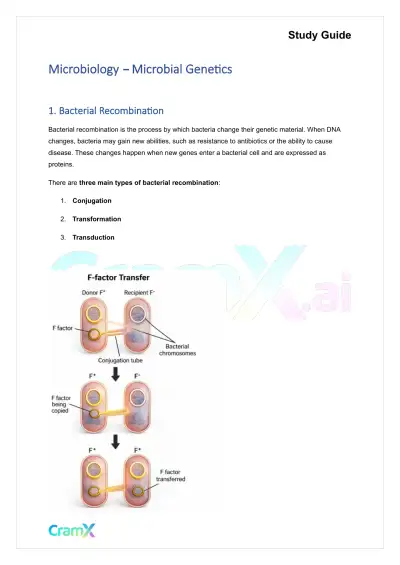 Quick Guides
Microbiology - Microbial Genetics
Microbiology
13 pagesMar 2026 Past Exams
Microbiology Practice Exam With Answers (1000 Solved Questions)
Microbiology
156 pagesMay 2025
Study this document with CramX
Once it is in your library, every tool can work from it.