

Test Bank For Microbiology Fundamentals: A Clinical Approach, 2nd Edition
- Microbiology
- 878 pages
- Shared May 2025
Test Bank For Microbiology Fundamentals: A Clinical Approach, 2nd Edition prepares you for success with a mix of theoretical knowledge, problem-solving techniques, and exam strategies.
Preview 16 of 878 pages
See the first 16 pages exactly as they appear in the document.
Page 1 Read page 1 as text
Chapter 01 - Introduction to Microbes and Their Building Blocks 1 - 1 Chapter 01 Introduction to Microbes and Their Building Blocks Multiple Choice Questi ons 1. When humans manipulate the genes of microorganisms, the process is called A. bioremediation. B. genetic engineering. C. epidemiology. D. immunology. E. taxonomy. ASM Objective: 04.05 Cell genomes can be manipulated to alter cell function. ASM Topic: Module 04 Information Flow Bloom's Level: 01. Remember Learning Outcome: 01.04 Explain the ways that humans manipulate organisms for their own uses. Section: 01.01 Topic: Basics of Genetic Engineering Topic: Microbial Roles 2. Which of the fol lowing is not considered a microorganism? A. mosquito B. protozoan C. bacterium D. virus E. fungus ASM Objective: 01.02 Mutations and horizontal gene transfer, along with the immense variety of microenvironments, have result ed in a vast diversity of mi croorganisms. ASM Topic: Module 01 Evolution Bloom's Level: 01. Remember Learning Outcome: 01.01 List the various types of microorganisms that can colonize humans. Section: 01.01 Topic: Taxonomy of Microorganisms
Page 2 Page 3 Read page 3 as text
Chapter 01 - Introduction to Microbes and Their Building Blocks 1 - 2 3. All microorganisms are best defined as organisms that A. cause human disease. B. lack a cell nucleus. C. are infectious particles. D. are too small to be seen with the unaided eye. E. can only be found growing in laboratories. ASM Objective: 01.02 Mutations and horizontal gene transfer, along with the immense variety of microenvironments, have resulted in a vast diversity of microorganisms. ASM Topic: Module 01 Evolution Bloom's Level: 01. Remember Learning Outcome: 01.08 Compare and contrast the relative sizes of the different microbes. Section: 01.01 Topic: Cellular Organization 4. Which activity is an example of biotechnology? A. bacteria in the soil secreting an antibiotic to kill competitors B. a microbiologist using the microscope to study bacteria C. Egyptians using moldy b read on wounds D. Escherichia coli producing human insulin E. public health officials monitoring diseases in a community ASM Objective: 06.03 Humans utilize and harness microorganisms and their products. ASM Topic: Module 06 Impact of Microorganisms Bloom's Level: 02. Understand Learning Outcome: 01.04 Explain the ways that humans manipulate organisms for their own uses. Section: 01.01 Topic: Basics of Genetic Engineering
Page 4 Read page 4 as text
Chapter 01 - Introduction to Microbes and Their Building Blocks 1 - 3 5. Living things ordinarily too small to be seen with the unaided eye are termed A. bacteria. B. viruses. C. parasites. D. microorganisms. E. None of the choices is correct. ASM Objective: 01.02 Mutations and horizontal gene transfer, along with the immen se variety of microenvironments, have resulted in a vast diversity of microorganisms. ASM Topic: Module 01 Evolution Bloom's Level: 01. Remember Learning Outcome: 01.08 Compare and contrast the relative sizes of the different microbes. Section: 01.01 Topic : Cellular Organization 6. The microorganisms that recycle nutrients by breaking down dead matter and wastes are called A. decomposers. B. prokaryotes. C. pathogens. D. eukaryotes. E. fermenters. ASM Objective: 06.01 Microbes are essential for life, as we know it, and the processes that support life (e.g. in biogeochemical cycles and plant/animal microflora). ASM Topic: Module 06 Impact of Microorganisms Bloom's Level: 01. Remember Learning Outcome: 01.02 Describe the role and impact of microbes on th e earth. Section: 01.01 Topic: Microbial Roles
Page 5 Read page 5 as text
Chapter 01 - Introduction to Microbes and Their Building Blocks 1 - 4 7. Cells, like bacteria and archaea, that do not have a nucleus in their cells have traditionally been called A. decomposers. B. prokaryotes. C. pathogens. D. eukaryotes. E. fermenters. ASM Objectiv e: 01.01 Cells, organelles (e.g. mitochondria and chloroplasts) and all major metabolic pathways evolved from early prokaryotic cells. ASM Objective: 02.02 Bacteria have unique cell structures that can be targets for antibiotics, immunity and phage infecti on. ASM Topic: Module 02 Structure and Function Bloom's Level: 01. Remember Learning Outcome: 01.06 Differentiate among bacteria, archaea, and eukaryotic microorganisms. Section: 01.01 Topic: Cellular Organization 8. The first cells appeared about ___ billion years ago. A. 5 B. 4 C. 3.5 D. 2 E. 1.5 ASM Objective: 01.01 Cells, organelles (e.g. mitochondria and chloroplasts) and all major metabolic pathways evolved from ear ly prokaryotic cells. ASM Topic: Module 01 Evolution Bloom's Level: 01. Remember Learning Outcome: 01.03 Explain the theory of evolution and why it is still called a theory. Section: 01.01 Topic: History of Microbiology
Page 6 Read page 6 as text
Chapter 01 - Introduction to Microbes and Their Building Blocks 1 - 5 9. Which of the following is not a human use of microorganisms? A. mak ing bread B. treating water and sewage C. manufacturing copper wire D. mass producing antibiotics E. cleaning up oil spills ASM Objective: 06.03 Humans utilize and harness microorganisms and their products. ASM Topic: Module 06 Impact of Microorganisms Bloom's Level: 01. Remember Learning Outcome: 01.04 Explain the ways that humans manipulate organisms for their own uses. Section: 01.01 Topic: Microbial Roles 10. Using microbes to detoxify a site contaminated with heavy metals is an example of A. biot echnology. B. bioremediation. C. decomposition. D. immunology. E. epidemiology. ASM Objective: 05.03 Microorganisms and their environment interact with and modify each other. ASM Objective: 06.03 Humans utilize and harness microorganisms and their produ cts. ASM Topic: Module 05 Systems ASM Topic: Module 06 Impact of Microorganisms Bloom's Level: 01. Remember Learning Outcome: 01.02 Describe the role and impact of microbes on the earth. Learning Outcome: 01.04 Explain the ways that humans manipulate organ isms for their own uses. Section: 01.01 Topic: Microbial Roles
Page 7 Read page 7 as text
Chapter 01 - Introduction to Microbes and Their Building Blocks 1 - 6 11. Disease - causing microorganisms are called A. decomposers. B. prokaryotes. C. pathogens. D. eukaryotes. E. fermenters. ASM Objective: 05.04 Microorganisms, cellular and viral, intera ct with both human and non - human hosts in beneficial, neutral or detrimental ways. ASM Topic: Module 05 Systems Bloom's Level: 01. Remember Learning Outcome: 01.05 Summarize the relative burden of human disease caused by microbes. Section: 01.01 Topic: Mic robial Roles 12. The most prevalent worldwide infectious diseases are A. AIDS - related diseases. B. diarrheal diseases. C. malaria diseases. D. measles. E. respiratory diseases. ASM Objective: 05.04 Microorganisms , cellular and viral, interact with both human and non - human hosts in beneficial, neutral or detrimental ways. ASM Topic: Module 05 Systems Bloom's Level: 01. Remember Learning Outcome: 01.05 Summarize the relative burden of human disease caused by microbe s. Section: 01.01 Topic: Microbial Roles
Page 8 Read page 8 as text
Chapter 01 - Introduction to Microbes and Their Building Blocks 1 - 7 13. Which of the following is a unique characteristic of viruses that distinguishes them from the other major groups of microorganisms? A. cause human disease B. lack a nucleus C. cannot be seen without a micro scope D. contain genetic material E. lack cell structure ASM Objective: 02.05 The replication cycles of viruses (lytic and lysogenic) differ among viruses and are determined by their unique structures and genomes. ASM Topic: Module 02 Structure and Func tion Bloom's Level: 01. Remember Learning Outcome: 01.07 Identify a fourth type of microorganism. Section: 01.01 Topic: General Viral Properties 14. Helminths are A. bacteria. B. protozoa. C. molds. D. parasitic worms. E. infectious particles. ASM Ob jective: 01.02 Mutations and horizontal gene transfer, along with the immense variety of microenvironments, have resulted in a vast diversity of microorganisms. ASM Topic: Module 01 Evolution Bloom's Level: 01. Remember Learning Outcome: 01.06 Differentiat e among bacteria, archaea, and eukaryotic microorganisms. Section: 01.01 Topic: Taxonomy of Microorganisms
Page 9 Read page 9 as text
Chapter 01 - Introduction to Microbes and Their Building Blocks 1 - 8 15. Which group of microorganisms is composed only of hereditary material wrapped in a protein covering? A. viruses B. bacteria C. parasites D. fungi E. yeasts ASM Objective: 02.05 The replication cycles of viruses (lytic and lysogenic) differ among viruses and are determined by their unique structures and genomes. ASM Topic: Module 02 Structure and Function Bloom's Level: 01. Remember Learning Outcome: 01.07 Identify a fourth type of microorganism. Section: 01.01 Topic: General Viral Properties
Page 10 Read page 10 as text
Chapter 01 - Introduction to Microbes and Their Building Blocks 1 - 9 16. Which statement correctly compares the sizes of different microorganisms? A. Bacteria are larger than eukaryotic microorganisms. B. Archaea are larger than eukaryotic microrganisms but smaller than bacteria. C. Bacteria are larger than viruses. D. Eukaryotic microorganisms are smaller than viruses. ASM Objective: 02.01 The structure and function of microorganisms have been re vealed by the use of microscopy (including bright field, phase contrast, fluorescent, and electron). ASM Objective: 02.04 While microscopic eukaryotes (for example, fungi, protozoa and algae) carry out some of the same process es as bacteria, many of the ce llular properties are fundamentally different. ASM Topic: Module 02 Structure and Function Bloom's Level: 03. Apply Learning Outcome: 01.08 Compare and contrast the relative sizes of the different microbes. Section: 01.01 Topic: Cellular Organization
Page 11 Read page 11 as text
Chapter 01 - Introduction to Microbes and Their Building Blocks 1 - 10 1 7. The Dutch merchant who made and used quality magnifying lenses to see and record microorganisms was A. Francesco Redi. B. Antonie van Leeuwenhoek. C. Louis Pasteur. D. Joseph Lister. E. Robert Koch. ASM Objective: 02.01 The structure and function of microorganisms have been revealed by the use of microscopy (including bright field, phase contrast, fluorescent, and electron). ASM Topic: Module 02 Structure and Function Bloom's Level: 01. Remember Learning Outcome: 01.09 Make a time line of the develop ment of microbiology from the 1600s to today. Section: 01.02 Topic: History of Microbiology 18. Koch's postulates are criteria used to establish that A. microbes are found on dust particles. B. a specific microbe is the cause of a specific disease. C. l ife forms can only arise from preexisting life forms. D. a specific microbe should be classified in a specific kingdom. E. microbes can be used to clean up toxic spills. ASM Objective: 05.04 Microorganisms, cellular and viral, interact with both human and non - human hosts in beneficial, neutral or detrimental ways. ASM Topic: Module 05 Systems Bloom's Level: 02. Understand Learning Outcome: 01.09 Make a time line of the development of microbiology from the 1600s to today. Section : 01.02 Topic: History of Microbiology
Page 12 Read page 12 as text
Chapter 01 - Introduction to Microbes and Their Building Blocks 1 - 11 19. The surgeon who advocated using disinfectants on hands and in the air prior to surgery was A. Joseph Lister. B. Ignaz Semmelweis. C. Robert Koch. D. Louis Pasteur. E. Antonie van Leeuwenhoek. ASM Objective : 03.04 The growth of microorganisms can be controlled by physical, chemical, mechanical, and biological methods. ASM Topic: Module 03 Metabolic Pathways Bloom's Level: 01. Remember Learning Outcome: 01.09 Make a time line of the development of microbiolog y from the 1600s to today. Section: 01.02 Topic: History of Microbiology 20. Sterile refers to A. pathogen free. B. absence of spores. C. absence of any life forms and viral particles. D. pasteurized. E. homogenized. ASM Objective: 03.04 The growth of microorganisms can be controlled by physical, chemical, mechanical, and biological methods . ASM Topic: Module 03 Metabolic Pathways Bloom's Level: 01. Remember Learning Outcome: 01.09 Make a time line of the development o f microbiology from the 1600s to today. Section: 01.02 Topic: Basics of Microbial Control Topic: History of Microbiology
Page 13 Read page 13 as text
Chapter 01 - Introduction to Microbes and Their Building Blocks 1 - 12 21. Which scientist showed that anthrax was caused by the bacterium, Bacillus anthracis ? A. Joseph Lister B. Ignaz Semmelweis C. R obert Koch D. Louis Pasteur E. Antonie van Leeuwenhoek ASM Objective: 05.04 Microorganisms, cellular and viral, interact with both human and non - human hosts in beneficial, neutral or detrimental ways. ASM Topic: Module 05 Systems Bloom's Level: 01. Reme mber Learning Outcome: 01.09 Make a time line of the development of microbiology from the 1600s to today. Section: 01.02 Topic: History of Microbiology Topic: Taxonomy of Microorganisms
Page 14 Read page 14 as text
Chapter 01 - Introduction to Microbes and Their Building Blocks 1 - 13 22. If you were a microbiologist in 1950, which of the following scientific principles would you already know? A. Aseptic techniques could reduce the number of wound infections in the surgical setting. B. Very little DNA is transcribed into RNA that is then translated into proteins. C. Enzymes found in bacter ia can be used to cut DNA. D. Biofilms can form on implanted objects in the human body and be responsible for infection. ASM Objective: 03.04 The growth of microorganisms can be controlled by physical, chemical, mechanical, and biological methods . ASM Objective: 04.02 Although the central dogma is universal in all cells, the processes of replication, transcription, and t ranslation differ in Bacteria, Archaea, and Eukaryotes. ASM Objective: 04.03 The regulation of gene expression is influenced by ext ernal and internal molecular cues and/or signals. ASM Objective: 05.02 Most bacteria in nature live in bio - film communities. ASM Topic: Module 03 Metabolic Pathways ASM Topic: Module 04 Information Flow ASM Topic: Module 05 Systems Bloom's Level: 03. Apply Learning Outcome: 01.10 List some recent microbiology discoveries of great impact. Section: 01.02 Topic: History of Microbiology
Page 15 Read page 15 as text
Chapter 01 - Introduction to Microbes and Their Building Blocks 1 - 14 23. Taxonomy does not involve A. nomenclature. B. classification. C. taxa. D. identification. E. common name. ASM Objective: 01.05 The evolutionary relatedness of organisms is best reflected in phylogenetic trees. ASM Topic: Module 01 Evolution Bloom's Level: 01. Remember Learning Outcome: 01.18 Differentiate among the terms nomenclature, taxonomy, and classificat ion. Section: 01.04 Topic: Taxonomy of Microorganisms 24. Which scientific field is involved in the identification, classification, and naming of organisms? A. nomenclature B. taxonomy C. phylogeny D. Woesean classification E. None of the choices is cor rect. ASM Objective: 01.05 The evolutionary relatedness of organisms is best reflected in phylogenetic trees. ASM Topic: Module 01 Evolution Bloom's Level: 01. Remember Learning Outcome: 01.18 Differentiate among the terms nomenclature, taxonomy, and cl assification. Topic: Taxonomy of Microorganisms 25. The orderly arrangement of organisms into a hierarchy of taxa is called A. classification. B. identification. C. nomenclature. D. experimentation. E. biotechnology. ASM Objective: 01.02 Mutations an d horizontal gene transfer, along with the immense variety of microenvironments, have resulted in a vast diversity of microorganisms. ASM Objective: 01.05 The evolutionary relatedness of organisms is best reflected in phylogenetic trees. ASM Topic: Module 01 Evolution Bloom's Level: 01. Remember Learning Outcome: 01.18 Differentiate among the terms nomenclature, taxonomy, and classification. Section: 01.04 Topic: Taxonomy of Microorganisms
Page 16 Read page 16 as text
Chapter 01 - Introduction to Microbes and Their Building Blocks 1 - 15 26. Which of the following is a taxon that contains all the othe r taxa listed? A. species B. phylum C. kingdom D. genus E. family ASM Objective: 01.05 The evolutionary relatedness of organisms is best reflected in phylogenetic trees. ASM Topic: Module 01 Evolution Bloom's Level: 02. Understand Learning Outcome: 01. 19 Create a mnemonic device for remembering the taxonomic categories. Section: 01.04 Topic: Taxonomy of Microorganisms 27. The smallest and most significant taxon is A. genus. B. species. C. kingdom. D. family. E. phylum. ASM Objective: 01.04 The tra ditional concept of species is not readily applicable to microbes, due to asexual reproduction and the frequent occurrence of horizontal gene transfer. ASM Topic: Module 01 Evolution Bloom's Level: 02. Understand Learning Outcome: 01.19 Create a mnemonic d evice for remembering the taxonomic categories. Section: 01.04 Topic: Taxonomy of Microorganisms 28. Select the correct descending taxonomic hierarchy (left to right): A. family, order, class B. family, genus, species C. genus, species, family D. class, phylum, order E. kingdom, domain, phylum ASM Objective: 01.05 The evolutionary relatedness of organisms is best reflected in phylogenetic trees. ASM Topic: Module 01 Evolution Bloom's Level: 01. Remember Learning Outcome: 01.19 Create a mnemonic device for remembering the taxonomic categories. Section: 01.04 Topic: Taxonomy of Microorganisms
862 more pages in the full document
Unlock it once and it stays in your library, ready to chat with or turn into flashcards.
Unlock the full documentMore Microbiology study materials
See all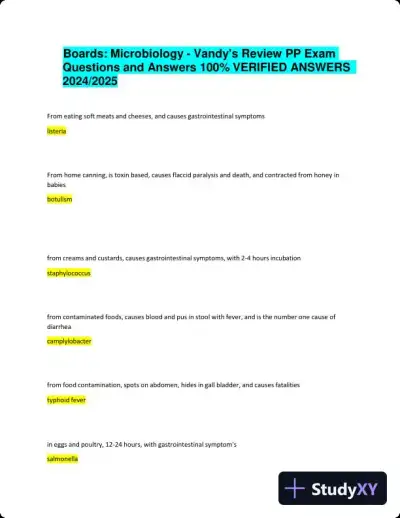 Past Exams
2024-2025 Boards: Microbiology - Vandy's Review PP Exam with Answers (55 Solved Questions)
Microbiology
22 pages171downloadsFeb 2025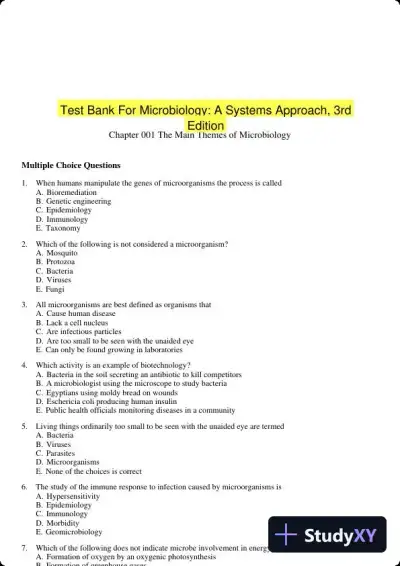 Exam Guides
Test Bank For Microbiology: A Systems Approach, 3rd Edition
Microbiology
546 pages124downloadsFeb 2025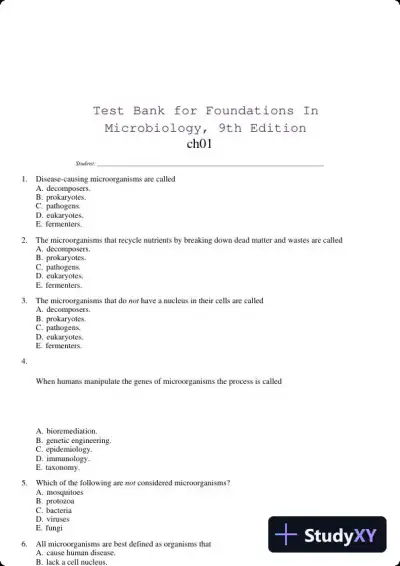 Exam Guides
Test Bank for Foundations In Microbiology, 9th Edition
Microbiology
338 pages120downloadsFeb 2025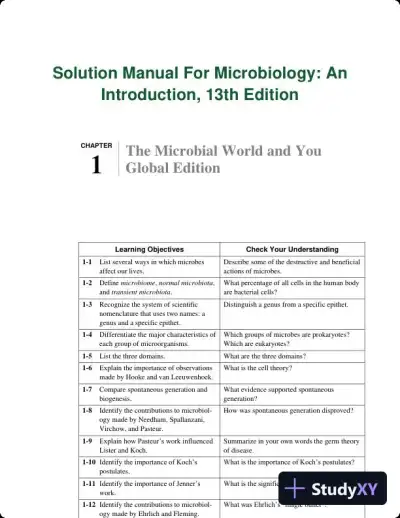 Textbook Guides
Solution Manual For Microbiology: An Introduction, 13th Edition
Microbiology
298 pages36downloadsFeb 2025 Exam Guides
Test Bank For Microbiology with Diseases by Taxonomy, 6th Edition
Microbiology
532 pagesMay 2025 Quick Guides
Microbiology - DNA and Gene Expression
Microbiology
15 pagesMar 2026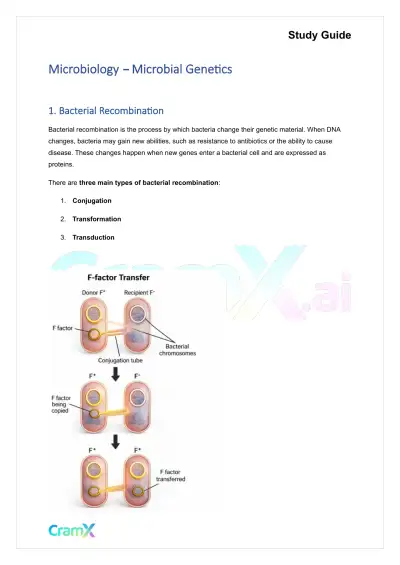 Quick Guides
Microbiology - Microbial Genetics
Microbiology
13 pagesMar 2026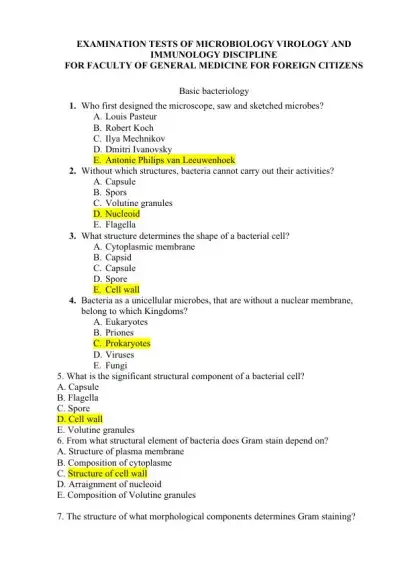 Past Exams
Microbiology Practice Exam With Answers (1000 Solved Questions)
Microbiology
156 pagesMay 2025
Study this document with CramX
Once it is in your library, every tool can work from it.