
CramX Logo
2023 NCLEX RN Pathophysiology Comprehensive Exam with NGN With Answers (30 Solved Questions) - Document preview page 1

2023 NCLEX RN Pathophysiology Comprehensive Exam with NGN With Answers (30 Solved Questions) - Page 1

Document preview content for 2023 NCLEX RN Pathophysiology Comprehensive Exam with NGN With Answers (30 Solved Questions)

2023 NCLEX RN Pathophysiology Comprehensive Exam with NGN With Answers (30 Solved Questions)

2023 NCLEX RN Pathophysiology Comprehensive Exam with NGN With Answers makes exam preparation easier by providing past exam insights.

Mason Carter
Contributor
4.5
0
12 months ago
Preview (11 of 35 Pages)
100%
Log in to unlock
Page 1 of 11
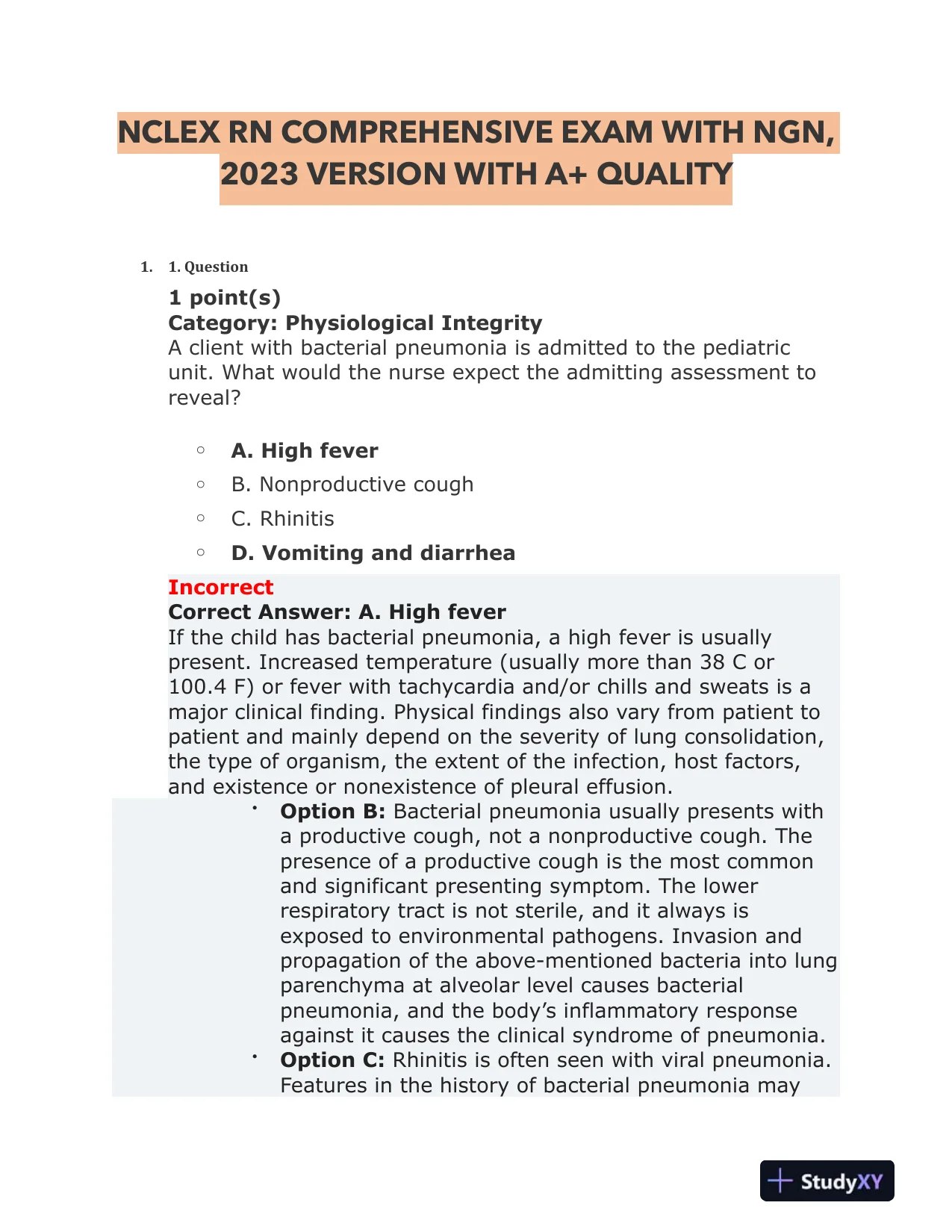
2023 NCLEX RN Pathophysiology Comprehensive Exam with NGN With Answers (30 Solved Questions) - Page 1 preview imageNCLEX RN COMPREHENSIVE EXAM WITH NGN,2023 VERSION WITH A+ QUALITY1.1.Question1point(s)Category:Physiological IntegrityA client with bacterial pneumonia is admitted to the pediatricunit. What would the nurse expect the admitting assessment toreveal?oA. High feveroB. Nonproductive coughoC. RhinitisoD. Vomiting and diarrheaIncorrectCorrect Answer: A. High feverIf the child has bacterial pneumonia, a high fever is usuallypresent. Increased temperature (usually more than 38 C or100.4 F) or fever with tachycardia and/or chills and sweats is amajor clinical finding. Physical findings also vary from patient topatient and mainly depend on the severity of lung consolidation,the type of organism, the extent of the infection, host factors,and existence or nonexistence of pleural effusion.Option B:Bacterial pneumonia usually presents witha productive cough, not a nonproductive cough. Thepresence of a productive cough is the most commonand significant presenting symptom. The lowerrespiratory tract is not sterile, and it always isexposed to environmental pathogens. Invasion andpropagation of the above-mentioned bacteria into lungparenchyma at alveolar level causes bacterialpneumonia, and the body’s inflammatory responseagainst it causes the clinical syndrome of pneumonia.Option C:Rhinitis is often seen with viral pneumonia.Features in the history of bacterial pneumonia may
Page 2 of 11
2023 NCLEX RN Pathophysiology Comprehensive Exam with NGN With Answers (30 Solved Questions) - Page 2 preview image
Page 3 of 11
2023 NCLEX RN Pathophysiology Comprehensive Exam with NGN With Answers (30 Solved Questions) - Page 3 preview imagevary from indolent to fulminant. Clinical manifestationincludes both constitutional findings and findings dueto damage to the lung and related tissue.Option D:Vomiting and diarrhea are usually not seenwith pneumonia. Atypical pneumonia presents withpulmonary and extrapulmonary manifestations, suchas Legionella pneumonia, often presents with alteredmentation and gastrointestinal symptoms.2.2.Question1point(s)Category:Safe and Effective Care EnvironmentThe nurse is caring for a client admitted with epiglottitis. Becauseof the possibility of complete obstruction of the airway, which ofthe following should the nurse have available?oA. Intravenous access suppliesoB. A tracheostomy setoC. Intravenous fluid administration pumpoD. Supplemental oxygenIncorrectCorrect Answer: B. A tracheostomy setFor a child with epiglottitis and the possibility of completeobstruction of the airway, emergency tracheostomy equipmentshould always be kept at the bedside. Prepare for intubation ortracheostomy; Anticipate the need of an artificial airway. Anartificial airway is required to promote oxygenation andventilation and prevent aspiration.Option A:Administer IV antibiotics as ordered. Afterobtaining blood and epiglottic cultures, second-or-third generation cephalosporins and beta-lactamase-resistant antibiotics should be started as soon aspossible.Option C:Discourage examining throat with a tongueblade or taking throat culture unless immediateemergency equipment and personnel at hand. Positionthe child in a sitting up and leaning forward positionwith mouth open and tongue out (“tripod” position).
Page 4 of 11
2023 NCLEX RN Pathophysiology Comprehensive Exam with NGN With Answers (30 Solved Questions) - Page 4 preview imageAllows maximum entry of air into the lungs forimproved oxygenation.Option D:Oxygen will not treat an obstruction.Endotracheal intubation must be readily available;assist with tracheostomy if needed or prepare for theprocedure in surgery. Establishes airway if obstructionpresent and respiratory failure and asphyxia areimminent.3.3.Question1point(s)Category:Physiological IntegrityA 25-year-old client with Grave’s disease is admitted to the unit.What would the nurse expect the admitting assessment toreveal?oA. BradycardiaoB. Decreased appetiteoC. ExophthalmosoD. Weight gainIncorrectCorrect Answer: C. ExophthalmosExophthalmos (protrusion of eyeballs) often occurs withhyperthyroidism. Graves’ orbitopathy (ophthalmopathy) is causedby inflammation, cellular proliferation and increased growth ofextraocular muscles and retro-orbital connective and adiposetissues due to the actions of thyroid stimulating antibodies andcytokines released by cytotoxic T lymphocytes (killer cells).These cytokines and thyroid stimulating antibodies activateperiorbital fibroblasts and preadipocytes, causing synthesis ofexcess hydrophilic glycosaminoglycans (GAG) and retro-orbitalfat growth.Option A:Physical signs of hyperthyroidism includetachycardia, systolic hypertension with increased pulsepressure, signs of heart failure (like edema, rales,jugular venous distension, tachypnea), atrialfibrillation, fine tremors, hyperkinesia, hyperreflexia,warm and moist skin, palmar erythema and
Page 5 of 11
2023 NCLEX RN Pathophysiology Comprehensive Exam with NGN With Answers (30 Solved Questions) - Page 5 preview imageonycholysis, hair loss, diffuse palpable goiter withthyroid bruit and altered mental status.Option B:Hyperthyroidism usually increases theappetite. If the client is taking in a lot more calories,they can gain weight even if their body is burningmore energy. Make sure to eat healthy foods, getregular exercise, and work with a doctor on a nutritionplan. These steps can all help combat weight gainfrom an increased appetite.Option D:In younger patients, commonpresentations include heat intolerance, sweating,fatigue, weight loss, palpitation, hyper defecation, andtremors. Other features include insomnia, anxiety,nervousness, hyperkinesia, dyspnea, muscleweakness, pruritus, polyuria, oligomenorrhea oramenorrhea in the female, loss of libido, and neckfullness.4.4.Question1point(s)Category:Health Promotion and MaintenanceThe nurse is providing dietary instructions to the mother of an 8-year-old child diagnosed with celiac disease. Which of thefollowing foods, if selected by the mother, would indicate herunderstanding of the dietary instructions?oA. Ham sandwich on whole-wheat toastoB. Spaghetti and meatballsoC. Hamburger with ketchupoD. Cheese omeletCorrectCorrect Answer: D. Cheese omeletThe child with celiac disease should be on a gluten-free diet.When a child has celiac disease, gluten causes the immunesystem to damage or destroy villi. Villi are the tiny, fingerliketubules that line the small intestine. The villi’s job is to get foodnutrients to the blood through the walls of the small intestine. Ifvilli are destroyed, the child may become malnourished, nomatter how much he eats. This is because they aren’t able to
Page 6 of 11
2023 NCLEX RN Pathophysiology Comprehensive Exam with NGN With Answers (30 Solved Questions) - Page 6 preview imageabsorb nutrients. Complications of the disorder include anemia,seizures, joint pain, thinning bones, and cancer.Option A:Be careful of corn and rice products. Thesedon’t contain gluten, but they can sometimes becontaminated with wheat gluten if they’re produced infactories that also manufacture wheat products. Lookfor such a warning on the package label.Option B:Avoid all products with barley, rye, triticale(a cross between wheat and rye), farina, graham flour,semolina, and any other kind of flour, including self-rising and durum, not labeled gluten-free.Option C:Substitute potato, rice, soy, amaranth,quinoa, buckwheat, or bean flour for wheat flour. Youcan also use sorghum, chickpea or Bengal gram,arrowroot, and corn flour, as well as tapioca starchextract. These act as thickeners and leavening agents.5.5.Question1point(s)Category:Physiological IntegrityThe nurse is caring for an 80-year-old with chronic bronchitis.Upon the morning rounds, the nurse finds an O2 sat of 76%.Which of the following actions should the nurse takefirst?oA. Notify the physicianoB. Recheck the O2 saturation level in 15 minutesoC. Apply oxygen by maskoD. Assess the pulseIncorrectCorrect Answer: C. Apply oxygen by maskRemember the ABCs (airway, breathing, circulation) whenanswering this question. Administer oxygen first to increase theO2 saturation level. Provide humidified oxygen as ordered.Administering humidified oxygen prevents drying out theairways, decreases convective moisture losses, and improvescompliance.Option A:Monitor vital signs and cardiac rhythm.Tachycardia, dysrhythmias, and changes in BP canreflect the effect of systemic hypoxemia on cardiac
Page 7 of 11
2023 NCLEX RN Pathophysiology Comprehensive Exam with NGN With Answers (30 Solved Questions) - Page 7 preview imagefunction. Auscultate breath sounds, noting areas ofdecreased airflow and adventitious sounds. Breathsounds may be faint because of decreased airflow orareas of consolidation. Presence of wheezes mayindicate bronchospasm or retained secretions.Scattered moist crackles may indicate interstitial fluidor cardiac decompensation.Option B:The normal oxygen saturation for a child is92%–100%. Monitor O2 saturation and titrate oxygento maintain Sp02 between 88% to 92%. Pulseoximetry reading of 87% below may indicate the needfor oxygen administration while a pulse oximetryreading of 92% or higher may require oxygentitration.Option D:Before assessing the pulse, oxygen shouldbe applied to increase the oxygen saturation. Monitorvital signs and cardiac rhythm. Tachycardia,dysrhythmias, and changes in BP can reflect the effectof systemic hypoxemia on cardiac function.6.6.Question1point(s)Category:Physiological IntegrityA gravida 3 para 0 is admitted to the labor and delivery unit. Thedoctor performs an amniotomy. Which observation would thenurse be expected to make after the amniotomy?oA. Fetal heart tones 160bpmoB. A moderate amount of straw-colored fluidoC. A small amount of greenish fluidoD. A small segment of the umbilical cordIncorrectCorrect Answer: B. A moderate amount of straw-coloredfluidAn amniotomy is an artificial rupture of membranes and normalamniotic fluid is straw-colored and odorless. Successful rupture ofmembranes most commonly is determined by the immediatereturn of amniotic fluid from the vagina. This fluid usually is clearand odorless.
Page 8 of 11
2023 NCLEX RN Pathophysiology Comprehensive Exam with NGN With Answers (30 Solved Questions) - Page 8 preview imageOption A:Fetal heart tones of 160 indicatetachycardia. Monitoring of the fetal heart rate as wellas uterine activity can be easily obtained via externalmonitoring systems. However, in certaincircumstances, more direct evaluation of the fetalheart rate or uterine activity is required during labor.Option C:Greenish fluid is indicative of meconium. Incertain circumstances, the fluid may either containmeconium or may be blood-tinged. It is important tonote the color of the fluid at the time of rupture.Option D:If the nurse notes the umbilical cord, theclient is experiencing a prolapsed cord and would needto be reported immediately. Typically, followingartificial rupture of membranes, the practitionershould not immediately remove their hand from thevagina because it is at this point that the highest riskof potential cord prolapse can occur and will be notedas the amniotic fluid continues to drain. After theimmediate flow of amniotic fluid ceases, and there isno palpable cord in the vagina, the vaginal hand thencan be removed.7.7.Question1point(s)Category:Physiological IntegrityThe client is admitted to the unit. A vaginal exam reveals thatshe is 2cm dilated. Which of the following statements would thenurse expect her to make?oA. "We have a name picked out for the baby."oB. "I need to push when I have a contraction."oC. "I can’t concentrate if anyone is touching me."oD. "When can I get my epidural?"CorrectCorrect Answer: D. “When can I get my epidural?”Dilation of 2 cm marks the end of the latent phase of labor.During the latent phase, the cervix dilates slowly toapproximately 6 centimeters. The latent phase is generallyconsiderably longer and less predictable with regard to the rate
Page 9 of 11
2023 NCLEX RN Pathophysiology Comprehensive Exam with NGN With Answers (30 Solved Questions) - Page 9 preview imageof cervical change than is observed in the active phase. A normallatent phase can last up to 20 hours and 14 hours in nulliparousand multiparous women respectively, without being consideredprolonged.Option A:This is a vague answer. The latent phase iscommonly defined as the 0 to 6 cm, while the activephase commences from 6 cm to full cervical dilation.The presenting fetal part also begins the process ofengagement into the pelvis during the first stage.Throughout the first stage of labor, serial cervicalexams are done to determine the position of the fetus,cervical dilation, and cervical effacement. Cervicaleffacement refers to the cervical length in theanterior-posterior plane. When the cervix iscompletely thinned out and no length is left, this isreferred to as 100 percent effacement.Option B:This indicates the end of the first stage oflabor. The first stage of labor begins when labor startsand ends with full cervical dilation to 10 centimeters.Labor often begins spontaneously or may be inducedmedically for a variety of maternal or fetal indications.Option C:This indicates the transition phase. Thesecond stage of labor commences with completecervical dilation to 10 centimeters and ends with thedelivery of the neonate. This was also defined as thepelvic division phase by Friedman. After cervicaldilation is complete, the fetus descends into thevaginal canal with or without maternal pushing efforts.8.8.Question1point(s)Category:Physiological IntegrityThe client is having fetal heart rates of 90–110 bpm during thecontractions. The first action the nurse should take is:oA. Reposition the monitoroB. Turn the client to her left sideoC. Ask the client to ambulateoD. Prepare the client for delivery
Page 10 of 11
2023 NCLEX RN Pathophysiology Comprehensive Exam with NGN With Answers (30 Solved Questions) - Page 10 preview imageIncorrectCorrect Answer: B. Turn the client to her left sideThe normal fetal heart rate is 120–160 bpm; 100–110bpm isbradycardia. The first action would be to turn the client to the leftside and apply oxygen. A slow heart rate, or bradycardia, mayindicate the baby is not getting enough oxygen delivery to thebrain. A fast heart rate, or tachycardia, may indicate oxygendeprivation. There is an acceptable range of acceleration anddeceleration – or speeding up and slowing down – of fetal heartrates during contractions and labor.Option A:Repositioning the monitor is not indicatedat this time. Obstetricians and nurses must carefullyreview fetal monitor strips throughout labor anddelivery to ensure fetal heart tones are reassuring andthe baby is getting enough oxygen. If non-reassuringconditions occur, appropriate and timely actions mustbe taken.Option C:Asking the client to ambulate is not thebest action for clients experiencing bradycardia.Generally, nursing interventions are attempted first torestore normal oxygenation to the baby. These includethe administration of supplemental oxygen, changes inmaternal position, increasing intravenous fluids, andthe administration of medications that subduecontractions and maximize placental blood flow.Option D:There is no data to indicate the need tomove the client to the delivery room at this time. Iffetal heart tones remain non-reassuring despitenursing interventions, the fetus should be delivered byemergency cesarean section. Emergency cesareansection should be performed within 5 to 30 minutesdepending on the circumstances.9.9.Question1point(s)Category:Physiological IntegrityIn evaluating the effectiveness of IV Pitocin for a client withsecondary dystocia, the nurse should expect:oA. A painless delivery
Page 11 of 11
2023 NCLEX RN Pathophysiology Comprehensive Exam with NGN With Answers (30 Solved Questions) - Page 11 preview imageoB. Cervical effacementoC. Infrequent contractionsoD. Progressive cervical dilationCorrectCorrect Answer: D. Progressive cervical dilationThe expected effect of Pitocin is cervical dilation. Oxytocin isindicated and approved by the FDA for two specific time framesin the obstetric world: antepartum and postpartum. In theantepartum period, exogenous oxytocin is FDA-approved forstrengthening uterine contractions with the aim of successfulvaginal delivery of the fetus.Option A:Pitocin causes more intense contractions,which can increase the pain. When oxytocin isreleased, it stimulates uterine contractions, and theseuterine contractions, in turn, cause more oxytocin tobe released; this is what causes the increase in boththe intensity and frequency of contractions andenables a mother to carry out vaginal deliverycompletely.Option B:Cervical effacement is caused by pressureon the presenting part. During the later stages ofpregnancy, the fetus’s head drops into the pelvis,pushing it against the cervix. This process stretchesthe cervix, causing it to thin and shorten.Measurement of effacement is usually in percentages.For example, when the cervix is 100% effaced, itmeans that it is completely thinned and shortened.Option C:Infrequent contractions is opposite theaction of Pitocin. Exogenous oxytocin causes the sameresponse in the female reproductive system as that ofendogenous oxytocin. Both types of oxytocin stimulateuterine contractions in the myometrium by causing G-protein coupled receptors to stimulate a rise inintracellular calcium in uterine myofibrils.10. 10.Question1point(s)Category:Physiological Integrity
Preview Mode

This document has 35 pages. Sign in to access the full document!