

MHVide beck Ch22 NCLEX
- National Council Licensure Examination
- 15 pages
- Shared June 2025
NCLEX Chapter 22: Autism spectrum disorder signs in toddlers & vaccine safety concerns. Includes key behaviors, nurse response strategies, and evidence-based practice for pediatric care.
Preview 5 of 15 pages
See the first 5 pages exactly as they appear in the document.
Page 1 Read page 1 as text
1. Chapter 22 The nurse is assessing a 16 -month-old child during a well- baby checkup. Which of the following behaviors would be consistent with autism spectrum disorder? Select all that apply. 1. A) The child displays little eye contact with others. 2. B) The child thrives on changes in routine. 3. C) The child makes few facial expressions toward others. 4. D) The child does not like repetition. 5. E) The child answers questions verbally. Ans: A, C, D Feedback: Children with autism display little eye contact with and make few facial expressions toward others; they use limited gestures to communicate. They have limited capacity to relate to peers or parents. They lack spontaneous enjoyment express no moods or emotional affect and cannot engage in play or make-believe with toys. There is little intelligible speech. These children engage in stereotyped motor behaviors such as hand flapping, body twisting, or head banging. 2. A mother expresses concern to the nurse that the child's regularly scheduled vaccines may not be safe. The mother states that she has heard reports that they cause autism. The most appropriate response by the nurse is, 1. A) ilt is recommended that you wait until the child is older to vaccinate.! 2. B) iThere are safer alternative immunizations available now.i 3. C) iThere has been no research to establish a relationship between vaccines and autism.i 4. D) iThe risks do not outweigh the benefits of immunization against childhood diseases! Ans: C
Page 2 Read page 2 as text
Feedback: The National Institute of Child Health and Human Development, Centers for Disease control (CDC) and the Academy of Pediatrics have all conducted research studies for several years and have concluded that there is no relationship between vaccines and autism and that the MMR vaccine is safe. Page 1 3. A parent is concerned that his child might suffer from attention deficit hyperactivity disorder (ADHD). Which of the following behaviors reported by the parent would be consistent with this diagnosis? 1. A) The child interrupts others. 2. B) The child has been hoarding objects. 3. c) The child has lots of friends. 4. D) The child is excelling academically in school.. Ans: A Feedback: By the time the child starts school, symptoms of ADHD begin to interfere significantly with behavior and performance. He or she cannot listen to directions or complete tasks. The child interrupts and blurts out answers before questions are completed. Academic performance suffers because the child makes hurried, careless mistakes in schoolwork, often loses or forgets homework assignments, and fails to follow directions. Socially, peers may ostracize or even ridicule the child for his or her behavior. The child often loses necessary things. 4. Which of the following symptoms are characteristic of ADHD? Select all that apply. 1. A) Enuresis 2. B) Inattentiveness 3. C) Encopresis 4. D) Overactivity 5. E) Impulsiveness
Page 3 Read page 3 as text
Ans: B, D, E Feedback: ADHD is characterized by inattentiveness, overactivity, and impulsiveness. Encopresis is the repeated passage of feces into inappropriate places such as clothing or the floor by a child who is at least 4 years of age either chronologically or developmentally. Enuresis is the repeated voiding of urine during the day or at night into clothing or bed by a child at least 5 years of age either chronologically or developmentally. Encopresis and enuresis are elimination disorders that are unrelated to ADHD. Page 2 5. Which of the following are common coexisting psychiatric disorders for adults with ADHD? Select all that apply. 1. A) Social phobia 2. B) Bipolar disorder 3. C) Obsessivencompulsive disorder 4. D) Major depression 5. E) Alcohol dependence Ans: A, B, D, E Feedback: Approximately 70% to 75% of adults with ADHD have at least one coexisting psychiatric diagnosis, with social phobia, bipolar disorder, major depression, and alcohol dependence being the most common. 6. A nurse asks an assigned client, iHow are you doing today?i The client responds with idoing today, doing today, doing today.i Which speech pattern disturbance is this an example of? 1. A) Reactive attachment disorder 2. B) Stereotypic movement disorder 3. C) Selective mutism 4. D) Echolalia Ans: D
Page 4 Read page 4 as text
Feedback: Echolalia is repeating the last heard sound, word, or phrase. Stereotypic movement disorders include waving, rocking, twirling objects, biting fingernails, handing the head, biting or hitting oneself, or picking at the skin or body orifices. Selective mutism is characterized by persistent failure to speak in social situations where speaking is expected. 7. Which of the following terms describes the repeating of one's own words or sounds? 1. A) Coprolalia 2. B) Palilalia 3. C) Echolalia 4. D) None of the above Ans: B Feedback: Palilalia is the repeating of one's own words or sounds. Coprolalia is the use of socially unacceptable words, which are frequently obscene. Echolalia is the repeating of the last heard sound, word, or phrase. Page 3 8. Which of the following disorders involves problems with forming sounds associated with speech? 1. A) Phonologic disorder 2. B) Mixed receptivenexpressive language disorder 3. c) Expressive language disorder 4. D) Stuttering Ans: A Feedback: Phonologic disorder involves problems with articulation. Mixed receptivefiexpressive language disorder includes problems of expressive language disorder along with difficulty understanding and determining the meaning of words and sentences. Expressive language disorder involves an impaired ability to communicate through verbal and sign language.
Page 5 Read page 5 as text
Stuttering is a disturbance of the normal fluency and time patterning of speech. 9. A parent of a child with autism spectrum disorder asks the nurse if there is anything that can be done to control the child's tantrums. Which option should the nurse inform the parents that may be appropriate? 1. A) Give the child rewards for resisting tantrums. 2. B) Reason with the child why tantrums are not effective. 3. C) Place the child in a time-out when tantrums occur. 4. D) Explore the use of antipsychotic medications to control tantrums. Ans: D Feedback: Pharmacologic treatment with antipsychotics, such as haloperidol ( Haldol ) or risperidone (Risperdal), may be effective for specific target symptoms such as temper tantrums, aggressiveness, self-injury, hyperactivity, and stereotyped behaviors. 10. A child with ADHD complains to his parents that he does not like the side effects of his medicine, Adderall. The parents ask the nurse for suggestions to reduce the medication's negative side effects. The nurse can best help the parents by offering which advice? 1. A) Give the child his medicine at night. 2. B) Have the child eat a good breakfast and snacks late in the day and at bedtime. 3. C) Limit the number of calories the child eats each day. 4. D) Let the child take daytime naps. Ans: B Feedback: Giving stimulants during daytime hours usually effectively combats insomnia. Eating a good breakfast with the morning dose and substantial nutritious snacks late in the day and at bedtime helps the child to maintain an adequate dietary intake. Daytime napping for a child with ADHD is unrealistic and not developmentally necessary.
10 more pages in the full document
Unlock it once and it stays in your library, ready to chat with or turn into flashcards.
Unlock the full documentMore National Council Licensure Examination study materials
See all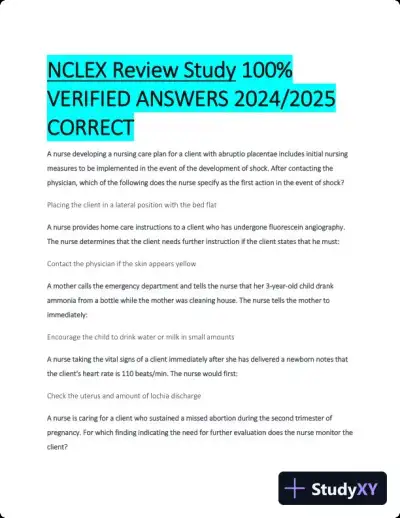 Past Exams
2024-2025 NCLEX Review Study Guide with Answers (50 Solved Questions)
National Council Licensure Examination
9 pages169downloadsFeb 2025 Certification Guides
Developing Clinical Judgment for Professional Nursing and the Next-Generation NCLEX-RN® Examination (2020)
National Council Licensure Examination
713 pages162downloadsFeb 2025 Certification Guides
NCLEX-RN Notes: Core Review and Exam Prep (2007)
National Council Licensure Examination
281 pages156downloadsFeb 2025 Certification Guides
HESI Comprehensive Review for the NCLEX-RN Examination 6th Edition (2019)
National Council Licensure Examination
842 pages150downloadsFeb 2025 Certification Guides
2020 NCLEX-PN Test Prep. Questions and Answers with Explanations (2020)
National Council Licensure Examination
943 pages147downloadsFeb 2025 Certification Guides
CliffsTestPrep NCLEX-RN (2011)
National Council Licensure Examination
510 pages130downloadsFeb 2025 Past Exams
2024-2025 NCLEX Rationals and Study Guide with Answers (168 Solved Questions)
National Council Licensure Examination
41 pages130downloadsFeb 2025 Certification Guides
NCLEX-RN For Dummies with Online Practice Tests (2020)
National Council Licensure Examination
485 pages125downloadsFeb 2025
Study this document with CramX
Once it is in your library, every tool can work from it.