

Microbiology Quizzes
- National Council Licensure Examination
- 11 pages
- Shared June 2025
NCLEX & Microbiology quiz review: Topics include TB diagnosis, Gram stain, enzymes, pathogens, viral structure, eukaryotic cells, and metabolism. Key facts and prep for exams in one place
Preview 4 of 11 pages
See the first 4 pages exactly as they appear in the document.
Page 1 Read page 1 as text
Quiz 1 Question 1 NCLEX Prep Question An RN is working at a public health clinic that sees many patients with infectious disease. Ms. Hungh, a Burmese immigrant, presents to the clinic with an interpreter, complaining of fatigue, weight loss, persistent cough, and rust-colored sputum. The interpreter explains that Ms. Hungh has had this cough for many months in her home country and, now that she is in America, is seeking treatment for her condition. QUESTION A sputum sample is ordered for microbial analysis in order to rule out the diagnosis of tuberculosis. Suspecting Mycobacterium tuberculosis may be the pathogen, the RN knows the laboratory technicians will perform which stain on the sample? Acid-Fast Question 2 Purines and pyrimidines are components in the build'ng block units of al enzymes. False Question 3 Amino acids are the building blocks of an enzyme. True Question 4 Glycogen are not monosaccharides True Question 5 When humans manipulate the genes of microorganisms, the process is called genetic engineering Question 6 All microorganisms are considered pathogens.
Page 2 Read page 2 as text
False Question 7 Taxonomy does not involve common name Question 8 Which of the following is not considered a microorganism? Mosquito Question 9 Which of the following is not a human use of microorganisms? Manufacturing copper wire Question 10 Thymine is part of the RNA molecule. False Question 11 When assigning a scientific name to an organism, both genus and species names are italicized or underlined. Quiz 2 NCLEX Prep Question A patient with presumed urinary tract infection (UTI) has a urine sample collected and sent to the laboratory for culture. To encourage the growth of scant pathogens in the sample, an enriched medium may be used. QUESTION Which of the following are substances that may be present in enriched media? Choose all that apply.
Page 3 Read page 3 as text
serum hemoglobin blood growth factors Q u e s t i o n 2 The Gram staining procedure is best described as a(n) staining technique. differential Q u e s t i o n 3 The Five I's of studying microorganisms include all of the following except infection Q u e s t i o n 4 If a microbiologist is studying a specimen at a total magnification of 950x, what is the magnifying power of the objective lens if the ocular lens is lOx? 95x Q u e s t i o n 5 All of the following are examples of different types of microbiological media except petri dish Q u e s t i o n 6 Which of the following magnifies the specimen to produce its real image? objective lens Q u e s t i o n 7 The correct microbiological term for the tiny sample of specimen that is put into a nutrient medium in order to produce a culture is the inoculum Q u e s t i o n 8 The term that refers to the purposeful addition of microorganisms into a laboratory nutrient medium is inoculation Q u e s t i o n 9 The purpose of staining cells on a microscope slide is to add contrast in order to see them better
Page 4 Read page 4 as text
Question 10 A pure culture contains only one species of microoganism Question 11 A selective medium contains one or more substances that inhibit growth of certain microbes in order to facilitate the growth of other microbes. True Chapter 3 T/F Chapter 1
7 more pages in the full document
Unlock it once and it stays in your library, ready to chat with or turn into flashcards.
Unlock the full documentMore National Council Licensure Examination study materials
See all Past Exams
2024-2025 NCLEX Review Study Guide with Answers (50 Solved Questions)
National Council Licensure Examination
9 pages169downloadsFeb 2025 Certification Guides
Developing Clinical Judgment for Professional Nursing and the Next-Generation NCLEX-RN® Examination (2020)
National Council Licensure Examination
713 pages162downloadsFeb 2025 Certification Guides
NCLEX-RN Notes: Core Review and Exam Prep (2007)
National Council Licensure Examination
281 pages156downloadsFeb 2025 Certification Guides
HESI Comprehensive Review for the NCLEX-RN Examination 6th Edition (2019)
National Council Licensure Examination
842 pages150downloadsFeb 2025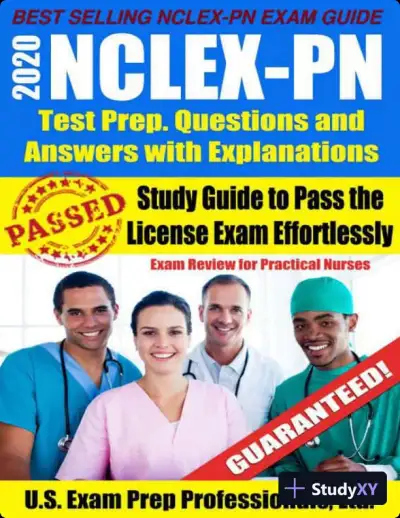 Certification Guides
2020 NCLEX-PN Test Prep. Questions and Answers with Explanations (2020)
National Council Licensure Examination
943 pages147downloadsFeb 2025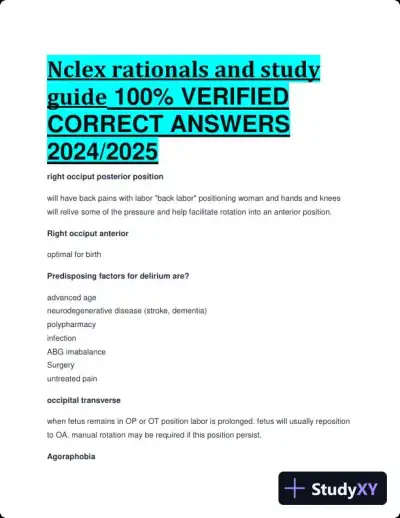 Past Exams
2024-2025 NCLEX Rationals and Study Guide with Answers (168 Solved Questions)
National Council Licensure Examination
41 pages130downloadsFeb 2025 Certification Guides
CliffsTestPrep NCLEX-RN (2011)
National Council Licensure Examination
510 pages130downloadsFeb 2025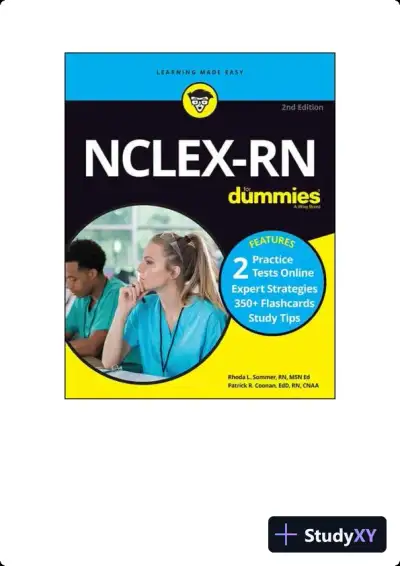 Certification Guides
NCLEX-RN For Dummies with Online Practice Tests (2020)
National Council Licensure Examination
485 pages125downloadsFeb 2025
Study this document with CramX
Once it is in your library, every tool can work from it.