

NCLEX Acid Base Balance Ventilators
- National Council Licensure Examination
- 95 pages
- Shared June 2025
NCLEX study guide on acid-base balance and ventilator interpretation. Covers key lab values, metabolic vs. respiratory conditions, and opioid effects—designed to help nursing students master critical care concepts for NCLEX success.
Preview 29 of 95 pages
See the first 29 pages exactly as they appear in the document.
Page 1 Read page 1 as text
BEST,UPDATED NCLEX STUDY GUIDE L E C T U R E N O T E S TABLE OF CONTENTS - (2} STUDY GUIDES Keep Calm and Pass NCLEX w i t h Best lecture Notes Review Anticholinergic vs. Cholinergic Effects
Page 2 Read page 2 as text
KEEP CALM and PASS NCLEX 1. Acid-base balanoe/ventilatora Rule of the B r s.. If the p H & the bicarb are both in the same direction = metabolic If they are in different directions = respiratory 7 pH = 7.35-7.45 acidosis 'alkalosis HCO3 (bicarb) = 22-26 (2-2+2 = 6) CO2 = 45"33 ex: pH: 7.30 = j bicarb: 20 = 1 = metabolic acidosis ex: pH: 7.58 = ‘ bicarb: 32 = * = metabolic alkalosis ex: pH: 7.22 = ¥ bicarb: 30 = f = respiratory acidosis ex: You are providing care to a client with the following blood gas results: pH 7.32, CO 2 49, HCO3 29. PO2 8 0 & SaO2 90%. Based on the results : the client is experiencing: I = acidosis,. 1 = respiratory -opioid: CNS depressant. know the symptoms (sedation, respiratory depression, etc).. ♦ principle: acid base signs/symptoms..
Page 3 Read page 3 as text
a s the p H goes... s o goes m y patient!!! -when pH goes up: patient goes up., (everything gets irritable!] -when pH goes down; patient goes down] (systems in your body shut down) . . . e x c e p t with potassium: when pff goes up; potassium goes down... when pH goes down; potassium goes up! (up) alkalosis: irritibility. hyper-reflexia (3 & 4), tach}pnea : tachycardia, borborygnii (increased bowel sounds), seizure, aspirate.. (down) acidosis: hypo-refleKia, bradycardia, lethergy (obtunded), paralytic ileus (decreased bowel sounds): coma, respiratory arrest (ambu-bag!!) Kussmaul breathing is adeep and labored breathing pattern often associated with severe metabolic acidosis, particularly diabetic ketoacidosis (DKA) but also kidney failure... JIAC Kussmaul!! M : metabolic AC: acidosis ex: pT has respiratory' acidosis... (select all that apply).. +1 reflexes diarhhea adynamic ileus spasm urinary’ retention tachycardia and degree mobits type 2 heart block hypokalemia SATA questions: *never only' 1... never all o f them* diarhhea uriW cause a metabolic acidosis., but once you get addodic, it will shut pour bowels down = paraipfic ileus ...with scenarios., always ask first "is it lung?" = respiratory ...then ask if the pt is over-ventilating o r under-ventilating over-ventilating = alkalosis under-ventilating = acidosis ...it's about the SaOa!!! (pay attention!!) if it isn’t lung = metabolic., if pt has prolonged gastric vomiting o r suctioning... it’s always m e t a b o l i c aiitalosis... why? losing acid = becomes basic.. for everything else that is not lung - choose metabolic acidosis.. -if you d e n t know the answer,., always answer metabolic acidosis..
Page 4 Read page 4 as text
ventilators alarms.. Sigh pressure alarm... triggered by increasure resistance to airflow., (machine is pushing too hard to get air into the lungs), respiratory alkalosis 3 obstructions: kink in tubing [get kink out), water condensing within the tube [empty tube), mucus secretions in the airway [turn, cough, deep breathe... then suction)., suction as needed!! *in that order*... fouj pressure alarm., decreased resistance (too easy for the machine..) respirator; 7 acidosis Low pressure alarms are triggered by decreased resistance to airflow & can be caused by disconnections of the main tubing or oxygen sensor tubing... Tubing (reconnect it!) - oxygen sensor tube (reconnect it UNLESS tube is o n t the floor - bag them & call Respiratory therapist if this happens) Respiratoiy alkalosis = ventilator setting maybe too high. Respiratory acidosis = ventilator setting maybe too low. What does "wean" mean? gradually decrease with the goal of getting off altogether ex: Doc says wean off ’/ent in AM... bam AEG's show r e s p . acidosis... a) follow order b) cal] respiratory c) hold order., call doc d) begin to decrease the settings MASLOWs Priorities [HIGHest - LOWest) physiological safety comfort psychological (problems within the person) social (problems with other people) spiritual ex: Arrange from HIGHest - LOWest... denial spiritual distress, pain in elbow, fall risk, pathological family dynamics & electrolyte imbalance... = electrolyte imbalance [psyiological), fall risk (safety), pain in elbow (comfort), denial (psychological), pathological family djuamics (social) & spiritual distress (spiritual) alcoholism., (or any abuse) # 1 problem = denial *refusalto accept the reality of a problem* You treat denial by confronting it...
Page 5 Read page 5 as text
pronouns ~ good: i... bad: you... positions ~ good: i'm having a difficult time reading this... bad: you wrote it wrong.. loss & grief: Denial Anger Eargining Depression Acceptance don't confront it; support it.. ex: You have a pt that just hand a hand amputated & there say, "I can't wait to get back to placing the piano"... You say "Oh ; how long have you played, etc? - you NEVER say "You can t because you only have i hand" abuse = confront loss = support # 2 problem = dependency *when the abuser get the significant other to do something.. "Call my boss, i'm sick"* (abuser gets to keep abusing..) = co-dependency *calls the boss*... (positive self esteem) How to treat this?!? Set limits and enforce them... Learn to say NO! manipulation = when the abuser gets the significant other to do things for him or her... the nature of the act is dangerous or harmful how is it like dependency? the abuser is getting the other person to do something no harm = dependent / co-dependent (wife buying alcohol for husband) dangerous/harmful = manipulated (kid buying alcohol for father) ...depends on legal/illegal.. ..... Wernicke-Korsakoff Syndrome (WKS) is a neurological disorder. Wernicke's Encephalopathy and Korsakoffs Psychosis are the acute and chronic phases : respectively, of the same disease. WKS is caused by a deficiency in ihe Bi uitamin thiamine Thiamine (Ei) plays a role in metabolising glucose to produce energy for the brain. primary symptom of WKS = amnesia with confabulation (making up stories) *they believe the lie..* ex: You have a pt who believes he is Ronald Regan's Natioal Security Officer... And they want to go to a cabinet meeting... :/ WHAT DO YOU DO?!? Redirect!! ('well, why don’t you get a shower and then well go watch CNN and see what the news is in Washington D.C.") WKS is... -It's preventable & arrestable (stop it from getting worse) - Take vitamin B i -Irreversible... *About 70%*
Page 6 Read page 6 as text
Antibuse (disulfiram) -alcoholism medication *aversion therapy!* It can treat problem drinking by creating an unpleasant reaction to alcohol. It's used in recovery programs that include medical supervision and counseling. How long does it take to pet info & out of their system... a iceeits Patient teaching - teach how to avoid -VA USEA. UOAflUNG & DEATH xVO; mouthwash; aftershaves : perfumes colognes, insect repellants, -elixer (Robitussin), alcohol-based hand santizers, un-cooked icings (vanilla extract)... Homeuer, they CAN have RED WINE MNAGERETTE! Oi'erdoses /Withdrawals... Every abused drug is either an upper or a downer... ♦ Laxative (not upper or dovmer) but can be abused by the elderly.. UPPERS: caffiene, cocaine, PCP/LSD, methaphetamines, adderall.. Signs,' symptoms: things go up... euphoria; tachycardia, restlessness, irritibility, diarhhea, re/Zex 3/4, spastic - suction!!’ DOWNERS: heroin, alcohol, marijuana, etc. Sign /symptoms: things go „ - lethargic, respiratory depression, bradycardia; reflex 1/2, - ambubag!!! 2 steps... Step 1: ask yourself, is it an Upper o r Douner Step 2: ask yourself, is i: an Overdose (too much) or Withdrawal (not enough) If they say: "overdosed on an upper" (too much upper)... pick tilings!! If they say: "downer & intoxication" (too much DOWNER)... pick . things!! If they say: "withdrawal downer" (don’t have enough downer too little!) Too little downer makes everything g o up.. Too little upper makes everything g o d o w n . . Upper overdose LOOKS LIKE downer withdrawal... Downer overdose LOOKS LIKE upper withdrawal... 2 situtions (highest priority') = Respiratory depression/nrrest Downer overdose/upper withdrawal.. Seizure: Upper overdose/ downer withdrawal...
Page 7 Read page 7 as text
ex: Overdose on cocaine: UPPER/OVERDOSE.. (too much UPPER) *aka everything goes • * What would you expect to see? (select all that apply) -im'tabilifg. reflex 3/4, increased temp, borborygmi (increased bowel sounds) Withdrawing from cocaine.. -Mate sure the RRis above 12! NeedNARCAN!!! Drug addiction in the NEWBORN fronuface Always assume intoxication, not withdrawal a t birth ..After 24 hours - it's in withdrawal.. You are caring for an infant born to a equaline (pain killer) addicted mother... It is 24 hours after the birth... What do you expect to see.. SELECT ALL THAT APPLY: difficult to console, low core body temp, exaggerated startle reflex, respiratory depression; seizure risk, shrill high pitch cry... alcohol withdrawls = 24 (stable; not life threatening) *AWS* delirium tremens = 72 hours (unstable; can kill you) *DTS* AWS: regular diet, semi-private anywhere. u p a d lib. n o restraints.. PTS: NPO/clear liquid (seizure), private/near nurse s station, restricted bed rest (bedpans/urinals). restrained (VEST o r 2 point locked leathers *1 a r r n & opposite leg*)... xWS & DTS get a anti- hypertensive (B? pill) - everything is going up - keep everything down... They both get a tranquilizer.; because their up... multivitamin *bi* to prevent WKS. DRUGS : amino glyco cides - powerful antibiotics (the BIG GUNS!!.!) think: a m e a n old rnycin= serious.; life threatening.; resistent, gram negative (TB. etc.)... if it ends in mycin = mean old mycin ♦ not mean old mycins: erythro mycin, zithromycin : clarithromycin (thro) if it has thro = throw i t off the list... toxic effects: mycin = mice (ears)... oto- toxic!! -monitor hearing, tinnitus, vertigo (equalibrium) human ear shaped Eke kidney... nephro-toxicity! -monitor creatinine (best indicator for kidney function)... 8 (fits in a kidney) toxic to cranial # S and you administer them Q8H... route: IM or IV.. do not give PO, because they are not absorbed.. OPAL mycins: hepatic c o m a (liver coma) amonia level gets too high., pre-op b o w e l surgery 7 (to clean the bowel)... action: sterilize the bowel... which?! neomgcin a n d canomgcin " Who can sterilize m y bowel?! NEO KAN!!. 1 " @ T: trough: when the drug is at its lowest... A: adminster P: peak: when the drug is at its highest... Why do we do a TAP?! (narrow therapeutic window) what works/what kills.
Page 8 Read page 8 as text
Lasiks: 10-120 (wide) Dig: 0.125 - 0.25 (narrow 7 ) DO a TAP! IV push.. TROUGH: b4 sub: 5 0 mins., b it 1 : 5 0 mtns.. k j IM: 3 0 mins... 6 4 subQ: 3 0 mins., b j POr 3 0 mins.. PEAK; after sub? 3-10 mins., after iu: 25-30 mins.. after IM; 30-60 mins... after subQ; SEE Diabetes lecture.. after PO: DON'T WORRY ABOUT IT.. Calcium Channel Blockers: are Eke VALIUM for your V ! !! ...calms you down., calms the heart down! negative inotropic, negative chronotropic negative dromotropic = calm/ relax... cardiac depressant -what d o they treat: antihvpertensives ; anti-angina, anti-atrial-aarrh i ,thmia n S\T (atrial) Side effects: HA, HTN Name: ends i n -dapine... + Cardizem A- Vernpimii.. Cardizem (can be continous IV) -Check BP: HoldCCE if SYSTOLIC is< i o o ! Cardiac Arrthymias - knowing how 7 to read EKG strips... Know these p a tte rns I! 1) normal sinus rhythm 2 ) v-fib (no pattern) 3 ) v-tach (there's a pattern) 4 ) asystole
Page 9 Read page 9 as text
a flutter Q P S de-polarization = ventricular P wave = a t r i a l 6 rhythms... -a lack of QRS's = asystole -saw tooth = a flutter -chaotic = atriai/fbrilation -chaotic = ventricular fibrillation -QRS = ventricular tachycardia (bizzarre) -periodic bizarre wide QRS = PVC {law priority... can elevate to moderate: if there are more than 6/min.. or more than 6 PVC's in a row., or if the PVC falls a n the T v.'ave of the previous beat) PVC’s never reach HIGH.. LETHAL arrhytmias.. {they will kill you i n 8 minutes o r less) -nsystate (HIGH)
Page 10 Read page 10 as text
-u fib (HIGH) ...have in common: NO cardiac output (pulse).. NO brain perfusion. ♦ Potentially* LIFE threatening v-tach... (they have a cardiac output) TREATMENTS... PVCs/ V-TACH: Ventricular... A (arnioderone) Atrial: ABCD's adenocard (adenosine)', push in <8 seconds... *asystole for about 3 0 seconds!* beta blockers (side effects: HA/HTN) *no asthma!* calcium channel blockers... digitalis (digoxin, lanoxin) V-FIB: you D-FIB... Shock them! Asystole: EPI & atropine.. CHEST TUBES -purpose: re-establish negative pressure in the pleural space (need negative pressure for air exchange) ♦ Loot for the reason w h y it w a s placed!* pnemothorax (air = positive pressure., put chest tube in to re-establish negative pressure!) hemothorax (blood= positive pressure., put chest tube in to re-establish negative pressure!) pneumohemo (air & blood = positive pressure., put chest tube in to re-establish negative pressure?) ...what do you expect from a hemo chest tube: drain blood... LOCATION of the tube.. APICAL (high.: air) & BASILAR (bottom; blood) example: unilateral pneumohemo.. apical for pneumo & basilar for h e m o bilateral p n e u m o : 2 apicals chest trauma: unilateral (always assume its unilateral) post o p R pneumonectomy ( n o chest tube!!) TROUBLE SHOOTING: Knocked it over... DON’T freak out! Water seal breaks...? CLAMP IT!!! (so nothing gets in).. CUT IT AWAY FROM BROKEN DEUCE... SUBMERGE TUBE UNDER STERILE WATER!!! UNCLAMP IT... FIRST: CLAMP BEST: SL7BMERGE (re-establishes water seal) KNOW FIRST vs BEST... V-Fib.. BAD! FIRST: place backboard.. BEST: chest compressions.. What do you do if the chest tube gets pulled out? FIRST: takes a gloved hand and cover the hole.. BEST: cover it with vaseline gauze!!
Page 11 Read page 11 as text
BUBBLING (chest tubes) A sJ: where & when... ...Sometimes bubbline is good & sometimes it's bad - depends o n where & when! Bubbling, bubbling: bubbling... Where? Water seal.. When? Intermittent = GOOD! Document that! Bubbling, bubbling.: bubbling... Where? Water seal... When? Continous = BAD! = LEAK... You do not want continous bubbling in the water seal. Bubbling, bubbling: bubbling... Where? Suction control chamber.. When? Intermittent = BAD... Suction is not high enough Bubbling, bubbling; bubbling... Where? Suction control chamber.. When? Continous = GOOD.. Document that! *If something is sealed, should you have a continous bubbling? NO. straight cath is to a foley catheter a s a thoracentesis is to a chest tube.. Rules for clamping a tube: do NOT clamp longer than 15 seconds without a doctor s order... What happens if you break the water seal? CLAMP it! How long do you have to get it under water? 15 seconds, or you gotta unclamp.. Ha\e sterile water bottles nearby! Use rubber tip double clamps... CONGENITAL HEART DEFECTS (trouble or no trouble; either causes a lot of problems or it's no big deal at all - there is no in between) TRouBLe Trouble defect shunts blood: RIGHT to LEFT (cyanotic); needs surgery delayed growth, decreased life expectancy, needs more time in the hospital/pediatric cardiologist NO-trouble defect shunts blood: LEFT to RIGHT (pink); doesn't need surgery, normal growth, normal life expectancy, only 24-36 hours in the hospital/ pediatrician ,'NP.. 40 some congential heart defects.. TROUBLE: .Ml start with the letter "T"; if it does not start with a ' T"; it's not trouble. TROUBLE: tetrology of faUot, truncus arteriosus, transposition on the great vessels, transposition on the great arteries, tricuspid atresia, total anomalous pulmonary venous return (TAPV), left ventricular hypoplastic syndrome... N O TROL?B££: ventricular septal defect, patent ductus arteriosis, patent foramen o ’ale, atrial septal defect, pulmonic stenosis... ..ALL congenital heart defect kids (whther trouble or not} will have 2 things in common: they will all have a murmur (because the shunt of the blood) & they all have a n ECHO done.
Page 12 Read page 12 as text
4 defects of tetralogy offallot - VD (ventricular defect) - PS (pulmonary stenosis) - OA (over-riding aorta) - RH (right hypertrophy) VarieD Pictures Of A RancH (initials) INFECTIOUS DISEASE & TRANSMISSION BASED PRECAUTIONS 4 types... STANDARD/ UNIVERSAL: CONTACT: for anything enteric (fecal.''oral): c-diff, hep a, cholera, staph infections, RSV (however it is transmitted via droplet), herpes.. PRIVATE ROOM IS PREFERRED.. GLOSES. GOWN, HAND WASHING, DISPOSABLE SUPPLIES.. DROPLET 1 , bugs that travel (sneezing 'coughing): menegitis, hflu (causes epiglotitis)... PRIVATE ROOM I S PREFERRED. MASK, GLOVES, HAND WASHING, PATIENT WEARING MASK- WHEN LEAVING ROOM, DISPOSABLE SUPPLIES.. AIRBORNE: measles, mumps, rhubella. TB & varicella chickenpox.. PRIVATE ROOM REQUIRED, MASK, GLOVES, HAND HASHING, SPECIAL FILTER MASK (onfy for TB), PATIENT WEARING MASK - IFLEAVI-VG ROOM, NEGATIVE AIR FLOW. TB: (transmitted through droplet though).. PPE: Order to put on."'take off... TAKE OFF: in ABC order... gloves, goggles, gown, mask! PUT ON: reverse ABC for the Gs, but mask comes 2nd., gown, mask, goggles, gloves! MATH IV’ DRIP RATES... volume x drop factor / time in minutes (volume,' hours) micro drips: 6 0 drop.''ml macro drips: 10 drops 'ml PEDLA.TRIC DOSE childs weight... 2.2 lbs/kg... IV REPLACEMENT... Always ROUND at the END!’[ (NCLEX will tell you to where)
Page 13 Read page 13 as text
4- CRUTCHES, CANES. WALKERS Locomotion (human functioning): cast, traction, canes, crutches, walkers... CRUTCHES : how do you measure? (for risk reduction: nerve damange)... Length of crutch: 2-3 finger widths below the anterior axillary fold to a point lateral to and slightly in front of the foot.. Hand grip: when properly set, the elbox flexion will be about 30 degrees.. -How to teach how to use the different bpe of crutch GATES: 2 point, 3 point, 4 point & swing through... 2 point: 1 crutch,' opposite foot., other crutch,.'other foot.. 3 point: moving 2 crutches & the bad leg... 4 point: move everything separately... Swing through: NON-weight bearing.. *amputations* plant the crutches & swing through... WHEN DO THEY USE THESE...?? Even /or euen; odd /or odd = use the ex'en # of gates when the weakness is evenly distributed... Use 2 point (mild), 4 point (severe)., use odd # gate (3), when 1 leg is odd., can't bear weight/amputation = swing through! early stages of RA: 2 left above knee amptuee: swing through 1st day post op R knee replacement; partial weightbearing allowed: 3 advanced stages: 4 left hip replacement; 2nd day post op non weight bearing: swing through bilateral knee replacement: 4 bilateral total knee; 3 weeks post op: 2 Going up and down stairs with crutches: UP with the GOOD, DOWN with the BAD! CANES : Hoid the cone on the strong side... WALKERS: Picfc them up, set them doum... If they must tie belongings to the walker; have them tie if to the side & not the front (can tip over); n o wheels,, tennis balls (per boards!) DELUSIONS, HALLUCINATIONS & ILLUSIONS: *PSYCH* Is my patient NON-pspchotic rs. psychotic? (1st thing you must decide) N O N psychotic (neurotic): has insight and reality based; they know they have a problem... they need "good general therapuetic communication"; that must be uery dgjfaidt, hoio are you /eeiing; iohat do you mean by, can you teil me more? psychotic: has NO insight & is not reality-based; they don't have a problem/they aren't sick;, they blame everyone else... "unique specific strategies" SYMPTOMS: delusions, hallucinations & illusions... delusion = a false fixed idea or belief; there is no sensory component. 3 types: paranoid, grandiose (you're christ) & somatic (x-ray vision) hallucination = false fixed sensory (hear, feel, taste, smell, see)
Page 14 Read page 14 as text
most common hallucination = tmdifori/.. then visual... then tactile [feeling), gustatory (taste).. olfactory [smell] most common auditory = voices telling you to harm yourself. illusion = misinterpretation of reality., (sensory) *there is a referent in reality* (something to which a person refers) HOW DO YOU DEAL WITH THESE PATIENTS?!? If, psychotic - what is their problem? (What kind of psychosis do they have?) FUNCTIONAL psychosis: they can function in every day life (schizophrenia; schizoaffective disorder, major depression, manic) DEMENTIA: the brain is damaged (senile, alzheimers, organic brain syndrome) DELIRIUM: FUNCTIONAL: this person has the potential to learn reality/ improve.. Teach reality... Use 4 step process., acknowledge feeling, present reality, set a limit, enforce the limit.. Example (answer): FEELING: I see you're angry; you seem upset tell me more of how you're feeling... REALITY: I know that the voices are real to you, but they are not real... I'm a nurse, this is a hospital... SET LIMIT: That topic is off limits in our converstion.. We aren't going to talk about that.. ENFORCE LIMIT: I see you are too ill to stay reality based, so our conversation is over (it ends the conversation). DEMENTLA: this person can NOT learn reality... 2 steps: acknowledge feeling & redirect them (channel them from something they can't do to something they can do)... REALITY ORIENTATION: person, place & time (always appropriate)... but DON'T present reality... DELIRIUM: this is a temporary sudden dramatic secondary loss of realty - ... usually due to some kind of chemical imbalance in the body.. (*crazy for the short term; ex: AT. on Feb. 3rd F * , UTI, post-anesthesia, thyroid storm, adrenal crisis, delirium tremens)... REMOVE the underlying cause = 2 steps: tfte/eelin<j & then reassure (this is temporary and you will be kept safe). LOOSELY ASSCOCLATED = YOUR THOUGHTS xARE ALL OVER THE PLACE... flight 0 / ideas: go from thought to thought to thought... Word salad: babble random words (sicker) Neologism: making up words Narrowed self concept: when a (functional) psychotic refuses to leave their room or change their clothes... NURSE would say: "I see you feel uncomfortable.. You do not have to change your clothes or leave the room until you feel comfortable or are ready." Ideas of reference: when you think everyone is talking about you... 5- DIABETES INSIPIDUS: polyuria & polydipsia leading to dehydration, due to loWxADH. SLADH: oliguria (low urine output) and retaining water (gains weight) DLABETES (mellitus)
Page 15 Read page 15 as text
Diabetes = error of glucose metabolism, polyuria, polydipsia the less the urine out; the higher the speci/tc gravity... the more the urine out; the lower the specific gravity... Type i: insuEn dependent, ketosis prone... Type 2: non-insuEn dependent, non-ketosis prone... polyuria (increased urine), polydipsia (increased thirst), polyphagia (increased eating) TREATMENT Type i: DIE... diet, insulin, exercise Type 2: DOA... diet, oral hypoglycemic, activity DIET. INSULIN & EXERCISE Type 2: calorie restriction, 6 small meals... What does insulin do to the blood glucose? LOWERS it? EUTOGLI'CEJlfLA = PEAK... 4 types... Regular ( R): onset: 1 hr,, peak: 2 hrs., duration: 4 hrs. clear solution (can be IV drip) *rapid short acting* RAPID & RUN Lantus (Glargine): onset: 1 hr.. peak: NONE.. duration: 12-24 LITTLE to NO RISK for HYPOGLYCEMIA* (can SAFELY give at BEDTIME) *LONG acting* NPH: intermediate acting* onset: 6 hrs., peak: 8-10 hrs., duration: 12 hrs. cloudy., suspension * NEVER put anything in an IV bag!* NOT so fast & NOT in the bag Humalog (Lispro): onset: 15 mins., p e a k : 3 0 mins., duration: 3 hrs. *gtve it WITH MEALS!* .AL I VAIS check expiration dates!! (manufacturer's expiration date is only good when the bottle is closed... after it s open; it expires in 30 days!) *make sure you write the date on the bottle with EXP!* You should teach patients to refridgerate their insulin at home, but it doesn't need to be refridgerated in the hospital. ...EXERCISE (like another shot of insulin) ex: "and he exercised...’ aka "and he got another shot of insulin". she's going to play soccer this afternoon"., "she's going to get a shot of insulin this afternoon!" more exercise (more insulin) = really need less insuEn less exercise = need more insuEn
Page 16 Read page 16 as text
SICK days: glucose is going to go up., still take insulin. even if they're not eating., take sips of water; they get dehydrated fast. (HYPERGLYCEMIA & DEHYDRATION).. needs to stay active as possible. COMPLICATIONS of diabetes (mellitus) Acute -low blood glucose (tr;<pe i/type 2 ) HYPOGLYCEMIA.. not enough food, too much insulin/meds, too much exercise., danger = brain damage (permanent).. S/S: drunk i n shock = staggerin' gait, slurred speech, impaired judgement, delayed reaction time, labile (emotions all over the place), loud/obnoxious.. (vasomotor) low BP ; tachycardia, tachpnea, cold, pale, clammy, mottled.. WHAT DO YOU DO?! adminster rapidly metabolizable carbohydrates (sugars):, any juice, candy, milk, honey ; icing, jam... ideal combo = sugar plus a starch or protein.. ORANGE juice & crackers! apple juice & slice of turkey... 1/2 cup skim milk (has both sugars & protein), if UNCONSCIOUS, give GLUCAGON; IM injection.. DEXTROSE D10/D50; given IV.. -DKA (diabetic ketoacidosis/diabetic coma) *only type is*... glucose goes HIGH., too much food, not enough medication, not enough exercise.. # 1 cause = acute viral upper respiratory infections (in the last 2 weeks).. So,. iL'ften tftey come info the hospfiaZ & iftefr BS is 8 5 0 tALlVAlS asJt the parents "have they had a viral infection i n the l a s t s weeks!!!* S/'S: DKA = de.cycrGtion, ke tones in their blood/kussmaul breathing (deep & rapid)/K (high) potassium, acidosis (metabolic)/acetone breath, anorexia due to nausea.. 1VHAT DO YOU DO!?! HYDRATE!! (IV fluids; fast!! 200ml.'hour: regular insulin; normal saline/Dg?) D5 doesn't stay in ’reins; goes into the tissues., won't cause HYPERGLYCEMIA (Dio & D50 will!) hyperglycemic hyperosmolar nonketotic coma HHZVK(type 2) = DEHYDRATION... HYDRATE them!!!! insulin is most essential i n treating DKA!!! higher mortality rate = HHNK, however DKA has higher priority. ♦♦ long term complications of diabetes are related to: poor tissue perfusion & peripheral neuropathy... ♦ lab test: Aic (average glucose rate over 3 months)... you want it to be 6 & <!! 7 = need to check on it 8 & > = out of control
Page 17 Read page 17 as text
6. DRUG TONICITIES [5) Lithium: ANTImania drug for EiPolar.. Therapuetic level: o.6-1.2 Toxic level: 2 & > Lanoxin (Digoxin) : A-Fib & CHF Therapuetic level: 1-2... 2 can be toxic! Toxic level: 2 & > AminophjdlLne: Airway Anti-Spasmodic *NOT a bronchodilator* (when a bronchodilator doesn't work in an acute airway problem, give them aminophylline to relax the spasm: then give the bronchodilator). Therapuetic level: 10-20... 20 can be toxic! Toxic level: 20 & > Dilantin: Used for Seizures Therapuetic level: 10-20... 20 can be toxic! Toxic level: 20 & > Bilirubin: Waste product from the breakdown of RBCs (only tested in NEWBORNS on the NCLEX) Normal: 9.9 and < Elevated level: 10-20... 20 can be toxic! 14-15 *is when they need to be hospitalized* Toxic level: 20 & > Jaundice: yellowing; bilirubin in the skin Kernicterus bilirubin the the brain... usually occurs when the level gets around 20.. Opisthotonus: a position the baby assumes when they have bilirubin on the brain; HPPERENTEND.. In what position do you place an opisthotonic child? O n their side! DUMPING SYNDROME vs. HLATAL HERNLA Hiatal hernia: regurgitation of acid into the esophagus.; because the upper part of your stomach herniates upward through the diaphragm... *moves in the wrong direction in the correct rate* (you want it to empty faster; so it doesn't reflux) S/S: GERD (heartbum & indegestion) *when lying down after eating* Treatment: pZau around luith the head of the bed (raise); pZau around u.'ith water content juith the meat (flushfaster) & pou can pZay around iuith the carbohydrate content of the meal (carbs go fast)... LOW protein!! Dumping syndrome: gastric contents dump too quickly into the duodenum... hnoves in the right direction, but at the wrong rate * (you 5vant it to empty slower) S/S: * DRUNK* (staggering gait, slurred speech, impaired judgement) & *SHOCK* (tachycardia, tachypnea, cold, daunny, pale) DRUNK + SHOCK = HYPOGLYCEMLA *ACUTE ABDOMINAL DISTRESS* (cramping, pain, doubling over, borborygmi increased bowel sounds*, diarhhea, bloating; distension)
Page 18 Read page 18 as text
Treatment 1 Eat with head low & fumed to ffte side, low fluids with meal and low carb content in the meals, HIGH protein'! ELECTROLYTES Kalernias d o the SAME AS the prefix, except for heart rate & urine output!! S/S... HYPERkalemia: brain: irritability, restlessness, agitation,,. lungs: tychpnea heart: low heart rate urine: oliguria bo5vel: diarhhea, borborygmi muscles: spasticity reflexes: +3/+4 HYPOkalemia: brain: lethergy lungs: bradypnea heart: tachycardia urine: polyuria bowel: constipation muscles: flaccidity reflexes: 1/2 -Cushings immonosuppressed (needs PRIVATE room) (aldosterone; retain sodium & water; low on potassium) ex: SATA: HYPERkalemia -c/onus (muscle spasm). bradycardia Calcemias do the OPPOSITE AS the prefix... (if it skeleton or nerve, blame it o n calcium!) S/S... HYPERcalemia: brain: lethergy lungs: bradypnea heart: bradycardia urine: oliguria bowel: constipation muscles: flaccidity reflexes: 1/2 HYPOcalemia: brain: irritability, restlessness, agitation... lungs: tachypnea heart: tachycardia urine: polyuria bowel: diarhhea
Page 19 Read page 19 as text
muscles: spasms reflexes: -+3/+4 Chvostek sign: when you touch their CHEEK, they go into a spasm of the face (neuromuscular irritability associated with a LOW calcium} Trousseau sign: when you put a blood pressure cuff on, blow it up & they go into aspasm o f the hand. Afagnesiums d o the OPPOSITE A S the prefix... (in a tie, DON’T pick magnesium!) S/S... HYPERmagnesium: brain: lethergy lungs: bradypnea heart: bradycardia urine: oliguria bowel: constipation muscles: flaccidity reflexes: 1/2 HYPOmagnesium : brain: irritability restlessness, agitation... lungs: tachypnea heart: tachycardia urine: polyuria bowel: diarhhea muscles: spasms reflexes: +3/+4 Sodiums S/S... HYPERnatremia: DEHYDRATION *DKA*DI... HHNK? HYPOnatremia: OVERLOAD *Fluid volume excess* SIADH NUMBNESS & TINGLING (paresthesia) = Earnest sign of any electrolyte disorder " circumoral = n u m b & tingling lips UNIVERSAL sign of any electrolyte disorder = MUSCLE weakness (paresis) TREATMENT: (boards should only test potassium) H I G H potassium fwiZI stop your heart) Rules for Potassium: NEVER push IV! -NEVER more than 4 0 o f K per liter o f I V fluid. If more than 40, question & clarify with DOC first! -HIGH POTASSIUM = worst electrolyte imbalance! *can STOP heart!*
Page 20 Read page 20 as text
So, how do we lower potassium?!?! Gire D $ W wifh REGULAR insulin (drive potassium into the cell & o u t of the blood) *temporary/fast*!!! "enters early" -Kayexalate "K exits late” (switch the potassium with soldium) *permanent/ilow* So... *Give both D 5 W w / REG insulin & kay exala te!*... *switching from a life threatening imbalance (HTPERkalemia) for a non-life threatening imbalance (HYPERnatremia): just hydrate!!* @ 60 drops.'ml *remember!!* ENDOCRINE Overview HYPERthvroidism: thyroidsim' = "metabolism", because that is what the thyroid does, so HYPERtluroidism = HYPERmetabolism S/S: weightloss, high pulse & BP- irritable, heat intolerance, cold tolerance, exophthalmos (bulging eyes).. GRAVES disease (running yourself into the grave) Treatments: -radioactive iodine... KNOW: patient needs to b e by themself for 24 hours (restriction of visitors).. and then be really carefiil with their urine (flush 3 times!) If the urine is spilled, they must call the hazmat team !! Only RISK to the Nurse is the patient's urine (how the radioactivity is excreted!) -PTU (propylthiouracil): *Puts Thyroid Under* ...CANCER drug! KNOW: that it is an IMAI LWOsuppressor; monitor WBCs!! -thyroidectomy (most common way used!) "TOTAL (complete) or SUBTOTAL (partial) tyroidectomy* -TOTAL: need lifelong hormone replacements., at risk now for JfliPOcaicemzQ! -SUBTOTAL: do NOT need lifelong hormone replacements., at risk now for H f FROID SrORAf/CRISIS THYROID Storm = medical EMERGENCY (can cause ERAIN damage!!!) "basically frying your brain t o death, with HYPOXLA!* S/S: super H I G H temps (105 & >) ; extremely HIGH E P s *ex: 210/18o (stroke category!)*, severe TACHYCARDLAfex: 180-200) & PSYCHOTIC DELIRIUM Treatment: Get temperature D O W N & get the oxygen UP!! "FIRST ivap- to get temp down: ice packs.. BEST way to get temp down: cooling slantet... OXYGEN (permask @ ioL)!!E D O NOT USE TYLENOL - it works in the hypothalamus and isn't going to work at this time.. FYI: If it's a sequence question: oxygen, ice packs, cooling blanket.. NEVER. EVER leave patient! PostOP RISKS: (1st 12 hours): priority = airway & hemmorha e.. (same for both!) (12-48 hours): TOTAL: Tetany (muscular spasms in laraynx: can cut off airway) due to low calcium.. SUBTOTAL: Thyroid STORM!
Page 21 Read page 21 as text
(>48 hours *42-72*): IxVFECITON FYI for INFECTION: NEVER choose infection as a PRIORITY in thej'irst 7 2 hoars for anything!!! ONLY CHOOSE it q/?er the first 7 2 hours!!! HTTP thyroidism : "thyroidsim" = "metabolism"., because that is what the thyroid does, so HYPO tiriToidism = HYPOmetabolism S/S: obese, cold intolerance, heat tolerance, low pulse & BP = AfYYedema Treatment: give them thyroid hormones: synthroid (levothyroxine) ♦ CAUTION!!* do NOT sedate these patients: can put them in a coma -iVhat pre-op order would you question? AM BIEN (5 H S If the patient is supposed to be NPO; make sure you question that they still get their morning pill!! (they NEED it! NEVER hold your thyroid pills unless you have EXPRESS orders to do so). ADREAOCORIEA Disease (start with A & C) ex: Cushings,Conns,Addisons.. ADDISONS-. UNDER secretion of the adreno cortex S/S : rf YPERpigmented (tan!) &do NOT adapt to stress (your stress response is to raise your glucose & BP!) -these people can't do this; glucose & EP goes down = go into shock! Anything from a tooth filling at the dentist or a minor fender bender can cause these., people to stress out & die.. TICKING TIMEBOMB! ♦ ADDISONS is one o f the RAREST endocrine disorders* ex: for every 600 CUSHINGS patients, there's 1ADDISONS patients.. *JFKhad this dx; so when he was shot (even if it was in his shoulder & not his skull) , there was never any chance for sumval* Treatment: glucocorticoids (steroids; all e n d i n ' sone’ ex: prednisone, dexamethasone & hydrocortisone.. Remember: ADDISONS "ADD a SONE"!! CUSHINGS: OVER secretion of the adrenocortex (cushy = more!) S/S: pu#p- mocm/ace, fttrsutism (facial hair), trunkal obesity (big body), gynecomastia (female breats on men), buffalo hump, skinny arm &legs (muscles waste away), retain sodium &water; losing potassium, striae (stretch marks), bruising. ("I'm mad; I have an infection"; grouchy/irritable & immunosuppressed} fcHIGH glucose *??wsf inzportanf to remember!!* (hyperglycemic!!)'! CUSHman (know this picture!!)
Page 22 Read page 22 as text
Treatment HYPERsecreting of the adrenocortex = ADRENALectomy' (bilateral)., can cause Addisons though; so they need steriods; making you look like CUSHman againfrcwn&ce ♦ KID’s TOYS!!!* 3 questions to ALWAYS ask... -Is it SAFE? -Is it AGE APPROPRIATE? -Is it FEASIBLE? (possible to do easily or conveniently) SAFETY considerations -NO SMALL TOY'S for children UNDER 4 (could put in mouth/aspirate) -NO METAL (die-cast) TOYS, if OXYGEN is i n use., (sparks!) -BEWARE o f FOMITES (NON-living object that harbors micro-organisms) What toys are the worst for FOMITES? Stuffed animals... What toy is the best for FOMITES? Hard plastic toys /you can disinfect it! *BEST toy for an IMMUNSUPPRESSED child? HARD PLASTIC action figure! FEASIBILITY consideration -Could they do it? ex: Is swimming a good activity for a 13 year old? Safe; yes.. Age appropriate; yes.. Feasible for a kid in a body cast? NO!! AGE APPROPRIATE considerations Infant om-6iu: BEST toy: musical mobile *stimulates motor & sensory*... 2nd BEST toy: something SOFT & LARGE 6 m - p m : ♦ working on object permanence*: they know it’s still there even though they can’t see it* ex: you put a toy under a blanket - if they don’t have it; they!! cry.. if they have it: they know to lift the blanket & get it.. At this age : your "play' should be teaching them that ; that is their big task at this time. BEST toy: cover /uncover toy; play PEEK-a-BOO, the parent putting a blanket over their head and then taking it off, Jack-in-the-Box, etc... 2nd BEST toy: something large /hard.. WORST toy: musical mobile; they can sit up/reach up and then can stranglate themselves trov.ntace 91U-12111: *working on vocalization*: BEST toy: speaking toys; ex: ’Talking" Woody (Toy Story!), Tickle Me Elmo, Teddy Ruxpin, See & Say: "the COW says MOO", etc.. They also need PURPOSEFUL ACTIVITY... .VEUER PICK THESE ANSWERS if the. kid is UNDER gm: build, sort, stack, make, construct - why? PURPOSE words!! Toddlers 1-3: Best toy: PUSH,'PULL, ex: lawn mower, baby stroller *work on GROSS MOTOR; running, jumping* NO finger dexterity yet; can’t color, use scissors, etc. "Finger painting", yes, because they can use their HAND! Finger painting = HAND painting. -They do PARALLEL Play (play along-side, but not with)
Page 23 Read page 23 as text
Preschoolers Work on their FINE MOTOR (finger dexterity)? work on BALANCE (tricylces,. dance class, iceskates) Characterized by CO-OPERATIVE play (play together in groups) -They like to PRETEND: highly imaginative! School Age Characterized by the 3 C s -Creative (blank paper & colored pencils) -Collective (collect anything & everything) -Competitive (they don’t like being the loser) Adolescents Peer Group Association (hang out with their friends) Question (pertaining to Nursing): Do you. let 5-S adolescents hang out in a room together? YES!! UNLESS these 3 things: if anyone is fresh post-op (less than 12 hours out of surgery), if anyone is immunosuppressedk if anyone has a contagious disease LAMINECTOMY (is surgery that creates space by removing the lamina - the bacfc part of the vertebra that covers your spinal canal. Also tnoion as decompression surgery, lamuiectomg enlarges your spinal canal io relieve pressure on the spinal cord or nerves). lamina = vertebral spinous processes (posterior) ectomy = removal WHY do you do this?? RELIEVE NERVE R O O T COMPRESSION S/S of nerve root compression: 3 P’s -pain -paresthesia (numbness & tingling) -paresis (muscle weakness) MOST IMPORTANT thing to pay attention in any NEURO question = LOCATION’. 3 locations for laminectomy: -cervical (neck), thoracic (upper back) & lumbar (lower back) Questions pertaining to areas: cervical; diaphragm... #1 ansiver = check out their breathing... #2 answer = check out the function of their arms & hands. thoracic'; cough & bowels... #1 answer = checkhoiv well they cough lumbar; bladder & legs... #1 answer = is their bladder distended o r empty... - 2 answer = h o w is the f u action o f their legs POST op laminectomy: #1 answer = log rolll 3 tilings to mobilizing pt: doNOT dangle them (sit on the edge of the bed), do N O T sit for longer than 30 minutes & they m a y walk, stand & tie d o w n without restriction.. POST op COMPLICATIONS (depends on LOCATION!!) cervical: trouble breathing after surgery.. * 1 complication: PNEUMONLA thoracic: trouble with coughing.. # 1 complication: PNEUMONIA & ileus (because bowels won’t work) lumbar: # 1 complication : urinary 7 retention & problems with the legs
Page 24 Read page 24 as text
ANTERIOR THORACIC (from front through the chest to the spine) laminectomy: will have a CHEST TUBE (pneumothorax ! But no others will have a chest tube... Laminectomy with FUSION: they take a bone graft from the iliac crest... If you remove the disc, you have to get bone from somwhere, so there isn't bone on bone (grinding)! So, there will be 2 incisions: spine & hip: the most pain will be at the hip frownface -Afosf Weeding £- drainage will be a t the hip; will have a JP (Jackson-Pratt) drain... -HIGHEST risk for INFECTION: they are equal.. -HIGHEST risk for REJECTION: the spine! Surgeons are using bones from cadavers quite a bit to lower infection rates.. Discharge TEAC HING: Permanent restrictions = -NEVER pick up object by bending at the waist; lift with the knees!! -cervical lams can NEVER lift anything over your head (for life!) -NO mountain biking, jerky moving ride (rollercoasters), horseback riding, etc. Temporary restrictions = -doNOT sit longer than 30 minutes (6 weeks) -lie flat & log roll (6 weeks) -NO driving (6 weeks) -doNOT anything more than 5 lbs: gallon of milk (6 weeks) Remember: MOST IMPORTANT thing to pay attention to in * *any* NEURO question = LOCATION : 8 . LAB VALUES -Afust know and also haw to PRIORITIZE them!! A = LOW priority B = LOW priority, but be concerned (watch them) C = HIGH priority; critical/do something!! *you CAN leave the bedside* D = H I G H priority; extremely critical!! *you can NOT leave the bedside* creatinine (serum): BEST factor to determine P.ENJ.L function... 0.6-1. 2 LevelA * FYI* the only time you should contact the DOC because of a HIGH level creatinine, is if the pt is going for a test/ procedure (the next morning) that involves a DYE; but it is not priority to let them know (it can wait until bam/yam).
Page 25 Read page 25 as text
IXR: monitors ccmniadm therapy... i n the 2 s & 3's {ex: 2.1... 3.8) Level C; if 4 & >1 -do something = (1) always H O L D , (2) ASSESS (focuses assessment on area), (3) PREPARE, (4) GALL doc .’’respiratory ’’etc. ex: (click &: drag)... level of 4.7 = HOLD coumadin, ASSESS for bleeding: PREPARE to give vitamin K : CALL doc! -sometimes there's nothing to HOLD, so jump to ASSESS., sometimes there's nothing to PREPARE, so jump to CALL - but you should always go through the process in your mind, so you don’t miss a step. potassium: (an indicator that something is wrong) 3 . 5-5.3 Level C; if LOW ASSESS heart, PREPARE to administer potassium, CALL doc. Level C; if HIGH *5-4-5.9* H O L D all potassium. .ASSESS the heart, PREPARE (kayexalate. D5W & regular insulin) & GALL doc. Remember: if the potassium is = o r > than 6; it's a level D'. deadly serious: pt could DIE. in like the next 2 minutes.. :( HOLD all potassium; ASSESS the heart; PREPARE (kayexalate, D5W& regular insulin) & ■ CALL doc ***STAT!’! get everyone involved & Y O U stay with your PT*** p H : 7 . 3 5 - 4 5 pH in the 6’s (ex: 6.8) is a level D .ASSESS the I TEALS & GALE doc & get them there STAT!! B U X {blood urea nitrogen): *nttrogert u'cste products in the blood* 8 - 2 5 If. HIGH, n o BIG deal - ASSESS p t for DEHYDRATION ♦ FYI* If they give you an elevated blood value & you have NO clue what's going on: & they ask for what would you assess them; DEHYDRATION is a good answer. hemoglobin: 12-18 8-iLis a level B: .ASSESS for anemia (bleeding or malnutrition) -If < 8 , it 5 a level C, do something! .ASSESS for bleeding, PREP.ARE to adminster BLOOD & GALL doc. bi-carb : 22-26 HCO3 (chemical buffer that keeps the pH of blood from becoming too acidic or too basic),.. Abnormal bi-carb is a level A: d o n t worry ’ CO2: (carbon dioxide; getting from an arterial blood gas) 35-45 A CO2 that is H I G H (like in the 50's); level C ♦ Talking about people HTTTfOLT COPD!!* .ASSESS respirations, PREPARE ,'HA\T pT do PLB! Pursed lip breathing (PLB) is the breathing technique that consists of exhaling through tightly pressed (pursed lips) and inhaling through nose with mouth closed.... This should FEX’problem; so you shouldn't have to CALL doc. A CO2 that is HIGH (like in the 6o's): level D (respirator,' FAILLTRE) .ASSESS respiratory status, PREP ARE for INTUBATION/VENTILATE, CALL respiratory therapy first, then CALL the doc. (YOU stay with YOL T R pt!!!)
Page 26 Read page 26 as text
hematocrit : 36-54 (jx the hemoglobin: 12-1.8!) elevated hematocrit; abnormal: level B .ASSESS for DEHYDRATION p O a (from arterial blood gas; not pulse oxi): 7 8 - 1 0 0 if it is LOW: tut still in the 70's (ex: 70-77), level C! ASSESS for respiratory status; give them OXYGEN!’ (you CAN do this WITHOUT an order) FYI: when a pt is HYPOXIC: which rate increases first? respirator, - rate or heart rate? FYI : if you ever work CORONARY care, what are the 2 most common causes of episodic tachycardia in heart pt’s? HYPOXIA & DEHYDRATION if it is LOW in the 6 0 s (ex: 63-69), level D 1 ***When the O2 & the CO2 are both in the 6o's; this is when you need to INTUBATE.-'VENTILATE... CALI respirator, - therapv first, then CALL the doc. (YOU stay with Y O U R pt!!!) ex: (click & drag question): T H R O W o n Oa. -ASSESS, PREP.ARE to intubate,,i-enti late & then cal? respiratarp/doc.. 8 o % o f the time, you always assess before y o u d o anything.. -An example where this is n o t true, if if you had a blood tranfusion going o n and the patient w a s complaining o f itching... Y o u w o u l d STOP the infusion & then assess the pt! -ASSESS before you DO, UNLESS delaying DOING puts your p t a t higher risk! BEST vs. FIRST question... BEST: administer O a FIRST: raise head o f bed O a Sats: 9 3-10 Anything < than 9 3 is a level C (for NCLEX1!) In real life, b e HAPPY 7 with 8 8 & >!!)... .ASSESS pt & throw on O2! For PEDLATRICS: FREAK out if the kid goes BELOW 95!!! FYI: What invalidates for SAO2? ANEMIA falsely elevates it.. B N P (brain natriuretic peptide; BEST indicator for CHF): should b e UNDER i o o elevated BNP; level B sodium: 135-145 abnormal: level B = ASSESS! HIGH = ASSESS for dehydration LOW = ASSESS for overload ♦ If the question says that the level is abnormal & there is a change i n the LOC ; the priority of the pt goes to a level C (safety issue)
Page 27 Read page 27 as text
WEC: total W E C : s . o o o - n , O D D A N C (absolute neutrophil count}; NEEDS t o b e A B O V E 5 0 0 C D 4 count N E E D S t o b e A B O V E 2 0 0 *when belo5v 200, this is when HIV goes into AIDS* ALL of these, if BELOW the normal count, will be a level Cl ASSESS for signs of infection & place them on *VElTj?OPE.X7C precautions. 1 platelets : TRIGGER levels for thrombocytopenic or bleeding PRECAUTIONS... platelet count B E L O W 9 0 , 0 0 0 is a level C... platelet count B E L O W 4 . 0 , 0 0 0 is a level D... R E C : 4-6 million abnormal count is a level E MEMORIZE the 5 D si!! (the 550U really NEED to KNOWN) p H & potassium i n the 6 s C 0 2 & O 2 i n the 6 o ' s platelet count LESS than 4 0 , 0 0 0 ... These are the HIGHEST priority pt's!! LEARN all the C s & what to doll ! (about 8-10}... 9- PSYCH D R U G S KNOW generic names!] warfarin = coumadin acetaminophen = tylenol acetylsalicylic acid = aspirin meperidine = demerol A L L psych drugs cause L O W B P & W E I G H T CHANGES (usually GAINing) ...However : some other meds (ex: Prozac) can cause weight LOSS! p h enofliiazines (1st generation typical ANTTpsychotics) --.hey all end in "zine" actions? they don't cure psych diseases; they just reduces symptoms ...in LARGE doses- they are ANTTpsychotics "we use ZINEs for the ZANIEs’ ...in SMALL doses- they are ANTI emetics ...they are considered major TRANQUILIZERS *BIG GUNS!!* *aminogrpcocides are t o antibiotics. tikephenofhiazines are t o tranquilizers* = they r e b o t h the B I G GENS! S/S: A = antichoh'nergic (dry mouth) *Nursfny di; risfc/or injury* B = blurred vision *2Vursing dx: risk for injury* C = constipation D = drowsiness
Page 28 Read page 28 as text
E = EPS (ertrqpy ramidal symptoms); iifce Parxinsons Wursing dr: risfc/ar injury* F = Fotoscnsitiuity (photosentiinty) aG = agrGnulocytosis (LOH r white count; immuncwuppressed) TOXIC side effect: HOLD & CALL doc!!! d e c a n o a t e cr D (written after a medication name: ex: thorazine D) = it is IX3NG acting; sometimes it works for 2 weeks; sometimes it works for a month... Gwen IM form to noncompliant pt's; usually court ordered. tricyclic antidepressants (old class; grandfathered into the NSSRI class) MOOD elevators... examples: elavil, tofranil aventyl, desyrel S/S: A = anticholinergic (dry mouth) B = blurred vision C = constipation D = drowsiness E = euphoria *The pt must take these for 2 - 4 weeks before they s e e beneficial effects!* benzodiazipines ANTIanxiety meds... considered to be minor TRANQUILIZERS -they always have "zep ’ in the name ♦ diazepam (valium), lorazepam... indications: they are MORE than just minor tranquilizers -can be used as a pre-op t o induce anesthesia -can be used as a muscle relaxant -can be used for alcohol withdrawal -can be used to help with seizures -can be used to help a p t fight a ventilator (relaxes them) -they work quickly, but you must not to fee them longer than 2-4 weeks. "heparin is t o coumadin a s a tranquilizer is t o a n antidepressant' S/S: A = anticholinergic (dry mouth) B = blurred msicin C = constipation D = drowsiness MAPI's (monoamine oxidase inhibitors) antidepressants -NOT really given anymore; except with the VETERAN hospitals (they are super cheap; they cost only pennies) marplan nardil & parnate (NOT the generic name) S/S: A = anticholinergic (dry mouth) B = blurred vision C = constipation D = drowsiness S i thing that NCLEX t e s t s : P T teaching!!
Page 29 Read page 29 as text
-to PREVENT severe acute, sometimes fatal HYPERtensive crisis: the pt must avoid all TTRAMLVES,.. They ARE ALLO It Z D ALL /ruits & veggies, except N O salad BAR?!* BAR = bananas, avocados & raisins (raisins stands for any DRIED fruit) Grains are fine; cookies, hread : pies :) NO ORGAN meats; liver, kidney, tripe (sheep's stomach), etc. N O PRESER T D meats *smoked, dried, cured, pickled* NO hot dogs or certain processed lunch meats; they contain 'other assorted parts DAIRY: NO cheeses except cottage cheese & mozzarella! N O ALCOHOL or CHOCOLATE -Teach the pt's NOT to take over-the-counter meds when they are on a MAOI lithium -used to treat Bipolar disorder (decreases MANIA) -stablilizes nerve cell membranes S/S: 3 P's PEEing POOPing Paresthesia (numbness & tingling) because the early sign of ALL electrolyte imbalances... YOU can still GIVE lithium with these S/S; just tell the DOC when they come in. -lithium TOXIC effects: tremors, metallic taste & severe diarrhea.. HOLD dose & CALL doc!! # 1 intervention: is t o increase fluids! -watch SODIUM levels!! -if pt is sweating/manic - do NOT give them water; give Gatorade/POWERADE! -lithium is closely linked to SODIUM; LO TV sodium ??ist es lithium M O R E TOXIC... H I G H sodium will make lithium ineffective . -for lithium to work, the SODIUM level must b e normal prozac (SSRI) -similar to elavil (NSSRI) S/S: A = anticholinergic (dry mouth) B = blurred vision C = constipation D = droivsihess E = euphoria -prozac causes INSOMNLA (give it before NOON; don't give at BEDTIME) -when changing the DOSE in adolescents /voung adults; watch for increased suicidal risk! haldol *the ONLY MAJOR antipsy chotic tranqulizer that CAN b e given to pregnant women!* -like pheno thiazines (ist generation typical ANTIpsychotics) -has a "decanoate" form; LONG acting IM -basically the same as thorazine S/S: A = anticholinergic (dry mouth) ♦ Nursing dx: risk for injury* B = blurred vision *2Vursing dx: risk/or injury*
66 more pages in the full document
Unlock it once and it stays in your library, ready to chat with or turn into flashcards.
Unlock the full documentMore National Council Licensure Examination study materials
See all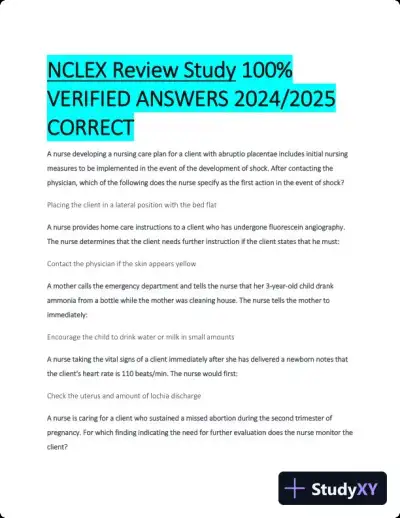 Past Exams
2024-2025 NCLEX Review Study Guide with Answers (50 Solved Questions)
National Council Licensure Examination
9 pages169downloadsFeb 2025 Certification Guides
Developing Clinical Judgment for Professional Nursing and the Next-Generation NCLEX-RN® Examination (2020)
National Council Licensure Examination
713 pages162downloadsFeb 2025 Certification Guides
NCLEX-RN Notes: Core Review and Exam Prep (2007)
National Council Licensure Examination
281 pages156downloadsFeb 2025 Certification Guides
HESI Comprehensive Review for the NCLEX-RN Examination 6th Edition (2019)
National Council Licensure Examination
842 pages150downloadsFeb 2025 Certification Guides
2020 NCLEX-PN Test Prep. Questions and Answers with Explanations (2020)
National Council Licensure Examination
943 pages147downloadsFeb 2025 Certification Guides
CliffsTestPrep NCLEX-RN (2011)
National Council Licensure Examination
510 pages130downloadsFeb 2025 Past Exams
2024-2025 NCLEX Rationals and Study Guide with Answers (168 Solved Questions)
National Council Licensure Examination
41 pages130downloadsFeb 2025 Certification Guides
NCLEX-RN For Dummies with Online Practice Tests (2020)
National Council Licensure Examination
485 pages125downloadsFeb 2025
Study this document with CramX
Once it is in your library, every tool can work from it.