

Pediatric Basic Care and Comfort Study Guide
- National Council Licensure Examination
- 16 pages
- Shared June 2025
This study guide covers Basic Care and Comfort topics for the NCLEX-RN exam, focusing on daily patient care, use of assistive devices, and support for sensory or mobility impairments—key for ensuring patient safety and independence.
Preview 5 of 16 pages
See the first 5 pages exactly as they appear in the document.
Page 1 Read page 1 as text
PEDIATRIC BASIC CARE A N D COMFORT STUDY GUIDES Basic Care and Comfort Study Guide for the NCLEX-RNExam How to Prepare for Basic Care and Comfort Questions on the NCLEX-RN® Exam General Information These questions represent one of four subdivisions of the topic Physiologies! /ntegrftycovered on the NCLEX-RN® exam. They examine the best practices for patient care during daily living activities, such as hygiene, physical movement, and obtaining nutrition. Here are some of the concepts you are likely to encounter in these questions. Assistive Devices An important part of the basic care and comfort of your patients will involve your ability to assess the need for assistive devices, provide instructions for their use, and evaluate the patient's ability to effectively use them. Types of Assistive Devices Assistive devices can include those for physical ambulation and safety, such as a walker, cane, and/or crutches. It is also important to keep in mind that devices such as hearing aids, sound amplifiers, and other alerting devices may be necessary for a patient with a hearing deficit. Likewise, a service animal, walking cane, and Braille devices may be utilized by patients with vision deficits or blindness. A patient with a speech impairment (such as after a stroke, etc.) may require the use of wordboards, pictureboards, or handheld speech-generating electronic devices to properly communicate. Assessing the Patient for Device Need
Page 2 Read page 2 as text
Each patient will need a full assessment to determine the proper assistive devices that would be the most helpful. Just as two patients with the same medical condition may require different therapies for optimal health and functioning, no two patients with the same speech, auditory, physical, or communication deficits will need the same assistive devices. You must individualizeyour recommendations based upon the specific needs of each patient. Assisting with Proper Use of Devices Nurses play an important educational role fortheir patients who need to use assistive devices. When the patient has been fully assessed and the correct assistive device chosen, the nurse must ensure that the patient is able to use the device safely and in a manner that allows the patient to efficiently and safely perform activities of daily living while allowing for the maximum amount of independencepossible. Evaluating the Success of Device Use Successful use of assistive devices can be determined by direct patient observation as well as his or her ability to remain injury-freedue to correct usage of the device. The patient should also feel a sense of enhanced self-esteem and self-worth with proper use. If adjustments to physical devices need to be made (cane length, height of crutches, etc.), you will be responsible for helping the patient make this correction. Likewise, if a particular assistive device does not seem to be allowing a patient to perform to his or her full potential, discuss alternative choicesand make arrangements for the patient to try something new. Elimination Helping patients meet their elimination needs is central to their basic care and comfort. Both bowel and bladderfunctions can become altered, which will require you to provide appropriate nursing interventions for your patient's health and well-being. Assessment for Elimination Issues A patient may develop an alteration of either bowel or bladder function (or both) for many reasons. These reasons include, but are not limited to: age,
Page 3 Read page 3 as text
decreased muscular tone, physical disorders including anatomical structural disorders, neurological disorders, and psychological problems. Medication use can also affect your patient's ability to properly void urine and/or feces. A full nursing assessment is necessary to identify the proper interventions for each patient. Common Terms Relating to Urination Problems Urinary elimination is more commonly referred to as m/ctur/tion. One of the most common problems related to micturition is a urinary tract infection (UTI). • Polyuria: excessive production of urine (>2.5 L in 24 hours). Normal output is about 2 L a day. Nocturnal polyuria, or nocturia, occurs only during the night time hours. • Oliguria: less than normal urinary output (<400 mL in 24 hours). • Anuria: lack of production of urine or severely scant amount of urine (<50 mL in 24 hours). . Dysuria: painful or difficult urination. • Urinary incontinence: the involuntary leakage of urine or loss of bladder control. The five main types are: functional, reflex, stress, urge, and total. • Urinary retention:the accumulation of urine in the bladder due to the inability to completely empty it. • Urgency: the strong, sudden, and uncontrollable urge to urinate. Common Terms Relating to Bowel Problems The passage of stool is referred to as defecation. You will need to identify potential bowel problems based on the age and health of your patient. • Constipation: less than three bowel movements a week. . Diarrhea: watery or loose stool. The medical definition of diarrhea is three or more loose stools over a 24-hour period.
Page 4 Read page 4 as text
• Fecal impaction: an accumulation of rock-hard stool inside the rectum that cannot be passed. • Flatulence:the expulsion of gastrointestinal gas. Irrigations At times, you will b e responsible for performing irrigations of bodily orifices in order to provide therapeutic intervention and maintain proper organ function. This may include: bladder, eye, ear, and ostomy (urostomyfor urinary diversion and colostomyfor fecal diversion). A gown should always be used to protect from sprays and splashes in addition to goggles and protective masks when these occurrences are expected, and gloves should always be worn. Sterile technique is always used with the exception of fecal diversion irrigation in which you should use clean technique. Skin Care for Incontinent Patients Providing constant and vigilant skin care is essential for an incontinent patient. Skin that is exposed to urine and feces should be washed and dried. In addition, the use of certain barrier productscan help prevent skin breakdown and complications. These may include solid skin barriers, moisture barrier ointments, moisture barrier pastes, and skin sealants. Alternative Therapies Patients who cannot urinate o n their own or who are unable to ambulate will need a urinary catheterto promote urination. The most common of these is the Foley catheter. The size of the catheter is referred to as the French or Fr.Men, women, and children all require different sized catheters. Due to the high risk of infection, catheter insertion is always performed under sterile technique and never delegated to unlicensed medical personnel. Evaluation of Restorative Methods Successful management of bowel and bladder elimination issues should include (at the very least): • regular, painless, and nearly complete emptying of both urine and stool without urgency
Page 5 Read page 5 as text
- the ability to recognize and respond to the need to urinate and defecate - remaining infection-free • good maintenanc e of skin integr ity. Patients with urinary or fecal incontinence may undergo bladder or bowel trainingto develop better control over elimination. Also, be mindful of basic interventionst hat can have a significant impact on a patient's ability to properly urinate and defecate such as diet, fluids, exercise, privacy, timing, and positioning if bedridden. Mobility and Immobility A nurse will need to assess a patient's mobility, including strength, gait, motor skills, coordination, and balance. Appropriate interventionsare necessary to prevent immobility, which carries the risk of complicationssuch as skin breakdown and contractures. Mobility Patients' ability to b e mobile is vital to their physical and psychological health. It i s defined a s "the ability to move freely, easily, and purposefully in one's environment." It is essential for life and plays a key function in one's recovery and overall health. Your assessment of mobility should uncover deficiencies that can b e corrected with appropriate nursing interventions to be implemented into the patient's care plan. Mobility Assessment Direct visualization of the patients is the best way to assess their mobility. Standardized tests may b e used, but simply observing the way they move in bed, sit unassisted, rise from sitting to standing, transfer from the bed to chair, or stand and walk can provide good information. Observe the gaitduring walking. Gait can give valuable information about balance, motor strength, joint mobility, and muscle coordination. Your assessment should also test each of these factors individually as well. Assistive Devices
11 more pages in the full document
Unlock it once and it stays in your library, ready to chat with or turn into flashcards.
Unlock the full documentMore National Council Licensure Examination study materials
See all Past Exams
2024-2025 NCLEX Review Study Guide with Answers (50 Solved Questions)
National Council Licensure Examination
9 pages169downloadsFeb 2025 Certification Guides
Developing Clinical Judgment for Professional Nursing and the Next-Generation NCLEX-RN® Examination (2020)
National Council Licensure Examination
713 pages162downloadsFeb 2025 Certification Guides
NCLEX-RN Notes: Core Review and Exam Prep (2007)
National Council Licensure Examination
281 pages156downloadsFeb 2025 Certification Guides
HESI Comprehensive Review for the NCLEX-RN Examination 6th Edition (2019)
National Council Licensure Examination
842 pages150downloadsFeb 2025 Certification Guides
2020 NCLEX-PN Test Prep. Questions and Answers with Explanations (2020)
National Council Licensure Examination
943 pages147downloadsFeb 2025 Certification Guides
CliffsTestPrep NCLEX-RN (2011)
National Council Licensure Examination
510 pages130downloadsFeb 2025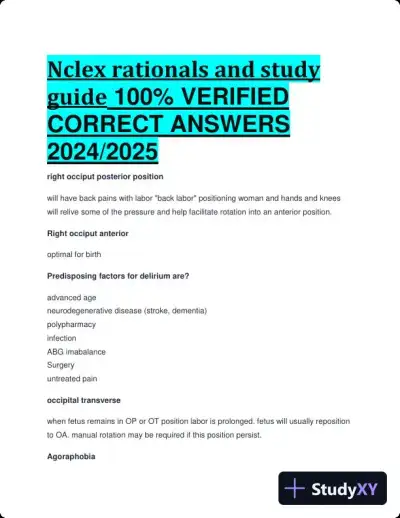 Past Exams
2024-2025 NCLEX Rationals and Study Guide with Answers (168 Solved Questions)
National Council Licensure Examination
41 pages130downloadsFeb 2025 Certification Guides
NCLEX-RN For Dummies with Online Practice Tests (2020)
National Council Licensure Examination
485 pages125downloadsFeb 2025
Study this document with CramX
Once it is in your library, every tool can work from it.