

Physiological Adaptation Study Guide for the Nclex
- National Council Licensure Examination
- 19 pages
- Shared June 2025
Study guide for NCLEX-RN® Physiological Adaptation: covers body system changes, patient assessment, and care strategies for chronic, acute, or life-threatening conditions.
Preview 6 of 19 pages
See the first 6 pages exactly as they appear in the document.
Page 1 Read page 1 as text
become Physiological Adaptation Study Guide for the NCLEX-RN® Exam This Study Guide is brought to you by become + Union Test Prep becomeanything.com
Page 2 Read page 2 as text
This download is subject to a revocable, non-exclusive, n on-transferable, limited right to use this download by You (an individual person) on a single device owned and controlled by You or a single printed copy. You agree not to reproduce, decompile, modify, or otherwise alter this download. You agree that You understand that the download includes Copyrighted material and other intellectual property of Union Media, and that use of the download is strictly in accordance with this limited single-use license. You agree that violation of this limited single-use license will result in irreparable harm to Union Media, that injunctive relief is proper, and that You will pay three times the price of a normal single-use download license for each and every additional use of this material that results from Your breach as liquidated damages for breach of this limited license. LIMIT OF LIABILITY/DISCLAIMER OF WARRANTY: Union Media makes no representations or warranties with respect to the accuracy or completeness of the content of this work and specifically disclaims all warranties, including without limitation warranties of fitness for a particular purpose. The content, advice and strategies contained herein may not be suitable for every situation. The content is provided with the understanding that the publisher is not engaged in rendering legal, accounting, or other professional services. If professional assistance is required, the services of a competent, professional person should be sought. Union Media shall be liable for damages arising herefrom. All rights reserved. The text of this publication, or any part thereof, may not be reproduced in any manner whatsoever without written permission from Union Media. This prohibition includes storage in a retrieval system or transmission in any form or by any means, electronic, mechanical, photocopying, recording, scanning, or otherwise, except as permitted under Sections 107 or 108 of the 1976 United States Copyright Act and similar foreign copyright statutes. Unauthorized copying or reuse of any part of this material is illegal and prohibited.
Page 3 Read page 3 as text
Table of Contents Howto Prepare for Physiological Adaptation Questions on the NCLEX-RN® Exam General Information Body System Alterations Patient Assessment Specific Situations Drainage Tubes Radiation Therapy Prenatal Conditions Infectious Diseases Invasive procedures Phototherapy Hypo and Hyperthermia Ventilator Use Wound Care Peritoneal Dialysis Suctioning Alterations in Body Systems Ostomy Care Seizures Pulmonary Care Increased Intracranial Pressure Post-Operative Care Evaluation Patient Education Fluids and Electrolytes
Page 4 Read page 4 as text
Signs and Symptoms of Imbalance Fluid Electrolytes Pathophysiology Application Patient Care Management Evaluation of Patient Response to Treatment Hemodynamics Patient Assessment for Dec ceased Cardiac Output Cardiac Rhythm Strip Abnormalities Pathophysiology Application Patient Care Providing Patient Strategies Interventions Managing Care of Patients in Special Circumstances Illness Management Data Reporting Pathophysiology Application Patient Education Interventions Gastric Lavage Continuity of Care VentiIation/Oxy genat ion Evaluation of Treatment Medical Emergencies Application of Knowledge and Skills Pathophysiology Nursing Procedures
Page 5 Read page 5 as text
Psychomotor Skills Emergency Care Patient Education Notification Evaluation Pathophysiology Identification General Principles Response to Therapies Patient Assessment Complications Recovery
Page 6 Read page 6 as text
Howto Prepare for Physiological Adaptation Questions on the NCLEX-RN® Exam General Information Often, a patient will need some sort of physiological adaptation to preserve and maximize physiological integrity. These questions deal with providing appropriate care for patients with chronic, acute, or life-threatening health conditions and any adaptations required to improve their situations. Body System Alterations A patient's body undergoes numerous alterations in response to an illness, disease process, intervention, and/or surgery. Recognizing these alterations help to implement proper care to return the patient to a more "normal" state of health. Nurses must explain these adaptations and resultant changes in patient care to help patients understand the reason behind these interventions. Patient A s s e s s m e n t Every patient's care begins with your assessment of the health and psychological status of the patient. This includes not only alterations due to illness, disease or interventions/treatments, but also the patient s ability to cope with his or her health situation and adaptation to an altered (sometimes permanently) state of impairment Patient assessment may also extend to the patients family and external support system as well. Specific Situations The following are some of the more important clinical scenarios in which you will be required to perform these functions: Drainage Tubes Any wound or tube drainage must be closely monitored. Pertinent characteristics of drainage assessment include monitoring for changes in color, consistency, and votame. Common drainage sites include surgical wound drains, respiratory secretions, chest tube drainage, and negative pressure wound therapy. Be familiar with the appropriate care involved in monitoring each. Nurses must be able to perform important interventions with drainage tubes including keeping dressings occlusive, monitoring for leaks or damage to the drainage systems, maintaining the drains (i.e. stripping,emptying, maintaining suction), and changing of equipment.
13 more pages in the full document
Unlock it once and it stays in your library, ready to chat with or turn into flashcards.
Unlock the full documentMore National Council Licensure Examination study materials
See all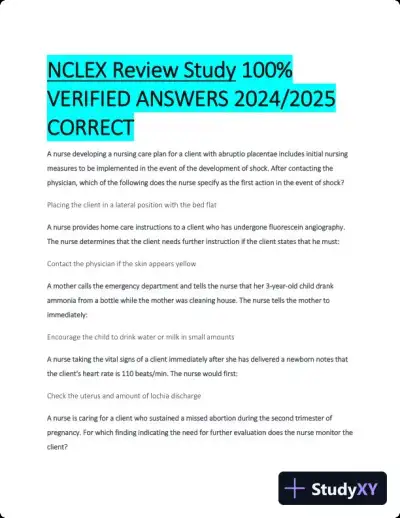 Past Exams
2024-2025 NCLEX Review Study Guide with Answers (50 Solved Questions)
National Council Licensure Examination
9 pages169downloadsFeb 2025 Certification Guides
Developing Clinical Judgment for Professional Nursing and the Next-Generation NCLEX-RN® Examination (2020)
National Council Licensure Examination
713 pages162downloadsFeb 2025 Certification Guides
NCLEX-RN Notes: Core Review and Exam Prep (2007)
National Council Licensure Examination
281 pages156downloadsFeb 2025 Certification Guides
HESI Comprehensive Review for the NCLEX-RN Examination 6th Edition (2019)
National Council Licensure Examination
842 pages150downloadsFeb 2025 Certification Guides
2020 NCLEX-PN Test Prep. Questions and Answers with Explanations (2020)
National Council Licensure Examination
943 pages147downloadsFeb 2025 Certification Guides
CliffsTestPrep NCLEX-RN (2011)
National Council Licensure Examination
510 pages130downloadsFeb 2025 Past Exams
2024-2025 NCLEX Rationals and Study Guide with Answers (168 Solved Questions)
National Council Licensure Examination
41 pages130downloadsFeb 2025 Certification Guides
NCLEX-RN For Dummies with Online Practice Tests (2020)
National Council Licensure Examination
485 pages125downloadsFeb 2025
Study this document with CramX
Once it is in your library, every tool can work from it.