

Respiratory NCLEX Q and A
- National Council Licensure Examination
- 17 pages
- Shared June 2025
NCLEX Respiratory Q&A: Chest tube care, expected findings post-thoracotomy, client instructions for removal, and pneumothorax management. Key nursing actions for safe, effective respiratory care.
Preview 6 of 17 pages
See the first 6 pages exactly as they appear in the document.
Page 1 Read page 1 as text
NCLEXQA Respiratory The nurse is assessing the functioning of a chest tube drainage system in a client who has just returned from the recovery room following a thoracotomy with wedge resection. Which are the expected assessment findings? Select all that apply. 1. Excessive bub blin g in th e wate r seal chamber 2. Vigorous bubbling in the suction control chamber 3. Drainage system maintained below the client's chest 4. 50 mL of drainage in the drainage collection chamber 5. Occlusive dressing in place over the chest tube insertion site 6. Fluctuation of water in the tube in the water seal chamber during inhalation and exhalation The nurse is assisting a health care provider with the removal of a chest tube. The nurse should instruct the client to take which action? 1. Stay very still. 2. Exhale very quickly. 3. Inhale and exhale quickly. 4. Perform the Valsalva maneuver. The nurse caring for a client with a pneumothorax and who has had a chest tube inserted notes continuous gentle bubbling in the water seal chamber. What action is most appropriate? 1. Do nothing, because this is an expected finding. 2. Check for an air leak, because the bubbling should be intermittent 3. Increase the suctio n pressure so th at the bubb ling becom es vigoro us. 4. Clamp the chest tube and notify the health care provider immediately. The nurse is caring for a client who suffered an inhalation injury from a wood stove. The carbon monoxide blood report reveals a level of 1296. Based on this level, the nurse would anticipate noting which sign in the client? 1. Coma 2. Flushing 3. Dizziness 4. Tachycardia Rationale: Carbon monoxide levels between 11% and 2096 result in flushing, headache, decreased visual activity, decreased cerebral functioning, and slight breathlessness: levels of 21% to 40% result in nausea, vomiting, dizziness, tinnitus, vertigo, confusion, drowsiness, pale to reddish-purple skin, and tachycardia: levels of 4196 to 6096 result in seizure and coma: and levels higher than 6096 result in death. The emergency department nurse is assessing a client who has sustained a blunt injury to the chest wall. Which finding indicates the presence of a pneumothorax in this client?
Page 2 Read page 2 as text
1. A low respiratory rate 2. Diminished breath sounds 3. The presence of a barrel chest 4. A sucking sound at the site of injury Rationale: This client has sustained a blunt or closed-chest injury. Basic symptoms of a closed pneumothorax are shortness of breath and chest pain. A larger pneumothorax may cause tachypnea, cyanosis, diminished breath sounds, and subcutaneous emphysema. Hyperresonance also may occur on the affected side. A sucking sound at the site of injury would be noted with an open chest injury. The nurse is caring for a client hospitalized with acute exacerbation of chronic obstructive pulmonary disease. Which findings would the nurse expect to note on assessment of this client? Select all that apply. 1. A low arterial PCo 2 level 2. A hyperinflated chest noted on the chest x-ray 3. Decreased oxygen saturation with mild exercise 4. A widened diaphragm noted on the chest x-ray 5. Pulmonary function tests that demonstrate increased vital capacity The nurse instructs a client to use the pursed- lip method of breathing and evaluates the teaching by asking the client about the purpose of this type of breathing.. The nurse determines that the client understands if the client states that the prim ary purpose of pursed-lip breathing is to promote which outcome? 1. Promote oxygen intake. 2. Strength en the dia phragm. 3. Strengthen the intercostal muscles. 4. Promote carbon dioxide elimination. The nurse is preparing a list of home care instructions for a client who has been hospitalized and treated for tuberculosis. Which instructions should the nurse include on the list?Select all that apply. 1. Activities should be resumed gradually. 2. Avoid contact with other individuals, except family members, for at least 6 months. 3. A sputum culture is needed every 2 to 4 weeks once medication therapy is initiated. 4. Respiratory isolation is not necessary because family members already have been exposed. 5. Cover the mouth and nose when coughing or sneezing and put used tissues in plastic bags. 6. When 1 sputum culture is negative, the client is no longer considered infectious and usu aIly ca n retu rn to former emp loym ent.
Page 3 Read page 3 as text
The nurse is caring for a client after a bronchoscopy and biopsy. Which finding, if noted in the client, should be reported immediately to the health care provider? 1. Dry cough 2. Hematuria 3. Bronchospasm 4. Blood -streaked sputum Rationale: If a biopsy was performed during a bronchoscopy, blood-streaked sputum is expected for several hours. Frank blood indicates hemorrhage. A dry cough may be expected. The client should be assessed for signs of complications, which would include cyanosis, dyspnea, stridor, bronchospasm, hemoptysis, hypotension, tachycardia, and dysrhythmias. Hematuria is unrelated to this procedure. The nurse is preparing to suction a client via a tracheostomy tube. The nurse should plan to limit the suctioning time to a maximum of which time period? 1. 5 seconds 2. 10 seconds 3. 30 seconds 4. 60 seconds The nurse is suctioning a client via an endotracheal tube. During the suctioning procedure, the nurse notes on the monitor that the heart rate is decreasing. Which nursing intervention is appropriate? 1. Continue to suction. 2. Notify the health care provider immediately. 3. Stop the procedure and reoxygenate the client. 4. Ensure that the suction is limited to 15 seconds. The nurse is assessing the respiratory status of a client who has suffered a fractured rib. The nurse should expect to note which finding? 1. Slow, deep respirations 2. Rapid, deep respirations 3. Paradoxical respirations 4. Pain, especially with inspiration A client with a chest injury has suffered flail chest. The nurse assesses the client for whichmost distinctive sign of flail chest? 1. Cyanosis 2. Hypotension 3. Paradoxical chest movement 4. Dyspnea, especially on exhalation
Page 4 Read page 4 as text
The nurse is assessing a client with multiple trauma who is at risk for developing acute respiratory distress syndrome. The nurse should assess for which earliest sign of acute respiratory distress syndrome? 1. Bilateral wheezing 2. Inspiratory crackles 3. Intercostal retractions 4. Increased respiratory rate The nurse has conducted discharge teaching with a client diagnosed with tuberculosis who has been receiving medication for 2 weeks. The nurse determines that the client has understood the information if the client makes which statement? 1. "I need to continue medication therapy for 1 month." 2. " l e a n t sho p at th e malI for the next 6 mont hs." 3. "I can return to work if a sputum culture comes back negative." 4. "I should not be co ntagious afte r 2 to 3 weeks of medication the ra py." A client has experienced pulmonary embolism. The nurse should assess for which symptom, which is most commonly reported? 1. Hot, flushed feeling 2. Sudden chills and fever 3. Chest pain that occurs suddenly 4. Dyspnea when deep breaths are taken A client who is human immunodeficiency virus (HIVJ-positive has had a tuberculin skin test (TST). The nurse notes a 7-mm area of induration at the site of the skin test and interprets the result as which finding? 1. Positive 2. Negative 3. Inconclusive 4. Need for repeat testing A client with acquired immunodeficiency syndrome (AIDS) has histoplasmosis. The nurse should assess the client for which expected finding? 1. Dyspnea 2. Headache 3. Weightgain 4. Hypothermia Rationale: Histoplasmosis is an opportunistic fungal infection that can occur in the client with AIDS. The infection begins as a respiratory infection and can progress to disseminated infection. Typical signs and symptoms include fever, dyspnea, cough, and weight loss. Enlarge me nt of the die nt's lymph nodes, liver, and spleen may occur as well.
Page 5 Read page 5 as text
The nurse is giving discharge instructions to a client with pulmonary sarcoidosis. The nurse concludes that the client understands the information if the client indicates to report which early sign of exacerbation? 1. Fever 2. Fatigue 3. Weight loss 4. Shortness of breath Rationale: Dry cough and dyspnea are typical early manifestations of pulmonary sarcoidosis. Later manifestations include night sweats. fever, weight loss, and skin nodules. The nurse is taking the history of a client with occupational lung disease (silicosis). The nurse should assess whether the client wears which item during periods of exposure to silica particles? 1. Mask 2. Gown 3. Gloves 4. Eye protection An oxygen delivery system is prescribed for a client with chronic obstructive pulmonary disease to deliver a precise oxygen concentration. Which oxygen delivery system would the nurse prepare for the client? 1. Face tent 2. Venturi mask 3. Aerosol mask 4. Tracheostomy collar The nurse is instructinga hospitalized client with a diagnosis of emphysema about measures that will enhance the effectiveness of breathing during dyspneic periods. Which position should the nurse instruct the client to assume? 1. Sitting up in bed 2. Side-lying in bed 3. Sitting in a recliner chair 4. Sitting up and leaning on an overbed table The community health nurse is conducting an educational session with community members regarding the signs and symptoms associated with tuberculosis. The nurse informs the participants that tuberculosis is considered as a diagnosis if which signs and symptoms are present? Select all that applly. 1. Dyspnea 2. Headache 3. Night sweats 4. A bloody, productive cough 5 . A co ugh with the ex pecto ration of muco id s putu m
Page 6 Read page 6 as text
The nurse performs an admission assessment on a client with a diagnosis of tuberculosis. The nurse should check the results of which diagnostic test that will confirm this diagnosis? 1. Chest x-ray 2. Bronchoscopy 3. Sputum culture 4. Tuberculin skin test The nurse is teaching a client with emphysema about positions that help breathing during dyspneic episodes. The nurse instructs the client that which positions alleviate dyspnea? Select all that apply. 1. Sitting up and leaning on a table 2. Standing and leaning against a wall 3. Lying supine with the feet elevated 4. Sitting up with the elbows resting on knees 5. Lying on the back in a low Fowler's position A client is returned to the nursing unit after thoracic surgery with chest tubes in place. During the first few hours postoperatively. what type of drainage should the nurse expect? 1. Serous 2. Bloody 3. Serosanguineous 4. Bloody, with frequent small clots The nurse is preparing to care for a client who will be weaned from a cuffed tracheostomy tube. The nurse is planning to use a tracheostomy plug and plans to insert it into the opening in the outer cannula. Which nursing action is required before plugging the tube? 1. Deflate the cuff on the tu be. 2. Place the inner cannula into the tube. 3. Ensure that the client is a ble to speak. 4. Ensure that the client is able to swallow. The nurse is caring for a client w r ho is on strict bed rest and creates a plan of care with goals related to the prevention of deep vein thrombosis and pulmonary emboli. Which nursing action is most helpful in preventing these disorders from developing? 1. Restricting flu ids 2. Placing a pillow under the knees 3. Encouraging active range-of- motion exercises 4. Applying a heating pad to the lower extremities
11 more pages in the full document
Unlock it once and it stays in your library, ready to chat with or turn into flashcards.
Unlock the full documentMore National Council Licensure Examination study materials
See all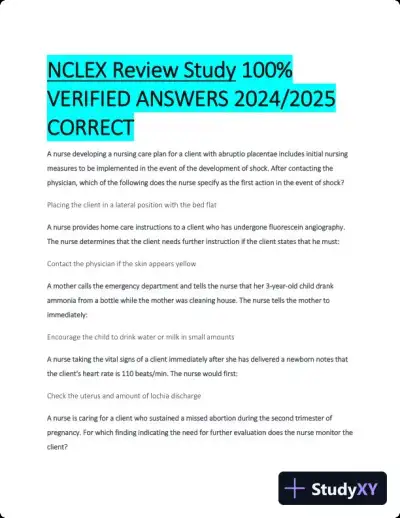 Past Exams
2024-2025 NCLEX Review Study Guide with Answers (50 Solved Questions)
National Council Licensure Examination
9 pages169downloadsFeb 2025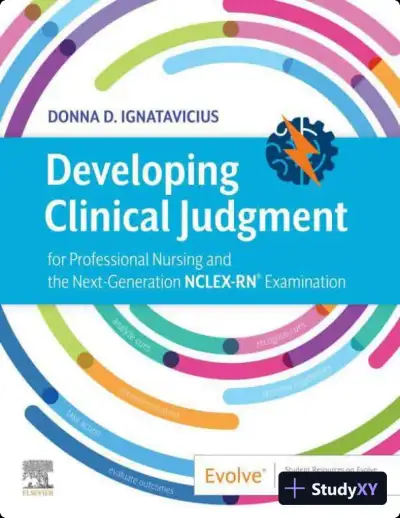 Certification Guides
Developing Clinical Judgment for Professional Nursing and the Next-Generation NCLEX-RN® Examination (2020)
National Council Licensure Examination
713 pages162downloadsFeb 2025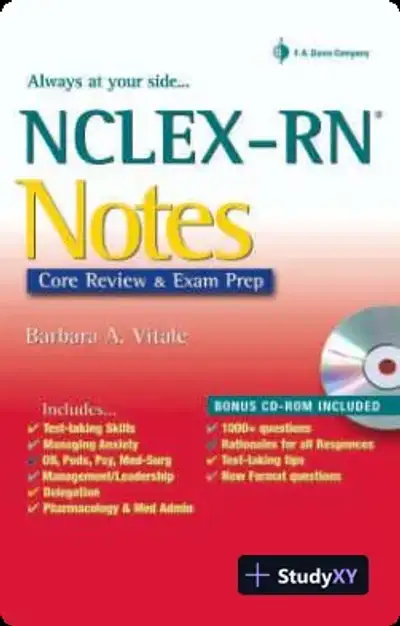 Certification Guides
NCLEX-RN Notes: Core Review and Exam Prep (2007)
National Council Licensure Examination
281 pages156downloadsFeb 2025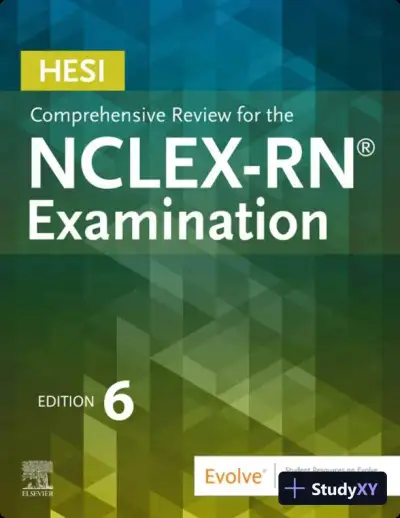 Certification Guides
HESI Comprehensive Review for the NCLEX-RN Examination 6th Edition (2019)
National Council Licensure Examination
842 pages150downloadsFeb 2025 Certification Guides
2020 NCLEX-PN Test Prep. Questions and Answers with Explanations (2020)
National Council Licensure Examination
943 pages147downloadsFeb 2025 Certification Guides
CliffsTestPrep NCLEX-RN (2011)
National Council Licensure Examination
510 pages130downloadsFeb 2025 Past Exams
2024-2025 NCLEX Rationals and Study Guide with Answers (168 Solved Questions)
National Council Licensure Examination
41 pages130downloadsFeb 2025 Certification Guides
NCLEX-RN For Dummies with Online Practice Tests (2020)
National Council Licensure Examination
485 pages125downloadsFeb 2025
Study this document with CramX
Once it is in your library, every tool can work from it.